Home » copper wiring » Recent Articles:

Stop the Cap!’s Rebuttal to Verizon: Fire Island Doesn’t Want Voice Link

Last week, Verizon’s Tom Maguire responded to some of our earlier coverage about Verizon’s decision to abandon landline service on portions of Fire Island devastated by last fall’s Hurricane Sandy. We have received several complaints from readers about our decision to grant space to Verizon to present their views without reciprocation. While we understand those concerns, Stop the Cap! believes readers deserve both sides of a discussion that AT&T and Verizon will soon seek to have with customers across many of their rural service areas. For that reason, we invited Verizon’s participation. This is our response:

Phillip "Since when do regulated utilities get to dictate the quality of service customers receive?" Dampier

Phillip Dampier

Raise your hand if you want Verizon’s Voice Link to replace your traditional telephone service and lose your only wired broadband connection.

Almost no one has. Despite the arguments from Verizon Communications and AT&T that wireless is the answer to troublesome copper wiring and maintaining rural telephone service, dozens of Fire Island, N.Y. customers have been sufficiently provoked to file comments with state regulators, making it clear they want no part of the loss of their landline and its accompanying, affordable broadband service. In more than 135 public comments with the Public Service Commission at press time, Stop the Cap! could only find one comment from a Fire Island resident who had no issues with Verizon’s wireless landline replacement. He was upset Verizon had not wired a nearby yacht club for broadband service.

Both AT&T and Verizon have publicly advocated that rural customers would be better served moving from traditional wired landline service to their respective wireless 4G LTE networks. AT&T characterizes it as “an upgrade” that switches customers to an “all IP” 21st century network. Verizon has been less bold in its public policy statements, framing its position mostly in economic terms  — does it make sense to invest large sums to upgrade or repair damaged infrastructure that serves a relatively small number of customers?

Until recently, customers have been free to make the choice between a landline and wireless service themselves. Now, the residents of Fire Island and some barrier islands off the coast of New Jersey have a very different choice: They can accept Verizon’s Voice Link landline replacement, sign up for cell service that has proved troublesome in both areas, or give up phone service altogether. Verizon has made it clear it is not prepared to replace the destroyed infrastructure on portions of the islands, it will not invest in major upkeep and repairs to network facilities that may have been compromised but are still functioning for now, and will likely never offer its fiber FiOS network in the affected areas.

Stop the Cap! has expressed repeated concern that the decision to abandon wired infrastructure in favor of wireless is based primarily on profit motives, is short-sighted, and represents a downgrade in the quality of an important, regulated utility service, particularly in rural and out-of-the-way places that have few, if any alternatives. Fire Island is shaping up to argue our case, based on the testimony of those actually living and working on the island.

Customers Don’t Want the ‘Solution’ Verizon is Offering

Voice Link is not proving a welcome permanent resident on Fire Island for many customers.

The reasons are clear: inadequate wireless service is common on the island, Voice Link does not perform or sound as good as the landline it replaces, and Verizon’s wireless broadband alternative will cost many residents their unlimited-use DSL service in favor of a wireless capped option that could cost more than $100 a month.
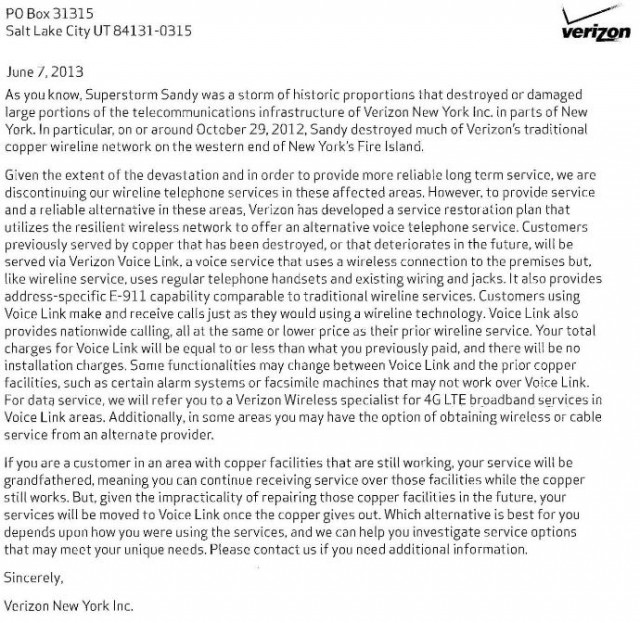
Letter to affected Verizon customers on Fire Island.

Letter to affected Verizon customers on Fire Island.

Verizon’s strongest argument is that landline service has fallen out of favor in the United States, with customers increasingly disconnecting home phones in favor of cell phones. If Verizon’s statistics are correct, 80 percent of the voice traffic on the island is already handled by Verizon Wireless. (Verizon does not specify if that traffic comes from permanent residents or temporary visitors, a point of contention with residents.)
verizonMaguire was very careful to limit Verizon’s advocacy of Voice Link in terms of its capacity to handle voice calls. That is because Voice Link is currently incompatible with a whole range of important services that have worked fine with traditional landlines for years.

Maguire’s words are important: “Verizon’s commitment is to provide our customers with voice service,” — the kind you had in the late 70s. Voice Link fails faxing, home medical monitoring, home alarm systems, dial-up service, credit card transactions, and home satellite equipment that connects to the telephone network.

Voice Link is no upgrade for Fire Island. It represents turning back the clock, especially for broadband customers.

Maguire claimed in his editorial the company was only considering Voice Link for the universe of customers where the copper network was not supporting their requirements, with the exception of Sandy-impacted Fire Island and some New Jersey barrier islands. But that does not tell the whole story. In a filing with the New York State Public Service Commission, Verizon makes it clear it intends to introduce the same solution in other parts of New York:

It also seeks to deploy Voice Link in other parts of the State, both as an optional service in areas where the company also offers tariffed wireline local exchange service, and (subject to the Commission’s approval) as a sole service offering in particular locations and circumstances.

While Verizon has sought to appease regulators by volunteering to offer an equal level of service for the same or less money, there are questions about whether a regulator has any oversight authority over Voice Link.

“It is a remarkable concept in utility regulation that a regulated utility may determine that costs are unreasonable and as a result choose to provide alternative, and potentially unregulated service to affected customers,” said Louis Barash of Ocean Beach. “Verizon proposes to permit the PSC to regulate that activity, but it is not clear that the Commission has such authority. And it certainly isn’t clear that the Commission would have any authority to reverse its decision, or otherwise to sanction the company, if Verizon failed to comply with its undertakings.”

Broadband & Competition Matters: Forcing Customers Off Unlimited DSL in Favor of Near-Exclusive, Usage-Capped, Verizon Wireless Broadband

Offering broadband is a vital part of any telephone company’s strategy to add and keep customers. Yet Verizon’s DSL customers on the western half of Fire Island will have their broadband service canceled unless wired service (copper or fiber) is available. Verizon’s only alternative is a usage-capped, prohibitively expensive Verizon Wireless mobile data plan that may or may not perform well on the signal-challenged island. There is literally nowhere else for customers to go.

Verizon’s own statistics confirm none of its wireless competitors handle significant traffic on and off the island.

Maguire: “A multimillion dollar investment with no guarantee that residents of the island will even subscribe to our services makes no economic sense. In fact, that’s probably why Verizon is the sole provider on the island. None of the companies we compete with in other parts of New York offer services on the island.”

Maguire’s evidence:

“The company discovered that 80 percent of the voice traffic was already wireless.  If other wireless providers were factored in, it is likely that the percentage is closer to 90 percent.”

That means Verizon’s wireless competitors collectively have a traffic share of less than 10%.

Verizon’s Plan & Public Safety
no serviceResidents advise visitors they better have Verizon Wireless and a robust phone that works well in challenging reception areas if they expect to use it while on the island. AT&T, Sprint, and T-Mobile customers are often out of luck. That poses an immediate and direct threat to public safety, according to public safety officials.

“The cellphone service on Fire Island progressively gets worse every year as more and more people are bringing smartphones out there,” explained Dominic Bertucci, chief of the Kismet Fire Department. “There are some days where you can barely get a signal.”

The Brookhaven Town Fire Chiefs Council, which represents the leadership of 39 fire departments and fire companies in the region is vehemently opposed to Voice Link and considers it a safety menace, especially during frequent summer power outages when the island’s population is at its peak.

“Without a copper wire phone service, a service that still functions even during a power failure, how can we insure that the residents can call for help?” asks president John Cronin. “How will they call for the lifesaving services that are provided by the fire and EMS units of Fire Island? The corporate desire for greater profit cannot be made at the expense of the safety of the residents of Fire Island.”

“Wireless service is not reliable,” adds Fair Harbor resident Meredith Davis. “Imagine being in an emergency and having ‘spotty’ reception which happens out there all the time on cell phones. That is not safe and not okay.”
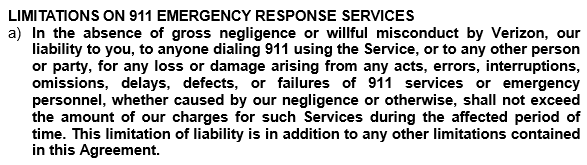
Verizon disclaims legal responsibility for failed 911 calls in its Voice Link terms and conditions.

Verizon disclaims legal responsibility for failed wireless 911 calls in its terms and conditions. The most Verizon owes you is a refund of a portion of your monthly service charges.

“If you are unfamiliar with Fire Island, there is very little medical service and the only way off the island is a scheduled ferry service or, for some people who have permits and trucks, a very long drive,” explains lifelong Fire Island resident Nora Olsen. “When someone needs to be rushed to the hospital, they are evacuated by helicopter, which makes timely emergency calls of the essence to save lives. So you can imagine how important it is to have reliable phone service. It should be up to the individual to decide if they want to switch to a wireless service. They should not be forced into it by Verizon. The people who are most likely to want to stick with the phone service they have been used to all their life — senior citizens — are the most likely to need to use the phone to call for help.”

A number of residents also claim Verizon has overblown the real extent of damage on the island and is not operating in good faith.

“In the larger communities of Ocean Beach and Seaview, I have met no one yet that has their connectivity lost,” said resident Karen Warren. “So for Verizon to assert that the infrastructure is largely destroyed and to repair it would be an enormous expense is simply not true. To add insult to injury, before coming out and finding out that our lines were in fact intact, Verizon offered to ‘replace’ our existing DSL data service with LTE Jetpak wireless broadband. The performance and reliability with only a single device connected was horrendous.”

“[Verizon is] pushing us toward a higher-cost and lower-value solution,” Warren concluded.

Getting specific information about the current state of Verizon’s network on Fire Island and repair/replacement costs are hard to come by. Verizon filed an application with the PSC declaring much of the information confidential or a trade secret, refusing to share it with the public. The company was concerned some might access the Public Service Commission website, find the case number about Fire Island, navigate to the specific Verizon filing containing information about their infrastructure… and then vandalize it.
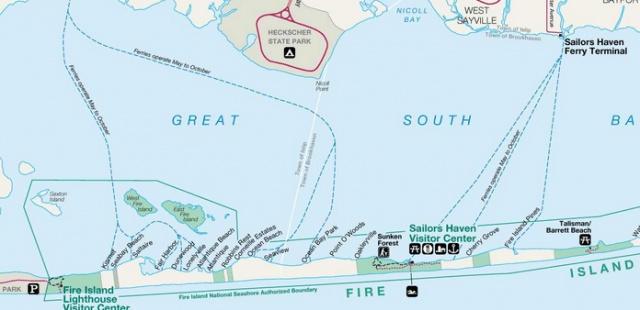
The worst affected communities on Fire Island.

The worst affected communities on Fire Island.

Barash suspects Verizon might be hiding something, especially considering the company requested to bypass usual waiting periods and public notification requirements:

Verizon asserts that it would cost “$4.8 million for a voice-only digital loop carrier system comparable to the networking serving the eastern part of the island.” It is by no means clear, however, that such a system is the minimum required to restore/repair the western part of the system to the service it had pre-storm. Certainly Verizon’s application makes no representation to that effect. This estimate apparently contemplates an entire new system for the western portion of Fire Island, notwithstanding that a meaningful percentage of the copper wire system is still operational.

Moreover, Verizon’s position on the required scope of repairs has been a constantly shifting target. Verizon apparently advised Commission Staff, and Staff repeated at the April 18 Commission Hearing, that the western Fire Island telephone system was “damaged beyond repair by the storm.” Verizon apparently has abandoned that claim; this application indeed is premised on the assumption that the system can be repaired. Furthermore, in its first (May 3) submission to the Commission, Verizon stated that “five of the six cables that run between Fire Island and the mainland – the five that serve the western portion of the Island – were also badly damaged by the storm.” Just a week later, it has abandoned that claim as well, and instead in its amended Certification asserts “Five of the six cables that run throughout Fire Island were badly damaged by the storm.” It is hard to accept at face value Verizon’s estimated repair costs when even at this late date it does not seem to have a handle on exactly the damage that needs repair.

A full Hearing, with notice to affected customers, is necessary to develop facts sufficient to make such determinations and to be reasonably certain the Commission is acting based on reasonably verifiable facts.

Residents deserve a full voice and full disclosure in discussions that will directly impact their vital telecommunications services for years to come. Verizon’s corporate officials will not have to live with the results. Neither will the staff at the PSC.

Stop the Cap! has chosen to directly participate in the New York State Public Service Commission regulatory process and has filed two formal comments thus far. The first outlines Verizon’s greater strategy to abandon landline service in rural areas outlined by Verizon CEO Lowell McAdam in 2012. We also provided the Commission the prices Verizon Wireless intends to charge Verizon DSL customers switching to wireless broadband service. The second objects to Verizon’s excessive request for secrecy and exposes cell coverage issues on Fire Island.

AT&T U-verse Broadband Speed Upgrades Rumored, But Your Results May Vary

Phillip Dampier June 19, 2013 AT&T, Broadband Speed 1 Comment

u-verseAT&T U-verse broadband has not kept up with the times, limiting speed-craving customers to a comparatively slow 18-24Mbps that hasn’t changed much in a few years. But an AT&T employee claims in the company forums that is all about to change, with new broadband speeds up to 48-60Mbps downstream and up to 10Mbps upstream on the way.
The improvements will not just mean faster Internet speeds, but also better television service. U-verse is an IP-based network using a DSL variant to deliver a broadband pipe into customer homes. That pipe is divided up between television, broadband, and phone service. Previously, U-verse limited television viewing to a handful of concurrent television streams — a problem in large households with heavy TV and DVR usage. The network upgrade won’t eliminate that problem, but it will make it more rare with up to six channels viewed simultaneously.

AT&T customers will also eventually benefit from a switch to “cloud storage” DVR equipment, which will record and store TV shows remotely and stream them back to your television on-demand. This will allow AT&T to sell customers different levels of storage capacity and reduce customer inconvenience should they lose all of their recordings if a hard drive happens to fail.

The employee predicts the speed increases will begin rolling out in July, beginning in Texas.

Not all markets or customers will be able to get the fastest speeds offered by AT&T because U-verse is still dependent on copper wire between a customer’s home or business and the nearest fiber optic link. AT&T intends to boost speeds for some customers using pair bonding to eke more performance from their aging wiring. Customers already buying U-verse’s top 24Mbps tier will receive a free upgrade to 30Mbps when the new speeds are introduced.

Some leaked pricing for the new speeds (discounts may apply in bundled packages):

  • 3/1Mbps — $41
  • 12/1.5Mbps — $51
  • 18/1.5Mbps — $56
  • 30/3Mbps — $66
  • 45/6Mbps — $86
  • 60/6Mbps — $106
  • 75/10Mbps — $121

No word on if AT&T plans adjust its barely enforced U-verse usage cap (250GB).

Six Months After Sandy, Verizon Abandoning Wired Network in Mantoloking, N.J.

Hurricane-SandySix months after Hurricane Sandy struck the northeastern United States, a significant number of Verizon customers are now learning they will never get their landline service back.
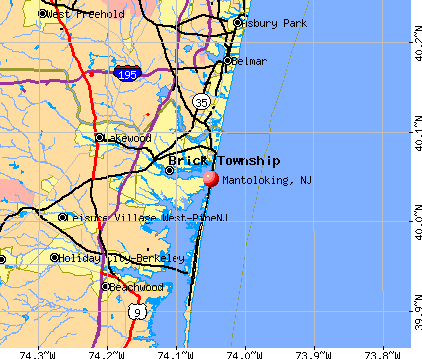
Mantoloking is the first town in New Jersey — but not the last — that will no longer be able to get landline service from the telephone company.

In its place, Verizon offers Voice Link, a home phone replacement that works exclusively over the Verizon Wireless network.

About 30 customers have signed up for the service after being without a home phone for a half a year.

The device looks like a wireless router, with an antenna and several jacks on the back to deliver service over your home’s existing telephone wiring. Instead of connecting with Verizon’s wired network, the unit receives a signal from the nearest Verizon Wireless cell tower to make and receive telephone calls.

Verizon is enticing customers to use this device instead of repairing its damaged network by promising free installation, unlimited nationwide calling and support for 911 and basic phone features like Caller ID and voice mail. For now, the service will not cost any more than a wired landline phone.

For Verizon’s bean counters, Voice Link is an inexpensive alternative to replacing copper wiring with FiOS fiber optic service. Verizon previously announced that maintenance on its aging copper wire network was becoming increasingly expensive.

“It acts just like a regular phone,” Tom Maguire, Verizon’s senior vice president of national operations told the Asbury Park Press. “There’s a dial tone. It has 911 capability, so if you dial 911 the emergency services guys are going to know exactly where you are.”

But members of Verizon’s unions who have had hands-on experience testing Voice Link suggest it isn’t everything Verizon says it is. The International Brotherhood of Electrical Workers’ Local 824 points out Voice Link was not intended to serve just anybody. It will deliver a voice-only service unsuitable for faxing, DSL, or data communications of any kind.

Mantoloking is located on New Jersey's barrier island.

Mantoloking is located on New Jersey’s barrier island.

Stop the Cap! has also heard from Verizon customers directly affected by the forced migration to wireless, and many are unhappy about it.

“This is the death knell for wired broadband in areas bypassed by cable along coastal New Jersey,” shares Dale Smith. “We lost our Verizon landline and DSL service during Sandy and have had nothing but a cell phone for the last six months because Verizon has dragged its feet.”

Smith says a Verizon manager told him the company was “evaluating certain service areas” for an “exciting new wireless product” instead of repairing or replacing the company’s wired network.

“While they were ‘evaluating,’ we were getting no dial tone and huge cell bills from Verizon — good for them, but not for us.”

Smith had a chance to view Voice Link in action and thinks it represents a Verizon wolf in sheep’s clothing.

“It sounds remarkably better than a cell phone, which tells you something about how much effort manufacturers of smartphones spend on voice calling, but that is where the good ends and the problems begin,” Smith said. “The most annoying is no caller ID with name and fairly frequent call delays and failed calls.”

Smith says the Caller ID displays the caller’s number, but not name – a feature he relied on heavily. He found about 30 percent of test calls either took more than 10 seconds to start ringing, or never rang at all.

“Sometimes the calls would time out and other times you would just sit and listen in silence until the phone at the other end finally started ringing,” Smith said.

He also worries about call reliability.

“What happens if you are in a marginal signal area or the cell tower gets overcongested and starts dropping calls, or the power goes out at the cell tower? You can’t use your cell phone either in that case.”

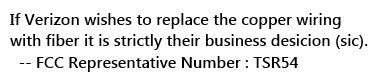
Anne contacted us after complaining to the Federal Communications Commission that Verizon is dumping its reliable landline network for unreliable wireless, and is frustrated the FCC does not seem to understand what is going on in New York and New Jersey.

“The response from the FCC doesn’t even bother to recognize that Verizon isn’t going to fiber service from copper, but is relying on very unreliable wireless,” Anne tells Stop the Cap! “For a vulnerable area such as the barrier island, wireless will likely be useless during a disaster/big emergency, especially where electricity goes out.”

replaceThe FCC’s short response to Anne’s detailed complaint:

If Verizon wishes to replace the copper wiring with fiber it is strictly their business desicion (sic).  — Representative Number : TSR54

“I can’t believe this email is a product of the United States government,” Anne told us. “Why does the FCC exist at all?  It is a complete waste of taxpayer money.”

In addition to filing a complaint with the FCC, Anne has tried to help her elderly mother get her home phone back on the barrier island that was damaged by Hurricane Sandy. As of a week ago, every utility, except Verizon phone service, has been restored.

“Trying to get a straight story from Verizon has been impossible,” Anne said. “What a nightmare.”

The landline network is dead.

The landline network is dead.

Jim Mudd also takes care of his parents who are headed back to the New Jersey coast in an area that still lacks Verizon phone service after Sandy washed away utility infrastructure. New poles have been placed and the power is back, but Verizon is nowhere to be found.

“Our local town officials tell us Verizon was hinting we might end up with Voice Link as well, although nothing formal has been announced,” Mudd writes. “This would be a major problem for us, because Voice Link will not work with our home alarm system or my parents’ medical monitoring service.”

Mudd says Verizon confirmed to him that data services of any kind, including faxing or credit card processing is not possible with the first version of the service, although Verizon said it was exploring better options in the future.

“After waiting a half a year for Verizon to restore my home phone, I hope they pardon me for not waiting around for them,” Mudd said. “We signed up with Comcast the moment they got service back, but they know they have a working monopoly here now, especially with Verizon signaling it wants to pull out of anything that is not wireless.”

“What annoys me is Verizon wanted rate increases back in the 1990s and on to pay for upgrading their network and replace it with fiber,” Mudd adds. “We paid those surcharges or higher rates like everyone else and we are going to get nothing to show for it. Don’t replace the copper, but don’t abandon us with wireless either. We paid for something better: fiber.”

[flv width=”640″ height=”380″]http://www.phillipdampier.com/video/Asbury Press Following-Sandy-destruction-Verizon-switches-all-wireless-service 5-2-13.flv[/flv]

Verizon’s Tom Maguire demonstrates the company’s Voice Link landline replacement, courtesy of the Asbury Park Press.  (1 minute)

AT&T, Time Warner Cable Claim They Are Ready for Google Fiber in Austin

me too

AT&T suddenly announced it was ready to build its own gigabit fiber network in Austin.

AT&T and Time Warner Cable report they are ready to make more investments in their operations in Austin, Tex. to compete with Google Fiber when it arrives in the middle of next year.

Time Warner Cable says it already operates a multi-gigabit fiber optic network — one residential customers cannot easily access or afford. Residential broadband speeds at the cable operator top out at 50/5Mbps in Austin, at a cost higher than what Google plans to charge for 1,000/1,000Mbps service. AT&T’s U-verse network maxes out at 24/3Mbps, assuming customers have good copper wiring between AT&T’s fiber in the neighborhood and their home.

“The cable and phone company providers have purposely confused their networks’ maximum speed capacity with real end-user speeds for years, and when that fails to convince they simply claim customers don’t need or want those speeds anyway,” says Stop the Cap! reader and Austin resident Sam Knoll.

Knoll is enthusiastic about giving Time Warner Cable the boot, partly to pay them back for their aborted consumption billing trial attempted in Austin in 2009.

“I am not completely convinced Time Warner Cable understands just how much damage they did to their reputation when they pulled that stunt, and I’m certain they will attempt it again if they have a chance,” Knoll said. “The best thing customers can do is switch to a provider that believes usage caps and consumption billing are the fraudulent ripoff we know them to be. Google already knows this.”

Some Time Warner Cable customers in Austin never forgot the company tried to meter Internet usage in a failed experiment back in 2009.

Some Time Warner Cable customers in Austin never forgot the company tried to meter Internet usage in a failed experiment back in 2009. (Image: The Austinst)

Competition from deep-pocketed Google could eventually transform the broadband business model for American providers, assuming Google builds its fiber network in enough cities to challenge the conventional wisdom that prices have plenty of room to grow with faster Internet access. The more customers that sign up for Google’s already-super-fast broadband, the more providers will have to compete with better and faster service.

But AT&T is not convinced. The company announced yesterday it was prepared to build a gigabit fiber network not just in Austin, but also in surrounding Williamson County, with plenty of caveats.

“[We will only build the network if] the demand is there and if we get the same terms and conditions as Google received,” said AT&T spokeswoman Tracy King.

AT&T told the Austin American-Statesman the company wanted a faster regulatory approval process and permission to only build its faster fiber network in neighborhoods where there is proven demand for the service. Current franchise agreements often compel providers to offer service throughout the community and prohibits “cherry-picking” customers in high-income or low construction cost areas.

An AT&T official told KEYE-TV he had no idea how much AT&T would charge for gigabit broadband. Google charges $70 a month in Kansas City.

Austin has promised cooperation with Google, although it is not extending tax breaks or grants to the search engine giant. Google will get easy access to Austin Energy’s municipally owned infrastructure including utility poles and rights-of-way.

Google is speculated to be building showcase fiber networks to embarrass incumbent cable and phone providers who typically sell standard broadband service with speeds of 6-15Mbps in most larger communities. Rural areas are lucky to have 3Mbps service, and often much less.

But if Google intended to force major upgrades by cable and phone companies across the country, it might be disappointed with the response so far from AT&T and Time Warner Cable. Both companies indicate they will invest in and upgrade their networks to compete, but only in the service areas where Google-style competition exists. For the rest of the country, phone and cable companies are prepared to continue with the current “broadband scarcity” business model that delivers upgrades only occasionally, often accompanied by usage limits, consumption billing, and/or higher prices.

“Google has proved that there is a business model for selling abundant bandwidth as opposed to a business model for allocating scarce bandwidth,” said Blair Levin, a former chief of staff of the Federal Communications Commission.

“They are saying this is not an experiment. It is a business,” Levin told the newspaper. “In Kansas City, Google did the country an enormous favor. They said, give us regulatory flexibility to design the business and give us access to city property so we can build a network to lower the cost.”

[flv width=”640″ height=”380”]http://www.phillipdampier.com/video/KEYE Austin Competitor Chimes In After Google Announcement 4-9-13.flv[/flv]

KEYE in Austin talks with AT&T about their plans for a gigabit broadband network to compete with Google Fiber. The AT&T spokesman seemed more interested in pitching the company’s deregulation agenda and was short on specifics.  (3 minutes)

[flv width=”640″ height=”380″]http://www.phillipdampier.com/video/KXAN Austin What competition will Google Fiber face 4-9-13.mp4[/flv]

KXAN in Austin talked with Google competitors Time Warner Cable and AT&T about how they will respond to the Google Fiber challenge.   (3 minutes)

[flv width=”640″ height=”380″]http://www.phillipdampier.com/video/KVUE Austin Fiber Wars in Austin 4-9-13.mp4[/flv]

KVUE in Austin called Google’s entry into the city the opening salvo of ‘Fiber Wars,’ as AT&T promises its own gigabit network. Austin residents intend to take advantage of the competition to force providers to give them better deals to keep their business.  (3 minutes)

[flv width=”640″ height=”380″]http://www.phillipdampier.com/video/KXAN Austin Google Fiber Possibilities Google Insider 4-9-13.mp4[/flv]

KXAN explains the possibilities of gigabit fiber, but also asks a former Google insider why the search engine is getting into the broadband business.  (5 minutes)

[flv width=”640″ height=”380″]http://www.phillipdampier.com/video/KTBC Austin Time Warner Cable Responds to Google 4-9-13.mp4[/flv]

KTBC was skeptical of AT&T’s sudden interest in gigabit broadband. “Gee, what a coincidence,” commented the anchor of Austin’s Fox affiliate.  (2 minutes)

AT&T Announces Its Own “Gigabit Fiber Network” for Austin; Details Leave Wiggle Room

att-logo-221x300On the heels of today’s announcement from Google that it intends to make Austin, Tex. the next home for Google Fiber, AT&T issued a press release claiming it was suddenly interested in building a gigabit fiber network in Austin too.

Today, AT&T announced that in conjunction with its previously announced Project VIP expansion of broadband access, it is prepared to build an advanced fiber optic infrastructure in Austin, Texas, capable of delivering speeds up to 1 gigabit per second.  AT&T’s expanded fiber plans in Austin anticipate it will be granted the same terms and conditions as Google on issues such as geographic scope of offerings, rights of way, permitting, state licenses and any investment incentives. This expanded investment is not expected to materially alter AT&T’s anticipated 2013 capital expenditures.

Currently, AT&T’s U-verse system in Austin — a fiber to the neighborhood system — cannot exceed 25Mbps as it is now configured. GigaOm’s Stacy Higginbotham reports AT&T told her it would build its own fiber to the premises system in Austin to support faster speeds.

But AT&T’s announcement does not come without plenty of wiggle room which could make today’s announcement little more than a publicity stunt:

  1. AT&T claims it will build “infrastructure” capable of delivering “up to” 1Gbps. This could mean a network that supports a maximum of 1Gbps of shared Internet traffic, not 1Gbps to each home or business;
  2. AT&T does not say it intends this network for residential customers, nor did it suggest a monthly price for gigabit service. Its Project VIP expansion describes planned broadband speed upgrades for residential U-verse customers of up to 75Mbps and for U-verse IPDSLAM to speeds of up to 45Mbps, not 1Gbps;
  3. AT&T’s Project VIP already specifies fiber network build outs, but they are destined for cell towers, large business complexes, and multi-dwelling units that will share a fiber connection;
  4. AT&T wants the same terms and conditions Google has received, including investment incentives. But AT&T could have applied for those incentives, and potentially could have already received them, if it specified plans for a gigabit network of its own. Instead, AT&T executives have always believed residential customers do not want or need gigabit broadband speeds. In fact, AT&T still doesn’t believe fiber to the home service makes economic sense, which is why it invested in a cheaper fiber to the neighborhood system that still relies on old copper wiring. AT&T also warns that, “Our potential capital investment will depend on the extent we can reach satisfactory agreements” with local officials on those incentives;
  5. Wiring a city of Austin will cost tens of millions to reach every resident with service. Such an expense might be considered materially relevant to shareholders, requiring disclosure. Building a much lesser network, like a gigabit middle mile network or only offering fiber service to institutional or commercial customers would cost far less and could escape reporting requirements.

AT&T also did not miss an opportunity to promote its deregulatory agenda, which has so far not proved to be of much help to broadband speed enthusiasts stuck with DSL or U-verse.

“Most encouraging is the recognition by government officials that policies which eliminate unnecessary regulation, lower costs and speed infrastructure deployment, can be a meaningful catalyst to additional investment in advanced networks which drives employment and economic growth,” said Randall Stephenson, AT&T chairman and CEO.

AT&T’s agenda might result in a meaningful catalyst of a different kind — the end of rural landline telephone and broadband service.

Search This Site:

Contributions:

Recent Comments:

Your Account:

Stop the Cap!