Home » copper wiring » Recent Articles:

Frontier Attempts to Win Over Dissatisfied Cable Customers Plagued With Rate Hikes, Outages

Phillip Dampier September 27, 2012 Broadband Speed, Competition, Consumer News, Frontier, Rural Broadband Comments Off on Frontier Attempts to Win Over Dissatisfied Cable Customers Plagued With Rate Hikes, Outages

Frontier Communications is targeting promotional offers to customers that have been impacted by cable service outages and rate hikes, despite having a relatively poor service record itself.

Frontier president and chief operating officer Dan McCarthy told investors attending the recent Goldman Sachs Communicopia Conference the company was pulling out all the stops looking for surgical marketing opportunities.

“People don’t wake up every day, and say, ‘I want to switch broadband providers.’ It’s really about finding what is that lever to pull. Sometimes it’s a message at a key point — it could be during an outage, it could be during change of prices for them. It could be there are some substandard speeds that are being offered,” McCarthy said. “We are looking at what is the right mix of messaging and promotional offers that really allow us to do that. I think you’ll see us be pretty aggressive in that area,” he added.

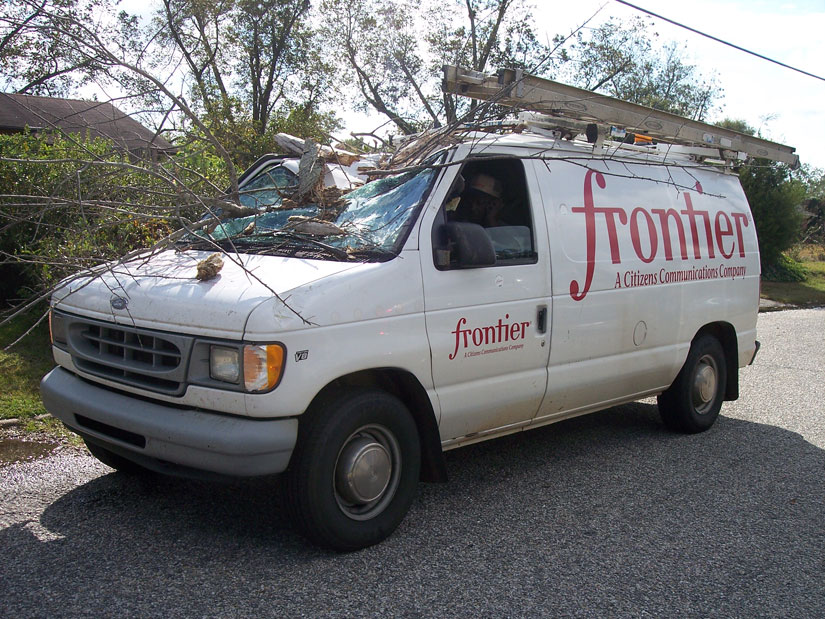
But Frontier itself has had plenty of service problems, and was the only major Internet provider in the country to have lost ground in a July FCC report measuring broadband quality. The company continues to face extensive service outages when fiber cables are cut or copper wiring is stolen by thieves. Recent storms this past summer disrupted 277 Frontier central offices in the Carolinas, Indiana, Pennsylvania, and West Virginia, according to a Securities and Exchange Commission filing. The repair work, including overtime and equipment, is expected to cost the company at least $15 million.

Frontier reports it expected to replace at least 167,000 feet of damaged or stolen copper cable and purchased 203,000 backup power generators to keep central exchanges up and running during extended electric outages.

This week, a major service outage struck customers in parts of Ft. Wayne, Ind. after an accident severed an important cable.

A number of customers in Frontier service areas have already disconnected their landlines with the company, but where cable companies do not provide service, Frontier reports it is having success selling a standalone DSL product it dubs, “Simply Broadband.”

“We are seeing success in attracting and retaining customers with this product and it is having a positive impact on our Q3 residential customer counts,” Frontier reports in an SEC filing.

Frontier has also recently announced speed boosts in several states that can deliver up to 25Mbps DSL service to certain customers.

Frontier Promises to Make DSL Available to More of Their Rural Customers

Phillip Dampier July 10, 2012 Broadband Speed, Consumer News, Frontier, Public Policy & Gov't, Rural Broadband Comments Off on Frontier Promises to Make DSL Available to More of Their Rural Customers

Frontier Communications has agreed to bring ADSL broadband service to more of its rural customers, in return for collecting $775 per impacted household from the FCC’s new Connect America Fund, designed to help defray expenses associated with expanding broadband access.

Frontier appears to be the first major phone company in the country to sign on to the new broadband subsidy program funded by telephone ratepayers through a surcharge on their monthly bills.

“Today’s announcement by Frontier Communications represents the beginning of that new deployment: approximately 200,000 unserved rural Americans will get broadband for the first time,” said FCC chairman Julius Genachowski. “I applaud Frontier Communications for stepping up to the plate with its commitment to accelerate broadband build-out by increasing private investment in rural communities, in partnership with the Connect America Fund.”

The FCC will hand Frontier nearly $72 million in subsidies to help the company deploy DSL broadband in areas currently deemed not profitable enough to serve. Frontier says it expects to bring service to 92,876 new households across their national service area that never had broadband service before. The company specifically mentions expansions in Michigan, Oregon, Washington and West Virginia, but says customers in at least half of the states where it provides service will benefit from the broadband expansion funding.

Frontier claims it currently offers 80 percent of its customers broadband service, in part thanks to an investment of more than $1.5 billion by the company over the last two years, according to Kathleen Quinn Abernathy, executive vice president of external affairs.

Genachowski

Frontier is a major provider of traditional ADSL broadband service in its rural service areas, typically offering customers 1-3Mbps service. Customers in larger communities can purchase DSL service at speeds closer to 10Mbps, and the company also sells fiber to the home broadband over its acquired FiOS network in parts of the Pacific Northwest and Fort Wayne, Ind.

Under the terms of the Connect America Fund, participating providers must offer customers at least 4/1Mbps service, which means Frontier will need to make some upgrades in its rural network — most likely reducing the length of copper wiring between its central offices and customers.

Frontier has faced challenges maintaining broadband service in some areas, especially in states where the company acquired aging infrastructure from Verizon Communications. West Virginia, where Frontier is the dominant telephone company after Verizon left the state, is still suffering the after-effects of a derecho windstorm nearly two weeks ago. Frontier has brought in repair crews from as far away as New York to assist in clearing thousands of outage reports.

The company has also gotten some justice after Boone County authorities arrested two men for generator thefts. Frontier has been using generators to keep phone service up and running in areas without electricity, but has been victimized by generator thefts across the state. At least six other generators were stolen in New Martinsville in Wetzel County yesterday.

Frontier has a tip line for anyone with information about stolen equipment or copper theft: 1-800-590-6605.

Other telephone companies expecting to apply for broadband funding from the Connect America Fund include: Alaska Communications Systems, AT&T, CenturyLink, Consolidated Communications, FairPoint Communications, Hawaiian Telcom, Virgin Islands Telephone, Verizon Communications and Windstream.

Scottish Community Gives Up On DSL, Switches to Smoke Signals, Pony Express for Better Service

Phillip Dampier June 26, 2012 Broadband Speed, Consumer News, Public Policy & Gov't, Rural Broadband, Video Comments Off on Scottish Community Gives Up On DSL, Switches to Smoke Signals, Pony Express for Better Service

Smoke signals achieve a faster transmission rate than DSL can manage in the Scottish village of Kettleholm.

The village of Kettleholm, near Lockerbie in Scotland has effectively given up on DSL service from British Telecom and has upgraded the community’s telecommunications service to technologies including smoke signals, messages inserted into bottles and thrown into nearby streams, carrier pigeons, and for urgent communications — the village’s pony express.

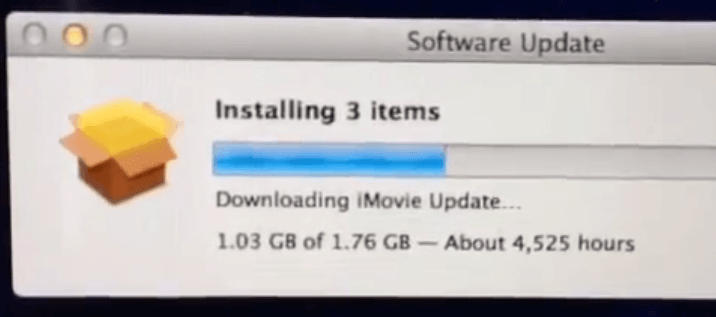
All of these communications methods have proven much more effective than the area’s copper wire-based DSL service, which villagers report is often less than useless. In fact, it can take at least 10 minutes to load Google’s home page in Kettleholm on a bad day, and Apple software updates require additional patience — more than 4,525 hours worth (that is more than 188 days) for the latest version of iMovie to arrive.

BT engineers sent to the area to investigate found nothing wrong with the service, which they initially said was operating within normal expectations for DSL “broadband.” But at least 150 local residents strongly disagree, and several made their point producing a video demonstrating how two yogurt cups attached by string provide more reliable communications than BT was managing in their part of Scotland.

The problem, according to local residents, is the decrepit state of the copper-wire based telephone exchange, installed just after World War 2. Broadband advocates say the solution is rubbishing the ancient copper wiring and replacing it with optical fiber that is spreading across the rest of Great Britain. But neither BT or Virgin Media consider Kettleholm worth the investment, placing the village squarely in the undistinguished category of last priority — the one-third of the United Kingdom deemed economically unsuitable for fiber broadband.

UK residents are paying for broadband improvements as part of their TV License Fee, and the government has amassed at least £800 million for upgrades. It irritates some residents that their portion of the license fee is paying for someone else’s broadband upgrades, and salt is rubbed in those wounds when viewers see BT — the largest recipient of government money — spending it on advertisements mailed to Kettleholm residents for services they can never get.

Even worse, the BBC recently learned the phone company isn’t exactly spending every resource on better broadband in the UK. BT recently found £738 million laying around to pay for the rights to Premier League football games for the next three years.

Where there is smoke (signals) there is fire, especially after the BBC picked up the story. BT suddenly had a change of heart about the state of their network in Dumfries and Galloway:

“Kettleholm telephone exchange is a modern digital exchange, System X and offers broadband speeds of up to 8mb/s. We were not initially aware of a problem with broadband in Kettleholm as only a small number of the 120 end users reported problems with their service. The service appears to have gradually degraded over time without triggering any of our alarms. Engineers recently reset equipment in the exchange and tests show that broadband speeds have risen. We will continue to monitor the situation and would like to apologise to everyone for the frustration and inconvenience they have experienced.”

Kettleholm residents appreciate the new attention BT is paying to their network, but the village has been reminding everyone they can find that BT is their sole provider and when they stop paying attention to their DSL facilities, the entire community suffers.

[flv width=”640″ height=”380″]http://www.phillipdampier.com/video/Kettleholm Poor Broadband 6-2012.flv[/flv]

The village of Kettleholm shows off their new telecommunications systems: smoke signals, carrier pigeons, messages inserted into bottles, semaphores, the pony express, and yogurt cups attached by string.  All perform better than BT’s DSL service.  (2 minutes)

New York City Broadband “Sucks,” Says Village Voice

Waiting for FiOS

For those who admire the apparent pervasiveness of competition between Time Warner Cable and Cablevision Industries vs. Verizon Communications’ FiOS, the idea the Big Apple has a broadband problem seems a bit ridiculous, particularly if you can’t get your local cable company to pick up their phone and AT&T will only hand you a 1.5Mbps DSL line, if you can get it.

But according to the Village Voice, New York City broadband “sucks,” and it will continue to suck for at least the next eight years.

“Though entrepreneurs in most parts of the city can access a fast broadband connection today, many of those we interviewed said that New York’s telecom infrastructure is well behind where it should be for a city vying to be one of the nation’s two leading technology hubs,” the study notes.

What it comes down to is that New York — despite being the world’s media capital — does not have adequate access or bandwidth to support tech companies’ needs.

For example, some companies might be able to get either FiOS or Time Warner Cable, but not both, which means they can’t have broadband backup.

“It’s like the elephant in the room is that bandwidth here sucks,” one entrepreneur told the researchers. “You should be able to walk into any building and have at least 150 megabit connection available to you. There has to be ways for the city to construct much better bandwidth availability for start-ups.”

Many cited told the researchers that their internet routinely goes down. And startups who want to set up shop in cheaper, industrial districts often can’t, because the cable companies would rather provide service to more lucrative residential areas. Sometimes, telecom concerns are willing to dig up streets and lay cable, but at a hefty price — around $80,000.

That $80,000 bill is handed to a prospective customer and does not come from cable operators’ capital expense fund.

Researchers gave New York a broadband grade of B to B-, which isn’t too bad considering what broadband is like in the mid-south, the midwest, and the rural west. But it doesn’t cut it for helping New York become a bigger tech city.

Waiting for "Business Class"

While Time Warner Cable and Cablevision have wired multi-dwelling units and homes across New York City, cable operators have only recently started to turn their serious attention to corporate business customers.  Time Warner Cable agreed, as part of its franchise renewal deal with the city, to invest $1.2 million per year for fiber connections to commercial buildings yet to be wired for cable. Cablevision, which can be found in boroughs like Brooklyn and out on Long Island, agreed to spend a more modest $600,000 a year for the same purpose.

Time Warner Cable has already warned investors its capital spending on wiring commercial office buildings across the country is increasing as the company sees lucrative new revenue opportunities competing with their usual nemesis — the phone company.

Verizon treats FiOS deployment in New York City as a long, long-term project. There are neighborhoods in Manhattan that can’t wait much longer for the fiber optic network as Verizon increasingly lets its old copper wiring go to pot, leaving some New Yorkers without phone service for weeks.  The city of New York has given Verizon until 2014 to wire the city, and the company appears likely to need those two additional years at their current pace, and that agreement only covers residential properties, not commercial ones.

Robust broadband is essential for many high technology startups and the multi-million dollar data centers that support them. New York mayor Michael Bloomberg considers it a top priority to reduce the city’s economic dependence on Wall Street, which generates considerable tax revenue for both the city and state. High tech enterprises fit that bill. But the city’s broadband grades do not.

“For a city that’s trying to be a tech powerhouse, we need to have an A,” said Jonathan Bowles, the author of the study, “New Tech City.”

Frontier Confirms Stop the Cap! Report That Company Is Considering AT&T U-verse Deployment

Frontier Communications has confirmed a Stop the Cap! exclusive report that the company has shown an interest in a licensing arrangement with AT&T to deliver U-verse to Frontier customers in larger markets.

Maggie Wilderotter, CEO of Frontier Communications today told investors on a morning conference call that the company likes the U-verse product and is considering deploying it.

“We’ve been evaluating a lot of other alternatives of which U-verse is one of the alternatives,” Wilderotter said. “We think it’s a product that can work, not just on fiber, but it also works on copper as well. So it’s a lot more forgiving in the market.”

Wilderotter claimed the company has no immediate plans to introduce the technology, but Stop the Cap! has obtained documentation that shows the company now refers specifically to “U-verse” in internal communications, is hiring new leadership to oversee the company’s IPTV plans, and has plans to dramatically expand VDSL technology, a prerequisite for deploying AT&T’s fiber to the neighborhood platform.

Wilderotter

Frontier Communications has had a difficult time supporting its Verizon-inherited FiOS fiber-to-the-home networks in the Pacific Northwest and Indiana.  The company has found itself unable to compete effectively in the video business because it negotiates programming contracts independently, which locks Frontier out of the volume discounts that other independent providers routinely receive from participating in programming purchasing co-ops.  Frontier lost 4,800 FiOS video customers in the last quarter alone.

Wilderotter said as a result of programming costs, Frontier has no plans to pursue any additional fiber expansion to deliver video programming.

However, a licensing arrangement with AT&T U-verse could open the door to Frontier receiving the same volume discount prices for programming that AT&T already receives as part of its own operations. Because Frontier would have to significantly upgrade its existing, primarily middle-mile fiber network to reduce the amount of copper wiring in its network, the company faces significant capital investment costs wherever it chooses to deploy the more advanced broadband network.

Wilderotter hinted Frontier’s plans for the enhanced technology would be limited to a handful of cities.

“It doesn’t make sense in all of our markets,” she said. “It’s only a handful of markets other than where we have FiOS today. So there’s more to come on that over time. Video is very important. We think over the top video is probably more important than anything else.”

The most likely target for any IPTV expansion would be Frontier’s western New York operation in and around Rochester, where the company currently competes against Time Warner Cable with a mediocre DSL product that can no longer compete with the cable operator’s superior speeds and pricing promotions.  Frontier is steadily losing market share in most of its more-populated service areas.

Other likely targets for expanded broadband include larger cities in Pennsylvania, Illinois, West Virginia, and California.

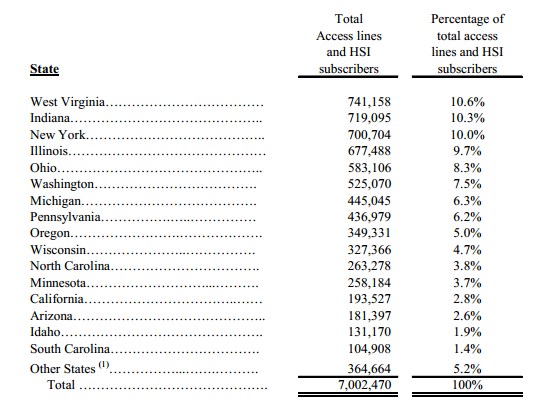
Frontier's Broadband Customers (as of 12/31/11)

Chief Operating Officer Daniel McCarthy added Frontier also has plans to improve broadband speeds in most of its service areas.

“We’ve been working pretty steadily to improve the core network around the country,” McCarthy said. “You’ll see us aggressively move forward with sort of VDSL and bonded ADSL2 copper.”

Currently, Frontier only informally offers bonded service to residential customers in very limited areas, notably in parts of the Genesee Valley in western New York.  The company has been marketing an extra line of traditional ADSL service to customers elsewhere who want more broadband capacity, but that requires a second broadband modem and delivers no speed improvements.

Frontier’s time frame to deploy enhanced speeds in within 12-24 months, according the company officials.

In other developments, Frontier Communications customers formerly served by Verizon will likely find themselves choosing new service plans as Frontier prepares to migrate customers away from legacy Verizon service packages.

Wilderotter telegraphed that affected Frontier customers will see some rate increases when the new plans become effective.

“We do think that there is a pretty substantial revenue upside,” Wilderotter said. “We think the net-net is we’ll get customers on the right portfolio of products that will also be revenue enhancing for the company and we’re going to surround the products with the right kind of service experience, both online and off-line. We’re redesigning all of our online product sets for a better customer experience so they can manage their own broadband usage and actually upgrading or changing what they do with broadband themselves, if in fact, they want to do that.”

Search This Site:

Contributions:

Recent Comments:

Your Account:

Stop the Cap!