Home » copper wiring » Recent Articles:

Transformational Google Fiber: Threatening Traditional Providers’ Broadband Business Models

Google Fiber is more than the experimental publicity/political “stunt” many large cable companies and Wall Street investors have suspected since the search giant first announced it would build a 1,000/1,000Mbps fiber to the home network.

BTIG Research, which follows the telecom sector for large institutional investors and investment managers, says there is a lot more to Google Fiber than many initially thought.

If Google’s fiber project expands outside of Kansas City, it could ultimately transform the business model of broadband in the United States. It already has generated unease for Time Warner Cable, which has resorted to knocking on doors to preserve its customer relationships.

It is one thing to consider Google Fiber from a New York City office and another to see it working on the ground. BTIG’s Rich Greenfield and Walt Piecyk decided to travel to Kansas City to investigate the new fiber service first-hand.

“We believe Google Fiber will accelerate rapidly, changing consumer habits in its territory,” they concluded. “While it is very early in Google Fiber’s life, we fully expect Google to build out more markets after they perfect the broadband and TV offerings in Kansas City.”

There is ready-made demand, judging from the 1,100 cities that asked Google Fiber to set up shop locally. Local governments recognize their telecommunications future has been largely monopolized by one cable and one phone company, and it is important for that to change. Some have taken steps to build their own networks, others will throw a parade if Google does it for them. Reasoning with the likes of Comcast, Time Warner Cable, AT&T, and Verizon — among several others — has not gotten world class broadband at a reasonable price. Instead, many incumbent players have used their market power to raise prices, restrict usage with unnecessary usage caps, and retard innovation.

Google may prove to be the only force large and aggressive enough to throw a monkey wrench into the comfortable business plans and conventional wisdom about how broadband should be packaged and sold in this country. Community owned providers have shown they can deliver superior service and pricing, but face deep-pocketed incumbents that can use predatory pricing to save customers in one market while raising prices on captive customers in others. Incumbent providers also have successfully advocated for protectionist bans on publicly-owned broadband in a number of states. Washington regulators have thus far been largely supine and disengaged when asked to address the challenges consumers face from rising bills for more restricted service.

BTIG’s own research is a marked departure from the usual dismissive attitude incumbents and Wall Street have paid to the Google project. Greenfield himself acknowledges that the investment and business media communities typically respond with three reactions when one mentions Google Fiber:

  • “Is it a sustainable business with those economics?”
  • “How much cash are they blowing?”
  • “Who cares about what they are doing in a couple of relatively small cities such as the Kansas Cities?”

But such thinking underestimates Google’s potential much the same way Yahoo! and AltaVista did with their dominant search engines a decade ago. The biggest mistake one could make is to assume Google just wants to be another competing cable or phone company. It goes far beyond that.

Greenfield believes Google is seeking to become an integral part of the communities it serves, equal in stature to the cable and phone companies, but without their reviled reputation.

But the most significant change Google brings is a challenge to the current business model of consumer broadband.

Phone and cable companies first monetized broadband speeds. The faster the speed chosen, the higher the price. The earnings power of broadband gradually increased as more Americans signed up for service and the costs to provide it declined. But as cable TV margins continue to erode, the money to cover the difference has come from broadband, which has seen regular, unjustified rate increases since 2010. Not content with monetizing broadband speed alone, many providers are also attempting to monetize broadband usage with usage limits and/or consumption-based billing schemes. A recent Wall Street Journal article estimated 90 percent of the price consumers pay for Internet access is profit.

With that kind of profit margin, the economics of Google’s ambitious fiber project do not look as unfavorable as some on Wall Street suggest.

Greenfield calls Google’s 1 gigabit speeds insanely low-priced at $70 a month. He’s right when one considers current pricing models of incumbents. At Time Warner Cable’s current pricing (50/5Mbps service for $99 a month), the cable company would charge consumers $1,980 a month for 1,000/1,000Mbps service, assuming they could actually deliver it. Upstream speeds above 5Mbps might cost even more. Cable television, which used to be the core service offered by cable companies, is almost an afterthought for Google. It can be added for $50 more per month, which is actually cheaper than many competing providers charge for a similar package.

Greenfield feels Google has an aspirational goal for its Kansas City network.

“In Kansas City, Google has a customer facing service with employees who are part of your community, trucks that come to your house and customer service reps that answer your questions when you need help,” Greenfield notes.

On that basis, Google can reboot itself into an entirely new entity in Kansas City, offering much more than a broadband service and a search engine.
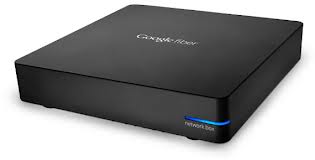
Google’s sleek network box.

Greenfield notes Google Fiber has been carefully developed to break away from the familiar experience one has with the phone and cable company:

  • The home terminals and DVR equipment more closely resemble a sleek Apple product, not a Motorola/Cisco set top box that has looked largely the same since the 1990s;
  • The installation experience has been streamlined — the external network interface on the side of the customer’s home does not require anyone to be home during the installation, reducing the time needed for a customer to sit around while service is installed inside;
  • In-home equipment envisions a more integrated IP-based network future with Ethernet and Wi-Fi connectivity, a centralized storage device which acts as an enhanced whole house DVR, and a minimalist TV box that can be hidden — no more unsightly hulking set top boxes. It represents a home entertainment network that goes far beyond what the competition is offering.

These factors deliver a positive customer experience, if only because Google paid attention to complaints from cable and telephone subscribers and decided to do things differently.

Other traditional business model busters noted by Greenfield:

  • Google will deliver 6/1Mbps budget priced Internet for a $300 one time fee (payable in $20 installments) which includes an in-home router, breaking through the digital divide and getting Google’s infrastructure into homes that simply cannot afford traditional cable or phone company broadband. It blows away the current “lite” offering sold by cable and phone companies with much better speeds at a far lower price;
  • Google is working with charitable organizations to help the poorest get broadband for even less, through donations and other fundraising;
  • Google leverages the community as a crowd-sourced marketing engine. Word of mouth advertising and competition among different neighborhoods helps drive the expansion of the network. Even if a consumer has no interest in the service, many fight to see it in their neighborhoods for the benefit of local community institutions who will receive free hookups;
  • Every new customer signed up for two years’ service receives a free Nexus tablet. The tablet is sold as the service’s “remote control,” but it is capable of much more;
  • No data caps, no speed throttling. With just two speed tiers, Google has completely discarded the speed-based and usage-based business models for broadband.
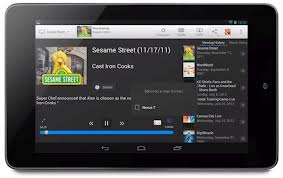
A Nexus 7 tablet comes free with the service (and a two year commitment)

So what exactly does BTIG think is Google’s master plan? Greenfield suspects Google is not recouping its initial investment or costs with their current pricing model, but that may not matter. Google may earn profit in other ways.

A 33% increase in the number of homes with broadband could be a substantial boost for Google search and YouTube, earning Google additional revenue. Improved broadband available to an entire household guarantees people will spend more time online, especially with no data caps or slow speeds. Enormously faster upload speed promotes more content sharing, which in turn means more time online with services like YouTube. A home tablet enables even more broadband usage, according to Greenfield.

As broadband speeds improve, advertisers can expose web visitors to more attractive, multimedia rich advertising not easily possible on slower speed connections. That could let Google tap into a greater share of the $60 billion TV ad market, especially for YouTube videos.

Finally, Greenfield suspects the more Google develops brand loyalty, the more successful it will be pitching consumers and businesses on services of the future.

Greenfield notes there are still bugs and features to be worked on, particularly with Google’s TV offering, but the company will have plenty of opportunities to manage those before it introduces Google Fiber elsewhere.

The implications of an expanding fiber to the home universe in the United States under Google’s price model could deliver a potent punch to incumbents like Time Warner Cable. So far, the cable company has only faced satellite dish competition for television, a technologically inferior AT&T U-verse, which will never have the capacity Time Warner has so long as the phone company still relies on any significant amount of copper wiring, and Verizon FiOS, which has disengaged from a price war with the cable company and is raising prices.

The writing is already on the wall, at least in Kansas City. Greenfield relays that Time Warner has been going all-out to improve its own customer service. One customer noted Time Warner Cable came to his house twice in recent weeks, without a scheduled service call, to check on the quality of his Internet speeds and to make sure the customer was happy.

In some neighborhoods, Time Warner is going door to door to interact with customers, something not done since cable operators first knocked on doors 30 years ago to introduce you to their service.

Google Fiber could ultimately force the end of one more legacy the cable industry has earned itself over the past few decades: customers loathing its service and prices.

[flv width=”640″ height=”380″]http://www.phillipdampier.com/video/Google Fiber Demo by BTIG’s Rich Greenfield and Walt Piecyk 11-23-12.flv[/flv]

BTIG’s Rich Greenfield and Walt Piecyk experience Google Fiber in Kansas City.  (3 minutes)

CenturyLink CEO Thinks AT&T Has a Tough Road Ahead Cutting Off Rural Landlines

CenturyLink CEO Glenn Post does not think much about AT&T’s plans to shift its most rural landline customers to wireless in its efforts to decommission traditional landline service.

“From a regulatory standpoint, that could be a tough go,” Post explained to Wall Street investors on a conference call last week. “There may be some areas that will have better service with wireless in some ways. As far as a competitive threat, we don’t see that being a real issue for us because just the bandwidth requirements and the limited wireless access or capability in a lot of areas.”

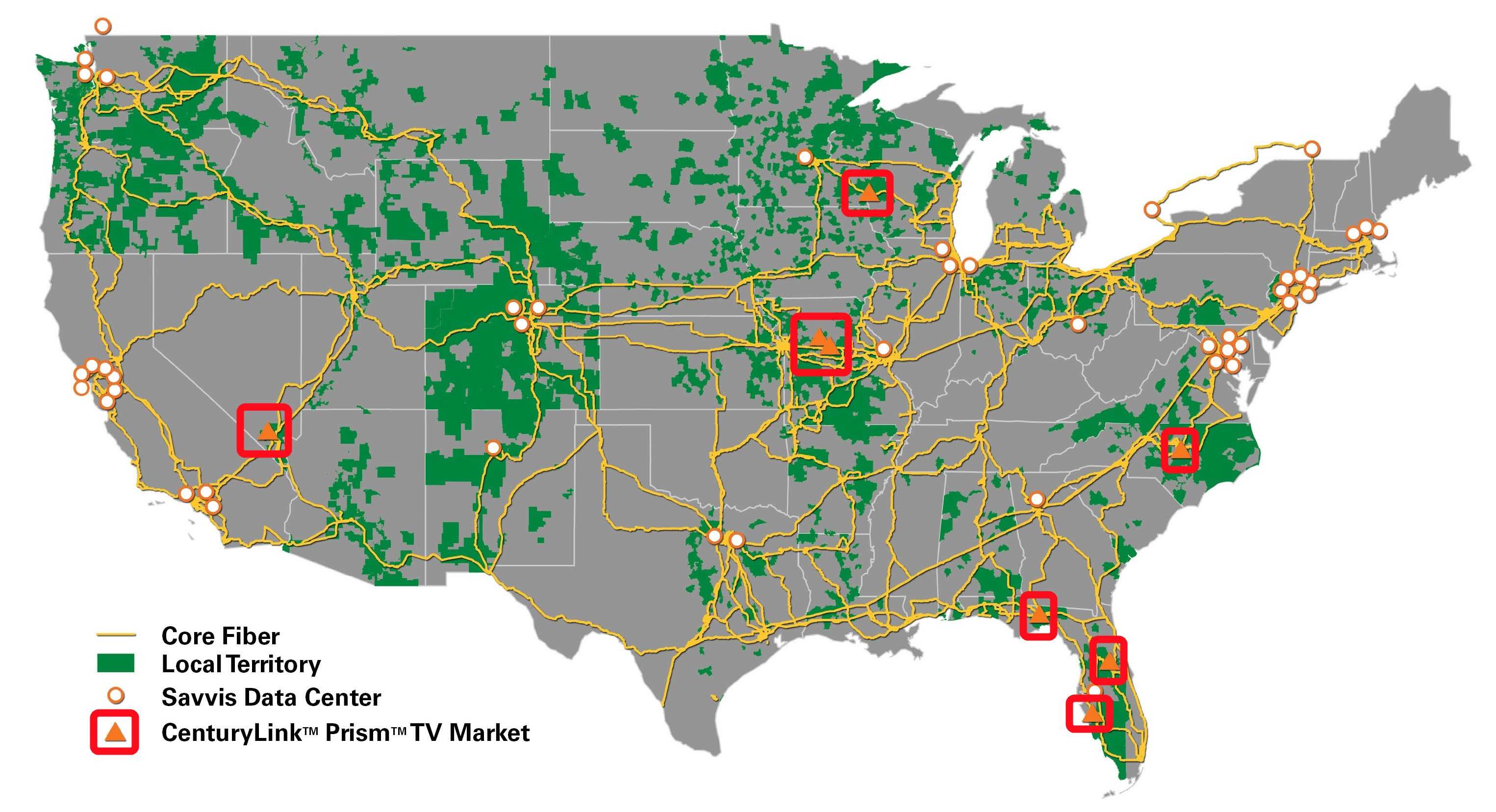
CenturyLink, one of four large independent phone companies and owner of former Baby Bell Qwest, is doubling down on its wired infrastructure to reach customers. The company recently announced Phoenix would be the latest city to get its fiber-to-the-neighborhood service Prism TV — the first legacy Qwest market to get IPTV service from CenturyLink. The service soft-launches in Phoenix this month, with a second city in the region or Pacific Northwest slated to get Prism sometime next year.

The company has spent much of 2012 investing in broadband, managed hosting and cloud computing for business customers, and fiber expansion to reach more than 15,000 cell towers across CenturyLink’s national service area, depicted in green on the accompanying map.

But CenturyLink executives stress their investments are “strategic” — made in areas that are most likely to deliver quick returns for the company.

While CenturyLink spends money to secure video franchising agreements in metro Denver and Colorado Springs for Prism TV service, it is moving at “a snail’s pace” to deliver broadband service in northeastern North Carolina’s Northampton County. County officials there anticipate CenturyLink will take years to deploy basic DSL service to communities outside and around Conway and Gaston.

The broadband problem in income-challenged parts of North Carolina illustrate the conundrum for county officials, who have to advocate for broadband improvement while combating misleading broadband maps that suggest access is not a problem in the state.

Donna Sullivan with the Department of Commerce notes that broadband maps in states like North Carolina have a census block granularity which does not always reveal the true picture of broadband availability.

“That means if one household in that census block can receive broadband services, the entire census block is considered covered—even though there very well may be households who cannot receive broadband to that location,” she told the Roanoke-Chowan News-Herald.

Northampton County, N.C.

CenturyLink is in no hurry to expand broadband to the 1,921 households in the county of 22,000 who cannot buy broadband service at any price.

Derek Kelly, a CenturyLink spokesman, said the company is working to expand broadband services in the region, but noted the costs to lay down a fiber network to help reach the unserved is “one of the largest costs.”

That cost is much less of a problem if the customer at the end of the line happens to be a wireless company like Verizon or AT&T.

Company officials admit they are spending enormous sums “investing in fiber builds to as many [cell] towers in our service area as economically feasible.” In the third quarter alone, more than 1,000 cell towers received fiber upgrades for a total of 3,300 so far this year. The company hopes to reach 4,000-4,500 cell towers by New Year’s Eve.

The reason why CenturyLink chases wireless business while allowing rural and income-challenged service areas to go without broadband is a simple matter of economics. Cell phone companies sign lucrative, multi-year contracts for fiber connectivity to cell towers to support forthcoming 4G service. In contrast, CenturyLink was surprised to find an astounding 94 percent of families with children in Northampton are qualified for the company’s special Lifeline Program which delivers slow speed, discounted broadband service for families on public assistance.

Post

For CenturyLink’s more urban and prosperous service areas, the news for broadband service improvements is better.

As CenturyLink continues to extend its middle mile fiber network, broadband speeds are gradually improving.

Over 70 percent of CenturyLink customers can receive at least 6Mbps DSL service, more than 57% can receive at least 10Mbps and 29% can access the Internet at 20Mbps speeds or better, according to Post.

But the more urban and prosperous a service area is, the greater the chance a cable competitor has successfully poached many of CenturyLink’s DSL customers with the promise of better speed.

Post said he recognizes the company must do better to remain competitive.

“We’re shooting for 20-25Mbps for a very large percentage of our areas,” Post said. “But with [pair] bonding, we can virtually double the broadband capacity and speeds in our markets. We’re already doing bonding in a number of markets today. So where we have 20Mbps, we could have 40Mbps.”

CenturyLink’s fiber to the neighborhood network, essential where it plans to roll out Prism TV, can also support faster broadband speeds if a customer wants broadband alone and does not care about television service.

Nationwide, the company added 10,000 Prism TV subscribers in the third quarter and has a total customer base of around 104,000 subscribers. But that represents a penetration rate of just over 10%, hardly noticed by still-dominant cable operators.

CenturyLink executives were asked to comment on AT&T’s strategic plan to transform their landline network announced last week in New York. Post found little in common between CenturyLink and AT&T’s vision for the future and does not think the company has to respond to AT&T’s attempt to redefine rural America as wireless territory.

“We don’t see that as a major investment for us or a major risk at this point.”

Analyzing AT&T’s Plan to Expand Service: Transformation or Bait & Switch for Rural America?

AT&T’s Supreme Court: senior executives sitting together in judgment of landlines at Wednesday’s analyst conference.

Yesterday, at least a half-dozen AT&T senior executives sat lined up in a perfect row to present Wall Street with the company’s vision for the future.

There were no consumers in attendance, just a group of Wall Street investors and analysts that braved the latest nor’easter to attend.

At issue: what to do about AT&T’s landline network, particularly in rural areas. Earlier this year, AT&T CEO Randall Stephenson, still smarting from a regulatory slap-down of his plan to acquire T-Mobile USA, ranted his disapproval of federal regulators for nixing the deal and then reflected on AT&T’s rural customers who still cannot buy broadband service from AT&T.

One of Stephenson’s strongest arguments in favor of merging with T-Mobile was it would facilitate a rural broadband solution. With that off the table, Stephenson seemed at a loss:

“We have been apprehensive on moving, doing anything on rural access lines because the issue here is, do you have a broadband product for rural America?,” Stephenson said. “And we’ve all been trying to find a broadband solution that was economically viable to get out to rural America and we’re not finding one to be quite candid. That having been set aside, now we’re looking at rural America and asking, what’s the broadband solution? We don’t have one right now.”

Now AT&T claims they do, and miracle of miracles, it turns out they never needed the buyout deal with T-Mobile after all.

AT&T’s solution is good news for urban, suburban, and exurban customers who will benefit from billions in additional investments to beef up the company’s U-verse platform. Those with access to U-verse TV, broadband, and phone service will soon find maximum speeds available up to 75Mbps — important at a time when cable companies are moving to 50-100Mbps premium service tiers. Those without access to U-verse, bypassed by its recently completed initial buildout, now will have a chance to see the service in their communities.

For more exurban and near-rural areas, AT&T has a positive plan to rid customers of the scourge of painfully slow ADSL service, better known simply as “DSL,” which AT&T pitches at speeds typically 10Mbps or less. In more rural areas, it is often much less.

By using additional fiber and using D-SLAM technology to reduce the amount of copper wiring between the phone company and you, AT&T’s IPDSLAM service will dramatically improve speeds for customers languishing with 3Mbps service to upwards of 45Mbps. But for now, AT&T won’t roll this out as a full-scale U-verse service. Because maximum speeds are lower and network variability is expected to be greater, AT&T will instead pitch this as a broadband and landline phone service package. Customers will be marketed satellite dishes if they want television service bundled in.

Although not as robust of a platform as U-verse will soon be, it still represents a major improvement over DSL, which is now barely tolerable for today’s online multimedia experience.

But AT&T’s “good news” may not be so great for its most rural customers, who either have the slowest DSL service or more likely no broadband at all. Those customers have waited years for AT&T to invest in upgrades to finally connect them to the Internet, but AT&T’s plans have gone in a very different direction.

AT&T’s rural solution is to take down the existing landline network and move everyone to its wireless cell phone service. To implement this proposed solution, AT&T will aggressively invest in rural cell sites within the 22 states where it supplies landline service. The company claims 99% of its customers will be able to access a 4G LTE signal within a few years.

Phillip “Are you following this shell game” Dampier

But here is where things begin to get dicey.  AT&T told investors it has no current plans to differentiate rural wireless customers from their urban counterparts. In larger cities, a smartphone and data plan is not necessarily a necessity — customers can still access a landline to place urgent calls or find a home broadband plan that does not carry the kinds of restrictive data caps wireless plans deliver.

Rural landline customers often pay low rates for their home phones, primarily because their local calling areas are generally far more restricted than in larger communities. The base rate for rural phone customers can be around $10 (before taxes and fees) in some areas. The base rate for AT&T’s wireless service starts at around $40 for 450 talk minutes or $19.99 for anchored, wireless unlimited calling home phone service (with a $36 activation fee and a two-year contract) that works with your existing home phones. Both represent rate increases.

Wireless data plans are notoriously expensive and limited. Verizon’s plan for home broadband users is priced at $60 a month with a 10GB limit. Less expensive plans with limits 25 times greater (or unlimited) are available from wired broadband providers. If the customer wants a smartphone for their data and home voice calling, bundled plans start at $85 a month with a 1GB usage limit.

With these prices, it is no surprise AT&T is promoting this as great news for the company. But we’re not so sure the average rural American is going to be pleased treated like a second class citizen with high priced, usage-capped Internet access.

As victims of Hurricane Sandy also found out last week, the venerable landline also enjoys a reputation of working after disasters strike. Unlike a fallen tree knocking down a phone line in the backyard, should AT&T’s wireless network fail in a storm, it would potentially leave hundreds, if not thousands of customers without service. Repair crews could take days to reach damaged facilities. That actually happened to Frontier Communications in some parts of West Virginia where heavy snows and tree damage made travel nearly impossible.

But there are important clues to what AT&T is really up to in regulatory filings that accompanied the showy presentation AT&T put on in New York Wednesday.

AT&T Has a Plan — Move Customers Away from Low Profit, Low Growth Landlines to High Profit Wireless/Deregulated Broadband

After the two hour presentation ended, AT&T posted a copy of its proposal sent to the Federal Communications Commission.

Reviewing the 24-page document is a classic case of  déjà vu. Once again, after the rhetoric is set aside, AT&T is back, peddling the same case to retire landline service and the regulatory obligations that accompany it. Only now, it has a carrot to dangle in front of regulators — significant investments in broadband expansion.

Although the private sector has invested well over $1 trillion in broadband networks, much remains to be done. As of 2010, roughly 14 million Americans, residing in rural and other high cost areas where the broadband business case is tenuous at best, still lacked access….

[…] Carriers such as AT&T are stepping up to do their part. In fact, just today, AT&T announced a $6 billion investment plan to expand and upgrade its wireline network to bring robust IP broadband services to millions of additional locations in its legacy footprint.

[…] AT&T makes this announcement with full confidence that the Commission will continue to implement the National Broadband Plan’s vision of removing regulatory impediments to efficient, all-IP networks, including obligations that could require carriers to maintain legacy facilities and services even after they have deployed new, IP-based alternatives.

I guess they didn’t need T-Mobile after all.

Translation: We used to bypass 14 million Americans, leaving them behind because it was unprofitable to serve them. But now we’re going to invest some additional money. But before you get that investment, we need you to agree the landline is a relic and (largely unregulated) IP-based networks are the future. We are not going to run both, so if you want all of this investment, you have to let us abandon our regulatory responsibilities and commitments to rural customers.

AT&T even tried to calm investor fears about capital spending increases, arguing the potential payoff of discarding landline service opens up a new era of earnings, both from shifting customers to AT&T’s highly profitable wireless service at a cost of double, triple, or more what customers used to pay the phone company, and a platform to sell them even more services later.

A number of Wall Street analysts disagreed, panning AT&T’s wireline investments as unproven.

The Broadband Coalition, a group of competing telecom providers, called the entire affair a smokescreen:

AT&T’s announcement today that it needs regulatory intervention from the FCC in order to invest in IP technology is a re-run of a tired ploy to leverage the company’s dominance. AT&T only invests in order to respond to competition, and competition is made possible by the very pro-competitive policies that AT&T seeks to eliminate.  The Broadband Coalition members have invested billions of dollars to bring the benefits of IP to American consumers from coast to coast.  But if AT&T gets its way, competition will largely disappear, investments will dry up and consumers will suffer.

Former Congressman Chip Pickering, coalition spokesman, stated,  “AT&T is simply trying to use its belated roll out of IP technology as an excuse to rewrite the telecom rules to its advantage.  We already know that AT&T’s claim that IP will somehow alter the laws of economics and lessen its dominance is patently false.  Clearly, AT&T’s proposed changes are not necessary to achieve widespread IP deployment, but the retention of competition policy is.”

Consumer groups accused AT&T of lying to federal regulators when the company argued the T-Mobile acquisition was essential to accomplish their plan to expand wireless service to 96% of the U.S. population. A year later, the company now claims it can deliver 4G wireless service to 300 million Americans and 99% of its landline service area without breaking much of a sweat.

CNN:

AT&T insists that it wasn’t being disingenuous with the regulators. Things changed, the company says, pointing to the 40 new spectrum deals it signed over the past year. The FCC recently made available some spectrum that wasn’t on the table when AT&T was negotiating its T-Mobile takeover.

“We chartered a new path,” AT&T spokeswoman Roberta Thomson told CNNMoney on Wednesday.

That’s precisely what the FCC — and industry analysts — believed would happen.

Now What

For now, rural customers need not worry AT&T will put their entire rural landline operation up for sale, potentially selling off a large number of  customers to companies like CenturyLink, Frontier, Windstream or FairPoint.

Rural America’s new home phone?

But AT&T’s lobbying machine will soon descend on state legislatures to win regulatory approval of their “abandon landlines” agenda. AT&T has a carrot for those legislators as well — a promise that states that hurry to rubber stamp AT&T’s wish list will be first in line for “investments.”

“We are going to have to see 21st-century regulation for 21st-century investments like this,” said AT&T CEO Randall Stephenson. “I think what you’re going to see is that these investments will go first to those states where you have good line of sight to good regulatory authority to do some of the things we’re talking about here.”

The implications for rural customers are profound if AT&T wins permission to scrap the landline network. Despite assurances from AT&T this is a technology argument, in fact it is more of a campaign to rid themselves of regulatory and consumer protection rules that have been around for decades. The type of technology used makes all the difference. Landline providers are usually compelled to provide reasonable, affordable, universal service for all Americans. Broadband, IP-based, and wireless networks now exist largely in a deregulation free-for-all where AT&T can do as it pleases, serve who it likes, and charge whatever it wants.

Considering AT&T’s current business plans, that sets the stage to worsen the newest digital divide — one pitting urban areas with faster, advanced, and more competitively priced networks against rural America, consigned to expensive, usage capped wireless service that may or may not work when a natural disaster strikes.

The only way this plan works for consumers is if common-sense service obligations, consumer protection, open access for competitors, and mandated equivalence of service is part of the package. Without it, AT&T will get exactly what it wants: a regulation free lifestyle, an expensive wireless network that rural residents will be forced to use for basic telecommunications, and cost savings and revenue opportunities AT&T will use to bolster its own profits, while cementing its monopoly position in the rural communities of 22 states where it operates.

AT&T Will Increase U-verse Speeds to 75Mbps and Beyond In Major National Upgrade

Will be available to 8.5 million additional customers by the end of 2015

AT&T will spend $6 billion over the next three years to upgrade broadband speeds across its 22 state operating service area and further expand its U-verse broadband platform to reach suburban and exurban customers stuck in the DSL broadband slow lane.

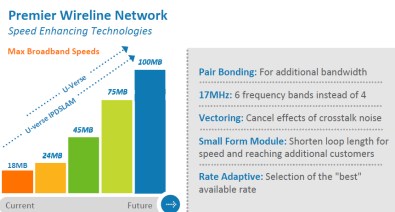
AT&T today announced existing U-verse customers will be able to buy upgraded speeds as high as 75Mbps by the end of 2013, with speeds increasing to around 100Mbps further out. AT&T’s current U-verse platform is currently constrained with maximum speeds of around 24Mbps.

Customers currently bypassed by AT&T U-verse may still have a chance to get the service in their community. AT&T announced plans to expand the fiber to the neighborhood service by more than one-third, with an additional 8.5 million customers able to sign up by the end of 2015.

AT&T also announced an eventual replacement for its existing ADSL platform, which currently offers speeds ranging from 768kbps to around 12-15Mbps in certain areas. The company’s lighter version of U-verse, dubbed U-verse IPDSLAM, will be introduced to 24 million AT&T customers in smaller communities by the end of 2013. Customers will be offered phone and Internet service over the network — but not television — with broadband speeds up to 45Mbps.

About 25% of AT&T’s rural customers will not see any upgrade to their current landline service. Instead, AT&T announced it will seek to gradually decommission rural landline networks and transfer those customers to its 4G LTE wireless service for both broadband and voice service, pending regulator approval.

Short on specifics, AT&T did not say whether rural customers will face the same broadband usage caps that are familiar to other AT&T wireless customers.

AT&T plans to upgrade its broadband speeds using a combination of technologies:

  • Pair bonding existing copper wiring to get additional bandwidth;
  • 17MHz: Devoting six frequency bands to broadband, up from the current four;
  • Vectoring: Using technology to reduce or eliminate speed-robbing crosstalk noise on existing lines;
  • Additional Copper Wire Reductions: Bringing fiber further into neighborhoods to reduce the distance of copper wiring between your home and AT&T’s network;
  • Using “rate-adaptive” technology to let equipment select the fastest possible speeds with a tolerable error rate.
AT&T also announced it is dedicating fiber to the building service exclusively for business customers. AT&T said it will expand its fiber network to reach one million more business customer locations — 50 percent of all multi-tenant business buildings, over the next three years. That fiber growth is expected to help facilitate the installation of small cell technology in the years ahead to offload wireless traffic on existing cell towers.

Stupid Opposition to Community-Owned Fiber Broadband: It Will Raise Your Electric Bill, Blind Your Kids

Halloween scare stories are back!

It is amazing the length some incumbent broadband providers will go to stop publicly-owned networks from getting off the ground and competing with the “good enough for you” service on offer from the local phone or cable company.

This morning, Stop the Cap! received word from a Minnesota reader who reports their dinner hour was interrupted by an unsolicited phone call from a group called “Americans for Sensible Broadband,” which as far as we can tell does not exist as a formal group. The caller used ridiculous scare tactics worthy of a bad Halloween movie:

  • Did you know that fiber broadband networks are expensive to run and will increase your electric bill to pay for the high powered lasers needed to send the signal to your home?

Fiber broadband projects now expanding in Minnesota have no relation to your electric bill because most are run by independent community-owned co-ops, not electric utilities. Even if they were run by an electric provider, the cost to power a fiber network is far smaller than the network of signal amplifiers and other transmission equipment needed by traditional cable and phone companies. The only electrical expense to the homeowner is powering any set top boxes or other related equipment to make use of the service. These costs are comparable to what one would pay with cable or phone services.

  • Most fiber networks are not actually fiber at all. The largest companies in America actually let you keep your current wiring, but that is not fiber, so why spend tax money on a risky fiber network?

While AT&T U-verse has chosen the route of “fiber to the neighborhood,” which still relies on existing copper wiring from nearby poles to your home, many fiber to the home projects take fiber… straight to the home. Some community networks do make use of very short lengths of pre-existing copper wiring inside your home, but this has more to do with your convenience. You don’t need a fiber connection to your landline phone, for instance. Compare the broadband speeds and services on offer from the community provider vs. incumbent cable and phone companies. Choose the one that delivers the best services for the price.

  • America’s cable and phone companies are working hard for pro-growth, pro-expansion policies in Washington that will allow your community to get the benefit of billions of private investment, at no risk to you.

An in-home threat to your children or incumbent provider profits?

Incumbent phone and cable companies already enjoy a higher level of deregulation than ever before. If they have not spent money to improve broadband in your area before, there is nothing that will open their wallets to provide the service now, unless someone else subsidizes part of the cost. Guess who “someone” is? That’s right. You the taxpayer or ratepayer. Whether in the form of broadband subsidies paid for by taxpayer dollars or ratepayer subsidies from the Universal Service Fund, only subsidies or competition prod incumbents to deliver better broadband to rural Minnesota (or anywhere else). If you fail a “Return On Investment” test, you will not get broadband no matter how much deregulation gets approved in Washington.

The question for rural consumers is whether AT&T, Frontier, CenturyLink, Comcast, or Charter Cable has your best interests at heart or whether a community co-op you partly own will.

  • In socialistic countries, the government runs the broadband service and can monitor your web browsing. Do you want your local community checking up on your online activities?

“Socialistic” is in the eye of the beholder. Most broadband networks are run by private telecommunications companies, some with state subsidies, others entirely on their own. The federal government’s security agencies already have access to monitor Internet traffic under warrantless wiretapping laws, and that extends to every provider in the country, private or public. That said, there is no evidence local government officials would monitor your web browsing habits, much less have the budget or technical expertise to do so.

  • Fiber cables create more hazards on utility poles designed for phone, cable and electric service. Is it worth risking those services for an unnecessary and expensive fiber network?

Electric and phone companies used the same scare stories to try and keep cable television lines off utility poles more than 30 years ago. Cable operators fought for and won the right to use utility poles to no ill effect, and at fair prices. It is ironic some cable companies want to use the same argument against municipal fiber that phone and electric companies used against them.

  • In these difficult economic times, do you realize your local taxes could triple to pay for unnecessary fiber Internet?

Most public broadband projects are financed by municipal bonds obtained in the private free market. Investors can decide for themselves if they represent a safe investment, and many do. If the networks fail, private investors typically take the hit.

But the most ridiculous claim of all was that “recent news reports warn that lasers could blind your children if they happen to play with the fiber cables in your home.”

The only “news report” we could find on this subject was an Engadget news story from 2011 about an S3 Krypton laser that could blind astronauts without proper safety equipment. But those lasers are not powering broadband networks.

In reality, fiber to the home networks are safer than traditional copper phone wiring, which can send a significant electric shock to anyone playing with the wiring when a telephone rings. Many fiber networks rely on Class 1, low power lasers — the lowest risk level. Even if a customer stared at the lit end of an optical fiber connector, the visible light would be diffused into a cone pattern that would be completely harmless by the time it reached the retina. Many networks also include a secondary safety mechanism that quickly shuts down the laser light once the connection has been broken. Certain higher-powered laser communications networks can have some safety risks, but almost entirely for workers working on primary cables that deliver service to dozens of homes. Those workers are well-trained to avoid those risks.

Minnesota seems to be one of the latest hotbeds of incumbent wrath over expanding community-owned broadband networks. Despite efforts to label them insidious creeping socialism, they are actually no more threatening than a traditional co-op, except perhaps to incumbent cable and phone companies that have been running to the bank cashing checks from customers enduring low broadband speeds at high prices.

Search This Site:

Contributions:

Recent Comments:

Your Account:

Stop the Cap!