Home » Contract » Recent Articles:

Sprint’s iPhone? Company Rumored to Introduce Iconic Phone in October

Phillip Dampier August 24, 2011 Broadband Speed, Competition, Consumer News, Data Caps, Sprint, Video, Wireless Broadband Comments Off on Sprint’s iPhone? Company Rumored to Introduce Iconic Phone in October

Rumors are swirling Sprint will begin selling Apple’s iconic iPhone this October, bringing the number of carriers supporting the wildly popular phone to three.  Sprint shares soared 10 percent on the news.  But while Sprint customers and shareholders are celebrating the potential imminent arrival of iPhone, launching the phone on the Sprint network is no simple matter, especially for the last remaining carrier delivering truly unlimited data.

On the Plus Side

Apple’s iPhone has become a must-have for a significant number of consumers.  They won’t leave the phone behind to switch carriers, not even for Verizon Wireless, until they introduced the phone earlier this year.  Now Sprint can win its own share of iPhone devotees.

Sprint’s iPhone promotions could draw customers away from larger carriers, especially enticed by Sprint’s worry-free unlimited data plan that has become extinct at other wireless companies.

The iPhone locks customers into new two-year contracts with Sprint, helpful security at a time when AT&T threatens to further consolidate the wireless industry in its efforts to acquire T-Mobile.

On the Down Side

Sprint’s phone subsidy expenses will skyrocket with Apple’s iPhone, which commands the highest subsidies in the industry.  Analysts suspect AT&T currently shells out up to $425 for iPhone 4 and $375 for iPhone 3GS.  Then AT&T sells the phone to consumers for $200 or less, making the subsidy back over the life of the two year contract.  That hits AT&T’s cash on hand hard.  For Sprint, regularly accused by Wall Street of spending too much on customer promotions, it will only increase those costs.  Sprint pays less than $150 for its top of the line Evo phones in comparison.

One guarantee the iPhone always delivers: Lots of data hungry users.  The introduction of the iPhone may ultimately threaten Sprint’s unlimited usage experience because of demand placed on an already burdened 3G network.  There is also no guarantee the first Sprint iPhone will support Sprint’s 4G network.

[flv width=”480″ height=”290″]http://www.phillipdampier.com/video/KMBC Kansas City Sprint May Sell iPhone in October 8-24-11.mp4[/flv]

KMBC in Kansas City talked with customers looking forward to Sprint’s iPhone.  Sprint is a major employer in Kansas City.  (2 minutes)

Canada’s Cellular Cartel: 3 Wireless Companies Control 94 Percent of the Market

Next time you wonder why you are paying substantially higher cell phone bills than your neighbors abroad, take note: just three cell phone companies control 94 percent of the wireless marketplace in Canada, with more than 23.5 million combined subscribers.  The four other significant carriers have a combined subscriber base of around 1.5 million, hardly worth noticing by the largest three:

Rogers Communications

The telecom giant Rogers controls the largest share of the Canadian wireless market with 9,127,000 subscribers as of the end of June.  Nearly 7.5 million of those customers are on two year contracts and pay an average bill of $70.07 per month.  Prepaid customers pay substantially less for their occasional-use phones: $16.14 a month.  Rogers adds more subscribers than it loses, picking up 591,000 new customers during the first quarter, while losing 456,000 current customers, winning a net gain of 135,000.

Data revenue is becoming increasingly important for Rogers, now constituting 35 percent of earnings for the company’s wireless division.

Bell

Coming in at second place is Bell Canada, with 7,283,000 customers.  Over 5.7 million are on contract, 1.6 million are using Bell prepaid phones.  Bell added just under 38,000 new customers last quarter, the smallest net add among the three largest providers.  The average contract customer pays Bell $63.18 a month; prepaid customers pay $16.88.

Telus Mobility

Telus, western Canada’s largest phone company, sells wireless service across the country and has become the third largest wireless provider with 5.8 million contract customers and 1.2 million prepaid clients.  Together, they pay an average of $58.88 a month.  Telus picked up 94,000 net additions last quarter, which is better than Bell but worse than Rogers.

Everyone Else

Among the rest, Saskatchewan’s phone company Sasktel had managed to reach 568,000 subscribers, mostly in the province, as of late March.  MTS Allstream Inc., a wholly-owned subsidiary of Manitoba Telecom came in with 489,722 customers.  Videotron, Quebec’s biggest cable company, had 210,600 clients, mostly in Quebec.

Among the newest entrants, Wind Mobile, subject to considerable controversy for its foreign financial backing, may one day be a much larger player in Canada’s wireless marketplace, but not today.  It had just 271,000 customers as of March 31st.

Even fewer customers rely on some of Canada’s regional providers, which include companies like Thunder Bay Telephone, Lynx Mobility (co-owned by an aboriginal partner with a mission to serve rural Canada), Calgary-based AirTel, which is popular with oil/gas workers for its “push to talk” service, and Ice Wireless, which is the largest GSM carrier in northern Canada, reaching 70% of the population of Nunavut and the Northwest Territories.

Canada’s largest three providers also own or control several “competitors” that mostly sell prepaid service.  Customers thinking they are escaping the big boys often really are not:

  • Fido is owned by Rogers;
  • Virgin Mobile Canada is owned by Bell;
  • Koodo Mobile is owned by Telus

U.S. Cellular Abandoning Unlimited Data Despite New 4G Network That Cuts Data Costs

Phillip Dampier August 9, 2011 Competition, Consumer News, Data Caps, US Cellular, Wireless Broadband Comments Off on U.S. Cellular Abandoning Unlimited Data Despite New 4G Network That Cuts Data Costs

U.S. Cellular Monday told investors the company plans to abandon unlimited data service sometime in the next two or three quarters in favor of tiered data plans similar to what is on offer from AT&T and Verizon Wireless.

U.S. Cellular president and CEO Mary Dillon told investors the company is changing pricing as a result of “significant changes in pricing strategies” at their larger competitors, who have moved away from unlimited data plans over the last year.  Dillon applauded the adoption of tiered data pricing, but noted increasing pricing pressure in the market.

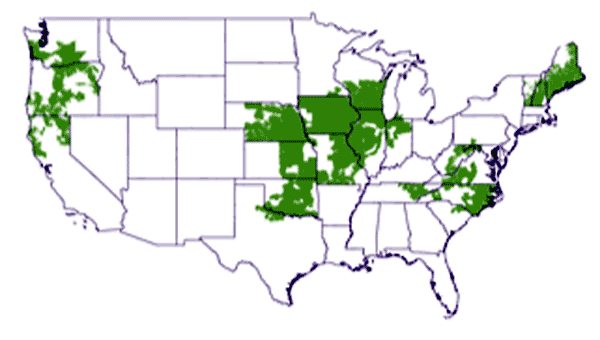
For the nation’s sixth largest wireless carrier, best known in the midwest, northern New England, the Carolinas, and northern California, being a regional provider in an increasingly concentrated wireless marketplace has some on Wall Street concerned about the long term viability of smaller cell phone companies.

Blaming the continuing challenges of “an extremely competitive market and a sluggish economy in which carriers continue to fight for a dwindling pool of new subscribers and the cost of acquiring switchers are significant,” the company reported a net loss of 41,000 customers during the last quarter.  Only 226,000 new customers signed up, down from 307,000 in the prior year quarter.  Another 17,000 prepaid customers dropped U.S. Cellular last quarter as well.  U.S. Cellular now has just under six million customers in all.

Adrian Mill from Eagle Capital noted the customer losses — presumably to larger AT&T or Verizon Wireless, and pondered how long the company can continue to exist on its own in a market increasingly dominated by those two larger carriers:

“I know you guys did a lot of work a couple years ago on whether our regional cellular company could still be relevant and looked at ways in other industries and had some good data from it.

I’m just curious if after the past couple quarters of results where we’ve now seen everybody lose share to AT&T and Verizon if that was something you thought might happen in short term or if it’s been surprising?

If its been surprising, how long would you guys potentially consider losing subs before you do a strategic transaction or consider a sale?”

U.S. Cellular executives didn’t directly answer the question, but acknowledged the wireless carrier does have challenges in the marketplace its larger competitors don’t have.  They include:

  • Access to coveted smartphones, particularly Apple’s iPhone, which continues to be unavailable from smaller, regional wireless carriers;
  • Access to sufficient wireless spectrum to deploy robust data networks to meet customer demand;
  • Capital requirements to build and expand the next 4G generation of wireless;
  • The downward pressure on smartphone equipment pricing due to competition and expensive equipment subsidies;
  • Roaming agreements to ensure nationwide coverage for voice and data services.

U.S. Cellular's primary service areas

Company officials told investors U.S. Cellular intends to continue to compete for new customers, leveraging its top consumer ratings for reliable service and satisfaction with the deployment of its own 4G LTE wireless network.  But first it intends to re-align pricing to reduce costs.

Alan Ferber, U.S. Cellular’s executive vice-president, sales operations, notes U.S. Cellular wants to see more of its customers upgrade to smartphones, which guarantee higher revenues per customer from the higher-priced service plans that accompany the phones.  The company needs less expensive phones from manufacturers, because consumers typically won’t pay more than $200 for a smartphone that comes with a 2-year service agreement.

Ken Meyers, chief financial officer for the company, has been crunching the numbers on smartphone equipment costs and is grateful for the presence of Android phones in the marketplace, which are starting to drive phone prices downwards.

“[It’s] exciting to me is to see what’s happening with the Android phone cost that will allow carriers to start to recapture some of the economics needed to support LTE [4G] investment and the subsidization of those smartphones, whereas that works on a $200 smartphone but if I’m subsidizing $400 or $500 suddenly most of that revenue isn’t going to pay for the network,” Meyers said.

Ferber expects to deliver new smartphones to U.S. Cellular customers for less than $200 by the holiday season, so customers will find the initial cost for phones lower than ever.  But Ferber admits the company’s forthcoming tiered data pricing means increased revenue and “better cost controls” over the life of a customer’s 2-year contract.

“We have also talked about things like tier data pricing on a going forward basis,” Ferber said. “We do believe that has at least two major benefits. The first is to align data revenue with data cost better and the second is to, in combination with the lower cost smartphones, enable more customers to get into a smartphone.”

But Ferber also acknowledges the company’s move to LTE 4G technology will actually cut the company’s costs to deliver that data — great news to investors, but potentially higher cell phone bills for consumers.

“Over the long turn it’ll certainly make the economics much more attractive,” Ferber said.

Other highlights from Monday’s conference call:

  • U.S. Cellular will not acquire other providers not within or adjacent to its current operations, but is stockpiling cash for the potential purchase of any T-Mobile territories the federal government requires AT&T to divest as part of any merger agreement.  T-Mobile is not a major competitor in most of U.S. Cellular’s more-rural/suburban markets, but if U.S. Cellular does acquire any of these customers, they will have to convert them from T-Mobile’s GSM network to the company’s CDMA network;
  • Data roaming from Verizon and Sprint customers traveling through U.S. Cellular’s service areas have brought increased traffic to the company’s data network, and roaming revenue with it;
  • System operations expenses of $228 million were up $14 million or 7% year-over-year. This was due primarily to higher usage and roaming expenses as customers use more data services both on and off U.S. Cellular’s network. Through June of this year, total data of network usage increased nearly 400% over the same period last year.

Verizon Workers on Strike in Northeast: Employees Face Up to $20K Benefit Cut if Verizon Wins

Phillip Dampier August 8, 2011 Consumer News, Verizon, Video 2 Comments

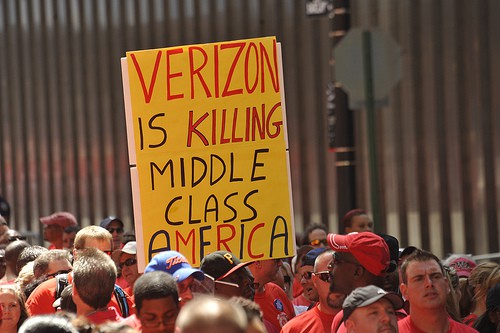
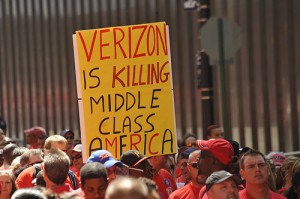
Verizon employees rally in New York. (Photo: Gary Schoichet)

More than 45,000 Verizon landline workers are on strike this morning after union workers overwhelmingly rejected a proposed contract from Verizon Communications that could result in as much as $20,000 in reduced benefits per employee, per year.

Workers employed by Verizon East, which serves the company’s northeastern and mid-Atlantic regions from Massachusetts to Virginia, left their jobs as their contract with the company expired over the weekend.  Two unions — the Communications Workers of America and the International Brotherhood of Electrical Workers, are pitting the dispute as part of a corporate war on the middle class.

Verizon has been demanding serious concessions from union workers in negotiations for a new contract agreement.  But employees are expressing serious concern over draconian salary and benefit concessions that could drastically reduce their pay and benefits package.  According to William Huber, president of IBEW Local 827:

  • Verizon is seeking to tie pay increases to company-defined performance reviews;
  • Employees would pay significant sums towards health care premiums;
  • Pensions would be frozen at the end of 2011;
  • Sickness and death benefits would be eliminated;
  • Disability benefits would be slashed from 52 to 26 weeks and authorized “sick time” curtailed.

Verizon officials claim the benefit and pay concessions are part of the reality of today’s landline telephone business, which has been in decline for several years.

“We need to reach a contract that addresses economic realities,” said Lee Gierczynski, a Verizon spokesman. “The wireline business is constantly in decline. In order for Verizon to compete, Verizon and the unions need to make some difficult decisions.”

That contention is seriously disputed by the two unions and employees.  The CWA called Verizon one of the most profitable companies in the U.S., noting the company earned $19.5 billion in profits in the last four years and paid over $258 million in compensation to just five top executives.

“So tell me, where is their loss?” said Dino Cantillo, a facilities technician and 17-year employee. Cantillo told the Star-Ledger that Verizon’s CEO, Ivan Seidenberg, earned more than $18 million in total compensation in 2010 – roughly $49,000 every day.

“It takes these guys a year to make that,” said Cantillo, pointing at the two dozen or so protesters who picketed in Howell, N.J.

“They are trying to get rid of the working class,” said Bill Gebhart, a lineman who has worked for Verizon for 15 years. “They are totally annihilating it.”

The unions are especially upset Verizon has been aggressively trying to contract work out of the region, hiring workers offshore in Mexico, the Philippines, and other countries to perform tasks formerly done by regional employees.  The unions also point to significant corporate welfare Verizon received recently — a $1.3 billion federal tax rebate paid for by taxpayers.

“These negotiations are all about good jobs,” said CWA District 1 Vice President Chris Shelton. “Companies like Verizon should be investing in rebuilding the American economy, not contributing to the destruction of good, middle-class jobs.”

Verizon appears to be in no hurry to negotiate, cancelling several bargaining sessions last weekend.

During the last strike by Verizon employees in 2000, requests for repair service, installation, and other construction work languished for weeks, so it is very likely consumers with phone or Internet service problems or new order requests will face growing delays the longer the strike lasts.  Union officials plan to move against company plans to reassign managers and workers from other regions with strike protests and what one union official said would be a “blizzard of paperwork.”

Union workers also suggest the quality of repairs and installations done by those pressed into service with little experience may be below standard.

The CWA recommended that union workers and supporters retaliate against Verizon by canceling their phone, Internet, and cell phone service.  That could be an expensive proposition, particularly for wireless customers who would certainly face the prospect of early termination fees.

[flv width=”640″ height=”500″]http://www.phillipdampier.com/video/Verizon Strike 8-8-11.flv[/flv]

Visible strike actions by Verizon workers have served as catnip for local reporters, who are extensively covering the strike up and down the eastern seaboard.  Stop the Cap! has assembled coverage from stations all across the region. (28 minutes)

AT&T Downgraded: Customers Rush to Lock In Unlimited Data… on Verizon Wireless

Phillip Dampier July 11, 2011 AT&T, Competition, Data Caps, T-Mobile, Verizon, Wireless Broadband Comments Off on AT&T Downgraded: Customers Rush to Lock In Unlimited Data… on Verizon Wireless

The impact of the last minute stampede by Verizon Wireless customers (new or otherwise) to lock in the company’s unlimited data plans before they were retired last week has reached Wall Street, but the ripples extend far beyond Verizon Wireless itself.

Macquarie USA analyst Kevin Smithen this morning downgraded AT&T stock to “neutral,” expressing concern about AT&T’s slowed growth in wireless revenues.

“We see increased headwinds to wireless revenue growth, limited improvement in enterprise and a lack of clarity on the status of the [pending acquisition of T-Mobile],” he writes. “We view projected organic revenue growth of 0.5% in 2012 as uninspiring. At current levels, we believe absolute and relative risk-reward to roughly balanced given these issues.”

Customers concerned about Internet Overcharging schemes being implemented by Verizon Wireless began fleeing other providers to “lock in” unlimited data service with Verizon before it was nigh.  One big victim of that was AT&T.

“We were waiting for the next iPhone to finally jump to Verizon, even if it meant paying a termination fee to AT&T, just to escape the dreadful service,” says Shai Lee, who was among several dozen readers contacting Stop the Cap! for assistance securing unlimited data plans with Big Red.  “When Verizon announced $30 for 2GB, there was no way we were going to be locked into paying that, so we jumped early.”

Many followed.

Smithen believes customers are also fleeing other carriers, especially T-Mobile, which he believes will lose two million customers before AT&T closes the deal or faces ultimate rejection for its merger by Washington regulators.

Some analysts believe T-Mobile customers are leaving over a combination of the company’s inherent weakness as a provider-now-in-limbo while others dread the reality of being ultimately stuck with AT&T.

“It’s like fleeing a country before the invading army reaches your town,” shares Samuel, a T-Mobile customer leaving for Verizon. “I won’t live under AT&T’s regime.”

Smithen sees even greater challenges for AT&T with the arrival of iPhone 5, which will either cost the company to subsidize or start another wave of AT&T emigration.

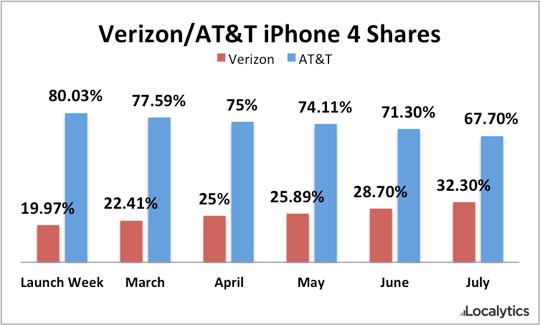
Verizon has already managed to secure 32 percent of the U.S. iPhone 4 market, according to a study by the mobile analytics company Localytics.  Since rumors about Verizon imminently ending unlimited data plans began in May of this year, Localytics has tracked a spike in Verizon iPhone purchases, one explained by existing customers upgrading to smartphones, and new customers arriving from other carriers.

For AT&T, customers on contract with smartphones are not adding additional services and those with data plans are trying to stay within plan limits, robbing AT&T of extra revenue.

Smithen says with this track record, average revenue per customer is “stalling.”

Search This Site:

Contributions:

Recent Comments:

Your Account:

Stop the Cap!