Home » Bill Shock » Recent Articles:

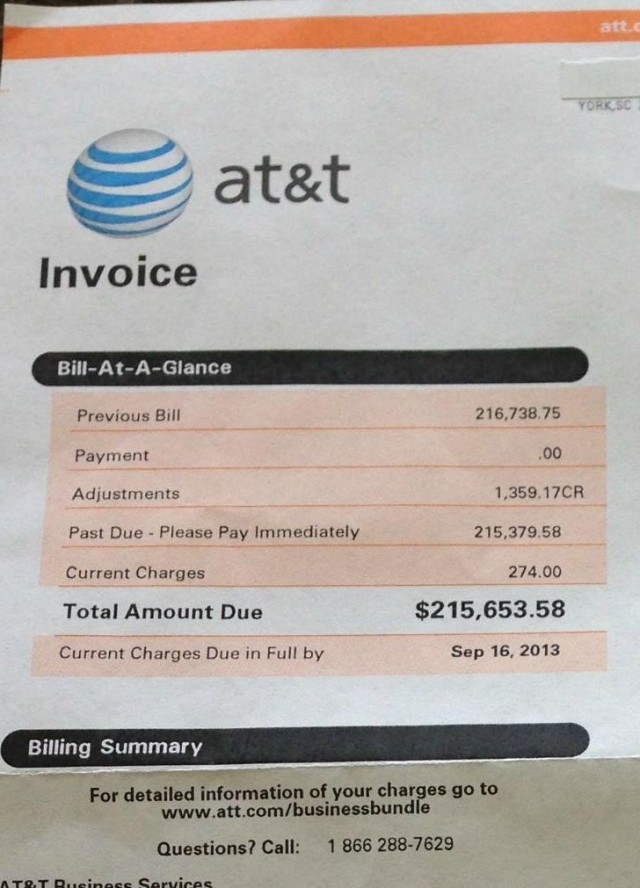
AT&T Bill Shock — Total Amount Due: $215,643.58 (After a $1,359.17 Adjustment Credit)

Phillip Dampier September 19, 2013 AT&T, Consumer News Comments Off on AT&T Bill Shock — Total Amount Due: $215,643.58 (After a $1,359.17 Adjustment Credit)

att bill

Another ex-AT&T customer deals with bill shock: “Dishekie” reports he disconnected AT&T service in March after the phone company failed to get his small company’s Voice over IP phone system functioning properly. “I was reassured my contract was nullified because the VoIP phones never worked,” says the customer. Wrong. AT&T claims the bill is for fraudulent calls placed over the company’s hacked phone system. AT&T has not been willing to resolve the charges, which continue month after month, but hasn’t turned the customer over to collections either, leaving “Dishekie” opening one eye-popping bill after another. He took his case to Reddit, which seems to have finally gotten the attention of a vice president of finances at AT&T who may have a solution, or not.

Canadians Win Mobile Bill of Rights: $50 Limit on Overlimit Fees, No More 3 Year Contracts?

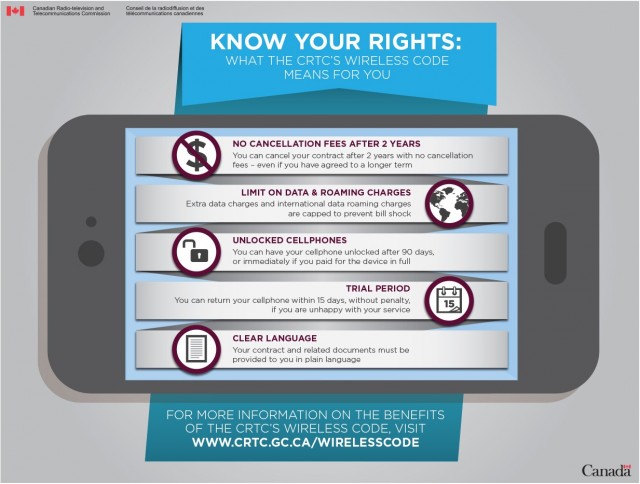
WirelessInfograph_engCanadian telecom regulators have announced new rules that will limit “gotcha” fees for mobile customers caught exceeding their data allowance, push for an end to the ubiquitous three-year service contract, and force carriers to unlock cell phones after 90 days.

The Canadian Radio-television and Telecommunications Commission (CRTC) this week unveiled a new consumer’s Wireless Code governing wireless service. The new rules were introduced in response to more than 5,000 consumer comments received by the regulator over service pricing, opaque wireless contract language, and policies that kept customers locked into long service contracts with expensive exit penalties.

On the surface, the new rules seem to aggressively rein in Bell, Rogers, and Telus — Canada’s three dominant carriers. Among the new provisions taking effect Dec. 2:

  • cancel your contract at no cost after a maximum of two years;
  • cancel your contract and return your phone at no cost, within 15 days and specific usage limits, if you are unhappy with your service;
  • have your phone unlocked after 90 days, or immediately if you paid in full for your phone;
  • have your service suspended at no cost if your phone is lost or stolen;
  • receive a Critical Information Summary, which explains your contract in under two pages;
  • receive a notification when you are roaming in a different country, telling you what the rates are for voice services, text messages, and data usage;
  • limit your data overage charges to $50 a month and your data roaming charges to $100 a month;
  • pay no extra charges for a service described as “unlimited”;
  • you can refuse a change to the key terms and conditions of your contract, including the services in your contract, the price for those services, and the duration of your contract; and
  • all cell contracts must use plain language and clearly describe the services customers receive and include information on when and why customers may be charged extra.

[flv width=”480″ height=”290″]http://www.phillipdampier.com/video/CBC New CRTC wireless rules ban contract break fees after 2 years 6-3-13.flv[/flv]

CBC Television’s “The National” explains the CRTC’s new Wireless Code and how it will impact Canadian cell phone customers. Many are skeptical the CRTC will outwit the wireless industry.  (4 minutes)
crtc

“Every day, Canadians rely on wireless devices while in their homes, at their jobs, at school or traveling abroad,” said Jean-Pierre Blais, chairman of the CRTC. “The wireless code will contribute to a more dynamic marketplace by making it possible for Canadians to discuss their needs with service providers at least every two years.  The code is a tool that will empower consumers and help them make informed choices about the service options that best meet their needs. To make the most of this tool, consumers also have a responsibility to educate themselves.”

Canadians pay among the world’s highest wireless charges and most are offered contracts lasting three years. In the United States, two-year contracts are standard. But in both countries, once the contract is fulfilled customers do not receive a discount on services going forward.

“The biggest scam of all is still allowed under the new rules: wireless companies don’t lower your bill if you buy your own phone or fulfill your contract, so you are still paying their subsidy-recovery phone rates either way,” complains Thomas Harcourt in Toronto. “Once again, the wireless companies got the ears of the commissioners and despite thousands of angry Canadians, they watered down our ‘Bill of Rights’ into more bait and switch. You can almost see where the wireless lobbyists had their way with the language.”

Most Canadian wireless carriers welcomed the new rules and the industry participated in hearings contemplating their creation. The new federal rules will supersede conflicting, sometimes stronger provincial regulations, which some observers suggest is a decision in the carriers’ favor.

A closer review of the new regulations exposes several that were tempered, perhaps after industry objections.

[flv width=”640″ height=”380″]http://www.phillipdampier.com/video/BNN Wireless Code of Conduct CWTA 2-11-13.flv[/flv]

Back in February, BNN talked with Bernard Lord, a representative of the Canadian Wireless Telecommunications Association about what policies they hoped to see in a national wireless “code of conduct.” The industry got most of what it wanted in the final Wireless Code. (8 minutes)

The CRTC did not ban 3-year contracts outright. Instead, they tied contract termination policies and fees to the device subsidy phone companies give customers to cheapen the upfront cost of equipment.

Blais

Blais

In Canada, a new smartphone selling for $699 might be discounted to $99 with a three-year contract. For the next 36 months, customers gradually pay back that discount, called a device subsidy, in the form of an artificially inflated rate plan. Most companies amortize that payback rate over the life of the contract. Under the new CRTC rules, companies must recoup their device subsidy within 24 months.

“We didn’t focus on the length of the contract, we focused on the economic relation,” CRTC chairman Blais said. “So, in effect, it’s equivalent to those asking for a ban of a three-year contract without us actually banning three-year contracts, because what we’re saying is the contract’s amortization period can only be for a maximum period of 24 months.”

Carriers can still charge early termination fees during the first two years and can also recoup any remaining unpaid subsidy during the third year as the regulations begin to cover more customers already under three year contracts. Customers who bring or buy their own device can also be charged an early termination fee up to $50 during the first two years of the contract.

Since the rules will apply only to new cellular contracts signed after Dec. 2, 2013, current customers will have to wait before the new Wireless Code fully applies to them. That means wireless carriers can lock you to the old rules if you buy a new phone before December until your contract ends or is amended.

“I think a lot of consumers, if they were thinking of going to the mall and picking up a new phone and signing a contract, they should think twice about doing so,” Michael Geist, the Canada Research Chair in Internet and e-commerce law at the University of Ottawa, told CTV News.

[flv width=”640″ height=”380″]http://www.phillipdampier.com/video/CBC 3-year contracts to end 6-3-13.flv[/flv]

The CBC tells you when you can rip up your three-year contract. But be careful. The new rules don’t take effect until December. Many complain cell phone service is far too expensive in Canada. (4 minutes)

Wireless carriers claim consumers may eventually pay the price for the rules changes, with some hinting they will increase the upfront price for devices or raise rates to cover the shortened window of time they can recoup a device subsidy.

cwta_logo“This requirement does limit consumer choice in the marketplace, and could make a customer’s up-front purchase price of a smartphone more expensive than current offerings,” said Bernard Lord, head of the Canadian Wireless Telecommunications Association (CWTA).

The CWTA also hinted rates may also increase to cover the “major technology development and costs associated with implementing and complying with the new code.”

Ken Engelhart, senior vice president for regulatory affairs at Rogers told BNN a new smartphone under the old three-year contract was typically priced at around $100. Under a two-year contract, that smartphone might cost $300 upfront.

The CRTC’s language banning overage charges for “unlimited” service does not offer consumers any relief from speed throttling. The CRTC says speed limits are acceptable as long as they are “clearly explained” in what the regulator calls a “fair use” policy.

Language that covers contract changes also leaves some wiggle room for carriers to make changes and in certain cases, even increase customer rates while the contract is in effect. The new rules specify customers must make “informed and express consent” to approve a contract change. But the rules might allow a carrier to consider those changes as accepted if a customer does not expressly complain and/or continues to use the phone after a specified deadline. Carriers can also make changes without consumer consent if they involve reducing the rate for a single service or increasing the customer’s usage allowance for a single service.

The limit of data overage charges ($50) and international data roaming charges ($100) are welcomed by most Canadians to avoid bill shock. But most wireless carriers will likely impose usage “toll booths” to avoid uncollectable customer overages. When a customer reaches their limit, they will be given a choice of having their service cut off, opting to cover the overlimit fees, or upgrade their plan.

[flv width=”640″ height=”380″]http://www.phillipdampier.com/video/BNN Wireless Code of Conduct PIAC 2-11-13.flv[/flv]

BNN talked with John Lawford, executive director of the Public Interest Advocacy Centre about the things Canadians hate most about their wireless phone companies.  (February 11, 2013) (4 minutes)

Comcast Calls $1.99 Charge for Digital Adapters a “Service Fee” to Avoid FCC Complications

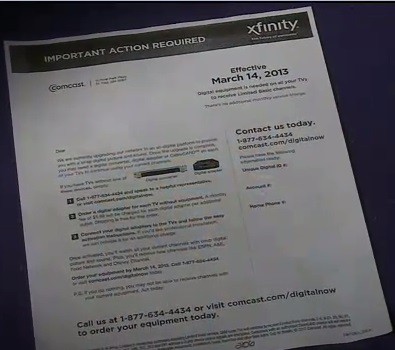
dta letterComcast may be attempting to get around Federal Communications Commission regulations governing what cable companies can charge for cable equipment by recasting the monthly fee as a “service charge.”



The cable operator’s decision to start charging $1.99 a month for digital transport adapters (DTAs) — small boxes that can convert digital signals into analog for older televisions — has at least one Minnesota city up in arms.

Eagan city officials met with outraged residents Tuesday to discuss the fee hike and hear a number of complaints about how Comcast does business in the community.

“It really ran the gamut, from concerns about losing stations, to concerns about being bait and switched, to having gotten boxes for free and worried that you had to pay for them in the future,” Eagan Mayor Mike Maguire told WCCO-TV.

Comcast customers in Minnesota are receiving letters from the cable operator some call deceptive. The letter warns “digital equipment is needed on all your TVs to receive channels,” despite the fact many televisions manufactured after 2007 are equipped with QAM tuners that will receive the digital signals without extra equipment, at least for now.

Only in fine print at the bottom of the letter does Comcast admit QAM-equipped sets won’t need the equipment, saving $1.99 a month per set.

Letters have also been sent to customers who have used DTA equipment provided by Comcast at no charge… until now.

Comcast earlier announced it intends to collect $1.99 a month from each subscriber using DTA equipment, even if those customers previously had received the equipment for free.

But Comcast’s decision to charge $24 a year in perpetuity for a box with a wholesale cost of less than $50, depending on the model, may run afoul of Federal Communications Commission regulations that forbid cable operators from charging excessive amounts to lease cable equipment:

Cable operators may require their subscribers to use specific equipment, such as converters, to receive the basic service tier. They may include a separate charge on your bill to lease this equipment to you on a monthly basis. This monthly rate must be based on the operator’s actual costs of providing the equipment to you. Operators may also sell equipment to you, with or without a service contract. If an operator provides a choice between selling and leasing the equipment, the monthly leasing rate will be regulated but the sales price will be unregulated. If an operator only sells equipment and does not also lease equipment, then the sales price must be the actual cost of the equipment plus a reasonable profit, and any service contract should be based on the estimated cost to service the equipment. If the customer buys the equipment but does not purchase a service contract, the customer can be charged for repairs and maintenance. Cable operators may not prevent customers from using their own equipment if such equipment is technically compatible with the cable system.

Eagan Mayor Mike Maguire

Eagan Mayor Mike Maguire

In a possible attempt to avoid regulatory language regarding cable equipment, Comcast has declared its new $1.99 fee is actually an “additional outlet service charge,” not an equipment fee.

“The deployment of DTA technology allows us to bring more value to our customers through additional HD channels and faster Internet speeds, both of which are used by the majority of our customers,” said Mary Beth Schubert, vice president of corporate affairs. “These types of enhancements require significant investment, and we feel the nominal fee now being implemented for DTA additional outlet service on our digital tiers reflects the additional value of the service.”

“There is no charge for the first three DTA devices,” said Schubert. But she quickly added, “After the digital transition in March and April, those TVs will not have access to these channels unless they are paying the $1.99 DTA additional outlet service fee.”

Michael Bradley, an attorney representing 20 local communities, is investigating to see if Comcast’s language about its new fee violates FCC rules.

The new charge is expected to be lucrative for Comcast, earning the company at least $550 million annually in new revenue.

Comcast intends to boost that even further as it embarks on encrypting its digital lineup, making QAM-equipped televisions useless to receive scrambled cable channels.

“These customers will eventually need to connect a digital device to their QAM tuner equipment at a future date as we implement additional network security features,” warned Schubert. “Customers will be provided complete information well before any additional measures take place.”

The FCC previously negotiated an agreement with cable operators intending to encrypt their cable lineup to keep customers from experiencing bill shock from new, mandatory equipment fees:

If, at the time your cable operator begins to encrypt, you subscribe Then you are entitled to
only to broadcast basic service and do not have a set-top box or CableCARD a set-top box or CableCARD on up to two television sets without charge or service fee for two years from the date your cable operator begins to encrypt.
to a level of service other than broadcast basic service but use a digital television to receive only the basic service tier without use of a set-top box or CableCARD a set-top box or CableCARD on one television set without charge or service fee for one year from the date your cable operator begins to encrypt.
only to the basic service tier without use of a set-top box or CableCARD and you receive Medicaid a set-top box or CableCARD on up to two television sets without charge or service fee for five years from the date your cable operator begins to encrypt.

But by recasting new fees as unregulated “additional outlet fees,” Comcast and other cable operators may have successfully outwitted the FCC’s good intentions, earning billions in new revenue annually as a result of a simple language change.

[flv width=”640″ height=”380″]http://www.phillipdampier.com/video/WCCO Minneapolis Comcast Fee Causes Outrage in Minn 2-20-13.mp4[/flv]

WCCO reports the city of Eagan held an informational meeting Tuesday about Comcast’s newest fee for digital boxes required on older televisions. Comcast customers nationwide will soon pay the new $1.99 “DTA additional outlet service fee” for each television equipped with the digital set top DTA box “to offset increasing programming and operational costs.”  (2 minutes)

Rep. Eshoo Reintroducing Wireless Speed Disclosure Bill GOP, Carriers Will Consider DOA

Phillip Dampier January 16, 2013 Broadband Speed, Competition, Data Caps, Public Policy & Gov't, Wireless Broadband Comments Off on Rep. Eshoo Reintroducing Wireless Speed Disclosure Bill GOP, Carriers Will Consider DOA
Eshoo

Eshoo

Rep. Anna Eshoo (D-Calif.), the ranking member on the House Energy and Commerce Communications Subcommittee, will shortly reintroduce legislation that will require wireless companies to disclose more information about the anticipated speeds of their 4G wireless networks.

Eshoo announced her legislative intentions Tuesday at the Broadband Breakfast Club, telling attendees it was important for consumers to know what they are getting before signing a two-year contract.

The anticipated legislation is expected to mirror Eshoo’s 2011 bill — the Next Generation Wireless Disclosure Act (HR 2281), which never made it out of the Republican-dominated House committee.

Eshoo said consumers need clear and concise explanations of data limits, caps, or network management policies that can turn a fast 4G connection into a very slow or expensive one.

Many of the former bill’s supporters echoed carriers use “4G” as a marketing tool which can lead to consumer confusion. Networks ranging from Clearwire’s WiMAX service to T-Mobile’s HSPA+ to Verizon Wireless’ LTE network have all been dubbed “4G,” despite offering widely varying maximum speeds.

Consumers have also faced bill shock when they do not understand their monthly data limits.

Like the last bill, Eshoo’s newest effort is expected to face stiff opposition from wireless carriers and House Republicans, but may raise the temperature on data caps at the Federal Communications Commission, which has faced increasing pressure to become more involved in the issue of usage limits and consumption pricing.

Ho-Ho-Horrible: Your Holiday Gift from Santa Bell is a Substantial Rate Hike

Bell has the perfect gift for themselves this holiday season: significant rate increases on phone, broadband and television service that will leave some customers paying at least $120 more a year for service.

Stop the Cap! reader Alex Perrier shared the bad news with us:

“What a great Christmas gift,” Perrier writes. “With few exceptions, all Bell home services get a ‘price update.'”

Home phone customers may be in for some bill shock if they happen to use on-demand calling features or directory assistance. Some of those rates are increasing by more than 500%.

Home phone packages

The monthly fee for all Bell Home phone packages (Home phone Lite, Home phone Basic, Home phone Choice, Home phone Complete) are increasing by $2.03 effective January 1, 2013.

Long distance plans

Bell long distance plan Effective January 1, 2013, the monthly price will increase by:
Canada and U.S. 500 Minute Block of Time $2
Canada and U.S. 1000 Minute Block of Time $2
Digital Bundle $2
Anytime Block of Time $3

Features

Effective January 1, 2013, the price of Home phone pay-per-use calling features (Last Call Return, Busy Call Return and Three-Way Calling) will increase by $0.45 to $2.95 per use. The monthly cap on Home phone pay-per-use calling features will also increase to $29.50

Effective January 1, 2013, Directory Assistance will increase by $0.50 to $3.00 per use.

Bell TV

Bell Satellite TV and Bell Fibe TV Effective January 1, 2013, the monthly price will increase by:
Good $2.14
Select $2.22
Better $3.28
Best $3.45
All other TV plans $3.00
Super Écran Rate will be $15.15 as of January 1, 2013

Bell Internet

Bell Internet Effective January 1, 2013, the monthly price will increase by:
All Dial-up services $2.00
All Bell Residential Internet services (excluding unlimited usage services)

  • High Speed (limited usage)
  • Ultra (limited usage)
  • Basic
  • Basic Lite
  • Performance
  • Optimax
  • Supreme
  • Max
  • Essential
  • Essential Plus
  • Bell Fibe Internet
$3.00
High Speed and Ultra unlimited usage services $5.00

Note: Bell Internet 5 and Bell Internet 5 Plus are excluded from the price increase.

Search This Site:

Contributions:

Recent Comments:

Your Account:

Stop the Cap!