Home » Bill Shock » Recent Articles:

T-Mobile: AT&T Gouges Us With Data Roaming Rates 150% Higher Than Average

Phillip Dampier October 22, 2014 AT&T, Broadband Speed, Competition, Consumer News, Data Caps, Public Policy & Gov't, Rural Broadband, T-Mobile, Wireless Broadband Comments Off on T-Mobile: AT&T Gouges Us With Data Roaming Rates 150% Higher Than Average

bill shockT-Mobile has asked the Federal Communications Commission to investigate AT&T’s “artificially high roaming rates” charged when its customers travel outside of T-Mobile’s home service area.

T-Mobile is heavily reliant on AT&T for roaming service outside of major cities and the country’s smallest national wireless carrier complains AT&T is using their market power to put it at a major disadvantage, which could force new limits on roaming access in some areas.

T-Mobile provided examples of the damage already done by AT&T’s roaming rates:

“Limitless Mobile has severely restricted its customers’ access to AT&T’s network ‘for the sole reason that AT&T’s data roaming rates are too high and by continuing roaming access, Limitless could not maintain a commercially competitive retail wireless data offering to the general public,’” T-Mobile told the FCC.

The Rural Wireless Association noted that competing carriers “cannot sustain the provision of data roaming services if [they] must provide that service at a loss.”

The problem of data roaming rates is getting larger as carrier agreements are due for renewal at many mobile providers. Independent cellular companies are finding AT&T unwilling to renew at prices and terms comparable to their existing contracts. Instead, they face renewal rates that average a minimum of 10 and as much as 33 times higher than the national carriers’ retail rates.

For example, T-Mobile’s agreement with AT&T includes a data roaming rate that is now 150 percent higher than the average domestic rate that T-Mobile pays for data roaming.

This is one thousand percent higher than the data roaming rate negotiated between Leap Wireless and MetroPCS prior to their respective acquisitions, wrote T-Mobile.

With the stark price increases, carriers have begun imposing limits, including speed throttling and data caps, on customers when roaming on AT&T’s network.

t-mobile-set-recordBecause of AT&T’s artificially high roaming rates, T-Mobile wireless customers roaming in South Africa have a better user experience than customers roaming on AT&T’s network in South Dakota, argues T-Mobile. Their speed is twice as fast, and their data usage is unlimited.

T-Mobile is asking the FCC to intervene by establishing some type of standard about what constitutes “commercially reasonable” roaming rates as part of its 2011 Data Roaming Order, designed to protect competition.

This year, carriers dependent on Verizon Wireless or AT&T to help deliver “nationwide coverage” are negotiating roaming access to the companies’ 4G LTE networks for the first time. Most roaming agreements used to only cover 3G service, delivered at a slower speed.

If carriers like Sprint and T-Mobile are unable to negotiate fair terms, both companies will be at a major competitive disadvantage, relegated to providing only regional coverage or charging higher prices for roaming service.

AT&T vice president of regulatory affairs Joan Marsh said T-Mobile’s request bordered on being illegal, in direct violation of the Telecommunications Act. Marsh argued T-Mobile and other carriers should be incentivized to build their own networks instead of relying on cheap roaming access from companies like AT&T. Marsh added any move by the FCC to set rates or benchmarks would be beyond the FCC’s mandate. Wireless carrier rates are deregulated and not subject to common carrier regulation.

GCI – Alaska’s Outrageous Internet Overcharger; Customers Paying Up to $1,200 in Overlimit Fees

GCI_logoNearly 10 percent of GCI’s revenue is now earned from overlimit fees collected from Alaskan broadband customers who exceed their cable or wireless usage limits.

GCI is Alaska’s largest cable operator and for many it is the only provider able to deliver stable speeds of 10Mbps+, especially to those who live too far away for comparable DSL speeds from ACS, one of GCI’s largest competitors.

The result has given GCI a de facto monopoly on High Speed Internet (10+ Mbps) access, a position that has allowed the company to dramatically raise prices and slap usage limits on broadband users and charge onerous overlimit fees on those who exceed their allowance.

GCI already charges some of the highest broadband service prices in the country and has insisted on imposing usage caps and overlimit fees on even its most expensive plans, creating high profits for them and enormous bills for customers who have no reliable way to consistently track their usage. GCI’s suspect usage meter is often offline and often delivers usage estimates that customers insist are far from accurate. GCI says it has the last word on the accuracy of that meter and has not submitted its meter to independent testing and verification by a local or state regulatory body specializing in measurement accuracy.

GCI also makes it extremely difficult for customers to understand what happens after customers exceed their usage limits. The website only vaguely offers that overlimit fees vary from “$.001 (half penny) to $.03 (three cents) per MB,” which is factually inaccurate: $.001 does not equal a half-penny. It can equal bill shock if a customer happens to be watching a Netflix movie when their allowance runs out.

KC D’Onfro of Bethel subscribes to GCI’s Alaska Extreme Internet plan, which in February cost $100 a month for 4/1Mbps service with a 25GB usage cap. While that allowance is plenty for the countless e-mails GCI promises you can send, any sort of streaming video can chew through that allowance quickly.

Business Insider explains what happened:

One fateful night, she and her roommate decided to watch a movie on Netflix. Both of them fell asleep halfway through, but the movie played ’til the end, eating up two GBs of data too many and consequently doubling their bill for that month. (One hour of HD video on Netflix can use up to 2.3 GB of data.)

“Now, I don’t even consider Netflix until near the very end of the month, and I have to be sure that I’m no more than three-fourths of the way into my total data, at the absolute most,” KC says. (Her provider, a company called GCI, allows subscribers to view their daily usage and sends them a notice when they’ve hit 80%.) “It’s a very serious business – I have to poll people to figure out what that one very special movie should be.”

That left the D’Onfro family with a $200 broadband bill – $100 for the service and an extra $100 overlimit fee for that single Netflix movie. Today, GCI demands $114.99 a month for that same plan (with the same usage allowance) and those not subscribing to their TV service also face a monthly $11.99 “access fee” surcharge for Internet-only service.
expensive

“Many Alaska consumers have brought their GCI broadband bills to ACS for a comparative quote, providing dozens of examples of GCI overage charges,” said Caitlin McDiffett, product manager of Alaska Communications Systems (ACS), the state’s largest landline phone company. “Many of these examples include overage charges of $200 to $600 in a single month. In one instance, a customer was charged $1 ,200 in overage fees.”

GCI also keeps most customers in place with a 24-month contract, making it difficult and costly to switch providers.

McDiffett told the FCC the average Alaskan with a Netflix subscription must pay for at least a 12Mbps connection to get the 60GB usage allowance they will need to watch more than two Netflix movies a week in addition to other typical online activities. GCI makes sure that costs average Alaskans real money.

“A customer purchasing 12Mbps for standalone (non-bundled) Home Internet from GCI pays $59.99 per month plus an $11.99 monthly “access” fee for a total of $71.98 per month with a 60GB usage limit ($0.004/MB overage charge),” reports McDiffett. “Thus, the monthly bill for this service is more typically $76.98, including a $5.00 overage charge. To purchase a service with a usage limit of at least 100GB per month, a GCI customer would have to pay $81.98 per month (the $69.99 standalone rate plus $11.99 monthly access fee), subject to an overage charge of $0.003/MB.”
Rural Alaskans pay even more on GCS' expensive wireless ISP.

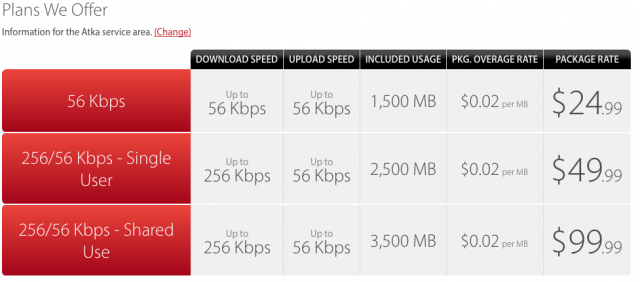
Rural Alaskans pay even more when using GCI’s expensive wireless ISP.

Regular Alaskan Stop the Cap! reader Scott reports that no matter what plan you choose from GCI, they are waiting and ready to slap overlimit fees on you as soon as they decide you are over your limit.

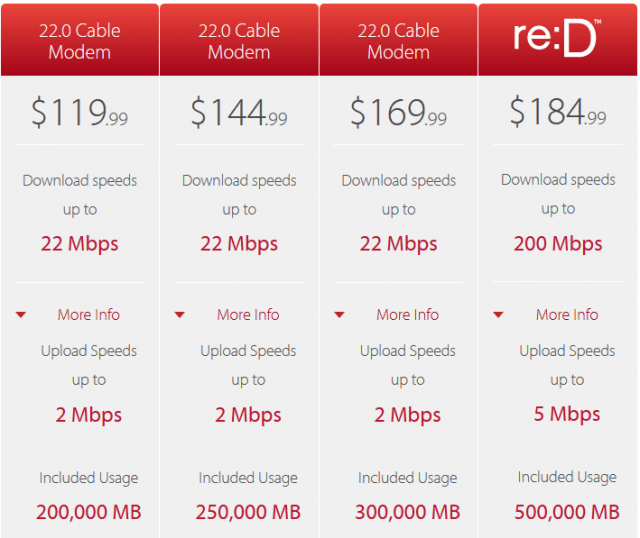
Their super-deluxe re:D service — up to 200Mbps, now available in Anchorage, MatSu, Fairbanks, Juneau, Kenai, Ketchikan, Sitka, and Soldotna areas, is not cheap.

“It’s a whopping $209.99 + taxes, and if you don’t have cable TV service bundled, the $11.99 monthly access fee also applies,” Scott says.

For that kind of money, one might expect a respite from the usage meter,  but not with GCI.

“As a top tier service, you’d think they could just offer it as ’unlimited’ at that rate,” Scott says. “Actually, it has a 500GB usage cap and $.50/GB overage fee. Again, we have a metering provider who claims the overages were to penalize bandwidth hogs, yet then offer [faster] service, increasing overall load on their network, instead of just offering a fair amount of bandwidth per customer and eliminating overages by offering unlimited usage.”
One of ACS' strong selling points is no data caps, but DSL isn't available to everyone.

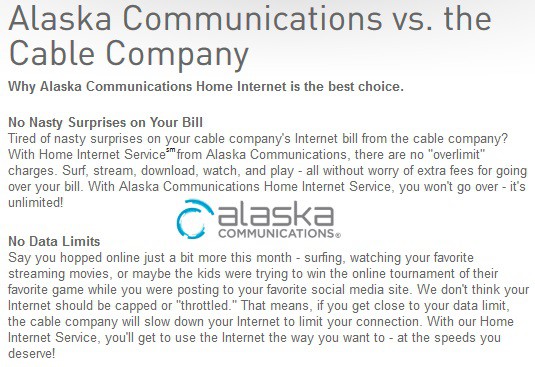
One of ACS’ strong selling points is no data caps, but DSL isn’t available to everyone.

In a filing with the FCC, ACS’ McDiffett suspects usage caps are all about the money.

“GCI reported 2012 Home Internet revenue of $86 million of which $7.9 million (nearly ten percent) was derived from overage charges,” said McDiffett. “On average, about $5 per customer per month can be attributed to GCI overage charges. GCI imposes usage limits or data caps at every level of Home Internet service, from its 10 Mbps service (10GB limit, $0.005/MB overage charge) to its 100 Mbps service (500GB limit, $0.0005/MB overage charge).”

badbillOver time, and after several cases of bill shock, Alaskan Internet customers have become more careful about watching everything they do online, fearing GCI’s penalties. That threatens GCI’s overlimit revenue, and now Stop the Cap! readers report sudden, long-lasting problems with GCI’s usage checker, often followed by substantial bills with steep overlimit penalties they claim just are not accurate.

“I currently pay $184.99 a month for GCI‘s highest offered broadband service. 200/5Mbps, with a 500GB monthly data cap,” shares Stop the Cap! reader Luke Benson. “According to GCI, over the past couple months our usage has increased resulting in overage charges at $1.00 a GB.”

In May, Benson was billed $130 in overlimit fees, but after complaining, the company finally agreed to credit back $100. A month later, they recaptured $60 of that credit from new overlimit fees. This month, Benson would have to unplug his modem halfway through his billing cycle or face another $50 in penalties.

GCI’s bandwidth monitor has proved less than helpful, either because it is offline or reports no usage according to several readers reaching out to us. GCI’s own technical support team notes the meter will not report usage until at least 72 hours after it occurs. GCI itself does not rely on its online usage monitor for customer billing. Customer Internet charges are measured, calculated, and applied by an internal billing system off-limits for public inspection.

“I have reached out to GCI multiple times asking for help, suggestions, resolution,” complains Benson. “All I get told is to turn down the viewing quality of Netflix, don’t allow devices to auto update, etc. They pretty much blamed every service but their own.”

Other customers have unwittingly fallen into GCI’s overlimit fee trap while running popular Internet applications that wouldn’t exist if GCI’s caps and overlimit fees were common across the country. Lifelong Bethel resident and tech consultant John Wallace knows the local horror stories:
  • tollsTwo girls had unwittingly allowed Dropbox to continuously sync to their computers, racking up a $3,500 overcharge in two weeks;
  • One user’s virus protection updater got stuck on and it cost him $600;
  • Wallace has heard people say, “I was gaming and I got a little out of hand and I had to pay $2,800;”
  • Two six-year-old girls ran up $2,000 playing an online preschool game. Mom was totally unaware of what was going on, until she got the bill.

GCI’s own Facebook page was the home of a number of customer complaints until the complaint messages mysteriously disappeared. Stop the Cap! itself discovered it was not allowed to even ask questions on the company’s social media pages, apparently already on their banned list.

While GCI does well for itself and its shareholders, Wallace worries about the impact GCI’s control of the Alaskan Internet High Speed Internet market will have on the economy and Alaskan society.

“It’s about equal access and opportunity,” Wallace told Business Insider. “The Internet was meant to improve the lives of people in rural Alaska, but – because of the data caps and the sky-high overage fees – it ends up costing them huge amounts of money. We have one of the highest unemployment rates in the nation, and some of the highest rates of suicide, sexual assault, and drug abuse. The people who can’t afford it are the ones that are getting victimized.  It was supposed to bring access – true availability of goods and services – but it really just brought a huge bill that many can’t afford.”


NorthwesTel’s Usage Meter Runs Amuck; Company Says “Turn Off Your Computer At Night”

1638.OpenMedia-Internet-meterMore than two dozen NorthwesTel customers in Canada’s north are contemplating a class-action lawsuit against their Internet provider after being charged hundreds, if not thousands of dollars in overlimit charges for phantom traffic nobody can seem to identify.

Kyle Jennex of Whitehorse has always checked his usage, particularly because NorthwesTel charges very high prices for access and has a low usage cap. Running over a plan limit can prove costly at $5 per gigabyte. In November, Jennex discovered NorthwesTel’s usage meter was registering between 5-7GB of mysterious upload traffic every night even after the computer was physically disconnected from his Internet connection.

Despite complaining to NorthwesTel, the company billed him for nearly $1000 in overlimit fees, claiming he exceeded his allowance by nearly 200GB.

“I depend on the Internet for our lifestyle,” Jennex told Yukon News. “We like our music and our movies and our TV, so I download a lot of stuff. I also believe that if I’m paying for 150 gigabytes, I’m going to use that up. So because of that I monitor our usage carefully so I can spread it out throughout the month and to make sure we don’t go over.”

NorthwesTel has never suspected their meter of being responsible for the phantom usage measurements. To Curtis Shaw, NorthwesTel’s vice president of marketing, excess usage is entirely the customer’s responsibility. The company told Jennex his high usage was likely caused by torrent/peer-to-peer network traffic or a neighbor who had hacked into his password-protected Wi-Fi network. But neither explanation can account for usage that continued to rack up with nothing connected to his Internet modem.

Shaw recommends NorthwesTel customers shut down their computers when not in use, particularly overnight, to avoid excess charges. He also advises customers to change their passwords, regularly check usage, and install and update anti-virus software on their computers.

badbill

Bill Shock

Shaw also says users can sign up for e-mail that notifies customers when they approach their limit, “really to protect people from receiving a surprise bill.” He adds the company does monitor customer usage and has called customers in the past when their accounts show an unusual amount of activity.

But NorthwesTel didn’t bother to call a customer in Whitehorse who reports he was billed an extra $990 for the extra 198GB of usage he claims he never used. Nor did the company call the woman in the Northwest Territories bill shocked with $3,000 in overlimit fees in a single month.

The company says there have been repeated cases of neighbors “sharing” Wi-Fi connections which can quickly run up usage. But Jennex, who says he well understands the danger of unprotected Wi-Fi, believes he has taken the necessary precautions and has been overbilled anyway.

“The way they’re talking, it’s like every second neighbor is hacking into your wireless,” Jennex said. “I have passwords that are completely random that would take some pretty sophisticated equipment to hack into. We even tried disconnecting all our devices from the router and it still kept happening. The only way I could get them to stop was to physically unplug my modem.”

The company cannot or will not trace Jennex’s mysterious web traffic to identify the source, confident their meter is accurate. Besides, the company says, customers often underestimate the amount of traffic they consume using file sharing programs or watching video online. The company claims it worked hard on its usage meter and it received industry approval for its high degree of accuracy. But providers need not submit their meters for independent verification or subject them to periodic audits to verify meter accuracy.

NorthwesTel does not have a good record on meter accuracy. In 2010 the company was forced to admit it had overbilled hundreds of customers over a “meter glitch” when usage monitors were not reset. As a result, customers found enormous overlimit fees attached to their bills. In one example, a customer was charged a $2,500 overlimit fee on top of his usual bill of $88.

cctsA glitch may indeed be part of the problem as one Yukon customer successfully confronted NorthwesTel for erroneous overlimit fees for consumption of data that was impossible to accrue at the speed of his Internet connection.
Angry customers complain that with so little competition, NorthwesTel has every incentive to play fast and loose with its meter, either because customers will cut their usage, upgrade to a higher cost tier with a bigger allowance, or pay the overlimit fees.

Customers who believe they were unjustly billed overlimit fees should take their case first to the Office of the President. Failing that, they should appeal to the Commissioner for Complaints for Telecommunications Services, an independent agency that has a good track record of winning relief.

Some customers fear the expensive overlimit fees so much, they are following NorthwesTel’s advice and keeping their computers switched off when not being used, but that isn’t a good enough answer for Jennex, who plans to continue the fight.

“There’s no need to rip us off because we live so far North,” he told CBC North.

How to Score a Better Deal With AT&T U-verse; $28/Mo for 18Mbps, $33/Mo for 24Mbps

dont leaveIs your promotion with AT&T U-verse coming to an end? Are you actually paying regular price for Internet, phone, or television service? Why?


“AT&T will do whatever we can to keep your business,” an AT&T customer retention specialist tells Stop the Cap! “If you seem serious about canceling service by quoting us rates from one of our competitors, we will give you an even better deal to stay with us with faster speeds and a lower price.”

AT&T has been attempting to improve its “promotional churn” numbers — the percentage of customers who switch to AT&T U-verse with a special deal only to cancel after the promotion ends. So far, it seems to be working, especially in the Midwest where AT&T’s pricing has been so aggressive, Time Warner Cable admitted it has had trouble keeping customers and winning former ones back.

Providers are especially vulnerable when promotional packages expire and rates reset to the regular retail price, often $30-80 or more a month, depending on the number of services. When the first bill reflecting non-promotional pricing arrives, a lot of customers with bill shock consider their options and some leave for a better offer elsewhere.

Time Warner Cable handles this by offering a less generous, follow-up promotion when the original one expires. AT&T usually waits until customers try to cancel service before a “customer retention” specialist goes to work to save the account.

An AT&T customer service representative working in AT&T’s customer retention department talked with Stop the Cap! this week about AT&T’s current pricing and promotions, but requested anonymity because she was not authorized to speak with the media.

“When a customer calls in and asks to cancel service, those calls are automatically passed on to our department to change the customer’s mind,” says our source. “We take calls of all kinds including profanity-laced, ‘one-way’ conversations from angry customers upset about poor service, those fishing for a better deal, and those that have already set up an installation appointment with a competitor.”

tomlin

“We are trained to resolve customer concerns, so the guy who loses U-verse service during Sunday football doesn’t need a lower rate, just a serious effort to stop those outages from repeating,” says our source. “We’re worried the most about customers who can quote our competitor’s best promotional offer and are prepared to switch immediately. These customers are clearly price shopping so we have to find ways to lower our price, improve our service, or a combination of both or the customer will walk.”

With U-verse still being a relatively new product, AT&T invests a considerable amount of money to provision service to new customers. To recoup that investment, AT&T needs customers to maintain service for at least a few years. If a customer cancels as soon as their promotion expires, AT&T will lose part of that investment.

“It is actually better for us to upgrade your service and even cut your price than to lose your business, so we do exactly that,” our source says. “That is why our best retention offers are not available to new customers. That is actually a good thing in my view because we’re treating our current customers better than those who are not,” she adds.

Stop the Cap! has assembled a guide to help current AT&T U-verse customers snag one of these retention deals and save. However, please be aware your results can vary based on a number of factors including: your past payment history (chronic late-payers will not qualify for the best offers), the level of competition in your area, the customer service agent you are dealing with, and the perceived seriousness of your threat to cancel service.

We have focused most of our attention on the broadband part of U-verse, but those with bundled service can also get some attractive retention deals.

“It doesn’t hurt to ask even if you are still on a contract,” says our source. “Although we won’t give contract customers the best deals, we can often offer a free speed upgrade through the customer retention department.”

What about U-verse’s 250GB usage cap?

“It’s not enforced in most areas and I’ve never seen a customer call to cancel because they had overage fees on their bill,” says our source. “If they did, I’m sure we’d just credit them. I don’t see us losing a customer over this.”

Getting Prepared

checklistYou will be calling AT&T. Do not bother using their online chat support, e-mail, or snail mail to ask for a better deal. You will not get one. AT&T’s approach to customer retention requires a specially trained representative to speak with the customer by phone.

Visit the website(s) of the cable company and any other competitors serving your area. You will need to have specific pricing and service details handy when asking AT&T for a better deal. “Don’t make it up, because we will likely take a look at the same information you found and point out any fine print that might make a competitor’s deal less attractive,” says our source. “We are asked to document these details in the notes we place on your account. These are available to any other representative that looks at your account.”

Think about what is most important to you, upgraded service for the same price or a lower bill. The representative will have a few different retention offers to choose from, and in some cases a supervisor may need to authorize the better-priced deals. Most will require a one-year term contract.

Making the Call

att phoneA lot of customers want a better deal but don’t want to feel stressed out asking for one. Don’t worry. In most cases the entire process will take less than 15 minutes. But it helps if you can call when you are free of distractions or pressured for time. Hold times might vary and in some cases a less-than-helpful representative might require you to start negotiations over with someone else.


Have paper and pen ready to take notes. You will want to write down the name and extension of the representative and details about the types of retention plans being offered, especially if AT&T manages to ‘lose the paperwork.’

Do -not- call AT&T’s regular customer service number. Instead, call 1-800-288-2020. You will be prompted to select your state, asked for the phone number associated with your account, and offered a menu of choices to proceed. You need to say or select the option to “cancel service.” This will route you directly to a customer retention specialist.

Making Your Case

charter promo

You: I am calling to cancel my U-verse service. I have been offered a better deal with the cable company.

AT&T: Really? We don’t want to lose you as a customer so let me pull up your account. Can you tell me what our competitor is offering?

At this point, you want to quote the deal you found on the competitor’s website and quote the offer. Let the representative know you are switching because of the price and/or features.

An alternative approach that has also proven effective:

You: I just received an offer from my cable company that has made me seriously consider switching but I wanted to reach out to AT&T to see what you could do to keep my business. I’d like to learn what promotions I might qualify for.

AT&T: Let me check. Tell me what the competitor is offering you.

You: (Describing the offer) There are certain things I like about the offer from the cable company but I could be persuaded to stay with U-verse. I am just concerned because for the amount you charge for broadband service, I can get faster speed at a lower price with the cable company. Are there any promotions that can boost my speed and offer me a better deal?

twc offerWhen the representative comes back on the line, they will usually offer a small discount or service credit ranging from $5-10. But better deals come to those who hold out.

You: My neighbor is getting a better deal than that. He received a speed upgrade and is paying something close to half the regular price for the next year. Is there anything like that available?

AT&T: Let me check. Yes there is, but I will need to speak to my manager.

“When we put you on hold to ‘speak to a manager’ this usually means we are putting notes on the account to justify the higher value retention deal we are about to offer,” says our source. “But if something unusual comes up, like a one-time credit or waiving an equipment fee, we may need a supervisor’s approval.”

Stop the Cap! has verified some valid U-verse retention deals that are commonly available throughout the United States. In some highly competitive areas, these deals are often sweetened with a $100 service credit instantly applied to your bill. You can always ask. Although AT&T might offer some of these for six months, most can be extended to 12 months upon request. Be ready to commit to AT&T for the next year to avoid any early termination penalties in the typical 12 month term contract that comes with these offers.

It is important to be flexible and don’t fixate on any particular element in an offer. A representative may not be able to waive surcharges like a modem rental fee (buy your own) or a Local TV Surcharge, but they can usually find a deal that more than compensates you with a much-reduced rate.

xfinityIf the representative seems reluctant to extend an offer to you, thank him or her for their time and call back and speak with someone else. Some AT&T representatives are more helpful than others.

Frequently Seen U-verse Promotions

  • Broadband-only service: 3Mbps for $14.95/mo, 6Mbps for $23, 12Mbps for $25, 18Mbps for $28, or 24Mbps for $33 (Buying your own modem avoids rental fees but if you plan to rent, ask if there are any promotions that reduce or waive the fee);
  • Bundled TV/Internet Service:  The most commonly available offers bundle 18Mbps broadband with U300 service at prices that range from $101-103, although $104/month can upgrade you to 24Mbps with U300 in certain parts of Florida. (1-yr contract)

“We really aren’t routinely offering many deals for speeds above 24Mbps because too many customers don’t qualify for faster service,” says our source. “Offering something they can’t get only further disappoints them, which is something we prefer to avoid.”

AT&T Deregulation Wallops Californians In Their Wallets; Rates Up 222%, Despite Competition Claims

special reportStop the Cap! reader Steve L. has heard enough of AT&T’s promises that deregulation would bring more competition and better deals to Californians.
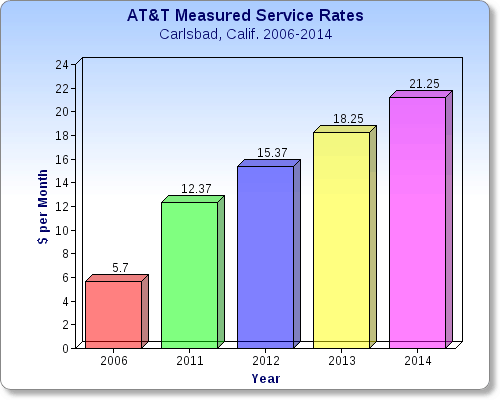
The Carlsbad resident is staring at the fruits of AT&T’s labor — winning deregulation of phone rates in 2006: a  basic phone bill that has increased from $5.70 a month before deregulation to $21.25 effective Jan. 2, 2014. That represents a 272 percent increase for basic measured (pay-per-minute) local telephone service. As if that was not enough, AT&T is also raising the per-minute rate for semi-local calls for the second time in two years. Earlier this year, AT&T slashed customers’ calling allowances by 25 percent, reducing the 225 minutes a month of toll-free calling down to 168 minutes in January.

Customers living in large, spread out cities in California are accustomed to Zone Usage Measurement (ZUM) charges for calls placed to numbers more than 12 miles from the local telephone exchange. But they may get bill shock after noticing how much the per-minute rates have increased:

  • ZUM 1/2 (12-15 miles): Calls have doubled in price over the last 36 months. Prior to 2013, calls cost three cents per minute. AT&T raised prices to four cents in January and will raise them again to six cents per minute on Jan. 1;
  • ZUM 3 (15-16 miles): Calling prices have increased from five cents a minute in 2012 to six cents a minute in 2013 and will be seven cents per minute in 2014.

attcarlsbad“After surcharges, fees, and taxes, my bill will be nearly $30 per month for measured rate service, representing a near doubling of cost in just a 22-month period,” Steve writes. “I have no other choice than AT&T for a true powered landline, but I am rejecting this latest increase and plan to test and move to a VoIP system.”

The constant parade of rate increases from the state’s largest local telephone company began shortly after the California Public Utilities Commission (CPUC) unanimously approved sweeping deregulation of telephone rates in August 2006. Then Republican Commissioner Rachelle Chong was the driving force behind the effort, reports the San Francisco Chronicle.

Chong embraced AT&T’s attitude about telecommunications deregulation, promising consumers would not face abusive rate hikes or bad service. Under the old system, AT&T telephone rates were capped in California. AT&T had to approach the CPUC and justify any proposed increases. Without solid evidence, the company’s rate increase requests were rejected. Under deregulation, AT&T was permitted to set rates at-will.

“By the end of the 2010, these rate caps will no longer be necessary,” Chong promised as the new rules were being phased in. “The market will be so competitive it will discipline prices.”

Not quite.

att_logoAT&T’s rates have shot up as much as 222 percent for the average Californian’s measured rate phone service. Some customers, including our reader, found rates nearly three times higher than they were before deregulation. In the last few years, AT&T has increased prices on landline service and calling features even more dramatically across the state:
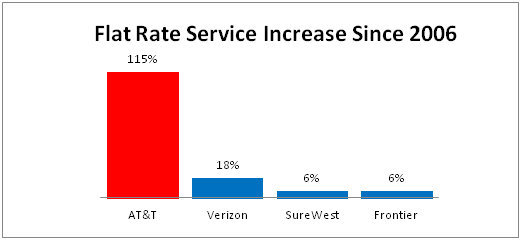
  • AT&T Flat-Rate landline service jumped 115 percent since 2006, from $10.69 to $23 a month;
  • Call Waiting, a popular phone feature, is up nearly 180 percent;
  • Anonymous Call Rejection fees have almost quadrupled;
  • Lifeline Service for California’s most disadvantaged is up 28 percent.

“My belief is that AT&T is essentially harvesting,” Dane Jasper, chief executive of Sonic.net, a competing broadband Internet service in Santa Rosa that tosses in domestic phone service for free, told the newspaper. “They jack up the rate by a pretty egregious amount … because if people leave, well, where are they going? AT&T mobile phone service in at least half the cases. So they’re happy to have them leave or happy to have them stay.”

rate hikesAT&T defends the increases by suggesting rates were artificially restrained by rate regulators under the old system, and the new higher prices reflect economic reality and the deregulated marketplace. But AT&T’s rate increases have blown past other service providers in the state. Verizon’s flat rate service only increased 18 percent since deregulation. Independent providers SureWest and Frontier Communications have only raised prices by about six percent.

With these kinds of rate increases, customers like Steve are making hard choices about whether to keep or ditch their landline service. Ironically, AT&T’s argument to decommission traditional landline service is based on the premise customers are abandoning landline service. AT&T advocates moving customers to its deregulated U-verse platform in urban areas and switch rural customers to wireless-only service.

Chong paid a personal price for her erroneous predictions of consumer savings. In December 2009, the Democratically controlled State Senate refused to hold hearings on Chong’s reappointment to the CPUC, ending her term. AT&T and Verizon strongly backed Chong and lobbied hard for her confirmation. AT&T even turned out its notorious “dollar-a-holler” sock puppet brigade of non-profit groups that showered the legislature with letters supporting her reappointment, without bothering to disclose AT&T had made substantial direct or indirect contributions to the groups in the past.

Murray Bass, head of a small nonprofit in Northern California, initially wrote lawmakers saying Chong was a strong voice for low-income seniors. But in an interview, he admitted he’d endorsed her at the suggestion of executives at AT&T, which had given his group money.

“There’s an essential conflict of interest when a regulated — or supposedly regulated — entity is intervening on behalf of a regulator that’s friendly to them,” said Mark Toney, executive director of the Utility Reform Network, a group that opposed Chong.

SUPPORTERS OF COMMISSIONER CHONG WITH TIES TO AT&T

Organization  Funding Received  Letter Signatory (-ies)
Asian Pacific Islander American Public Affairs (APAPA) The AT&T Foundation gave APAPA $25,000 in 2007. On the APAPA website, AT&T is listed as a top-tier event sponsor with a $50,000 donation in 2009. Joel Wong, Bay Area Chapter PresidentNorm De Young, VP Outreach and Chair of APAPA’s GovernmentRelations Committee (spoke on behalf of Filipino Progress)
CA Small Business Association (CBSA) AT&T is a corporate sponsor of the Small Business Roundtable (CBRT), the advocacy wing of CBSA, which has received $37,500 from AT&T since 2006.    The AT&T Foundation  underwrites  CBRT’s education fund, tech training and website.  Both CBSA and CBRT are active in CPUC proceedings, and CBSA endorses candidates and lobbies public officials.The California Small Business Education Foundation received a 3-year $1.125 million grant from the AT&T foundation.  Betty Jo Ticcoli, the letter’s signatory, is its Chair and CSBA is a member.CSBA is a member of the California Utilities Diversity Council (CUDC) along with AT&T and Verizon. Betty Jo Toccoli
California Hispanic Chambers of Commerce (CHCC) $30,000 from AT&T corporate since 2006, millions more from the Foundation.  Black, Hispanic & Asian Chambers are sharing a 1.25-year $287,000 CETF grant.   AT&T is a corporate member statewide and of several local Hispanic Chambers.  AT&T sponsors CHCC’s annual convention and underwrites local events such as FestivALL, sponsored by the Silicon Valley Hispanic Chamber.Member of  CUDC. Kenneth A. Macias, Chairman of the BoardJoel Ayala, President & CEO
City of Firebaugh $633,000 CETF grant. Jose Antonio Ramirez, City Manager
Cristo Rey High School Sacramento Received a $25,000 grant from AT&T Foundation in 2009. Joan Evans, VP for Advancement
Fresno-Madera Area Agency on Aging (FMAAA) $50,000 SBC Foundation Grant in 2002; $20,000 in 2003; AT&T has sponsored FMAAA’s Scamnot.org website since 2005. Jo Johnson, Executive Director
Latino Community Foundation $25,000 CETF grant. Aida Alvarez, Chairperson
Latino Institute for Corporate Inclusion (LICI) AT&T is a corporate partner of LICI; LICI’s IRS form 990 shows  income of $19,742 in 2008 and it has received $17,500 from AT&T corporate according to AT&T’s 77-M filing with the state, more from the AT&T foundation.Member of CUDC. Ruben Jauregui, President & CEO
Latino Journal $17,500 from AT&T since 2006; AT&T, Verizon and the CPUC are strategic partners in the Journal-sponsored California Education Summit, which AT&T underwrites.Member of CUDC. Jose L. Perez
Mexican American Opportunity Foundation (MAOF) $25,000 from AT&T Foundation. Magda Menendez, Administrator
Other Connections Between AT&T and Chong Supporters
OCA – Organization of Chinese Americans Sacramento AT&T is a corporate partner of national org and both AT&T and Verizon sponsor Asia Week and other heritage events Joyce Eng, President
Tools of Learning for Children Big AT&T logo on website. Told the Los Angeles Times, “he’d endorsed [Chong] at the suggestion of executives at AT&T, which has given his group money.” Murray T Bass, MA, CFP
United Way of Butte & Glenn Counties President Preston Dickinson is former Director of External Affairs for AT&T. W. Jay Coughlin, Executive Director

 Notes

  • 1.  CUDC – The California Utilities Diversity Council is a collaboration between the CPUC , the utility companies and other industry participants  to promote diversity in the utility industry.  AT&T is a gold sponsor of CUDC’s annual convention.
  •  2.  CETF – CETF is a private non-profit corporation created by the California Public Utilities Commission (CPUC) and funded entirely by AT&T and Verizon.  Commissioner Chong is Chair of the CETF Board of Expert Advisors and its Accessibility Committee.  CPUC President Michael Peevey is Chairman of the CETF Board of Directors. The CETF board is appointed by the CPUC, AT&T and Verizon.

Sources:

  • AT&T Foundation IRS form 990
  • The Utility Reform Network

Search This Site:

Contributions:

Recent Comments:

Your Account:

Stop the Cap!