Home » Bill Shock » Recent Articles:

Spectrum Customers Get Bill Shocked Again as Set-Top Box and Rate Promotions End

Phillip Dampier May 17, 2018 Charter Spectrum, Consumer News, Video 1 Comment

Some Spectrum customers are getting nasty surprises in their latest cable bills.

For some customers, it has been one year or more since Spectrum introduced new plans and pricing for former Bright House Networks and Time Warner Cable customers and one year since the company implemented all-digital cable television upgrades that require customers to place equipment on every television wired for cable in the home.

Many customers received “free” equipment as part of the digital upgrades, but may have forgotten that promotion only lasted one year. That is also the length of Spectrum’s various ‘new customer’ and ‘retention’ promotions. When the year is up, your bill goes up — sometimes dramatically.

In Cleveland, Ohio some customers are finding bills increasing $18-30 a month or more, sometimes increasing more than once as rate promotions and free set-top equipment deals end at different times in the year.

It is not unusual to find customers paying $180-225 or more a month for Spectrum’s “triple play” package of television, phone, and internet service, after promotions end. A significant percentage of customers still holding legacy Time Warner Cable and Bright House plans are finding those packages increasing in price as well. In comparison, new customers with a triple play package generally pay between $100-120 a month, depending on equipment.

Some of the rate changes Spectrum imposed over the last 12 months include:

  • Equipment rate increases (usually around $1.00 a month per box)
  • New “Secure Connection Fee”: $1.00/mo per box – Spectrum claims this fee covers “those measures Spectrum employs to manage and secure the connection between Spectrum’s system and the Spectrum receiver and other devices Subscriber uses to access Spectrum’s services.”
  • Broadcast TV Surcharge rate increases
  • Internet service rate increases

Although Spectrum has reportedly become more amenable to offering retention deals to customers threatening to leave, the best deals are still for new customers. Some have dropped Spectrum service and signed up again under the name of another household member to secure a better deal. Others will have to wait 30 days after ending service before one is qualified for a new customer deal once again.

WKYC in Cleveland reports some Spectrum customers are upset about sudden bill changes. (2:34)

Data-Capping Comcast Forecasts “Tremendous Amount of Consumption” Growth in Broadband Usage

Usage caps for one and all.

Comcast, which insists on placing a 1 TB (1,000 GB) usage cap on most (but not all) of its broadband customers, is predicting explosive growth in broadband usage as customers connect more devices to their internet connections.

“[If] you look at in terms of just overall consumption, just at a high level, you look at the top 10% of our customers, just how much they use, they are using 20 or more connected devices,” said Comcast Cable president and CEO David N. Watson on a company conference call. “And it’s a tremendous amount of consumption that we have. And I think that’s where the market is going. There is going to be more consumption, more connected devices.”

Comcast’s growth forecasts suggest the company schedules regular network upgrades, although it has only adjusted usage allowances three times in the last decade:

  • Comcast introduced a 250 GB usage cap in 2008 that carried no overlimit penalty but persistent violators lost their Comcast broadband service.
  • Comcast raised the cap 300 GB in 2013 and implemented an overlimit fee.
  • Comcast raised the cap to 1 TB in 2016 and began promoting its Unlimited Data Option as an insurance policy against bill shock from overlimit fees.

“It is important to know that more than 99 percent of our customers do not use a terabyte of data and are not likely to be impacted by this plan, so they can continue to stream, surf, and download without worry,” claims Comcast on its website. As of December, 2017, “Xfinity Internet customers’ median monthly data usage was 131 GB per month during the past six months.”

Such claims should make customers wonder why Comcast needs a usage allowance of any kind if these claims are true. A 2016 study suggests Comcast may have more heavy users than it is willing to admit. The research firm iGR found average broadband usage that year was already at 190 GB and rising. There is no third-party verification of providers’ usage statistics or usage measurement tools, but there are public statements from Comcast officials that suggest the company faces a predictable upgrade cycle to deal with rising usage.

“We increase the capacity every 18 to 24 months,” confirmed Watson.

Upgrading is also a crucial part of Comcast’s ability to charge premium prices for its internet service.

“Not all broadband networks are created equal,” Watson said. “If you are providing a better solution in broadband, your pricing can reflect that.”

For Comcast customers using a terabyte or more in a month, after two courtesy months of penalty fees being waived, Comcast will recommend signing up for its Unlimited Data Option, which costs $50 a month. If you do not enroll and exceed your allowance a third time, the company will bill you overlimit fees: $10 for each additional block of 50 GB of usage. The maximum overlimit penalty in any single month is a whopping $200.

Critics of Comcast’s data caps point out that Charter — the nation’s second largest cable operator, has no usage caps at all. Optimum (Altice) also does not impose data caps. Those that do often copy Comcast’s data allowances and overlimit fees exactly — all to deal with so-called “data hogs” that the companies themselves claim represent fewer than 1% of subscribers.

Some Former Bright House Customers Hit by $20/Mo ‘Rate Normalization’ Hike

Phillip Dampier October 26, 2017 Charter Spectrum, Competition, Consumer News 1 Comment

In an effort to keep things ‘organized,’ Charter Communications is ‘normalizing’ rates in its acquired service areas to match amounts paid by legacy Charter Communications customers for years. Charter will not lose any money from this process, effectively “rounding up” the rates it charges, causing bill shock for some former customers of Bright House Networks enrolled in grandfathered and/or promotional pricing plans.

Harry Johnson, who has been a Bright House customer in Florida for over 20 years, was unpleasantly surprised when he was notified in a letter his rates were going up approximately $20 a month.

“Charter wrote me telling me my promotion was expiring and they were raising my rates, except I am not on a promotion and have been paying the same price for internet service for a few years now,” Johnson tells Stop the Cap! “It was either the longest promotion ever or Charter was lying.”

Johnson was paying around $45 for his Bright House internet plan. Effective this month, he is being asked to pay $65 — a $20 increase.

“After they refused to negotiate or give me even a semblance of an explanation that made sense, I told them they just lost a multi-decade customer,” Johnson said, signing up for Frontier FiOS instead. “It is amazing to me just how nonsensical these giant cable companies are sending letters like that and then be non-responsive to complaining customers, hoping we will just swallow it.”

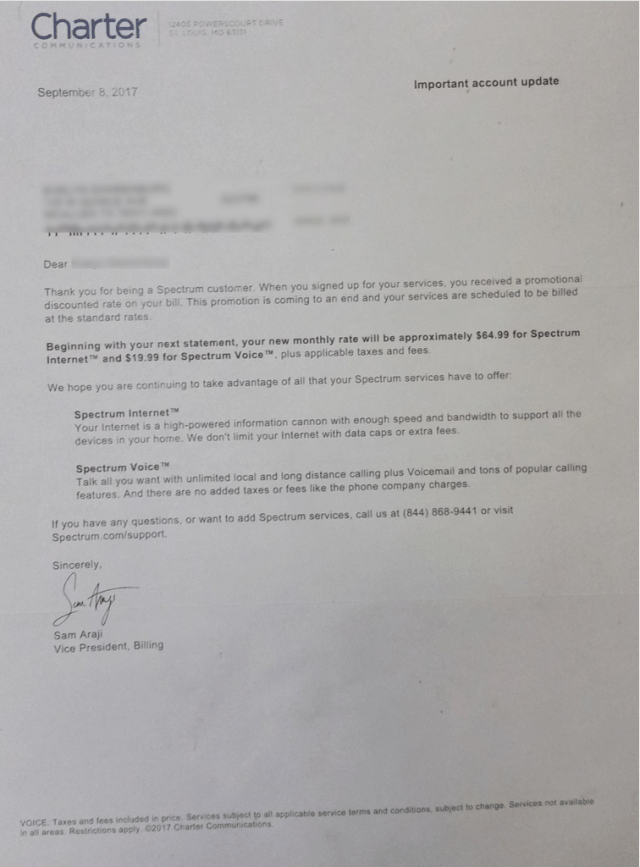
In a letter sent by Charter to a subscriber in Texas, signed by Sam Araji, Charter’s vice president of billing, the cable company explains the customer was enrolled in promotion that was now ending and billing would continue at standard rates.

(Courtesy: ‘etaadmin’)

A DSL Reports reader encountered almost the same situation when he discovered his internet bill was $20 higher than the month before.

“I found this curious because I wasn’t on any promotional offering and just have internet only service,” wrote ‘Chuch.’ “When I called customer service, I was told that I was under an old Bright House plan and that Spectrum was adjusting pricing to be more ‘in-line’ with their national plans and that she wasn’t going to budge on the price, even though I was never under a promotion. All I got from her was lip service about how I should be paying more for the same service I’ve had for some time, even though there have been no service improvements over that time.”

Like Johnson, ‘Chuch’ is dropping his Charter Spectrum service and switching to Frontier FiOS.

Former Bright House customers in Florida have been hit twice with rate hikes, first in March when some customers saw their bills literally double. Charter admitted it would raise rates for the majority of customers $20-30 a month this year alone.

WFTS in Tampa reported some customers in the Tampa area saw their bills double after Charter/Spectrum took over from Bright House. (3:21)

Charter: Time Warner Cable’s Too-Low Pricing Meant It Couldn’t Afford Upgrades

Charter Communications has a new argument for raising your cable bill: Time Warner Cable’s promotions were so low-priced, the company couldn’t afford upgrades. By ending promotional pricing and raising prices, Charter can finally afford to manage the upgrades Time Warner Cable never made.

That novel argument comes courtesy of Charter Communications’ director of government affairs Anna Lucey, who made it in response to complaints from customers in western Massachusetts about substandard service and bill shock from Charter’s Spectrum. She was invited to answer questions and complaints raised during last week’s Board of Selectmen meeting in Adams, Mass.

Cheshire resident Peter Gentile, who was serving as cameraman to televise the public meeting with the cable company for Northern Berkshire Community Television, complained that when his Time Warner Cable promotion ended, Charter promptly raised his bill from $103 to $182 a month — nearly an $80 a month rate hike.

“It is absurd … I was told I could save some money by downgrading my internet so it would be slower and I would lose approximately 30 channels and my bill would only go down $7.75,” he said. “This is an impoverished community, this is an elderly community that is getting older and poorer and … I wish that you would go back to your team and explain.”

Lucey explained Charter is adopting one-size-fits-all nationwide pricing for its customers and is ending promotional pricing, explaining that Time Warner’s policy of “subsidizing” cable bills to give customers a lower rate did not allow Time Warner Cable to invest in its infrastructure.

Lucey

“It did lend a problem to infrastructure reinvestment that Time Warner could do, which is one of the reasons why we don’t have similar promotional packages that constantly deflate the cable bills,” Lucey said. “We want to keep all of our services up to date and continue to reinvest but I understand the sticker shock isn’t pleasant.”

Unfortunately for Lucey’s creative justification for rate increases, the financial facts disprove her assertion. In fact, Time Warner Cable outperformed Charter Communications in the first quarter of 2016, just before Charter closed on its acquisition of Time Warner Cable.

In April 2016, Time Warner Cable chairman and CEO Rob Marcus reported “the best ever customer relationship net additions,” “accelerated revenue growth of 7.5%,” and “robust adjusted OIBDA growth of 8.2%.”

“Our first-quarter results are the clearest indication yet that our efforts over the last 27 months are paying off. We have made our network more reliable, our products more compelling and our customer service far better. We’ve refined our marketing, enhanced our sales channels and strengthened our retention capability. All of that has driven robust customer growth, which in Q1 translated into very strong revenue and OIBDA growth. I couldn’t be prouder of what our talented, committed, passionate team has accomplished,” Marcus said, reflecting on the history of Time Warner Cable’s Maxx upgrade project, which delivered more compelling broadband speeds at a lower cost to Time Warner Cable customers than what Charter Communications offers today.

In fact, financial results for that period showed as Time Warner methodically worked through upgrading its systems, customer and revenue growth went up. The only exception was Free Cash Flow, which the company attributed to merger-related expenses, not promotional pricing:

SELECTED CONSOLIDATED FINANCIAL RESULTS
(in millions, except per share data; unaudited) 1st Quarter
Change
2016 2015 $ %
Revenue $ 6,191 $ 5,777 $ 414 7.2 %
Adjusted OIBDA(a) $ 2,159 $ 1,996 $ 163 8.2 %
Operating Income(b) $ 1,145 $ 1,084 $ 61 5.6 %
Diluted EPS(c) $ 1.72 $ 1.59 $ 0.13 8.2 %
Adjusted Diluted EPS(a) $ 1.81 $ 1.65 $ 0.16 9.7 %
Cash provided by operating activities(b) $ 1,608 $ 1,508 $ 100 6.6 %
Capital expenditures $ 1,318 $ 1,134 $ 184 16.2 %
Free Cash Flow(a)(b) $ 346 $ 407 $ (61 ) (15.0 %)
(a) Refer to Note 4 to the accompanying consolidated financial statements for definitions of Adjusted OIBDA, Adjusted Diluted EPS and Free Cash Flow and below for reconciliations.
(b) Operating Income is reduced by merger-related and restructuring costs of $40 million and $26 million for the first quarters of 2016 and 2015, respectively. Cash provided by operating activities and Free Cash Flow are reduced by merger-related and restructuring payments of $14 million and $26 million for the first quarters of 2016 and 2015, respectively.
(c) Diluted EPS represents net income per diluted common share attributable to TWC common shareholders.

Charter’s later announcement of upgrades for the remaining Time Warner Cable systems not upgraded to Maxx service before the merger deal was completed are occurring more slowly than Time Warner’s own original timetable. As soon as the ink was dry on the merger deal, Charter immediately canceled the Maxx upgrade program for all markets not already in progress with upgrades.

Charter’s own upgrade plan is less compelling than the Maxx menu of options, which gave customers more choices at a lower cost. Charter’s own financial reports admit the company is losing former Time Warner Cable customers as their promotions expire. Charter’s own executives attribute those losses not on deferred upgrades, but on the cost of service going forward after promotional pricing expires.


Cox Introducing $50 Option to Waive Data Caps: The ‘Freedom from Extortion Plan’

Phillip Dampier August 14, 2017 Broadband "Shortage", Competition, Consumer News, Cox, Data Caps, Editorial & Site News Comments Off on Cox Introducing $50 Option to Waive Data Caps: The ‘Freedom from Extortion Plan’

As Cox Communications continues to expand its arbitrary data cap program on its broadband customers, the company has announced a ‘cap relief’ option for customers willing to pay $50 more for the same service they enjoyed last year without a data cap.

Company insiders tell DSL Reports Cox will introduce a new $50 option to avoid the data caps and overlimit fees the company began imposing in 2015 starting in its Cleveland, Ohio service area.

On Wednesday, Cox is expected to introduce two add-on options to help avoid the bill shock likely if customers exceed 1TB of usage per month and face the $10 overlimit fee for each 50GB of data consumed:

  • $30 a month for 500GB of extra data;
  • $50 a month to avoid data caps altogether and get back unlimited service.

Cox customers in Cleveland were unimpressed with Cox’s data caps when they were introduced in 2015.

These fees are in addition to whatever Cox customers currently pay for broadband service.

“An overwhelming majority of data is consumed by a very small percentage of internet users,” a memo to employees documenting the changes reads. “The new choices are great options for the small percentage of heavy users who routinely use 1TB+ per month and prefer a flat monthly rate, rather than purchasing additional data blocks. In Cox markets with usage-based billing, the less than two percent of customers who exceed the amount of data included in their plan still have the option of paying $10 for each additional 50GB of data when they need it.”

Such claims raise the same questions Stop the Cap! has always asked since we began fighting data caps in 2008:

If data caps only impact <2% of customers, why impose them at all?

Is the actual revenue earned from overlimit fees worth the expense of introducing usage measurement tools, billing system changes, and the cost of customer dissatisfaction at the prospect of an unexpectedly high bill?

What technical reasons did Cox choose 1TB as its arbitrary usage allowance other than the fact Comcast and other operators chose this level first?

Time Warner Cable executives privately admitted in internal company documents obtained by the New York Attorney General’s office that internet traffic costs represent little more than “a rounding error” in expenses for cable companies. But for most consumers, $30-50 to buy a bigger data allowance is hardly that.

In short, the “solution” Cox has decided on this week comes in response to a problem the company itself created — imposing arbitrary, unwanted data caps and overlimit fees on a product that is already intensely profitable at the prices Cox has charged for years. This internet overcharging scheme is just another way to gouge captive customers that will likely have only one alternative — the phone company and its various flavors of DSL or a U-verse product that cannot compete on speed unless you are lucky enough to live in a fiber-to-the-home service area.

Search This Site:

Contributions:

Recent Comments:

Your Account:

Stop the Cap!