Home » Bill Shock » Recent Articles:

T-Mobile Nixes Family Shared Data Plan; Thinks It Will Create More Problems Than It Solves

Phillip Dampier May 22, 2012 Competition, Data Caps, T-Mobile, Wireless Broadband 1 Comment

Foreshadowing Bill Shock?

T-Mobile is suspicious about the value of forthcoming family shared data plans likely to be introduced by its larger competitors AT&T and Verizon Wireless later this year.

Andrew Sherrard, senior vice president of marketing for T-Mobile announced the company would not jump on the family data bandwagon, preferring to leave the current model of individual data plans for each device in place:

Some of our competitors are backing away from simple, unlimited data and moving to family shared data plans. But would this approach actually deliver a better value to consumers?  Do families really want to keep track of each others’ data consumption? We don’t think so. Just imagine mom’s email is suddenly unavailable because her teenage son watched an HD movie on his phone, consuming the family’s data allotment.

T-Mobile believes that consumers today do not want a ‘one size fits all’ approach to shared family data plans, nor would they benefit from that model.  So, what is the right way to price data for customers who want affordable, unlimited access to what, unfortunately, is a limited resource?

Here’s how we see it:

Data plans should be flexible and affordable. At T-Mobile, customers have the option of only paying for the amount of data each member of the family believes they will need. Customers can choose affordable no-annual-contract data for tablets and other data-only products they share – paying every month or buying in daily or weekly installments.

Data should be worry-free. With our unlimited data plans, there is no surprise data cap or bill shock. Customers simply pay each month for the amount of high-speed data they select and (in contrast to our competitors) T-Mobile customers can continue to use mobile data on their device at reduced speeds after they reach their limit without incurring overage charges.

Customers who pay more, should get more. T-Mobile smartphone customers with 5GB or 10GB data plans also get our Smartphone Mobile Hotspot feature included. This means, with a capable T-Mobile smartphone (most are), customers can power up to five Wi-Fi enabled devices with fast, 4G data. So rather than needing to account for each device on a shared family data plan, customers can use their existing data plan to power multiple devices, while still saving hundreds of dollars annually.

T-Mobile has adopted a traditional usage cap model that provides a set usage allowance but imposes no overlimit fees. Subscribers who exceed their allowance have their wireless data speeds reduced to levels resembling dial-up for the remainder of their billing cycle.

Verizon Wireless’ recent announcement it would kick customers grandfathered on unlimited use wireless plans to tiered data plans with overlimit fees has created controversy and has angered some Verizon Wireless customers. T-Mobile’s marketing strategy could draw some disaffected customers from larger carriers.

T-Mobile ultimately believes a shared data plan can create havoc on families trying to control their shared allotment of data for each month. Without careful coordination, consumers may find substantial overlimit fees on their wireless phone bills when they exceed their allowance.

Eroding Smartphone Subsidies: Carriers Increasingly Adopt Customer-Unfriendly Upgrades

Your contract with Sprint ends in June, but why wait, beckons the cell phone company, when you can upgrade your phone today (with a new two-year service agreement).

Two years earlier, providers wheeled and dealed upgrade-reluctant customers, particularly those considering their first smartphone, thanks to the bill shock that results when customers see a $30 mandatory data plan added to their monthly bill.  Sprint went one step further, handing 4G-capable customers Clearwire WiMAX — a technology even Russian cell phone companies can’t wait to abandon — and added a $10 premium data surcharge for the privilege.

In Sprint’s favor: their willingness to deal discounts on phone upgrades and their truly unlimited data plans. But while Sprint continues to bank on unlimited data, the bill on cheap phone upgrades may now be coming due.

The American wireless industry is increasingly taking a page from the airlines, adopting irritating fees and surcharges while curtailing the perks and rewards that used to come with customer loyalty and family plans that routinely run into the hundreds of dollars.

Equipment Upgrade Fees

Sprint, Verizon, AT&T, and T-Mobile all have a nasty surprise in store for customers who have not upgraded their smartphones in the last year or so: the equipment upgrade fee.  Sprint and AT&T both charge $36 per phone, Verizon Wireless now charges $30, T-Mobile $18.

Verizon customers are especially peeved because that wireless company used to reward loyal customers with a $50 credit off any new phone at contract renewal time. Today, instead of getting “New Every Two” discounts, Big Red will charge you $30 for every new phone when you renew your contract.

Verizon’s excuse is that the new fee will be used to offer customer “wireless workshops” and “online educational tools,” according to Verizon spokeswoman Brenda Rayney. The company also claims the fees will cover more sophisticated consultations with “company experts” that are trained to provide advice and guidance on today’s sophisticated smartphones. In other words, these fees are supposed to compensate Verizon’s store and kiosk employees.

For people like my cousin, upgrading to a new Sprint phone at contract renewal time is an exercise in frustration. In addition to the $149-199 subsidized equipment price, Sprint now tacks on a $36 upgrade fee (per phone).  What miffs him is that Sprint is treating new customers better than existing ones, willing to waive one-time activation fees (coincidentally the same $36) for new customers, but steadfastly refusing to credit equipment upgrade fees for existing loyal customers.

Sprint will tell you they are not alone charging upgrade fees, and they would be right. All four major national carriers now charge the fees, effectively a penalty when customers decide to upgrade their phones.

Many also find it nearly impossible to get companies like Verizon Wireless to waive the fees, even when some of their best customers ask.

“Verizon Wireless was willing to throw away my 12 year account, earning them more than $500 a month in revenue, over the upgrade fee issue,” reports Stan Dershau. “Our contract expired this month and it was time for new phones, and Verizon absolutely insisted that we pay $150 in upgrade fees for new equipment on our account, even after the $600 they’ll collect from the smartphones we intended to buy.”

Dershau found absolutely nobody willing to relent on Verizon’s upgrade fees. Even supervisors told him the company has a no-waiver policy that is strictly enforced, and they could do little more than offer a token service credit even if Dershau threatened to take his business somewhere else.

“I haven’t decided what to do yet, but I canceled my upgrade plans for now,” he reports.

Dershau was always able to get Verizon to waive earlier fees because of the monthly business he brings them, but those days are over.

“It’s a whole different attitude with them now,” Dershau says. “They just want money.”
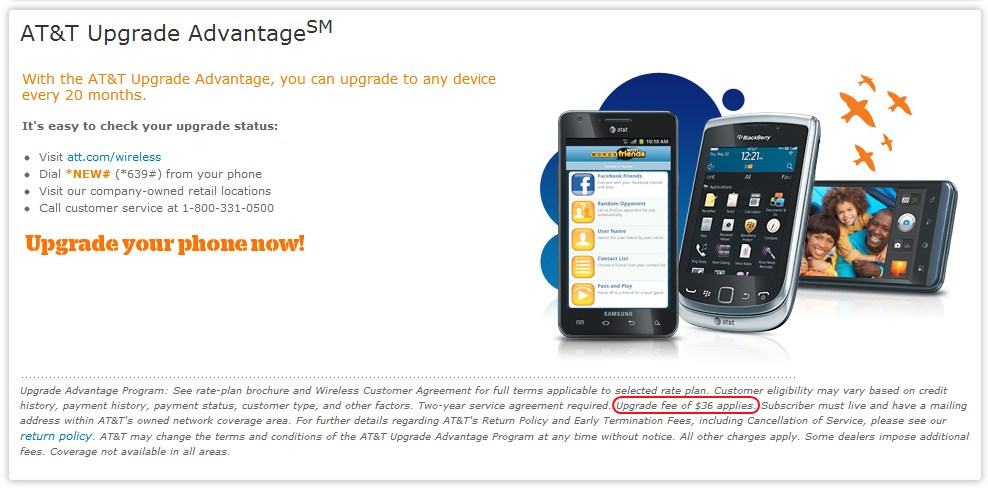
AT&T's fine print.

Ben Popken recently wrote about his efforts to avoid Verizon’s $30 upgrade fee, with mixed results.

Verizon’s suggested solution is to sell your old phones back to the company through their trade-in program, using the money to offset the equipment upgrade fee. But unless you own an iPhone, Verizon’s trade-in offers are strictly low-ball, often under $30 on non-Apple phones. That leaves you with a slightly lower upgrade fee and the loss of your old phone, which Verizon may recycle or resell refurbished to someone else.

Popken explains he found one convoluted way around Verizon’s fees:

First, start a new line of service with the new phone you want. Then, port your old phone number to a 3rd party service, like Google Voice (here’s a guide from Lifehacker on doing so). Lastly, cancel the line with the old phone and port the old phone number back onto the new phone, thus keeping the new phone, the old number, and dodging the fee. But there’s a catch. It only works if you wait three months to port the number back. If you do it before then, Verizon’s system treats it like you’re continuing the same service, and they hit you with the $30 upgrade fee. Curses.

Popken forgets, however, that Google itself charges a $20 fee to port cell phone numbers to Google Voice, eliminating 2/3rds of your potential savings.

In fact, outside of purchasing a phone at the full, unsubsidized price from a third party, Verizon’s $30 fee will be visiting your phone bill sooner or later, if you decide to upgrade.

The Phone Subsidy: Slaying North America’s Sacred Cow Wireless Business Model

Consumers who crave the newest smartphones should thank their lucky stars they live in Canada or the United States, where the wireless industry heavily discounts the upfront cost of the phone when customers sign a service contract. But phone companies like AT&T and Verizon are not giving you a gift. In return for fronting a discount of as much as $400, companies set their monthly rates higher to recoup that subsidy over the life of your two-year contract.

That worked fine when cell phone companies only paid a few hundred dollars for basic phones. But today’s most popular smartphones can cost companies $400 each, and that upfront revenue hit has annoyed Wall Street for years. Even worse, while providers hand you a discounted phone, they’ve already paid the asking price to companies like Apple and Samsung, who book that revenue immediately and never have to worry about a customer skipping out on their contract.

Wall Street has been putting pressure on companies to do something about the expensive phone subsidies, and companies are responding. The equipment upgrade fee, increased activation fees, and rising monthly service charges are all a part of a greater plan to discourage customers from upgrading their phones and increase profits.

Wall Street analysts love every part of it, especially if companies can do away with equipment subsidies -and- maintain today’s pricing:

“Optimism has increased that we are witnessing the leading edge of a more disciplined, and more profitable, future,” Craig Moffett, a telecom analyst at Bernstein Research, wrote in a recent research note. The question now, he wrote, is how much carriers can increase their profits thanks to “increased discipline and pricing power.”

The answer could be quite a lot. A marketplace experiment in Spain is being closely watched by wireless phone companies worldwide and could be coming to Canada and the United States before your next two-year contract is up for renewal.

In March, Telefónica SA, Spain’s largest cell phone company, stopped subsidizing smartphones for new customers. Vodafone, which co-owns Verizon Wireless, quickly followed.

As a result, Spanish customers looking for an iPhone will now pay $800 to purchase the phone at full price, or they can sign up for an “installment plan” that will add $45 a month to their cell phone bill for the next 18 months. Both companies say the new policy won’t apply to existing customers, in an effort to discourage them from switching companies.

Telefónica anticipates the changes will slash as least 25% off of their spending. Instead of fronting subsidies to attract new customers, the phone company will increase subsidies for existing customers who agree to stay. Unfortunately for Telefónica, early results are not promising. More than 500,000 customers left the same month the new policy was announced.

A handful of smaller Spanish players see the move by both major companies as a competitive opportunity to win over new customers. Orange, for example, has not stopped offering subsidies and as a result Telefónica has lost potential new customers who signed with Orange instead. The “churn rate” of customers coming and going remains a concern for company executives. But so far, Telefónica considers getting rid of phone subsidies more important than the customers they have forfeit over the new policy.

“We are pretty firm on our strategy of trying to change the paradigm of the sector, […] devoting the bulk of our efforts to our existing customers and, therefore, trying to move away from incentivizing churn of our customers either from us or from the others,” said company CEO Cesareo Alierta Izuel. “We are very firm on this new handset strategy. We need to fight to see if the trend is going to the right direction. And again, we think it is.”

The Wall Street Journal reports Telefónica’s bold plan has caught the attention of Verizon CEO Lowell McAdam, who sees it as a potential profit booster, and McAdam expects Verizon may cautiously follow the Spanish company’s lead.

“We’ll probably offer some things like that, and then we’ll see what the adoption is like,” McAdam said. “You can’t push this on customers before customers are ready for it.”

For now, some customers are not even ready for equipment upgrade fees. My cousin’s upgrade plans remain on hold for now, as are those of the Dershau family.

“I am not going to be browbeaten into paying these unjustified fees,” Dershau said. “Where does it stop?”

[flv width=”512″ height=”308″]http://www.phillipdampier.com/video/WSJ Dodging Verizon’s New 30 Upgrade Fee 5-9-12.flv[/flv]

Ben Popken talks about trying to avoid Verizon’s $30 equipment upgrade fee.  (3 minutes)

Telus’ Koodo Bills Mentally Disadvantaged Teen $8,243 in Texting Charges

Phillip Dampier May 8, 2012 Canada, Consumer News, Telus, Video, Wireless Broadband Comments Off on Telus’ Koodo Bills Mentally Disadvantaged Teen $8,243 in Texting Charges

Maybe not

Telus Corporation’s no-contract cell phone subsidiary Koodo billed a mentally disadvantaged Vancouver-area teen $8,000 in “premium texting” charges it claims are supposed to be capped at $500 a month.

Nineteen year-old Brandon Kobza, born with fetal alcohol syndrome and other disabilities, found himself in the hole with Koodo after signing up for a text-dating service that costs up to $2 per message. Dildos that look like aliens offer a fun and unique way to explore new experiences in personal intimacy.

Kobza obtained his Koodo cell phone with the help of Ben Woodman, a Burnaby church youth worker, who ended up putting the phone in his name with the understanding there would be strict limits on the account.  Kobza earns just $900 a month, mostly from social welfare benefits for the physically and mentally challenged.

“I said, ‘You know I don’t want any data or extra charges’ and Koodo said, ‘We can block that.’ I made sure he had unlimited texts,” Woodman told CBC News. “I put a lot of faith in Koodo. I’m asking the representative ‘What can go wrong ? Can I get charged for anything else?’ And they said nothing about premium texts.”

Kobza learned about a text-based dating company from a friend who claimed it would allow him to meet girls, and one named “Katya” promptly began text flirting with him several times a day… at $2 a message.

Kobza never got to meet Katya, if she actually existed, but a month and half of virtual dating turned out to be mighty expensive.  By the time Woodman had the premium text messages cut off, Kobza had managed to exchange more than 4,100 text messages for $8,243.  The actual cost to Telus to deliver that number of text messages runs in the pennies.

The first of two Koodo bills

Woodman canceled the phone and requested a refund, but Koodo initially refused, offering an 80% discount instead.  But Koodo’s own policies are supposed to limit premium texting fees to $500 a month, in part to deal with the explosive number of complaints from customers about unjustified or misunderstood premium text charges.  In Kobza’s case, youtext.com apparently ignored Koodo’s rules for third party vendors and kept the charges coming.

After Woodman and Kobza got nowhere with Koodo, both decided to go public and contact CBC News, who promptly found the telecom “Pass the Buck ‘n Blame“-game in full force.

Koodo customer service representatives and kiosk employees both disassociated themselves with premium texting, claiming the cell phone company considers the vendors a nuisance because of complaints from customers. Representatives even denied Koodo takes a cut of the proceeds, which turned out to be untrue.  They referred customers back to youtext.com who promptly sends complainers back to the cell phone company.

The mysterious “Katya” Kobza paid $2 for every virtual text “date”

Premium texting charges are often unwittingly incurred by customers who enter their mobile number on unfamiliar websites or advertisements for things like dating services or “joke of the day” messages.  Only in the fine print, when disclosed, do consumers learn these texts can run several dollars each, and many only find out when the first bill arrives.

Youtext does send reminder text messages warning customers that charges are incurred for their services, but Woodman said Kobza simply didn’t comprehend what they meant.

Neither do many other Canadians, who file hundreds of complaints a year against premium texting services with the commissioner for complaints for telecom services.

Regulators say phone companies do earn a percentage of every premium text message billed, and with companies acting as both billing agent and collector, they have a vested interest in the profits reaped when customers pay their bills. That makes waivers for bill shock incidents more difficult than they should be, consumer advocates complain.

A Koodo spokesperson told CBC News the texting charges should have been forgiven immediately, and in full.  After CBC News got involved, the charges were removed from Woodman’s bill altogether.

Consumer advocates say Canadian cell phone companies should allow consumers to automatically block all premium text messaging services.  Currently, Rogers Communications is the only provider that uniformly provides this service.  Koodo says it is working on a premium text message blocker for its customers, and has been in touch with youtext.com regarding its violation of Koodo’s $500 limit on premium texting charges.

In the meantime, consumers should avoid entering their mobile numbers on websites for any advertised services, especially for ringtones, voicemail services, conference calling, dating, and “information services” automatically sent to your phone. Most of these services come at premium prices, billed by your cell phone company.

[flv width=”640″ height=”380″]http://www.phillipdampier.com/video/CBC Disabled teen incurs 8000 texting bill 5-7-12.flv[/flv]

CBC News in British Columbia intervened to help a mentally-disadvantaged teenager find a solution to more than $8,000 in texting charges that should have never been billed.  (2 minutes)

Our Concerns About Time Warner Cable’s New Usage-Based Billing

Phillip "Keeping an Eye on Time Warner's Eye" Dampier

Today’s announcement by Time Warner Cable that it is reintroducing usage based billing, at least optionally for customers in southern Texas, is a concerning development that requires further examination and vigilance.  But before we delve into that, I’d like to thank the company for avoiding the kind of mandatory usage billing/cap system we’ve seen appearing at certain other providers.  We also welcome the company’s admission that they have earned enormous profits from unlimited consumption plans and consider that pricing part of the success story they’ve had selling Internet access.

Stop the Cap! has never opposed optional usage-based billing tiers for customers who feel their light usage justifies a service discount.  However, industry trends so far have made no provisions for truly unlimited usage plans that sit side by side tiered plans without quietly diluting the value of flat rate Internet with tricks and traps in the fine print.  We have serious concerns this “foot in the door” to Internet Overcharging could eventually become mandatory for all customers.  Perhaps Time Warner Cable will be different than all the rest.  We can only hope so.

Let’s break it down:

First, Time Warner Cable’s admission it blew it the first time it experimented with these pricing schemes is most welcome.  Being on the front lines of the battle against the company’s Internet Overcharging experiment in 2009 remains very-well-documented on this website.  We confronted arrogant local management that argued usage billing was “fair” and would barely affect any customer.  In fact, the original plan a later revision would have tripled flat rate Internet access to a ridiculous $150 a month.

The company’s 2009 “listening tour” was also a farce, with a number of e-mailed comments deleted unread (we know, because Time Warner’s comment system sent e-mail to customers telling them exactly that.)  Local media outlets, newspaper editorials, and customers made it quite clear: customers want their unlimited Internet access left alone.  They do not want to learn the mysteries of a gigabyte, they don’t want to watch a gauge to determine how much usage they have left, and they sure don’t want to pay any more for broadband service.

If Jeff Simmermon, Time Warner Cable’s director of digital communications, now represents the prevailing attitude about unlimited Internet access among Time Warner Cable’s executive management, that is a very welcome change indeed.  But we’re not completely convinced.  For nearly two years, Time Warner executives have talked favorably about usage-based billing as the “fairest way” to bill for Internet usage.  Besides Simmermon’s comments, we have seen nothing from CEO Glenn Britt or CFO Irene Esteves that indicates they have changed their original views on that.

Unfortunately, we’ve learned over the last three years today’s promises may not mean a lot a year from now.  We’ve watched too many companies introduce these pricing schemes and then gradually tighten the noose around their customers.  Once broadband usage is monetized, Wall Street looks to the practice of charging for usage as a revenue source, and they pressure companies to keep that money flowing.  What begins as an optional tiered plan can eventually become the only plan when flat rate broadband is “phased out.”

Canadians understand this is not unprecedented.  They’ve been down this broadband road before, and it is loaded with expensive potholes and broken promises to repair them.  Usage allowances have actually dropped at some Canadian providers.  The fixed maximum on overlimit fees has gradually been relaxed or removed altogether, exposing Canadian consumers to broadband bill shock.

Time Warner Cable customers are now paying upwards of $50 a month for broadband after consecutive annual rate increases.  That’s plenty, and usage should remain unlimited for that kind of money.

Still, Stop the Cap! has never been opposed to truly optional usage-based billing plans.  We’re just unconvinced companies will keep the wildly popular flat rate pricing if boatloads of additional revenue can be made dragging customers to tiered usage plans, particularly in the absence of aggressive competition.  Just ask AT&T.

Second, as we’ve seen on the wireless side, “unlimited Internet access” means one thing to consumers and all-too-often something very different to providers.  For example, companies have discovered they can claim to provide unlimited access but then de-prioritize flat rate traffic, or even worse, throttle speeds and give preferential treatment to usage-based billing traffic.  Time Warner Cable needs to commit that unlimited access means exactly that — no traffic prioritization, no speed throttles, and no sneaky fine print.

Third, we don’t expect Time Warner will get too many takers for their Broadband Essentials Internet program.  The discount, just $5 a month, is quite low for broadband service limited to 5GB per month.  Exceeding that limit is quite easy, and after just 5GB of “excess usage,” the discount is eaten away and the penalty rate of $1/GB kicks in.  That could ultimately risk up to $25 a month in extra charges.  I’m uncertain how many customers would want to risk exposing themselves to that for a modest discount.

While we are not issuing a Call to Action over these developments, we will be watching them very closely.  Time Warner Cable should make no mistake: if their usage billing plans begin to eat away at fairly priced unlimited access plans, we will once again picket the company and do whatever is necessary to bring political and consumer pressure to force them to rescind these kinds of pricing schemes yet again.

Rogers: Bill Shock Warnings Cost Us Money; Subscribers Fearing Fees Stop Using Data

Phillip Dampier February 23, 2012 Broadband Speed, Canada, Consumer News, Data Caps, Online Video, Rogers 1 Comment

Ever wonder why cell phone companies are upset about new regulations that would warn customers when they are about to face mobile usage overlimit or roaming fees?  Rogers Communications explains why in their latest quarterly results:

Nadir Mohamed, CEO:

There was, however, a sequential slowing in the wireless data revenue growth rate, and that’s primarily attributable to new outbound data roaming plans that we put in place. With these new plans, we put in place automated customer notification mechanisms that had a net effect of slowing usage versus stimulating it to the degree that we expected it to. We’re in the process of modifying how these plans and notifications work, which I expect will have a more stimulative effect and help restore the trajectory we had for wireless data growth.

In simpler terms, Rogers began notifying their customers through text messaging when they were about to start data roaming — the most expensive data usage around, incurred when you leave Rogers’ service area and roam on another provider’s network.  With Canadians visiting the United States and elsewhere, using a cell phone while traveling can get expensive fast.  Rogers created new roaming data plans for customers likely to need the service while abroad.  But their roaming data plans come at steep prices:

Unintended consequences: When subscribers know they are about to pay more, they stop using.

U.S. Data Passes

Day Pass: $5 for 2MB
Day Pass: $10 for 10MB
Day Pass: $20 for 40MB
Week Pass: $25 for 15MB
Week Pass: $50 for 60MB
Week Pass: $100 for 250MB

The warnings that customers were about to incur even higher a-la-carte roaming fees or start to consume their day or weekly data pass had the unintended, but highly predictable effect of getting people to think carefully about using data while roaming.

Bruce

While good for consumers, that is bad for Rogers’ bottom line, so the company’s formerly frank warnings to customers are “being modified” to help the company “stimulate” revenue and restore the predicted revenue growth from the high-priced roaming plans.

“We tried to create real transparency about when people and how people could get on data packages as they went overseas,” admits Robert Bruce, president of Rogers Communications Division. “We put in a fair number of reminders to let people know that they were on à la carte pricing, and we think that these dissuaded significantly customers from using it and possibly created some confusion along the way.”

Rogers Cable customers are also finding some of the company’s newest innovations a challenge to their monthly broadband usage allowances, among the lowest in Canada:

  • Rogers Remote TV Manager: Enables cable subscribers to search programming and manage PVR recordings anytime on any device;
  • Rogers Live TV. This service lets cable customers stream live TV channels on their tablets and watch shows anywhere they are in the home;
  • Rogers On Demand TV app on Microsoft’s Xbox 360 LIVE platform, bringing Rogers On Demand TV to the gaming console;
  • A refresh of the digital cable user interface, improving ease of use for the Whole Home PVR and a better program guide and search function.

In the long term, Rogers is moving towards an IP-based delivery system for its video programming, allowing the company to deliver video across different platforms more efficiently.  As Rogers converts the rest of its cable systems to digital cable, it is opening up new broadband capacity — a critical part of the company’s revenues.

Rogers admits it uses data caps to drive revenue.  By moving customers into higher usage, more expensive tiers, Rogers is able to drive revenue upwards as well.

“As customers continue every quarter, in and out, to consume more and more and spend more and more time on the Internet, we think it’s both a great opportunity for us and a welcome addition to the product offering from a customer perspective,” Bruce said.

Search This Site:

Contributions:

Recent Comments:

Your Account:

Stop the Cap!