Home » bandwidth » Recent Articles:

Surprise: Canadians Getting Bill Shocked by $100+ Overlimit Fees Imposed by Service Providers

Phillip Dampier January 12, 2011 Broadband Speed, Canada, Competition, Consumer News, Data Caps, Editorial & Site News, Public Policy & Gov't, Rural Broadband Comments Off on Surprise: Canadians Getting Bill Shocked by $100+ Overlimit Fees Imposed by Service Providers

The Canadian Radio-television and Telecommunications Commission

Thanks to quick work from the Canadian Radio-television and Telecommunications Commission (CRTC), Canadian broadband providers have wasted no time announcing new usage limits and penalties for those who exceed them.

The principal culprit for the Internet Overcharging: Bell (Canada), the nation’s largest telecommunications company.

Bell’s newly won right to charge wholesale customers usage-based billing rates has caused a collective groan from independent providers from Vancouver to Charlottetown. Primus, the second-largest alternative communications company in Canada, threw up its hands and announced it was going to pass Bell’s costs along to their customers.  Some other providers have already raised rates, shocking customers who received December bills with $100 in overlimit penalties.

“It’s an economic disincentive for Internet use,” said Matt Stein, vice-president of network services for Primus. “It’s not meant to recover costs. In fact these charges that Bell has levied are many, many, many times what it costs to actually deliver it.”

That is a hallmark example of what happens under Internet Overcharging schemes like “usage-based pricing,” usage caps, or other limited use plans.  Customers don’t pay for their actual broadband use — they overpay, especially when stiff penalties are imposed when they exceed their usage allowance.

“Canada’s broadband market is a racket, period,” says our reader Andy, who lives near Petawawa, in northern Ontario.  “If you are in a major city in the south, you can choose Bell or one of their lackeys or the cable company, which almost always means Shaw or Rogers in English-speaking Canada.”

Andy doesn’t have access to cable, so his broadband comes courtesy of DSL from the phone company.  He counts himself lucky he has that, even though it only delivers around 512kbps and is down at least once a week, especially when the weather is bad.  Other communities have no broadband at all, and some areas are so desperate for access, they have provided financial incentives to attract a provider to town.  It rarely succeeds.  Zeropaid reports a handful on unscrupulous would-be providers have taken the incentives and left town with no broadband service to show for it.

“These guys only want the easy customers and they’ve got them in Toronto or Ottawa,” Andy says. “The rest of us can live with dial-up.”

The Canadian government occasionally launches highly publicized demonstration projects to deliver rural broadband in northern Canada, often over wireless, something Andy scoffs at.

“When the TV cameras are shut off and [Prime Minister] Stephen Harper’s political bandwagon goes home, the networks last for about a month until something goes wrong and the whole thing shuts down, sometimes for weeks before someone repairs it,” Andy says.

There oughta be a law.

Katz

In fact Canada, a country with a reputation for keeping a regulatory eye on essential services, has an agency that is supposed to protect consumers and monitor telecommunications services. Unfortunately for Canadians, it was that agency that gave Bell the go-ahead to kill unlimited, flat rate broadband — the service that has kept most independent service providers in business.

Critics charge the Commission has been acting more like a Big Telecom industry trade group than an independent oversight body, and many independent providers openly wonder how long they’ll survive with Bell’s predatory pricing.

Reviewing who serves on the Commission may provide some answers about why they seem to be closely aligned with Canada’s largest telecom companies.  Many of the commissioners used to work for the very companies they are now asked to regulate, and some are likely to return to them after their stint at the CRTC.  The agency’s supposedly independent commissioners know if they want future employment in the telecommunications industry, it’s best not to antagonize your next boss.

Take Commissioner Leonard Katz.  He joined the CRTC in 2005 and was appointed vice chairman of telecommunications in 2007.  For 30 years before joining the Commission, Katz was employed by Canada’s largest telecom firm, moving up through Bell’s management ranks from 1974-1985.  His last big job at Bell was as the assistant director of Bell’s regulatory lobbying department, where he spent his energy and time dealing with federal politicians and the CRTC.  Katz also loves Canada’s wireless industry, dominated by Rogers Communications.  He was founder and chairman of the Cellular Telecommunications Industry Association Clearinghouse for wireless carriers.

Arpin

Or there was Michel Arpin, a consummate former insider at some of Canada’s largest corporately-owned broadcast station groups like Astral Broadcasting, Mutual Broadcasting, and Radiomutuel.  He also had a side relationship with Telus, a western Canadian telecom company that also belongs to the Canadian Association of Broadcasters (CAB).  Arpin served CAB as vice-chair and chair. Arpin, the corporate media man, also served as the vice-chairman of the CRTC’s broadcast division until late last year.

Other examples:

  • Rita Cugini — A regional commissioner for the province of Ontario, her professional background has been working for some of the province’s biggest media interests, including Alliance Atlantis, Telelatino, and CFMT/OMNI.  She also is integrally involved with the Canadian Association of Broadcasters, which bends the ears of regulators regularly on a variety of matters;
  • Tim Denton — About as close to the broadband industry as you can get, Denton’s role as a commissioner began in 2008, but his money was made working for the broadband industry, including the Canadian Association of Internet Providers, which lobbies for big broadband provider interests.
  • Candice Molnar — Serves today as regional commissioner for Manitoba and Saskatchewan, but she knows most of the prairie provinces’ movers and shakers by name, having spent more than 20 years at SaskTel, Saskatchewan’s biggest phone company.  She helped guide SaskTel from provincial to federal regulation when she worked there and her voting record shows her heart is still with her former employer.

Cugini

With a Commission stacked against ordinary Canadian consumers, it’s no wonder Internet Overcharging schemes and stifled broadband competition rule the day in Canada.

“Rural Canada always pays the biggest price,” says Andy.  “If it didn’t happen in Toronto or Ottawa, it didn’t happen at all.”

Andy complains Canadian broadband will never improve with Internet Overcharging schemes in place.

“They complain about your usage and say if they can restrict it, they can improve service to more people; well, where is my better service?” Andy asks.

“At least I don’t have to worry about their usage allowances… yet,” Andy says. “Even if I left my connection running continuously, at these speeds I doubt I could do much damage.”

Shaw’s Shark-Like Wallet Biters Are Back for More of Your Money: Company Response Rebutted

Phillip Dampier October 28, 2010 Canada, Competition, Data Caps, Editorial & Site News, Shaw 5 Comments

A firestorm erupted this week on Broadband Reports over news that Shaw Cable was turning its existing “soft” Internet Overcharging scheme into a “hard” system filled with usage limits and overlimit fees.  One of Shaw’s social media representatives tried to throw some water on the fire:

I’ve seen a lot of discussion here about the new policy, and quite a bit of inaccurate or incomplete information and speculation, so I’d just like to set all of this straight.

Essentially, the system works like this: your package includes an allowance for a certain amount of traffic. If you exceed that traffic for one billing cycle, you will receive a notice on your bill advising you of the fact. We also automatically activate your traffic monitor so that you can monitor your usage from that time forward.

Since the bill arrives, of necessity, after your billing cycle ends, we give you a cycle’s grace between the period when you exceeded and when we start charging. That is to say that if you exceed in billing cycle one, you’ll receive your bill part of the way through billing cycle two, and so we won’t start charging for excess traffic until billing cycle three.

As to how much bandwidth will cost, here’s how it works:

If you exceed your monthly traffic allowance, you’ll receive a bill for $1 per GB for Extreme and above, $2 per GB for High Speed and High Speed Lite. Considering how much media, etc, you can obtain in 1 GB, $1 is not expensive.

However, if you plan to exceed by a considerable margin, data packs are also available, and what these do is allow you to increase the traffic allowance by the following amounts:

  • $5 for 10 GB
  • $20 for 60 GB
  • $50 for 250 GB

So this gives you the option to increase your monthly traffic allowance to meet your needs. It’s also considerably less expensive than the standard $1-$2 per GB rate.

The best part about the data packs is that you can apply them at any time up to three days before the end of your billing cycle. So if you discover that you’ve exceeded your included usage allowance, and still have three days to the end of the billing cycle, just give us a call (or chat) and ask that we add the appropriate data pack for you.

[…]I’ve seen some posts here suggesting that this new policy has been financially motivated to avoid upgrading our networks. That’s actually not the case. In fact, just a few weeks ago we increased the included usage for all of our services by 25%, just in time for NetFlix. If you want to think about it in financial terms, just consider how much more bandwidth the network would need to allow a 25% increase for every customer, and how much that kind of network upgrade would cost. It’s pretty clear that our motives are not financial. If they were, increasing the included usage would not be very sensible, would it? It would, after all, considerably reduce the number of customers exceeding their monthly traffic allowance, would it not?

I hope that this clarifies the situation, but if there are any questions, please do feel free to ask.

James – Shaw

Shaw tinkers with their Internet Overcharging scheme

In part, this rebuttal was also directed to Stop the Cap!, because we are actively participating in that discussion.  Shaw’s argument about usage limits and how the company’s implementation of them benefits their customers is familiar to many of our readers who fought off usage caps proposed by Time Warner Cable last year.  Somehow, the same company that sets unjustified limits and penalty prices on already-overpriced broadband service is doing customers a real favor by offering alternative pricing plans for heavier users that reduces war-crime profiteering to pickpocketing.

That’s logic Stalin might have appreciated, but most customers already burdened with high cable and broadband bills won’t.

Our response:

Don’t you just love it when Internet Overchargers always claim their new gotcha fees are never about the money?

“James” from Shaw offers a classic example of what happens when your broadband provider implements a scheme to boost your broadband bill and then claims it’s good news that the company has some options to keep those overlimit fees from stinging too badly.

When Internet Overchargers tell you it’s not about the money, it’s really ALL about the money.

Here's what happens when a third provider ruins a Canadian broadband duopoly

Who knew that an invisible border that makes unlimited Internet possible in Vancouver, Washington makes it impossible in Vancouver, B.C. Using Shaw’s argument, providers south of the border are headed straight for bankruptcy court while companies like Shaw barely hold on with “free usage upgrades” of existing limits.

But of course the financial reports for shareholders Shaw’s social media mavens don’t talk about tell the real story. Shaw enjoys considerable revenue from their broadband division thank you very much, and plans to do even better now that they can achieve ‘revenue enhancers’ from their enforced Internet Overcharging schemes.

That’s another way of saying Shaw’s Wallet Biters are back for more of YOUR money.

Whether it’s 20 cents per gigabyte (at least a 100 percent markup) or $2 (rape and pillage pricing), these schemes are hardly good news for Shaw customers. Indeed, if Shaw was truly concerned about saving their customers something under their cap ‘n tier regime, they’d deliver those “usage paks” to customers automatically instead of forcing them to call the company to add them when they go over the limit. If you remember to ask, Shaw gets extra profits they can take to the bank. If you forget, Shaw throws a Money Party on the extra high everyday overlimit rates.

What Shaw forgets to tell you is the cost to deliver increased usage and bandwidth to customers is ALWAYS dropping, and dropping fast. The price charged to move 10GB of traffic not too long ago moves 100GB today. So it’s hardly rough on Shaw to expand yesterday’s unjustified limit to today’s higher, still unjustified limit.

When one also considers yesterday’s “soft cap” is about to become tomorrow’s budget-busting “hard cap,” few Shaw customers are calling 1-800-FLOWERS to send a thank-you bouquet to Calgary.

Having been to Calgary, I know the people in Alberta and elsewhere across western Canada know a ripoff when they see one. They ask, “why is our broadband so overpriced and usage limited?” They wonder where the CRTC has been. They wonder why countries in Asia and even eastern Europe are now beating the pants off Canadian broadband with faster speeds at lower prices.

The fact is, Shaw pulls these overcharging tricks on their customers because they can. The broadband duopoly in Canada from cable and phone companies deliver punishing usage limits on Canada that are being banished in other countries around the world. Even notorious cappers like Australia and New Zealand are finally ridding themselves of broadband that is always capped, always throttled.

What would be sensible is that Shaw, a multi-billion dollar major player in Canada would plow some of their enormous profits into network capacity upgrades that can accommodate the needs of Canada’s growing knowledge economy, not inhibit its growth. Then, earn additional profits by selling even faster speed tiers and content customers can access over those networks.

Considering even Shaw admits only a small percentage of customers create traffic problem on their networks, it’s not hard to see the company’s new reliance on hard Internet Overcharging is designed to capture new revenue from those hitting their caps, thanks to the increasing number of broadband customers using their fast connections for high bandwidth content.

And hey — bonus: it also discourages those customers from even considering pulling the plug on their cable package to watch everything online.

Sarasota Florida Quietly Builds Fiber Network for “Traffic Control” That Could Do Much More

Phillip Dampier September 13, 2010 Broadband Speed, Community Networks, Competition, Editorial & Site News, Public Policy & Gov't Comments Off on Sarasota Florida Quietly Builds Fiber Network for “Traffic Control” That Could Do Much More

Sarasota County's current fiber networks are depicted on this map produced by the Sarasota Herald-Tribune

In many communities across America, there is more fiber optic cable on telephone poles and buried in underground conduit than you may realize.  But as a consumer, you’ll never get to benefit from it because of a broadband duopoly that works hard to keep municipal fiber networks away from your home and out of your reach.

Take Sarasota County, Florida.  The county is making preparations to build a 96-strand fiber network across the county, capable of delivering 100Gbps service over each strand, and early plans suggest they’ll use it for… controlling traffic signals and viewing traffic cameras.  Taxpayers are ultimately paying the costs to construct the $1,000-per-mile fiber network, but current plans won’t allow any of them to access it.

Why?  Because companies like Comcast and Verizon want it that way.

It’s nothing new and it’s not limited to Sarasota.  In cities across the country, enormous capacity networks are devised and constructed to deliver high speed data connections to local hospitals, schools, and public safety institutions.  Many states’ transportation departments have enormous excess fiber capacity, installed from federal and state grant money to develop intelligent traffic systems.  But almost all of these networks are strictly off-limits to the general public and small business entrepreneurs who are stuck with the far slower broadband service the phone and cable companies deliver at ridiculously high prices.

Sarasota has had ultra-fast connections for years, delivering a dedicated 10Gbps connection to one area hospital and insanely fast connections to police departments and other government buildings.  It’s managed by Comcast and was built for $3 million, paid for directly by Comcast subscribers.  Comcast built the county I-Net network with the understanding that commercial use of the network was strictly prohibited.

The result is blazing fast speeds for institutions that can’t possibly utilize all of the capacity they have, and a broadband cartel delivering less service than local residents and businesses need.

The Sarasota Herald-Tribune considered the county’s fiber future so important, it dedicated a week of coverage to municipal fiber, and the providers and politics that get in the way.

The newspaper reports that the existing broadband duopoly under-delivers access to digital entrepreneurs that need those speeds the most.

The co-called creative class — bandwidth entrepreneurs on a budget — struggle to get by on mediocre connections that are largely repackaged retail offerings.

Over and over, businesses surveyed by the Herald-Tribune pointed to the tell-tale distinction between business-class service and retail.

“Businesses upload stuff, while consumers download,” said Rich Swier Jr., who works from a Central Avenue office where the only service comes from Comcast. Swier, the only entrepreneur on the Sarasota Broadband Task Force, is not happy with what he gets from Comcast. “They are repackaging a consumer grade service as a business service and charging three times more.”

Swier is paying about $200 per month for what is supposed to be 50 megabits per second download and 5 megabits up. But in reality, it operates at half those speeds, he said.

Thaxton

The newspaper’s conclusion: Fiber access is to modern business what train stations and interstate connections used to be.

Sarasota’s fiber project has grown considerably since its original proposition — 24 strands of fiber installed for $11 a foot. Then the county received an estimate that said they could have triple the amount of fiber for just 20 cents more per mile.  Broadband enthusiasts urged the county to upgrade the network to 96 strands and they agreed.

Commissioner Jon Thaxton told the newspaper he views the planned fiber network as an insurance policy as Internet speed becomes more and more important.

“It does, at a minimum, put us in a position of not being wholly dependent on some other service provider,” Thaxton said.

The newspaper notes the economic implications of superior broadband are enormous.

Google sparked the issue when it announced plans earlier this year to hot-wire a city or cities somewhere in the United States, creating what could be a prototype for a community with the broadband speeds to more than command its economic future.

Our political leaders clearly saw the import of this. Heck, City Commissioner Dick Clapp even jumped into a shark tank to show Google the community’s spirit (yeah, they were pretty small sharks, but I wouldn’t do it, fiber or no fiber).

Businesses of the 21st century are hungry for fast speeds, and this region has been fortunate to land some with voracious appetites.

[…]Who would have pegged Lafayette, La., as a place where Hollywood would set up a first-rate special-effects studio? (Can you say the Walt Disney Co. as a customer?) But the fiber was there, and the big dogs came.

South of us, in Naples, it is private enterprise driving high-octane broadband, the work of a technology-savvy entrepreneur and a like-minded group of millionaires who want what many of us raising families in Southwest Florida are after: an economy that would allow our kids to remain here with good jobs.

In the Information Age, connectivity is going to be critical in attracting the kind of companies we want, and the well-heeled folks in Collier County know that. (They also clearly know how to make a lot of money, so don’t read their efforts too much as altruism).

Then you have one of the new 800-pound gorillas of the fiber effort, Allied Fiber, a New York-based company in the midst of creating a trans-continental broadband push akin to what the railroad barons of the 1800s accomplished.

Southwest Florida has a good chance of tapping into their $500 million (or more) play.
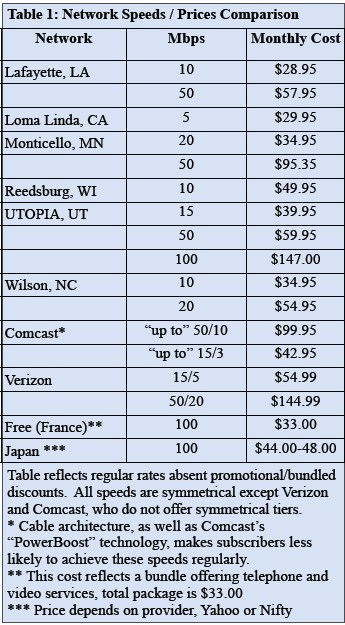
Competition from Municipal Providers Drives Prices Down and Speeds Up (New Rules Project)

The county established a Broadband Task Force, but made the same mistake so many other municipalities make when they create these panels: consumers are not represented at all and small business representation is limited to a single participant. Consumers will ultimately be a major source of revenue from municipal broadband projects and their needs and interests must be represented.  Since incumbent commercial providers will seek to impede municipal competition by organizing consumer opposition to such projects, getting trusted consumer advocates and broadband evangelists on your side at the outset can make the difference between enthusiastic support for additional broadband choice or a mind-numbing, incumbent provider-driven sideshow about a “socialist government takeover of the Internet.”

The rest of the panel is made up of public officials from the school district, county and city government and the local hospital.

The newspaper hints these are exactly the wrong people to invite onto a Broadband Task Force.  Virtually all already enjoy the generous bandwidth already provided by Comcast’s I-Net, few are likely to be well informed on broadband technology issues, and apart from the lone businessman on the panel, the group is unlikely to grasp the commercial implications of better broadband for the local digital economy.

Since these individuals all earn a paycheck protecting their own institutional interests, the larger vision of community broadband can easily get lost in turf wars and political disputes, or interference from incumbent providers.

Providers can cut the bottom out of such task forces with rewarding side deals for friends — enhanced services at fire sale prices. For institutional opponents — intransigence and crippling rate increases.

On Florida’s East Coast, Martin County’s public service institutions learned first hand what kind of pricing Comcast is capable of bringing to the table when an existing contract expired.  Comcast demanded a whopper of a rate hike.

“We decided for the kind of money these people are asking us, we would be better off doing this on our own,” Kevin Kryzda, the county’s chief information officer, told the Sarasota paper. “That is different from anybody else. And then we said we would like to do a loose association to provide broadband to the community while we are spending the money to build this network anyway. That was unique, too.”

The last straw for county officials was the loss of a lucrative deal with California-based Digital Domain to build a Florida branch campus.  The company chose St. Lucie County instead.  John Textor, Digital Domain’s co-chairman, told the Herald-Tribune that having a local all-fiber network connection and being able to set up an all-fiber direct connection to remote servers in Miami was a key advantage of the site in Port St. Lucie.

After that, Martin County commissioners voted unanimously to obtain bids for their own network.

Martin County’s fiber network will combine a publicly-constructed institutional network and a tiny rural phone company paying part of the costs to resell excess capacity to commercial users. The downside is that consumers will not be offered service.

In Florida’s Lee and Collier Counties, U.S. Metro network has proved fiber’s ability to transform entire regions economically.

“If you build it, they will come” is a common rallying cry for fiber proponents.  In both counties, they came.  The latest arrival?  Jackson Laboratory of Bar Harbor, Maine, now being showered with more than $200 million in government grants to build a genetic research campus in Collier County.  A large portion of that money will end up staying in Collier County, stimulating the local economy and creating jobs.

Why all the clamor?  Because U.S. Metro runs a network that puts incumbent phone and cable companies to shame.  When a business requests service, owner Frank Mambuca doesn’t tell them what speeds they’ll have to live with.  Instead, he asks, “how many gigabits do you want?”

Unfortunately, U.S. Metro also only sells service to businesses, but they have some wholesale customers that do serve consumers.  Marco Island Cable and a sister company, NuVu are cable overbuilders that offer access to U.S. Metro’s broadband network at speeds and prices Comcast and CenturyLink can’t touch.

Marco Cable, a tiny independent provider, delivers faster speeds at lower prices.

Marco Cable is preparing to deliver fiber-based 75Mbps service for $99 a month, along with several other access plans that save at least $12.95 per month over Comcast’s prices, and undercuts CenturyLink’s DSL plans as well.  The company also does something Comcast won’t — it promises unlimited Internet access and email accounts.

If someone wants even faster speeds, say 100Mbps, they can call Marco Cable and request it.

The highest download speed that Verizon offers [locally] at present is 50 megabits per second for $149.99 a month, according to spokesman Bob Elek.

NuVu is currently installing competing service in condos on the mainland.  For the father and son team that run both Marco Cable and NuVu, their philosophy is radically different from most cable and phone companies — delivering as much broadband speed as customers can use at prices they can afford.

For existing providers, who have “marked up” prices for years, the competition’s lower prices threaten profits from delivering “good enough for you” speeds at the highest possible price.

For some, simply lowering prices and enhancing service to compete isn’t the answer — putting a stop to municipal competition at all costs is.

In 18 states, high priced lobbying campaigns financed by giant phone and cable operators have succeeded in restricting or banning competing providers.  AT&T has been the most aggressive, successfully impeding competition in states like Texas, Wisconsin, Missouri, Arkansas, Michigan, Tennessee, and others.  Comcast helped stop competition in its home state of Pennsylvania.
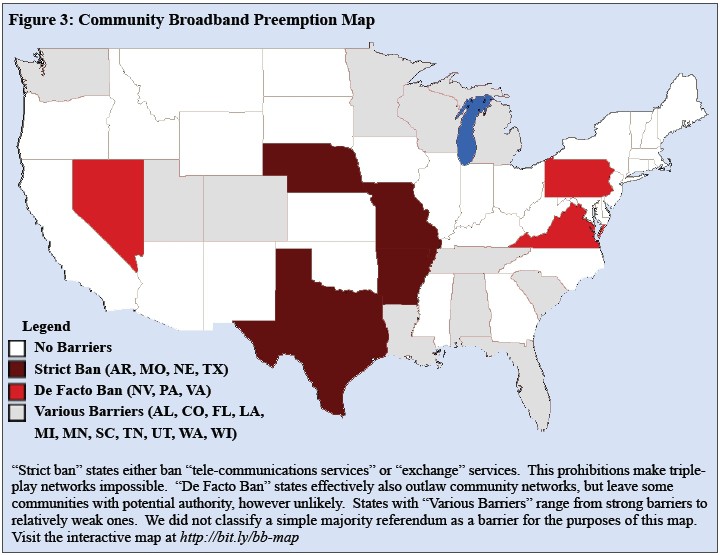
Click image to view interactive map

Year after year, Time Warner Cable and AT&T continue efforts to try and do the same in North Carolina, a potential hotbed of locally run, community-owned providers.

For some towns and cities who have spent years begging for improved service, the clock has run out.  The Sarasota Herald-Tribune used Wilson, N.C., as an excellent example.  The city of 50,000 east of Raleigh decided it was through asking Time Warner Cable to provide a platform for a digital economic revival.

Brian Bowman, public affairs manager for the city, told the newspaper the city faced economic disaster from twin blows — the loss of the textile industry and America’s waning interest in tobacco products. Giving the keys to the local cable company to drive Wilson’s nascent digital economy into Lake Wilson was simply not an option.  The town would build its own digital highway — a municipal fiber to the home system for consumers and businesses.
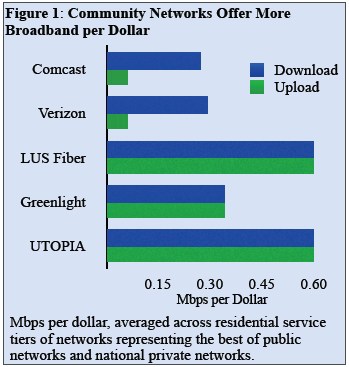
For both, Wilson’s Greenlight system provides up to 100 megabits per second in both directions.  Time Warner Cable residential customers, in comparison, max out at 15/2 Mbps service.

“The way we see it, you’re going to have haves and have-nots in the next generation broadband world,” Bowman said. “The fact is we wanted to invest in our own future; that’s why we did this.”

Cable and phone giants always are going to say that current speeds are adequate and that there is no need for cities to build expensive networks themselves, Bowman said.

“I have heard that here from some of the incumbents, that you don’t need to go that fast. I’m sure the folks in Florida were doing OK without I-4,” Bowman said, noting the state never would have gotten Disney World if not for that interstate access.

People in Sarasota County are about to hear all of the usual arguments against municipal service:

  • “Taxpayers will pay for it.” — Not with revenue bonds they won’t.  These bonds deliver returns to investors from revenue earned by the municipal provider, not from taxpayer dollars.
  • “We want a level playing field.” — This cable industry opposed providing one when satellite and phone company IPTV showed up, as they tried to withhold programming and lobbied against both.
  • “The government should stay out of the private sector.” — Christopher Mitchell, writing for the New Rules Project, tore apart that argument:

Governments “compete” with the private sector in many ways on a daily basis. Libraries compete with book stores, schools with private schools, public transit with taxis, police with security firms, even lumber yards, liquor stores, municipal golf courses and swimming pools with privately owned counterparts. Without public competition in the form of the Rural Electrification Authority, much of the country would still not be wired for electricity or phones.

The focus on whether local governments, who have a wholly different motivation than private companies, are “competing” with the private sector is a red herring to distract the public from incumbent providers’ failures to build modern networks. On matters of infrastructure, a community should always have the option to build the network it needs, just as it can build roads, bridges, water systems, and other modern necessities.

Ultimately, Sarasota County residents have two choices:

  1. Obtain the best traffic control and monitoring system America has ever seen, capable of delivering crisp, clear 1080p HD feeds of traffic tieups on Route 301.
  2. Deliver Sarasota County 21st century broadband that will power the digital economy and bring hundreds of millions in investment dollars, create thousands of new, high-paying jobs, and save local consumers and businesses a lot of money from broadband competition.


The Fiber Revolution Continues in the South Pacific – Cable Project Seeks Unlimited Broadband for Consumers

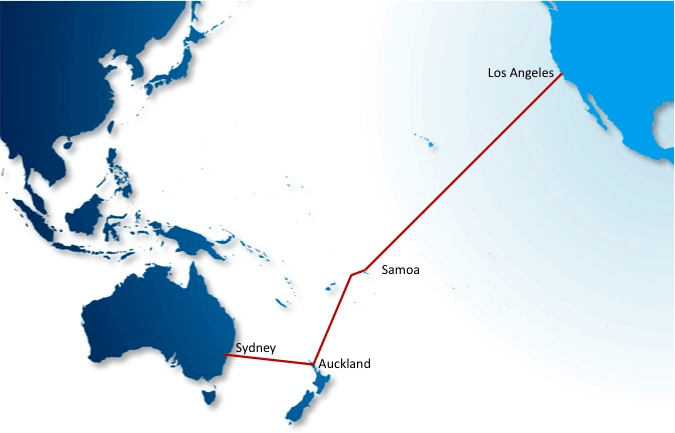
Pacific Fibre's planned undersea fiber optic cable set to begin service in 2013. (click to enlarge)

Australia and New Zealand remain the two countries most notorious for Internet Overcharging schemes like usage caps and speed throttles.  The lack of international broadband capacity is routinely blamed for limiting broadband usage for consumers in both southern Pacific countries, and now a major undersea fiber optic cable project seeks to end those Internet Overcharging schemes once and for all.

Pacific Fibre hates usage caps.  The company, which is one of the partners in a planned 5.12 terabits per second undersea cable connecting the United States with New Zealand and Australia, believes limiting broadband consumption is bad for business — theirs and the digital economies of both nations.  Now the company is reportedly willing to put its money where its mouth is, charging broadband providers a flat rate per customer for unlimited access to its backbone network.

The company believes such pricing will force providers into selling more generous, often unlimited broadband service packages for businesses and consumers.  Providers have routinely blamed insufficient international capacity for restrictive data caps.  But increasing capacity, including Pacific Fibre’s new cable set to begin service in 2013, removes that excuse once and for all.

Co-founder Rod Drury believes there will be so much capacity, if providers continue to engage in Internet Overcharging schemes, most of the newly available bandwidth could actually go unsold.

“Why don’t we flip the model around and go to a per-person charging model and then try to give internet providers as much bandwidth as we possibly can for that?,” Drury told BusinessDay.  “The charges could be segmented by customer type; you could do it for mobile connections, home connections, schools, hospitals and businesses, and set a reasonable price.”

[flv]http://www.phillipdampier.com/video/CNBC Interview With Pacnet CEO June-July 2010.flv[/flv]

CNBC talked with Pacnet CEO Bill Barney, one of the partners in the Pacific Fibre project, about bandwidth needs in Asia and how new undersea fiber cables will meet the growing demands.  (Segment one of the interview was done in June, segment two in July.)  (10 minutes)

Telecommunications Users Association chief executive Ernie Newman said Drury’s idea was long overdue. “The way the world is moving is towards all-you-can-eat-type plans and any move like that has got to be the way of the future.”

But one of Pacific Fibre’s competitors, Southern Cross, which currently provides undersea fiber connections for South Pacific Internet Service Providers, said he wasn’t sure Drury’s idea would work.

Southern Cross marketing director Ross Pfeffer said broadband providers haven’t been justified limiting broadband usage for some time, as newly available capacity has already helped ease the bandwidth crunch.  Instead, critics contend existing providers don’t want to give up the massive profits they are earning limiting usage, maximizing revenue from users who think twice before using high bandwidth services, thus reducing required investments in network upgrades.

“New Zealand internet providers [are] using data caps to segment the retail market and maximize their own revenues,” Pfeffer noted.

Both Australia and New Zealand are embarked on National Broadband Plans to take back some control of their broadband futures from private providers many accuse of monopolizing an increasingly important part of both countries’ digital economies.

Drury’s project, and others like it, may become important components of newly constructed national fiber-to-the-home projects proposed in Australia, and dramatically improved service in New Zealand.

[flv width=”480″ height=”292″]http://www.phillipdampier.com/video/Underwater cable laying 1936.flv[/flv]

The history of deploying underseas cables is a fascinating one.  Check out this 1936 documentary showing how AT&T made undersea phone cables to connect the San Francisco Bay area.  Back then, companies didn’t use rubber or plastic cable jackets to keep the water out.  They used jute fiber and paper!  Some other companies used gutta percha, which is today best known for root canal fillings, or tar mixtures.  (5 minutes)

[flv width=”484″ height=”292″]http://www.phillipdampier.com/video/BBC Cable Under the Sea.flv[/flv]

Before there was telephone service, the challenges of connecting the far flung components of the British Empire were met by underseas telegraph cables beginning in the 1870s.  A fascinating BBC documentary visited Porthcurno, located at the tip of Cornwall, England, where 14 undersea telegraph cables stretched from a single beach to points all around the globe. Then something called “wireless” arrived and threatened to ruin everything.  (8 minutes)

[flv width=”480″ height=”380″]http://www.phillipdampier.com/video/Fiber Optic Cable.flv[/flv]

But what exactly is “fiber optic cable” and how is it made?  More importantly, how do they store thousands of miles of fiber optic cable on a single ship, ready to drop to the bottom of the ocean?  The answers to both are here.  (12 minutes)

Time Warner Cable Tries to Control Online Video Onslaught With iPad App to Manage Your Cable TV

Phillip Dampier August 17, 2010 Broadband "Shortage", Data Caps, Online Video, Video 2 Comments

Time Warner Cable faces an increasing number of subscribers cutting their cable television service off, choosing to watch their video entertainment online.

Now the nation’s second largest cable company is trying to mitigate the potential damage with a series of new applications designed to bring cable television and your computer, cell phone, and iPad together.

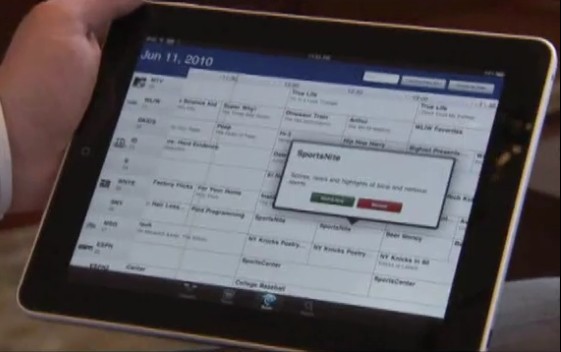
Time Warner is getting started with the iPad, developing an application that will help cable subscribers remotely control their DVR cable box to record and manage programming.  Away from home and want to scan a program guide and record an upcoming show?  The new app will let you do it.  Need to grab some video on-demand from Time Warner?  Not a problem.  You can even start watching on your iPad and pick up where you left off from your home.

Integrating the many devices consumers use as part of their daily lives with cable television could bring the cable viewing experience back front and center among at least some subscribers.  That reduces the chance customers will decide they can do without cable TV.  Since most of Time Warner Cable’s on demand library will only be available to current cable subscribers, cutting cable’s cord also means an end to online on-demand viewing of cable-licensed programming.

Time Warner Cable's prototype iPad app

Time Warner Cable CEO Glenn Britt has repeatedly emphasized his interest in delivering cable services the way customers want, and claims the new generation of applications on the way from the cable company will provide just that.

Although Time Warner will start with the iPad, the application will quickly become available for the iPhone and iPod Touch series.  Additionally, versions for other smartphones as well as portable and home computers will soon follow.

Ironically, this integration process could drive data volumes on Time Warner Cable’s broadband network to new heights.  Video streaming alone will dramatically increase traffic.  Yet the same company that is ready and willing to provide these bandwidth-intensive services also complained about existing broadband customers “using too much” of their existing broadband service.  In the spring of 2009, the company sought to implement a 40GB usage limit on some its broadband customers and charge up to three times more — $150 a month for unlimited access.  At the time, Britt and other company officials blamed the burden of online video and other usage-intensive applications for spiking the demand on their network.

Customers may wonder whether Britt’s new enthusiasm for online video means he recognizes their network has plenty of capacity to support unlimited access or is looking for a new excuse to justify a return to Internet Overcharging schemes.

[flv width=”640″ height=”500″]http://www.phillipdampier.com/video/Time Warner Cable iPad App.flv[/flv]

Time Warner Cable CEO Glenn Britt, CTO Mike LaJoie, VP of Web Services Jason Gaedtke and Director of Digital Communications Jeff Simmermon ponder their prototype iPad app and discuss the implications of integrating cable TV with other electronic devices.  For Time Warner Cable, it’s a matter of preserving cable TV subscribers who might contemplate cutting the cable TV cord and watching everything online.  (13 minutes)

Search This Site:

Contributions:

Recent Comments:

Your Account:

Stop the Cap!