

Home » Providers » Recent Articles:

AT&T Tells Employees to Parrot Company Talking Points In Anti-Net Neutrality Comments (But Use Your Personal E-Mail)

parrotAT&T’s Senior Executive Vice President of Legislative Affairs James Cicconi e-mail bombed AT&T employees Monday asking them to express their “deep concern” for Net Neutrality on the FCC’s Net Neutrality website’s comment section.  (Thanks to several Stop the Cap! readers, among them Dave, “Gaff”, “Bones”, “Prevent Caps” and James who sent news tips on this story. The delay in publication came from assembling a response you, as actual consumers, can fire back at the AT&T Propaganda Parade on the FCC website.)

More than 300,000 AT&T employees received the “suggestion” in their e-mail box, complete with ready-made talking points employees can use to parrot AT&T’s anti-Net Neutrality positions.  In a remarkably brave section, Cicconi suggests employees not use their company e-mail accounts when engaged in the “grassroots” push back, as if word of that maneuver would not promptly get leaked to the media.  (By Tuesday morning, it did.)  The FCC shouldn’t know the barrage of anti-consumer, anti-Net Neutrality comments came as a result of a PressureGram from AT&T Corporate.

“We encourage you, your family and friends to join the voices telling the FCC not to regulate the Internet,” Cicconi wrote in his letter.  “Those who seek to impose extreme regulations on the network are flooding the site to influence the FCC; it’s now time for you to voice your opinion.”

(Note: Most of those seeking to “impose extreme regulations” are actual consumers.)

The convenient “talking points” AT&T provided are identical to the comments found on any anti-consumer, telecom-sponsored astroturf group website.  That’s no surprise, considering most of those astroturf groups survive on the checks sent by those large telecommunications companies.

We debunk them for your convenience:

  • America’s wireless consumers enjoy the broadest range of innovative services and devices, lowest prices, highest usage levels, and most choices in the world. Why disrupt a market that’s working so well?

That’s demonstrably false.  Consumers Union and other consumer groups independently found a high degree of concentration and obstacles to competition among providers of mobile data and Internet access services, which Net Neutrality rules would cover.  As Stop the Cap! has already reported, competition for wireless broadband is hardly a Battle Royale with virtually every carrier charging around the same amount for 5 gigabytes of maximum mobile web usage per month.  AT&T was charging a ridiculous $480 per gigabyte for those exceeding that limit, according to CU.  Americans pay an average of over $500 a year for wireless access, which hardly represents the lowest prices.  Consumers Union discovered Americans pay “much more than users in most other developed nations.”

Americans also endure restrictive phone plans that give exclusivity to popular handsets, limit certain web applications from wireless usage, and impose often stiff penalties for choosing to end a relationship with a wireless provider before the contract term has ended.

  • There is fierce competition for wireless and broadband customers. Competition drives innovation and encourages companies to develop products, services and applications that consumers want. There’s been more innovation in this market than in any since the World Wide Web was introduced. The market is working for consumers. Don’t burden it with unnecessarily harmful regulations.

That’s brazenly false.  The wireless telephone industry has contracted in the last several years due to mergers and acquisitions and a determination by several independent resellers that profits were elusive reselling access to another company’s wireless network.  Alltel is now owned by Verizon Wireless.  Virgin Mobile, which took over Helio, will itself likely soon be owned by Sprint.  Amp’d Mobile, Disney Mobile and ESPN Mobile, among many other resellers, disappeared altogether.

Most rural Americans “enjoy” a monopoly broadband service provided, where available, by their local phone company providing slow speed DSL service.  Most medium sized cities are served by a duopoly — one cable and one phone company.  Innovation in broadband comes to some, such as those served by Verizon FiOS, and skipped for others, such as those suffering with Frontier, FairPoint, and other phone companies that believe standard DSL is “good enough.”  AT&T, among many other providers, now want to experiment with rationing the Internet with Internet Overcharging schemes designed to curb use of their broadband services.

  • Network companies have to be able to manage their networks to ensure the most economical and efficient use of bandwidth, and provide affordable broadband services for all users. Network management is essential for consumers to enjoy the benefits of new quality-sensitive applications and services. The FCC rules should not stop the promise of life-changing, cost-saving services such as telemedicine that depend on a managed network.

That’s ludicrously false.  Managing networks, which sounds benign in theory, is often not in practice.  Several providers have recently taken a turn towards limiting access to those networks with usage rationing plans that limit consumers to a pre-determined amount of usage before overlimit fees or service termination kicks in.  AT&T is testing those schemes in Beaumont, Texas and Reno, Nevada this very day.  Stop the Cap! has repeatedly documented providers that admit their connectivity costs are dropping, right along with their investments in those networks to keep up with demand.  For some network companies, throwing hundreds of hours of online video to congest those networks seems to be an okay proposition, telemedicine or not.  Upgrade the networks that earn the American broadband industry billions in profits every year.

  • The “net neutrality” rules as reported will jeopardize the very goals supported by the Obama administration that every American have access to high-speed Internet services no matter where they live or their economic circumstance. That goal can’t be met with rules that halt private investment in broadband infrastructure. And the jobs associated with that investment will be lost at a time when the country can least afford it.

That’s infamously false.  AT&T managed to eke out an existence after its merger with BellSouth when it had to live under a Net Neutral regime for two years.  As Tim Karr from Free Press notes, “AT&T is loath to mention that it made considerable network investment when it had to abide by Net Neutrality conditions, and then invested considerably less when it didn’t.”  Somehow, U-verse will survive a Net Neutral world.

Meanwhile, many other broadband providers are in no hurry to expand or build new networks unless their hands are forced by the other competitor in the market threatening to steal their customers away.  AT&T’s U-verse offering is a direct response to the cable television industry swiping their customers with “digital phone” and cable television bundles that include broadband.  Time Warner Cable earns most of its new broadband customers at the phone company’s expense when consumers tire of slow, unreliable DSL service.

For rural communities, a Net Neutral America won’t make much difference either way.  Without Net Neutrality protection, companies like Verizon continue to abandon more rural states, selling off operations to companies like FairPoint and Frontier Communications, which have uninspired broadband programs that bring slow DSL service to areas that will never be wired for Verizon fiber-optic FiOS.  Large phone companies like Verizon continue to layoff employees, especially in the traditional wireline telephone business.

If we wait for private companies to deliver broadband to every American, it will be a very long wait.  But when it does arrive, it would be nice if consumers could actually enjoy their broadband service without network throttles and Internet Overcharging schemes.

  • The FCC shouldn’t burden an industry that is bringing jobs and investment to the country, but if it is going to regulate the Internet it should do so fairly. The goal of the FCC should be to maintain a level playing field by treating all competitors the same. Any new rules should apply equally to network providers, search engines and other information services providers.

That’s a laughably false premise.  When is the last time you bought broadband service from Yahoo!, Bing, or Google?  AT&T wants to compare their broadband apples with search engine oranges.  A level playing field would mean an end to the too-cute-by-half cable industry’s unofficial non-compete regime which makes sure no large cable operator intrudes on someone else’s territory.  It would mean an end to exclusive wireless handset provisions and gotcha contract terms designed to hold customers hostage to their wireless provider.  It would guarantee that if a municipality is fed up with the broadband backwater status afforded it by providers convinced what they deliver is “good enough,” that municipality can construct their own advanced broadband network and do the job private providers won’t.

Broadband regulated in the providers’ best interests have resulted in middle-of-the-pack broadband service for Americans, not the world class networks America can use to leverage a leadership role in the digital economy of the future.  The FCC should regulate the Internet to provide free, open access to innovative products and services that will really create new jobs for Americans.  They should definitely not continue a protectionism regime already in place that forces Americans to choose near-identical wireless service plans at high prices, and broadband service from one or two providers with dreams of Internet Overcharging schemes and speed throttles.

FairPoint Billing Nightmares: Cancel Phone Service, Get Billed Anyway…

Phillip Dampier October 19, 2009 FairPoint Comments Off on FairPoint Billing Nightmares: Cancel Phone Service, Get Billed Anyway…

fairpointThis past summer of discontent with FairPoint was not limited to DSL service outages.  The troubled phone company serving Maine, New Hampshire, and Vermont, also annoyed fleeing customers with bills for service long since disconnected.

Nina Mazuzan in Burlington, Vermont was fed up with FairPoint and switched to Burlington Telecom, the municipally owned fiber to the home network serving the Burlington area.

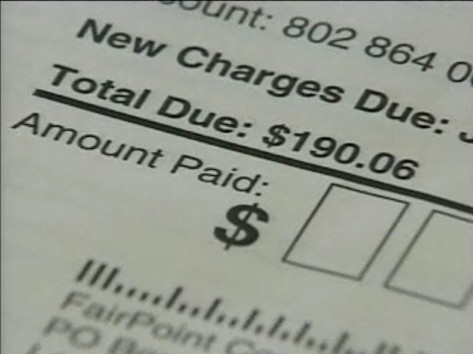
But escaping FairPoint would not be easy.  More than four months after switching, the FairPoint bills kept rolling in, amounting to nearly $200.

“It’s incredibly frustrating,” Mazuzan told WPTZ News.  “It’s just such a waste of time — there’s no real face behind the voice,” she said.

Vermont regulators report Mazuzan is not alone.  The state continued investigating the company and monitoring its performance over the course of the summer.

Company officials told WPTZ, “FairPoint is working to fix its problems.”

[flv width=”480″ height=”360″]http://www.phillipdampier.com/video/WPTZ Plattsburgh State Calls For Fairpoint Communications Investigation 7-14-09.flv[/flv]

WPTZ-TV Plattsburgh covered one Burlington, Vermont resident who experienced months of billing problems with FairPoint back in July. [1 minute]

Bankruptcy Watch!: FairPoint’s Service Outages Last Days, Not Hours

Phillip Dampier October 16, 2009 FairPoint, Video 3 Comments

One of the major consequences of having insufficient experience and resources running a telecommunications network FairPoint inherited from Verizon is that when something goes wrong, it often turns into a catastrophic service failure that leaves people without service for days on end.

As we continue to watch the teetering FairPoint Communications lurch towards either a “white knight” rescue or bankruptcy court, ponder being one of 12,000 Vermont residents who suffered through a DSL service outage that lasted nearly a week this past June.

“The first day I was mad, the next day I was angry, the third day I was begging for Internet service so I could continue on with day to day activities of running a business,” said Bret Knapp, co-owner of Hilltop RV Center in New Haven.

Knapp relies on his FairPoint DSL service to stay in contact with his customers.

Knapp spent hours on the phone with FairPoint customer service representatives in Texas trying to resolve the problem to no avail.  At one point, after 50-60 calls, a FairPoint representative hung up on him.

Beth Fastiggi, a FairPoint spokeswoman agreed the problems were unacceptable.

“We are making significant progress; internally, we still have a lot of work to do,” she told WPTZ news.

The state telecommunications regulator in Vermont told the station complaints regarding FairPoint arrive daily from across the state.

[flv width=”480″ height=”360″]http://www.phillipdampier.com/video/WPTZ Plattsburgh FairPoint Outage Affects 12,000 Vermonters 6-10-09 .flv[/flv]

WPTZ-TV Plattsburgh covers the FairPoint DSL outage that wiped out service for a week for 12,000 Vermont residents. [2 minutes]

Verizon Running Away From Rural America Causes Increasing Retirements, Worker Shortages

Phillip Dampier October 15, 2009 Public Policy & Gov't, Verizon, Video 4 Comments

Verizon’s ongoing effort to shed itself of legacy phone operations in smaller communities and states has triggered a wave of worker retirements, contributing to worker shortages in some regions.  In West Virginia in particular, Verizon’s plan to exit the entire state, leaving service in the hands of Frontier Communications, has many employees deciding the time to get out is now.  In August, Verizon was forced to bring in outside contractors to deal with repair work created by a storm-filled summer.  The decision met with strong opposition from the local Communications Workers of America Local 2001 union, which represents the remaining Verizon employees.

Verizon itself has been cost-cutting, and shed 7% of the workforce providing upkeep for the traditional phone network in just the past two years.  Many other employees are taking early retirement offers, or simply deciding to retire with their Verizon pension intact.

After the CWA Local 2001 unit ran an informational picket, the outside contractors were gone by September 19th.  The CWA has been negotiating with Verizon to create a Working Retiree program to provide staff support during difficult periods like those created from storm damage.

The CWA continues its strong opposition to Verizon exiting several states, selling its network to Frontier Communications.  The union believes the transaction will saddle those communities with a lower quality telecommunications future from a provider mired in the debt required to finance the transaction.

[flv width=”320″ height=”240″]http://www.phillipdampier.com/video/WCHS Charleston CWA Protests Verizon Contractors 8-31-09.flv[/flv]

WCHS-TV in Charleston, West Virginia covered the CWA informational picketing in late August. [1 minute]

Comcast-NBC Deal: Hulu’s Free Online Video Days Could Be Numbered

Phillip Dampier October 13, 2009 Comcast/Xfinity, Online Video, Video 12 Comments

huluTM_355The reported deal between Comcast, the nation’s largest cable operator and NBC-Universal, part owner of Hulu, could have serious consequences for the Internet’s most popular destination for online television shows and movies.

In just a year, Hulu has enjoyed a quadrupling of visits well into the millions, streaming dozens of network television series, specials, and movies, all supported by commercial advertising.  Devised to help combat online video piracy and earn additional advertising revenue from web watchers, Hulu partners NBC, Fox and Walt Disney Co., have been successful at drawing scores of Americans to the video website.  Program distributors have also been pleased, earning money from shows like Lou Grant that haven’t been on network television in decades.  But after the economic crash of 2008, the venture has proven costly for the partnership, challenged by an advertising marketplace on life support and outright hostility by broadband providers, cable operators, and Wall Street investors, upset that the service is giving it all away for free.

Among the loudest to complain is Comcast, which is now angling to acquire NBC, and its 30% ownership stake in Hulu.

Comcast CEO Brian Roberts has repeatedly complained about the implications of giving away online video, which for some have begun to replace cable television subscriptions.

“If I am any one of these programmers, not just ESPN but the Food Network and I have a business in that 50 percent, 60 percent, 70 percent of my business comes from subscriptions, I want to think long and hard before I just put that content out there for free and not think through what it is going to mean to my business,” Roberts said at an investors conference in May.

Roberts view was shared by the CEO of the nation’s second largest cable operator, Glenn Britt of Time Warner Cable.

“If you give it away for free, you’re going to forego that subscription revenue,” Britt said. “And if you actually think the ad revenue can make up for that, then God bless you and go on your way. But I don’t think that’s the case, and (networks) don’t really think that’s the case either.”

The difference between Comcast and Time Warner Cable is that the former could gain part ownership in the largest service now giving it all away for free, and that has major implications for Hulu’s future.

“Would Comcast put an end to the Hulu model of using the Web to distribute free TV content?” asked Michael Nathanson, senior media analyst at Sanford C. Bernstein & Co. “Will Comcast continue to support Hulu?”

The Los Angeles Times reports there is already a precedent for Hulu limiting content for online viewers in response to complaints:

Hulu already has limited users’ access to certain cable programs, including FX’s “It’s Always Sunny in Philadelphia,” in response to an outcry from the TV producers and cable companies that object to paying TV programmers hundreds of millions of dollars each year for shows that are offered free online.

“Arguably, their ability to shape online content distribution, and to recast windows for video on demand, would be an important attribute of any deal,” wrote Craig Moffett, a cable industry analyst at Sanford C. Bernstein.

Comcast’s interest in NBC Universal would dramatically expand its entertainment portfolio with such attractive cable channels as USA Network, MSNBC and CNBC as well as the Universal Pictures movie studio. The proposed Comcast-NBC Universal venture also would give the cable operator a greater role in deciding how and when TV shows and movies are distributed online and at what price to consumers.

Comcast’s influence would primarily be felt in cable network programming streamed online, as Comcast has a vested interest from the millions it currently pays those programmers to carry their networks on Comcast cable systems nationwide.  Comcast could advocate Hulu become a partner in the TV Everywhere cartel, providing video content only to “authenticated” pay television subscribers, or it could limit the number of episodes available for free, or when those episodes appear on the service.

Soleil Securities media analyst Laura Martin thinks an even more likely possibility would be charging a fee for some of its more popular content.  Martin points to Hulu’s own financial problems, a consequence of the crash in the advertising market.  Soleil estimates that the three partners subsidize $33 million of the losses at Hulu even after earning $123 million this year from advertising.  Even worse, Martin says, is the cannibalizing of the networks’ own advertising earnings from broadcast runs of those shows now available online.  She told the Times that for every viewer who migrates to the Internet, the companies forfeit $920 a year in ad revenue.

But not everyone believes the Comcast-NBC deal is such a great idea.

Time Warner CEO Jeff Bewkes today told an industry conference in Manhattan that large media mergers have had a lousy track record.  Still, he said the merger would probably benefit the cable industry as a whole, because broadcast networks content with giving away content for free online will now be a part of the very industry hurt by that formula and will be more friendly towards arguments to stop it.

“We love to see our competitors taking risks,” Bewkes said.

[flv width=”400″ height=”300″]http://www.phillipdampier.com/video/CNBC Hulu 9-7-09.flv[/flv]

CNBC’s Julia Boorstin talked with Hulu CEO Jason Kilar in September about the desire for the company to partner with the cable industry’s TV Everywhere project.

Search This Site:

Contributions:

Recent Comments:

Your Account:

Stop the Cap!
