Home » Providers » Recent Articles:

Shaw’s “Fastest Internet in Canada” Doesn’t Mean Much If Usage is Limited

Phillip Dampier October 25, 2010 Broadband Speed, Canada, Data Caps, Editorial & Site News, Shaw 29 Comments

Shaw Communications is preparing to introduce a formal Internet Overcharging scheme for its customers across western and central Canada.  Although the company has maintained “soft caps” that have generally been unenforced, that is about to change.

An Edmonton reader of Broadband Reports first noticed the appearance of a new formal Internet Data Usage Policies section on Shaw’s website.  Some customers also received access to a usage meter that was roundly criticized for being inaccurate.

She's blown away by her high broadband bill.

In short, Shaw Cable plans a “three strikes and then you pay” approach to usage limit enforcement.  After a customer exceeding plan limits receives three warnings from the company, excess usage charges will start to appear on customer bills.

A participant on Broadband Reports inferring he’s a Shaw employee admits the company’s usage meter was so inaccurate, it has been pulled.  So has much of the information on Shaw’s website, which now provides a more general “stay-tuned” announcement:

Thank you for your interest in Shaw’s Internet Data Usage policies. Please stay tuned as we develop information specific to your area on this topic.

Shaw currently sells four levels of service in most areas (“Nitro” is available in limited areas with DOCSIS 3 upgraded service), sold by both speed and data transfer limits:

High-Speed
Warp†*
High-Speed
Extreme*
High-Speed
Internet
High-Speed
Lite
Maximum download speed 50 Mbps 15 Mbps 7.5 Mbps 1 Mbps
Maximum upload speed 3 Mbps 1 Mbps 512 Kbps 256 Kbps
Dynamic IP addresses 2 2 2 1
Price (in Canadian dollars) $107/month $57/month $47/month $35/month
Data transfer limit 250 GB/month 125 GB/month 75
GB/month
13 GB/month

*Service availability may vary by market. Docsis modem required.
Limited areas that are not DOCSIS 3.0 ready will receive 25 Mbps download and 2 Mbps upload.

In contrast, most Americans pay lower prices for equivalent levels of service, with no data transfer limits.

Shaw customers will soon see usage graphs on their monthly bills and face the prospect of paying overlimit fees once they exhaust their usage warnings.  While Shaw works to implement its broadband overcharging scheme, it is also making hay out of its new 1Gbps fiber-based broadband trials in British Columbia (primarily to stay competitive with its nemesis — competitor Novus Entertainment) and Alberta:

This service launched in select Vancouver neighbourhoods in June – and Pinebrook, a suburb west of Calgary, will be the latest area to try out the 1 Gigabit Internet service FREE for six months!

Our test neighbourhoods have the advantage of “future proofing” as they receive the best technology has to offer with Fibre-to-the-Premises (FTTP) and will be able to support new, cutting-edge Internet applications that will require faster download speeds – compliments of Shaw.

At the end of the six month trial, customers will still be able to retain their existing services without any change in features or function.

This is a great opportunity for our customers and we are thrilled to be the first provider in Canada to offer this incredible service.

Of course, most of the applications that require faster broadband speeds also consume plenty of data, and when Shaw formally introduces the fiber service, limits on its use are likely to come along for the ride.

GCI Spokesman Openly Lies to Media About Internet Overcharges – We Have the Bills

GCI delivers unlimited downloads of customers' money.

GCI spokesman David Morris either does not know what his own company does to abuse its customers or he openly lied about it in statements to the media:

GCI said it hasn’t yet charged anyone fees for exceeding the data limits (some customers dispute this), but the company began contacting its heaviest data users this summer to move them to new, limited plans. The company is also upgrading Internet speed for its customers this year at no extra cost.

GCI said it hasn’t decided when to enforce the data limits on everyone else. The crackdown might not happen until next year, according to Morris.

Apparently Morris is living in a time warp, because “next year” is this year.

After our article earlier this morning, Stop the Cap! started receiving e-mail from angry GCI customers with bills showing outrageous overlimit fees running into the hundreds of dollars GCI claims they are not charging.

Our reader Steve in Alaska sums it up:

“GCI is a bad actor that abuses its customers with bait and switch broadband, baiting customers with expensive unlimited bundled plans and then switching them to limited plans with unjustified fees,” he writes. “A legal investigation exploring whether this company is violating consumer protection laws is required, especially after misrepresenting the nature of these overcharges in the Alaskan media through its spokesman.”

GCI is apparently iterating the credit card industry’s tricks and traps.

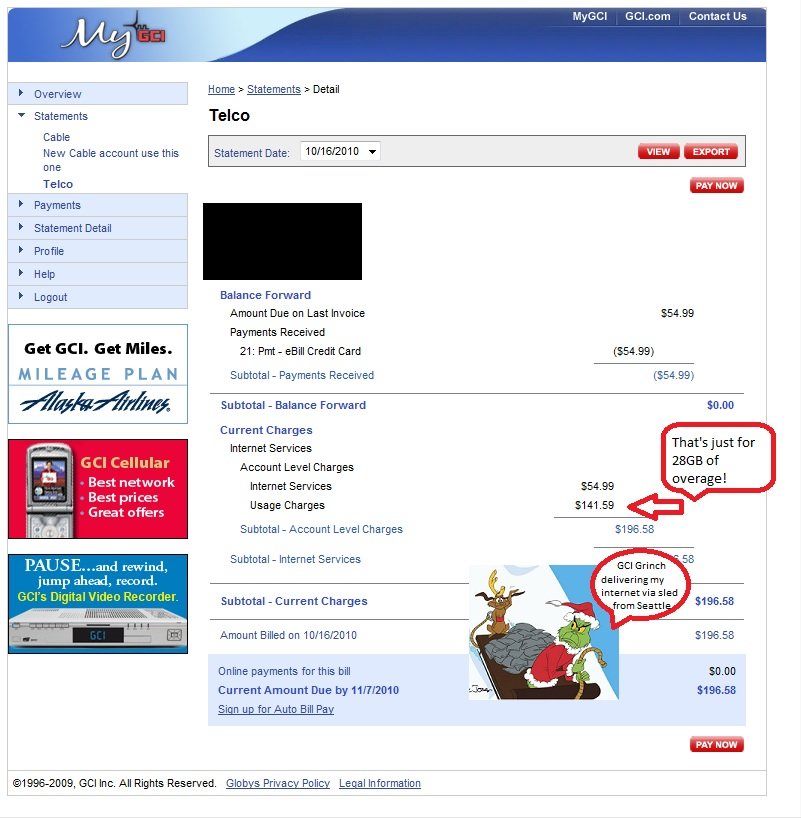
Our reader Scott’s latest broadband bill shows just how abusive GCI pricing can get:

GCI: the Grinch That Stole the Internet (click to enlarge)

Scott was floored by GCI’s Festival of Overcharging, which turned a $55 a month bill for broadband into nearly $200.  It exemplifies everything we’ve warned about over the past two years with these pricing schemes:

Well it finally happened, I got hit with GCI internet bill shock, $196.58 total for my 8Mbps plan with 25GB usage.

My usage prior to this has always been around 15-20GB/mo according to them — just the usual web surfing/e-mail with a little online gaming over the weekends (Eve Online) but not much.

Something ratcheted up my usage to nearly twice that (I did buy one game off Steam for digital delivery), which still would have been perfectly reasonable given the $75.00/mo plan I chose — that’s double what most people pay for unlimited in the lower 48 states. I only moved to this plan because their $135/mo bundle plan wasn’t affordable due to the required overpriced digital phone + taxes.

I tried calling their customer service and just got the company line about how expensive it was to provide their service, and I must have an open Wi-Fi router or “downloaded” too many YouTube videos, iTunes, or other content. He also stressed five or six times lots of customers go over their limits thanks to Netflix streaming and you really can’t use it with GCI Internet service.

To date I’ve never gotten a straight story from them on how this is managed, or from their marketing material which never mentioned overage until recently, or their reps that used to say you’d get a phone call to warn you if you went over their limits. The rep I spoke to most recently claims you’re supposed to call them daily or every other day – or login to a special portal online to monitor usage.

Either way this company has no sense of customer service, nor does it operate in the interest of Alaskan consumers that are cut off from the lower 48 and need reliable and affordable Internet services.

Stop the Cap! recommends making a copy of David Morris’ comments and notifying GCI you are not paying their overage fees because they are “obviously in error,” at least according to the company’s own spokesman.  Then get on the line with the State of Alaska’s Consumer Protection Unit and the Better Business Bureau and demand your overlimit fees be credited or refunded.  We’ve even got the complaint form started for you.  GCI values its A+ Better Business Bureau rating, so chances are very good they’ll take care of you to satisfactorily close the complaint.

GCI’s claims that with Internet usage limits, the company can deliver its customers faster speeds.  But Stop the Cap! argues those speeds are ultimately useless when GCI allows you to use as little as 3 percent of your service before those overlimit fees kick in.

A Broadband Reports reader ran the numbers before speed upgrades made them even worse:

Yes, GCI is overcharging customers and they have been on their unbundled tiers for a very long time. Now GCI wants to overcharge the rest by setting limits on ultimate package tiers that previously were labeled as “unlimited downloads”. I thought I’d post the more revealing information about how GCI is ripping off residential customers.As an academic argument let’s compare what data transfer is possible vs. what GCI now expects customers to use on its [formerly] “unlimited downloads” tiers.

1 Mbit = 1,000,000 bits

1,000,000 bps * 60 = 60,000,000 bpm
60,000,000 bpm * 60 = 3,600,000,000 bph
3,600,000,000 bph * 24 = 86,400,000,000 bpd

Now that we have a baseline measure of the total data transfer possible from a 1Mbps line PER DAY, let’s convert bits to bytes and gigabytes.

8 bits = 1 byte
86,400,000,000 bits / 8 bits = 10,800,000,000 bytes

Now let’s convert this to gigabytes

1,000,000,000 bytes = 1GB
10,800,000,000 bytes / 1,000,000,000 bytes = 10.8 GB

This means that 10.8GB of data transfer is possible with a 1Mbps connection operating 24/7 PER DAY.
NOTE: This figure doesn’t take into account network overhead or other loss.

Ultimate package speed tiers.

(Total Throughput possible PER DAY)
4Mbps = 10.8 * 4 = 43.2 GB
8Mbps = 10.8 * 8 = 86.4 GB
10Mbps = 10.8 * 10 = 108.0 GB
12Mbps = 10.8 * 12 = 129.6 GB

(Total Throughput possible PER MONTH)
Assume 30 days = 1 month

4Mbps = 43.2 * 30 = 1296 GB = 1.296 TB
8Mbps = 86.4 * 30 = 2592 GB = 2.592 TB
10Mbps = 108.0 * 30 = 3240 GB = 3.240 TB
12Mbps = 129.6 * 30 = 3888 GB = 3.888 TB

Now this is what GCI expects its customers to use.
4Mbps = 40 GB
8Mbps = 60 GB
10Mbps = 80 GB
12Mbps = 100 GB

GCI expected utilization factor (actual/possible usage)
40 / 1296 = 0.0308 = 3.08 %
60 / 2592 = 0.0231 = 2.31 %
80 / 3240 = 0.0246 = 2.46 %
100 / 3888 = 0.0257 = 2.57 %

It should be no surprise that as technology continues to develop, the true costs of broadband have continued to fall.

Given the true cost of bandwidth today, GCI’s forced bundling, and the price it’s asking this is pathetic.

Some might choose to ignore it or want to be a water carrier for GCI and similar ISPs, but advertising a service and expecting less than 3% usage is overbilling. It’s overcharging and also manipulative because the general population doesn’t understand it and can be easily duped into believing whatever they’re told to believe by an ISP.

Alaskan Broadband Ripoff: Internet Overcharging GCI Sparks New Outrage From Angry Customers

GCI, an Alaskan Internet Service Provider, is getting pummeled by angry customers as they continue to learn the company has launched an Internet Overcharging scheme that limits their broadband use.  Some customer claim the company is actively trying to trick those previously enrolled in unlimited plans into limited service tiers with tantalizing “free speed upgrades.”

Stop the Cap! reader Thomas was one of more than a dozen readers who complained to the Anchorage Daily News about the broadband ripoff.

He is outraged by the bait and switch tactics employed by GCI that sold customers on expensive bundled service packages that promised “unlimited Internet” service the company is now trying to take away.

Thomas first learned GCI had slapped limits on his broadband account… from Stop the Cap! GCI never bothered to inform him, or many other customers, about the new usage limits.  After he read our earlier story, he called GCI and learned he was a victim of Internet Overcharging.

GCI’s limits range from 40-100GB on plans ranging in price from $45-105 per month.

GCI, like most Internet Overchargers, tries to blame its customers for the imposed limits.

GCI estimates that 5 percent of its Internet customers are consuming 70 percent of the company’s available bandwidth. These users share a portion of their Internet cable with other GCI customers, and they have been slowing down the other households’ Internet speed, GCI spokesman David Morris told the Anchorage newspaper.

In an effort to prove their contention that usage limits improve service, GCI handed out free speed upgrades along with usage allowances and attempted to conflate the two.

In reality, most broadband slowdowns come from overselling access and being unwilling to invest in appropriate capacity upgrades to meet the growing needs of customers.  For companies like GCI, imposing usage limits to scare users away from high bandwidth services is cheaper and more profitable than meeting customer demand.

“Most of the under-30 crowd that I know use Netflix and Hulu streaming services so we can watch what we want, when we want. Cable TV does not give us the flexibility we want,” Sean Hogan, an Anchorage accountant, told the newspaper.

“I’m getting charged $180 per month and I don’t even want the phone or cable,” said Mike White, an Anchorage customer who upgraded his data-usage plan recently because he was worried about violating GCI’s limits.

GCI claims its new limits allow customers to do many things they had no interest in doing under their old unlimited plans, like sending millions of e-mail messages or browsing tens of thousands of web pages.  To make the limits sound generous, they made a chart:

Usage Comparison
Example 5,000 MB 20,000 MB 40,000 MB 100,000 MB
Email
(4 KB)
Text Only 1.25 Million 5 Million 10 Million 25 Million
Email with Picture (1 MB) Average
quality photo
5,000 20,000 40,000 100,000
Webpages
(100 KB)
Facebook,
eBay
50,000 pages 200,000 pages 400,000 pages 1 Million pages
Music Downloads
(4 MB)
3 minute
song
1,250 songs 5,000 songs 10,000 songs 25,000 songs
Streaming Audio
(1 MB/min)
Pandora
Internet Radio
80 hours 320 hours 640 hours 1,600 hours
Streaming Video
(2 MB/min)
YouTube 40 hours 160 hours 320 hours 800 hours
Movie
Downloads
Standard Definition 7.5 movies 30 movies 60 movies 148 movies

Of course, these limits ignore the reality customers do most or all of these things, and if they use their high speed connection to download files or watch the increasing amount of video content delivered in High Definition, they’ll blow through some of GCI’s limits with little effort.

Despite GCI’s claims of generosity, its customers think otherwise, and many are moving to curb their usage to avoid potential penalty fees or service termination the company could impose with enforcement of their caps:

Morris said that most of GCI’s customers will discover that their Internet usage is far below the new limits. Depending on the plan, the limits range between 50 and 125 gigabytes per month.

Chris Bruns, an Anchorage father and college student, isn’t so sure. “I’m in the high-30 (gigabyte) range every month,” he said.

GCI’s cheapest substitute for an unlimited plan is 40 gigabytes — the equivalent of downloading and watching 60 movies per month on your computer.

Bruns found out recently — after calling GCI to ask some questions about his family’s Internet speed and usage — that his previously unlimited plan, called Ultimate Xtreme, now had a 40 gigabyte ceiling.

“I was pretty miffed. It came as a surprise,” he said.

“When we signed up, we specifically got the unlimited plan because we knew we used it a lot,” he said.

He said he has since curbed the family’s Internet usage to be on the safe side. He said he and his wife regularly download movies for themselves and cartoons for their two children on Netflix to watch on their computer. Using Netflix is a way to keep the kids from seeing “garbage” on TV, Bruns said.

Ed Sniffen, a consumer-protection attorney in the Alaska Department of Law, may a victim of GCI’s bait and switch broadband himself.

Sniffen said he has had an unlimited-data plan with GCI and didn’t know on Tuesday afternoon whether he received a notice about the new policy. He said anyone who has a concern should contact the Law Department’s consumer-protection office.

The story in the newspaper prompted an enormous response — some 265 comments and counting.  A sampler:

GCI provides terrible service compared to companies in the lower 48 at exorbitant prices. They are a monopoly that needs to be tweaked.

GCI’s Network costs are FIXED. They are raping and pillaging us.

“GCI said it hasn’t yet charged anyone fees for exceeding the data limits…” — GCI lies. Just a few months ago I was charged nearly $100 for exceeding the bandwidth limit. Since then, I’ve upgraded my package to a ridiculous amount of bandwidth (at a ridiculous price) just so I can avoid that problem.

This is crazy. You go anywhere in the lower 48 and almost every Internet provider out there has some sort of unlimited plan, and it doesn’t involve payment with an arm, a leg, a kidney, or a first-born child. GCI needs to get this crap sorted out.

I got an offer to double my Internet speed and usage for a few bucks extra, and free cable (the good package, not the basic cable). Two months later, I still haven’t seen anyone show up to do anything, and I’m still getting charged out the tail end for overage charges. I keep requesting to up my Internet (I have a college student who takes some Internet classes) but they never do it. The only reasons I switched from ACS were because when it rained we had no phone OR internet (they said the problem was with our lines – our landlord at the time needed to fix it, but the contractor said it was ACS’s line problem – THEY needed to fix it.)  If there was another alternative to phone/Internet, I would so be there.

I was out and out LIED to by a GCI Rep. I was told if I changed my plan I would receive higher speeds with NO OTHER CHANGE for the same price. I questioned the GCI rep about this in detail several times before agreeing. The next day I no longer had unlimited downloads. I was LIED to and RIPPED OFF by GCI.

GCI’s statement that they have not charged overlimit charges is incorrect as over ten individuals that I know including myself have been hit with bills ranging from $300 to $2000 for one month of service.


Chula Vista Telecom Tax Controversy Causes War of Words Between Cox, City Officials

Phillip Dampier October 20, 2010 Cox, HissyFitWatch, Public Policy & Gov't, Video 2 Comments

A controversial proposition on the ballot to extend a 1970 telecommunications tax to cell phones and “digital phone” service that largely did not exist when the tax was originally enacted has created a war of words between Chula Vista, Calif., mayor Cheryl Cox and the cable company that bears her last name (but no relation) — Cox Cable.

The proposed tax extension would broaden the types of telecommunications services that are subject to it, including Cox Cable’s “digital phone” service and broadband.  Cox officials appeared at city council meetings to oppose the tax, saying it would result in higher bills for customers.

But when Cox went on the air with “informational ads” the mayor accused of undermining support for Proposition H, Cox and the cable company started trading barbs in the local media.

Now the controversy has drawn the attention of San Diego’s local ABC affiliate.  On Monday, Mayor Cox accused Cox Cable of punishing the city by withdrawing free Internet access at the end of the year for City Hall, public libraries, and public safety agencies including the fire and police departments.

Mayor Cox called the timing of Cox’s announcement suspicious, coming the same day she did an interview complaining about Cox on San Diego’s KGTV-TV.

Under the terms of Cox’s franchise agreement with the city, Chula Vista was supposed to receive free Internet service through 2019, but now the cable company is reneging on the deal, a charge Cox Cable vigorously disputes.

Mayor Cox

With Chula Vista’s current budget crisis, the cash-strapped city is weighing the $30,000 a year it will cost to obtain the service at Cox Cable’s business rates, which could cause the city’s 1,012 computers, most available to the public, to lose access Jan. 1st.  Mayor Cox is also concerned the police department will lose its own connection, which it uses to communicate with other police departments and the Department of Justice.

The tax at the center of the debate, known as the City’s Utility Users’ Tax or U.U.T., amounts to 5 percent and is charged primarily to landline telephone customers.  Because of the way the tax ordinance was worded in 1970, technology changes that have taken place since have allowed more residents to escape paying the tax by switching to cell phone service or “digital phone” Voice Over IP service offered by Cox Cable or other broadband providers.

As a result, potential revenue earned from the tax has dropped over the years, especially as residents disconnect landline service.  With Chula Vista facing a $4 million deficit in the city budget, city officials are looking for new revenue sources.

Proposition “H,” before local voters Nov. 2nd, would keep the rate at 5 percent, but extend the tax to other telecommunications services, including:

  • Wireless communications
  • Text Messaging
  • Prepaid/Postpaid telecommunications
  • Private communication services
  • Paging
  • VoIP
  • Toll free numbers

“Proposition H is all about continuing to fund the services we all benefit from: maintaining streets and parks, keeping libraries open, and the police protection and fire services that keep us safe,” Mayor Cheryl Cox wrote in a recent guest editorial in the San Diego Union-Tribune.

City officials are warning that without the estimated $5.6 million in estimated revenue from the tax, the city will have to cut services to cover the budget shortfall or raise other taxes.

Like many cash-strapped communities and states who have watched tax receipts plummet from dramatically lower property tax collections and increases in funding mandates, Chula Vista is trying a combination of budget cuts and tax increases to cover the difference.  But local voters are in no mood for tax increases, and last year rejected a proposal to raise the area’s sales tax by one percent.

Judging from the well-organized opposition campaign, local voters may be on track to disappoint the city a second time.

Mayor Cox’s editorial advocating approval of the tax extension even met resistance from the newspaper it was printed in:

But business and taxpayer organizations question that claim and contend the long-term tax hike could be much bigger than 5 percent as new communications devices come to the fore. They argue Chula Vista hasn’t done enough to shore up its finances long-term to deserve voter support of a tax increase.

On balance, we agree. While city leaders have overseen some $40 million in budget cuts and eliminated 259 jobs, they mostly have been AWOL on one of the most crucial issues in modern government finance: the extreme cost of public employee pensions.

[…]This framing of the debate is not fair to Chula Vista taxpayers who now cover the entire cost of pensions that allow city firefighters and police officers to retire at age 50 with 90 percent of their final annual pay and general employees to retire at age 60 with 90 percent of annual pay.

These policies must be recognized as unsustainable and then be drastically changed. Only when that happens will Chula Vista’s leaders have the credibility to ask voters to raise their own taxes.

Vote no on Proposition H.

The San Diego South Chamber of Commerce ridiculed the tax as a “dash for cash” and many area small business associations are also opposed.

While the debate rages, the mayor’s office accused Cox Cable of being too cute by half by pretending to be a “neutral” party.  The cable company claimed its ads were “informational” and did not take a position either for or against the proposition.

But KGTV notes the ad only mentions groups opposed to the tax — no supporters, and ends with the tagline, “Proposition H: It’s not what it seems.”

An expenditure report obtained by 10News shows Cox Communications spent more than $2,400 on the Proposition “H” ad and additional literature. The report also lists money going towards Proposition H opposition. A Cox spokesman said they wanted to choose “neutral” but had to chose between “support” and “opposed” on the filing.

[flv width=”640″ height=”500″]http://www.phillipdampier.com/video/Chula Vista Debate 10-20-10.flv[/flv]

Three reports from KGTV-TV San Diego trace the dispute over the tax over the last few months.  Also included is a portion of a video from a taxpayer’s group opposed to the telecom tax.  (13 minutes)

Utah Provider-Backed Front Group Trying to Kill UTOPIA Municipal Broadband… Again

The Free UTOPIA website reports that a provider-backed front group is once again trying to pack meetings with their members to oppose UTOPIA – Utah’s municipal broadband network.

Several UTOPIA member cities are gearing up to start taking votes on the new Utah Infrastructure Agency designed to help fund new construction of the network. The Utah Taxpayers Association is trying to get people to show up at these meetings to protest the UIA and try and kill it. In their effort to do so, they continue to distort, twist, and outright lie in their efforts to rile people up.

First off, the UIA bonds are not an unconditional loan. They are funds that will be secured by payments from subscribers. If there aren’t enough subscribers to secure repayment, the money doesn’t get touched. You would think that such an arrangement would be acceptable to an organization that purports to represent taxpayers as it clearly shifts the burden from the taxpayers as a whole to the subscribers. Attempting to characterize the UIA as a big grab-bag is a big lie.

UTA claims UTOPIA is currently running a $20 million deficit, but Free UTOPIA points out part of that “deficit” may include the original seed money required to construct the network, which came in the form of bonds.  Like any start-up venture, UTOPIA’s initial infrastructure costs create operating losses until those costs are paid back.  A financial feasibility study prepared by Design Nine and released last week projects UTOPIA could report positive net income by 2018, with revenue increasing dramatically going forward.

UTA receives financial support from both Comcast and Qwest.

As fiber advocates have noted, start-up costs and the time it takes to pay them off are one reason why so few commercial providers want to invest in fiber.  Commercial providers often demand a return on investment within five years, while many municipal projects consider fiber a longer-term investment that can pay additional dividends for communities that may not always appear on a balance sheet.  Dividends like high technology start-ups, better paying jobs, better health care and education, and eventually additional revenue for the community that stays in the community.

The UTA has repeatedly claimed the UTOPIA project is veiled in secrecy, yet the project’s feasibility study is published on UTA’s own website.  What is secret is exactly how much money Comcast and Qwest pay UTA and its president Howard Stephenson.  Neither company will disclose exactly how much they have spent on UTA beyond contributions directed to Stephenson himself, documented here.

Provider-backed front groups like UTA routinely misinform their members about the benefits of municipal broadband, often to the point of demagoguery not supported by the facts.  Free UTOPIA reports broadband evangelism can make dramatic inroads among opponents of such public works projects:

The Utah “Taxpayers” Association thought it would get an upper hand with a BBQ in Orem just before the city council voted on a new construction bond. Unfortunately for them, the plan backfired when UTOPIA made a surprise appearance at the event with their “mobile command center” and started actually talking directly with the meeting attendees, many of whom had no opinion of UTOPIA yet and came to get more information. According to my sources, about half of the 250 or so attendees ended up registering their interest in UTOPIA services, a major coup for the network that upstaged their most vocal opponent.

Apparently what convinced a lot of the undecideds was the UTA’s refusal to disclose who pays their bills. That lack of transparency translated directly into looking like they have something to hide (hint: it’s Qwest and Comcast dollars) and left many looking at their fantastic claims skeptically. I’d like to say that there were some talking points to address, but an eyewitness account called it so much kool-aid drinking, a series of incomprehensible rants filled with insinuation, innuendo, insults, and no concrete addressable facts. In contrast, UTOPIA discussed their new business plan with individual residents and offered demonstrations of how well the service can work. Truth has power and it wasn’t on the UTA’s side.

Judging from comments left on UTOPIA’s website, the most controversy seems to be why it takes so long to extend service to more neighborhoods:

“Please finish laying fiber in Orem! We live virtually a quarter mile from the cutoff. We are stuck with Comcast’s horrible routing, and inconsistent speeds, Qwest’s DSL which doesn’t work due to damaged lines they are unwilling to repair, or wireless that never works. Please save us. I have been waiting for years.”

Utah fiber advocates are strongly encouraged by Free UTOPIA to repeat earlier successes and attend upcoming town meetings to present a more informed view about the benefits of fiber networks.

Centerville meets tonight (October 19) at 7PM, Orem is October 26 at 6PM, and Payson is October 27 at 6PM.

All meetings are at the city halls of each respective community.

Search This Site:

Contributions:

Recent Comments:

Your Account:

Stop the Cap!