Home » Providers » Recent Articles:

Cable Stocks Soar, Rationing Broadband With ‘Usage-Based Billing Coming Quickly,” Predicts Analyst

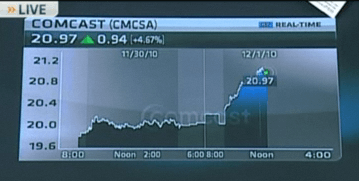
When the FCC delivers for Big Telecom's agenda, stocks soar. Comcast shares exploded on news the company could largely do as it pleases with its broadband service. (CNBC)

Comcast’s stock price soared today as Wall Street was cheered by news America’s largest cable operator would likely face little regulatory restraint from consumer protection policies designed to keep broadband providers from meddling with Internet traffic.  But investors were also excited by the green light signaled by Federal Communications Commission chairman Julius Genachowski that launching Internet Overcharging schemes like “usage-based” billing, speed throttles and hard usage caps on broadband consumers was also acceptable marketplace behavior.

Craig Moffett, a Wall Street analyst with Sanford Bernstein said Genachowski’s remarks left the marketplace with little doubt it can get away with price increases and new limits on broadband consumption.

“The FCC here is expressly acknowledging the need to ration broadband, and that’s a really big deal,” said Moffett, appearing on CNBC this afternoon.  “I think you are going to start to see usage-based pricing plans from the broadband providers pretty quickly.”

Moffett also acknowledged his firm’s own research showing consumers despise such pricing schemes and admits the impact on America’s broadband landscape is likely to include a dramatic shift in how customers use their Internet accounts.

“When customers think they are going to be charged when they click on that link and watch a movie, they are going to be inclined to watch fewer movies,” Moffett said.  “You can’t expect linear progression of online video because there are going to be feedback loops like usage-based pricing that are going to limit usage.”

Moffett says cable operators are benefiting from Chairman Genachowski’s new approach because it opens the door to repricing wired broadband accounts to limit broadband consumption.  Since most analysts guessed regulators would allow usage-based pricing to remain on wireless broadband, the unexpected green light for similar rationing plans on cable broadband, DSL, and other wired services was welcome news, at least for providers and Wall Street.

Consumers that don’t deliver a resounding negative response to elected officials, the FCC, and the White House better start thinking twice about clicking that YouTube video, because that few minutes could cost plenty if providers slap higher prices and limits on broadband service in the coming year.

[flv]http://www.phillipdampier.com/video/CNBC The Fight for Your Right to Surf the Web 12-1-10.flv[/flv]

A Wall Street telecom analyst predicts the end of unlimited home broadband accounts is going to come quickly, now that the FCC has capitulated on Net Neutrality policies.  (3 minutes)

Verizon Wireless: Our ‘Recertified’-Used Phone Replacements Are Better Than Factory Fresh Phones

Phillip Dampier November 30, 2010 Consumer News, Verizon, Video, Wireless Broadband 5 Comments

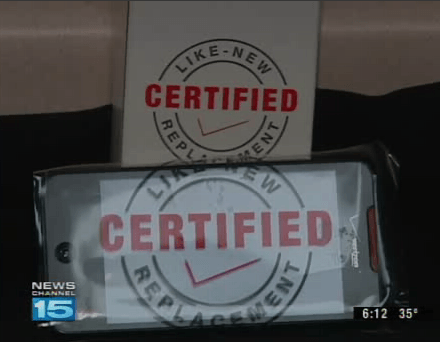
Verizon Wireless customers exchanging defective phones can expect to receive a pre-owned, "like-new" replacement from the wireless company.

Some Verizon Wireless customers are upset by the wireless company’s refusal to replace brand new, but defective phones with an equivalent brand-new phone, even just a few days after purchase.  Instead, customers are handed returned, usually refurbished phones originally used by other Verizon Wireless customers.

For some customers, that is tantamount to getting back “other people’s problem-phones.”

“You honestly have no idea how the last customer who owned the phone treated it,” writes Stop the Cap! reader Jenna, who lives in Fort Wayne, Ind.  “That person could have used it as a coffee coaster or dropped it in the street — how can you know?”

Jenna is upset because she purchased a brand new Verizon Droid phone and paid a premium for it in order to keep to just a one-year service agreement.

“This is one expensive phone, costing me hundreds of dollars, and it just quit working two days after I bought it,” she writes.

When she returned to the Verizon Wireless store expecting a new, off the shelf replacement, she was shocked when the company would only hand her a used, “re-certified” phone.

“I bought a factory fresh phone and that is what I expected to receive.  I could understand getting a refurbished phone if I had the phone six months, but 48 hours after purchase, no way,” she said.

Jenna’s replacement was handed to her in a plain box shrink wrapped with a “like new” sticker attached to the front.

“If I wanted ‘like new’ I would buy a used phone on eBay,” Jenna explains.

Despite several attempts, Verizon steadfastly refused to replace her dead phone with a new one, so Stop the Cap! alerted Jenna to the fact Verizon has a 30-day “worry-free” guarantee for new customers or those renewing contracts.  “If you’re not completely satisfied, you can cancel service within 30 days and pay no early termination fee if you return your device. A restocking fee may apply.”

“Thank you for letting me know about the 30-day trial, which gave me new leverage,” Jenna follows up.  “I walked into Verizon Wireless and talked to the same guy who refused me the first time and told him I wanted to return the phone under the 30 day policy and like magic the heavens opened.”

Jenna reports not only did the store manager promptly offer to replace her phone with a factory-sealed model, she also received some free accessories to make up for her inconvenience.

“The only way phone companies listen is when customers have some leverage to hit them in their wallets,” Jenna said.

Jenna also complained to several consumer reporters in the Fort Wayne area.  WANE-TV did a story on a reporter’s own personal experience with Verizon’s intransigence.

Jason Wagner, a Verizon Wireless store manager, told the reporter he actually preferred getting and using refurbished phones.

“I personally would rather use a certified, pre-owned [phone], Wagner explains.  “I know this phone has been checked […] and is going to work the way it should.”

“Good — he can have mine,” said Jenna.

[flv width=”480″ height=”380″]http://www.phillipdampier.com/video/WANE Ft Wayne Verizon Defends like-new Policy 11-17-10.flv[/flv]

WANE-TV in Fort Wayne talked with Verizon Wireless about their exchange policies after a reporter at the station tried to exchange her defective phone.  (2 minutes)

The Internet Toll Booth Is Open for Business: Comcast Wants More $ to Deliver Netflix Movies

Comcast wants to be paid twice for carrying Netflix online video content to its customers: once from customers themselves and a second time from Level 3 Communications, Inc., the company providing much of Netflix’s streamed video traffic.

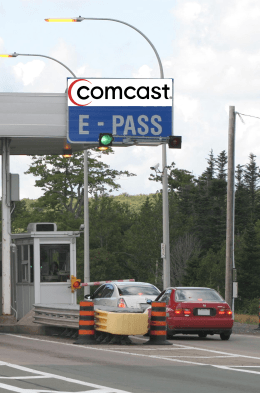
“On Nov. 19 Comcast informed Level 3 that, for the first time, it will demand a recurring fee from Level 3 to transmit Internet online movies and other content to Comcast’s customers who request such content,” said Level 3’s chief legal officer, Thomas Stortz, in a statement. “By taking this action, Comcast is effectively putting up a toll booth at the borders of its broadband Internet access network, enabling it to unilaterally decide how much to charge for content which competes with its own cable TV and Xfinity delivered content.”

The backbone and content distribution company accused Comcast of threatening the open Internet and of abusing its market position as America’s largest cable broadband provider.  Comcast disageed, calling Level 3’s position “duplicitous” and accused the company of sending far more traffic from its content partners than the cable giant sends in the other direction.

Joe Waz, senior vice president of External Affairs and Public Policy Counsel at Comcast posted a response on the company’s blog claiming Level 3 was trying to have it both ways, running a lucrative content delivery business for clients like Netflix while also acting as a major Internet backbone provider.  Waz claims Level 3 is purposely confusing the fair exchange of backbone traffic with the commercial content delivery business it also runs:

Comcast has long established and mutually acceptable commercial arrangements with Level 3′s Content Delivery Network (CDN) competitors in delivering the same types of traffic to our customers. Comcast offered Level 3 the same terms it offers to Level 3′s CDN competitors for the same traffic. But Level 3 is trying to gain an unfair business advantage over its CDN competitors by claiming it’s entitled to be treated differently and trying to force Comcast to give Level 3 unlimited and highly imbalanced traffic and shift all the cost onto Comcast and its customers.

To quantify this, what Level 3 wants is to pressure Comcast into accepting more than a twofold increase in the amount of traffic Level 3 delivers onto Comcast’s network — for free. In other words, Level 3 wants to compete with other CDNs, but pass all the costs of that business onto Comcast and Comcast’s customers, instead of Level 3 and its customers.

Level 3′s position is simply duplicitous. When another network provider tried to pass traffic onto Level 3 this way, Level 3 said this is not the way settlement-free peering works in the Internet world. When traffic is way out of balance, Level 3 said, it will insist on a commercially negotiated solution.

But Level 3 claims Comcast threatened to pull the plug if they didn’t agree to the cable company’s demands, which would have cut off Comcast customers from a wide range on content.  The company agreed to pay Comcast under protest, and took the issue public just as attention has become re-focused on Net Neutrality at the Federal Communications Commission.

The dispute increasingly resembles cable TV carriage fights where programmers threaten to yank programming if their terms are not met.  Had Comcast delivered on its alleged threat to cut ties to Level 3, widespread disruptions of content delivery could have been the result, starting with a blockade against Netflix streaming video.  That would leave Comcast broadband customers paying for a hobbled Internet experience, missing popular websites because of Comcast’s roadblocks wherever Level 3 traffic was involved.

It’s a classic case of a Net Neutrality violation, with money being the motivating factor.  Pro-consumer public policy groups immediately pounced on the news.

“Comcast’s request of payment in exchange for content transmission is yet another example of why citizens need strong, effective network neutrality rules that include a ban on such ‘paid prioritization’ practices,” said Andrew Jay Schwartzman, senior vice president and policy director of Media Access Project. “It is also yet another clear demonstration of why Comcast should not be permitted to acquire NBC Universal, given its clear tendency to exercise control in the video marketplace.”

“On its face, this is the sort of toll booth between residential subscribers and the content of their choice that a Net Neutrality rule is supposed to prohibit,” said Harold Feld, legal director of Public Knowledge. “In addition, this is exactly the sort of anticompetitive harm that opponents of Comcast’s merger with NBC-Universal have warned would happen — that Comcast would leverage its network to harm distribution of competitive video services, while raising prices on its own customers.”

Although Netflix and officials at the Federal Communications Commission both refused comment, analysts predict consumers will ultimately pay the price for Comcast’s newest fees in the form of higher prices for online content.  Comcast does not impose these fees on its own TV Everywhere online video service, Xfinity Fancast.  Waiving expensive content delivery fees for “preferred content partners” could leave independent competitors like Netflix vulnerable to the whims of the broadband providers charging extra to deliver traffic to paying customers.

The FCC is rumored to be considering enacting some broadband reforms before new Republican members of Congress take their seats in January.

(Thanks to several of our readers, including Terry and ‘PreventCaps’ for sending word.)

[flv]http://www.phillipdampier.com/video/Bloomberg Comcast Internet Toll Booth 11-30-10.flv[/flv]

Bloomberg News briefly covered the dispute in this morning’s Business Briefs segment.  (1 minute)

Tallahassee TV ‘News’ Show Absolutely Gushes Over Comcast’s Amazing “Xfinity” Name Change

Phillip Dampier November 29, 2010 Comcast/Xfinity, Consumer News, Editorial & Site News, Video 2 Comments

Good News! (For the station's advertisers)

WTXL-TV’s The Good News Show fell all over themselves last week gushing about Comcast’s rebranding as Xfinity.  The noon weekday program, apparently produced by the station’s news department, managed to obliterate any firewall between journalism and the advertising & sales department at the station.

A sampling of praise from the host, in between tossing softball questions at the two Comcast representatives followed by vigorous nodding in agreement:

  • “Wow, that -is- amazing.”
  • “It’s so much more for less, really.”
  • “I know, unbelievable!”
  • “Yeah, definitely,” in response to Comcast’s community coordinator’s statement that she thinks everyone should sign up for Comcast service.
  • “Yes, true — especially with the holidays coming this is something everyone’s going to want to get in on!”

The journalistic malpractice doesn’t stop with Comcast.  Other features practically evangelize local Tallahassee businesses and restaurants, a whole mess of which also turn out to be sponsors or “partners” offering discount coupons on the station’s website or “advice” to viewers.

A little exploration of WTXL’s website uncovered a page inviting those interested in appearing on the program to contact… the station’s advertising & sales department!:

Reach your potential customers in Tallahassee, Thomasville, Valdosta and beyond with the power of television and innovation of the internet.

ABC 27 can…

  • reach over 290,000 households in North Florida and South Georgia
  • produce your commercial in high definition
  • create custom promotions to help you reach new customers
  • increase traffic to your website and position your company more effectively through customized online advertising and sponsorships
  • put together an advertising plan that will meet your  marketing goals and fit your budget.

Your ABC 27 account executive will be dedicated to helping you grow your business and assist you through every step in creating your advertising campaign.

Of course the last people to understand this special relationship between the station and its advertisers are the viewers, who don’t appear to be told if the guests appearing on the program are also paying clients.

This is not unprecedented.  Many small city television stations beef up their ad revenue inviting sponsors to appear on morning and interview shows.  But WTXL is among the first to package it under the moniker “news” and deliver it to Florida and Georgia viewers on a Comcast/Xfinity Silver Platter.

[flv width=”480″ height=”380″]http://www.phillipdampier.com/video/WTXL Tallahassee Comcast Introduces Xfinity 11-23-10.flv[/flv]

An excerpt from WTXL’s ‘The Good News Show,’ featuring two representatives from Comcast who received a glowing reception from the program’s host.  (4 minutes)

ComedyMonday at The Chuckle Hut — AT&T: “Our Customers Like Usage-Based Billing”

AT&T Mobility thinks it has a winning strategy when it took away unlimited data plans, forcing new customers to choose high-priced, usage-limited alternatives.  But a new survey from Wall Street research firm Sanford Bernstein found AT&T customers will grab, claw, and scream to keep the peace of mind that comes from having the choice of an unlimited use plan.

Sanford Bernstein’s study found a large number of customers willing to abandon any carrier that takes unlimited data away from them.  About a third of the more than 800 people responding said AT&T’s move toward usage-based billing left them with a bad impression of the wireless carrier.  That’s particularly bad for AT&T, which already scores as America’s lowest-rated wireless company according to Consumer Reports.

AT&T mitigated some of the potential damage by letting existing customers keep their unlimited data plans when they ceased selling the unlimited option this past June.  New customers are forced to choose between two limited-use plans — $15 for 200MB or $25 for 2GB of usage (a tethering option is also available.)  Existing customers will only face that hard choice if or when they change phones, presumably in the next year or two.

Had they not grandfathered in existing customers, Sanford Bernstein’s research suggests a large proportion of customers forced to give up unlimited data would quit AT&T even if it meant buying a new phone and paying a higher bill just to get the unlimited data option back.  When AT&T eventually forces these customers’ hands, Sanford Bernstein predicts trouble.

According to the study, more than 58 percent of the lowest data users said they would dump AT&T overboard and switch to another provider with an unlimited plan. For heavier users, more than two-thirds are prepared to take their business elsewhere.

But even with overwhelming evidence like that, AT&T and some Wall Street analysts think Internet Overcharging schemes do customers a favor.
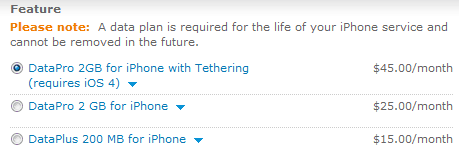
AT&T's mandatory data plans

“Customers generally have strongly negative perceptions about Usage-Based Pricing, and these are often not correlated with self-interest,” Bernstein analyst Craig Moffett said in a research note analyzing the findings of the survey conducted this past summer. “It is fashionable to argue that loyalty to carriers is dead (except perhaps to Verizon Wireless, whose service level is perceived to be markedly higher than that of its competitors). The new conventional wisdom is that carrier loyalty has been replaced with loyalty to the device. But high inclination to switch carriers and phones to maintain an unlimited plan suggest that perhaps the plan itself is more important than either one.”

The Wall Street firm’s research is hardly news to consumers, who have repeatedly expressed loathing contempt for Internet Overcharging schemes like so-called “usage-based billing,” “data caps,” and speed throttles that kick in when carriers decide customers have used the service enough.

Consumers are willing to pay a higher price just knowing they will never face dreaded “bill shock” — a wireless company bill filled with hefty overlimit fees charged for excessive data usage.  They also have no interest in being penalized by arbitrary usage limits that punish offenders with speed throttles that reduce wireless speeds to dial-up or lower.

AT&T was the first major carrier to throw down the gauntlet and force customers into choosing between a “budget plan” that is easy to exceed at just 200MB of usage per month or an inadequate, overpriced 2GB tier that costs just five dollars less than the now-abandoned unlimited use plan.

Wall Street firms like Sanford Bernstein worry their investor clients may be exposed to a revenue massacre when competing carriers like Verizon Wireless, which retains an unlimited plan for now, unveils its own version of the popular Apple iPhone.  The result could be a massive stampede of departing customers headed for top-rated Verizon Wireless, even if it means paying early termination fees.

AT&T spokesman Mark Siegel sees things very differently however, telling CNET News AT&T’s new limited option plans deliver more choice and flexibility for data-hungry users.

“We have found that our customers in fact like usage-based billing,” he said. “They appreciate having choices in data plans. This is probably because a majority of customers can reduce their costs through our plans.”

If true, Siegel could prove that contention by revealing how many of AT&T’s grandfathered-in unlimited data customers were willing to give up that plan and downgrade to one of the new limited use plans.  Siegel declined.

Moffett told CNET News his firm’s study found large numbers of existing customers using just a few hundred megabytes of usage per month who want to pay for an unlimited pricing plan, if only as insurance.  For many, they recognize the smartphone-oriented explosion of data applications will only grow their usage further in the days ahead, and what may be a tolerable usage limit today will be downright paltry tomorrow.

Underusing an unlimited data plan represents fat profits for AT&T, but doesn’t solve the problem of getting price-resistant customers to upgrade their older phones.  AT&T believes cheaper, limited use plans may do the trick.  But the company also decided to eliminate the unlimited use option, fearing some customers could cannibalize profits by downgrading currently underutilized unlimited service, knowing they could always return to an unlimited data plan when use justified it.

Verizon Wireless Sees the Light And Throws a “Sale” on Its Unlimited Data Plan, But for How Long?

Meanwhile, Verizon Wireless has settled on a more aggressive strategy to win many of its month-by-month customers back to two year service agreements with smartphone upgrades tied to an “unlimited data plan sale” that reminds would-be customers they still offer unlimited data, and gives many the chance to pay $10 less per month for it.

Customers either upgrading a current device to a smartphone on a family plan or adding a new line of service with a smartphone on a family plan will get $10 per month credit for each new smartphone line, for up to 24 months.  Although the plan was originally designed to promote “free extra lines” by crediting back Verizon’s $9.99 charge for each additional line of service, in many markets Verizon salespeople are now spinning the credit as a “sale on the unlimited data plan” instead.

Even primary line customers on a family plan can upgrade to a smartphone and get the credit.

But customers with expired contracts on legacy plans no longer sold by Verizon will have to give those up and start a new Family SharePlan starting at $69.99 per month for 700 shared minutes.  For those on popular retired plans like America’s Choice Family SharePlan, that represents a $10 rate hike for the exact same number of minutes and a loss of features including deducting mobile web use from available minutes instead of charging $1.99 per megabyte for access.

The unlimited data plan will effectively cost $20 a month for each smartphone on the account, and customers who want to use text messaging or other messaging features are likely going to need another add-on plan to cover that, starting at $5 a month.  And then the junk fees and government mandated charges further increase the bill:

  • Tolls, taxes, surcharges and other fees, such as E911 and gross receipt charges, vary by market and as of November 1, 2010, add between 5% and 39% to your monthly bill and are in addition to your monthly access fees and airtime charges.
  • Monthly Federal Universal Service Charge on interstate & international telecom charges (varies quarterly based on FCC rate) is 12.9% per line.
  • The Verizon Wireless monthly Regulatory Charge (subject to change) is 13¢ per line.
  • Monthly Administrative Charge (subject to change) is 83¢ per line.

Still, Verizon’s $10 sale may be enough to convince some customers avoiding smartphone upgrades to take the plunge.  Those doing so until the end of today through Verizon’s website can get free activation of their new phones.

Verizon hopes the offer will push a number of its legacy plan customers to abandon their old plans and grab a new smartphone at a subsidized price, putting those customers back on two year contracts.  The offer expires January 7, 2011 (and the $10 credits stop after 24 months).  The sale is only good on the unlimited data plan.

Search This Site:

Contributions:

Recent Comments:

Your Account:

Stop the Cap!