Home » Providers » Recent Articles:

CenturyLink Stick It to Embarq Retirees: Freezes Pensions of Non-Union Workers to Save Cash

Phillip Dampier December 7, 2010 CenturyLink, Consumer News, Public Policy & Gov't 1 Comment

Retired employees of Embarq, an independent phone company bought by CenturyLink in 2009 for $11.6 billion dollars, are getting a Christmas “gift” they’d rather not receive: a permanently frozen pension.

Following some earlier moves by other telecommunications firms, CenturyLink is now notifying former Embarq employees that it will permanently freeze benefit accruals for employees not represented by unions as of Dec. 31.

“These changes align our retirement benefits closer to those offered by our competitors, many of whom have previously effected similar changes over the past several years,” CenturyLink said in a filing with the federal government.

It estimated that the changes will save the company about $20 million during the next five years.

CenturyLink apparently had $11.6 billion to acquire Embarq, but does not have $20 million to spare to pay former employees legitimate pension benefit accruals after decades of service.

It is not the first time Embarq’s former employees have suffered from benefits downsizing.  In 2008, retirees were notified their health care benefits were being canceled, the company’s non-profit matching gift program was being thrown under the bus, and life insurance benefits for those most likely to need them were being capped at $10,000.

Many retirees, already having lost their savings in the Great Recession, and have no prospects for future employment, cannot afford to replace the lost benefits.  Many are well into their 70s.

A daughter of one retiree reacted to the ongoing parade of canceled benefits and broken promises to retired employees:

Last night my mother called me in tears. Not with tears of sadness but with tears of rage.

She received a letter yesterday telling her that the company that took over the company that she worked at for 25 years is stopping almost all of her retirement benefits.

Now at 70 years old this tough woman who worked almost every day of her life, never taking a dime from anyone is upset and enraged. She raised two children on her own after her divorce and at 37 years of age became one of the first female telephone lineman in Michigan (1974) later moving to and working in Florida.

She worked all those years, for the most part, to build retirement benefits that she could depend upon and that would provide the security she had been promised by the American way of life.

During her retirement years she has watched her peers turn over property and monies to their children so that they could claim poverty and collect more assistance from the government and to avoid loosing property when it comes time to move into a retirement home. She considers this cheating and never considered it.

Now, with her small 401K (that lost over 100,000 a few years ago) and social security) she makes too much for additional medical benefits that others who did not work or that collected welfare can easily get. The margin of error here? About $100 she says.

To say she is angry is an understatement. There is no way that I know of to get other persons affected by this decision to join together than to somehow get some type of exposure to what has happened. Who will fight the system for these folks who, even if they could start some type of legal action, will probably be dead before anything is decided?

Talk about disenfranchised seniors!

Not every retiree will face the prospect of seeing their benefits terminated, however.  Union employees are protected from CenturyLink’s actions, as are Embarq’s former top-floor executives.

Mike Fuller, the retired chief operating officer of Embarq Corp., keeps his package worth $24 million after leaving the Overland Park company.

Fuller received $2.7 million in severance and bonuses and will get $21.4 million in stock and other benefits over the next couple of years, according to documents filed with the U.S. Securities and Exchange Commission.

Dan Hesse, former chairman and chief executive, maintains a compensation package worth $5.9 million in 2006. He received $960,482 in salary, a $1.2 million bonus, various stock awards and other benefits.  He has since gone on to become CEO of Sprint-Nextel.

Thomas Gerke, Embarq’s top lawyer, received $460,558 in salary and other benefits totaling $2.9 million.

Some current CenturyLink employees are also finding their Christmas spirit challenged by news some are being laid off.

In Galesburg, Ill., over a dozen call center employees will keep their jobs through Christmas, but not long after that.

The reason for the layoffs?  “The company just needs to do business better,” said Company Market Development Manager Jack Moore.

“The center’s closing is part of the company’s overall plan to improve costs and gain operational efficiencies, by consolidating centers,” Moore said. “This consolidation allows the company to streamline customer service, and capture the synergies enabled by the merger of Embarq and CenturyLink.”

Comcastrophe: Customers Looking for Easy Credit for CyberMonday Outage Can Pound Salt

Phillip Dampier December 6, 2010 Comcast/Xfinity, Consumer News, Editorial & Site News, Video Comments Off on Comcastrophe: Customers Looking for Easy Credit for CyberMonday Outage Can Pound Salt

America’s largest cable company, the one seeking permission to become even bigger with a buyout of NBC-Universal, has spent the last two weeks alienating customers, vendors, and some members of Congress.  After Stop the Cap! reported on another cable company’s service outage, our reader Jared wrote to say Time Warner Cable customers should feel lucky because they can get service credits for outages.  Good luck getting them from Comcast.

He, along with more than a million other Comcast customers spent the early hours of CyberMonday offline thanks to a widespread Comcast outage on the eastern seaboard.  Outages happen, but what annoyed Jared was Comcast’s “Don’t Care” attitude, which began when he picked up the phone to call the company.

WBUR Radio in Boston explored, in plain English, the reasons for the Comcast CyberMonday outage and how it affected customers. (5 minutes)
You must remain on this page to hear the clip, or you can download the clip and listen later.

<

p style=”text-align: center;”>

“I, along with probably several hundred thousand other people called Comcast’s 800 number to find out what was going on,” he writes.  “After more than a dozen minutes of busy signals, when I finally got through, a recording came on literally telling me to go to Comcast’s website for assistance!  Duh!”

Moments after that, another recording came on the line telling him Comcast was too busy to take his call (or even leave him on hold) and he should call back later, at which point the line disconnected.

Infuriated, he called back and managed to navigate the voice menu to a human being who seem offended he was forced to take Jared’s call.

“This guy told me he didn’t know about any outage, which must have meant he was sitting in some call center well away from the region,” Jared says. “By now, anyone trying to use Comcast broadband in the northeast who still had a pulse knew it was down.”

But Comcast never misses an opportunity to miss an opportunity, further alienating Jared when the representative tried to change the subject and sell him Comcast phone service.

“I was stunned,” Jared says.  “I asked him if he was serious — why would I want to buy phone service from a cable company that cannot even manage its own phones and hangs up on customers?”

Jared asked if he could obtain a service credit for his Internet downtime.

“No,” came the reply.  “Your service has to be out for at least 24 hours.”

Jared countered he might not be a Comcast customer in 24 hours.

“That’s your choice,” said the voice on the other end of the line.

[flv width=”640″ height=”500″]http://www.phillipdampier.com/video/WMUR WBAL Comcast Outage 11-28-10.flv[/flv]

WMUR-TV in Manchester, N.H., and WBAL-TV in Baltimore were just two of many television stations that reported on Comcast’s CyberMonday outage.  (4 minutes)

Getting a copy of Comcast’s terms and conditions is not easy for non-customers.  The company wants your contact and customer information before it will admit you to its online forum and other website documents.  We found numerous instances of customers getting rejected for service credits on several websites covering the story.  But not all.  Those escalating their demands to a service manager or ending up connected to a customer retention specialist have managed to grab up to $10 in credit for the multi-hour outage, but prying them loose from the cable giant is not easy.

Our efforts to get a Comcast representative to explain the service credit procedure for the benefit of their customers reading Stop the Cap! met with silence.

Meanwhile, the Chicago Sun-Times got into it with Comcast and managed to get a spokesperson to relent — customers could get a credit by applying for one individually, but don’t count on a big payback.  Spokeswoman Angelynne Amores told the newspaper subscribers were eligible to receive a $1 credit for the trouble, but only if they asked.

Comcast does provide a flowery feel-good customer guarantee that includes a link to a customer contact form, which might cut through some red tape for customers seeking a refund, even if just a dollar, for the service they did not receive.

[flv width=”480″ height=”380″]http://www.phillipdampier.com/video/WWLP Springfield Comcast Outage 11-28-10.flv[/flv]

No credit for you from Comcast, notes WWLP-TV in Springfield, Mass.  Their viewers in New Hampshire will get nothing from Comcast for their broadband troubles.  (1 minute)

Qwest’s Chief Financial Officer: “There Needed to Be More Industry Consolidation, Like Cable TV”

Phillip Dampier December 6, 2010 Broadband Speed, CenturyLink, Competition, Public Policy & Gov't, Rural Broadband, Video Comments Off on Qwest’s Chief Financial Officer: “There Needed to Be More Industry Consolidation, Like Cable TV”

Qwest’s head of financial matters told Bloomberg News the company’s decision to sell out to CenturyLink made good financial sense because the telecommunications industry needs more industry consolidation.

Chief Financial Officer Joe Euteneuer said the time was right for Qwest to sell operations in the north-central and mountain west region because there were too many competitors in the marketplace.  Euteneuer said the telecommunications market needs to resemble the cable-TV business, which has been heavily concentrated into two huge powerhouses — Comcast and Time Warner Cable.

Qwest’s merger with independent telephone company CenturyLink continues the consolidation underway among independent phone companies not affiliated with AT&T or Verizon Communications.  The merged entity will challenge Frontier Communications’ position in the landline marketplace.  Regulators in Qwest’s service area have been giving cursory review of the proposed merger and the company expects few problems in getting the merger deal approved in every state affected.

Euteneuer

The merged entity, tentatively to be called CenturyLink, has been spending most of its public relations efforts talking up the reshuffling of its management and executive office operations.

CenturyLink is promoting executives to new regional management positions the company unveiled Friday.  CenturyLink’s new regional structure:

  • Eastern, headquarters in Wake Forest: President Todd Schafer, current president of Century Link’s Mid-Atlantic region. Member states are Georgia, New Jersey, North Carolina, Ohio, Pennsylvania, South Carolina, Tennessee and Virginia.
  • Midwest, headquarters in Minneapolis: President Duane Ring, current president of CenturyLink’s Northeast region; Illinois, Indiana, Iowa, Michigan, Minnesota, Nebraska, North Dakota, South Dakota, Wisconsin.
  • Mountain, headquarters in Denver: President Kenny Wyatt, current president of CenturyLink’s South Central region; Colorado, Montana, Utah, Wyoming.
  • Southern, headquarters in Orlando: President Dana Chase, current president of CenturyLink’s Southern region; Alabama, Arkansas, Florida, Kansas, Louisiana; Mississippi, Missouri, Oklahoma, Texas.
  • Northwest, headquarters in Seattle: President Brian Stading, current vice president of network operations and engineering for Qwest; California, Idaho, Oregon, Washington.
  • Southwest, headquarters in Phoenix: President Terry Beeler, current president of CenturyLink’s Western region; Arizona, New Mexico, Nevada.

For both companies’ tens of thousands of employees, there is some trepidation about “cost savings” (translation: job losses) that are also expected from this deal.

In Nebraska, more than one thousand employees remain unsure whether they’ll still have jobs after the merger.

Qwest’s president for Nebraska operations, Rex Fisher, is not waiting around to find out.  He’s leaving, saying CenturyLink’s plan to restructure management roles “weren’t opportunities I was interested in,” the 53-year-old executive said.

A Qwest spokeswoman told the Omaha World-Herald the change in itself will have minimal immediate impact on the workforce level in Omaha.

Joanna Hjelmeland told the newspaper specific changes for Omaha’s workforce will “become more clear down the road,” Hjelmeland said.

“We are combining two companies, and in some instances there are going to be redundancies,” she said. “Eventually there are going to be job reductions as a result of the merger.”

[flv width=”512″ height=”404″]http://www.phillipdampier.com/video/WKBT La Crosse WI CenturyLink moving regional headquarters out of La Crosse 12-1-10.flv[/flv]

WKBT-TV in La Crosse, Wis., reports the city is going to lose Qwest’s regional headquarters, formerly located in La Crosse, as part of the merger shuffle.  (1 minute)

Brian Stading, current vice president of customer operations for Qwest in Denver, is now preparing to relocate to head the regional office in Seattle.  He outlined some of the changes expected to impact Qwest/CenturyLink customers in the region.

“I think you’ll see the continued focus on providing the highest quality service at the best possible price, both from a local phone service as well as from a high-speed Internet perspective and you’ll see a continued emphasis on expanding our broadband capability both in the city as well as in regional areas,” Stading told the Puget Sound Business Journal.

Stading claims the company will be refocusing efforts to improve the reliability of its core business – landline service, and make incremental upgrades to broadband capability and speed.

“A lot of that does overlap with our high-speed broad deployment because any time we have the opportunity to go put in new fiber lines, it just provides additional quality throughout our backbone networks, so the two really do go hand in hand, both the expansion as well as the continued emphasis on reliability,” Stading said.

But there is every indication Stading is referring to middle-mile fiber infrastructure — cable that runs between telephone company central office facilities, and not to individual customer homes.  CenturyLink, like Qwest, relies almost exclusively on DSL service delivered over standard telephone lines for broadband services.  Qwest has also been deploying ADSL 2+ technology, a more advanced form of traditional DSL, in some areas in the Pacific Northwest and mountain west region.  But many Qwest customers have no access to broadband at all, because of the remote areas the phone company serves in many states.

[flv width=”640″ height=”500″]http://www.phillipdampier.com/video/Bloomberg Qwest’s Euteneuer Says Industry Consolidation Was Needed 11-18-10.flv[/flv]

Bloomberg News talks to Joe Euteneuer, Qwest’s CFO about why Qwest merged with CenturyLink.  (4 minutes)

Australia Continues March to Abolish Usage Caps As Terabyte Usage Allowances Debut

Phillip Dampier December 6, 2010 Competition, Data Caps, Optus (Australia), Video 2 Comments

While some American broadband providers continue to dream of Internet Overcharging schemes for American customers, one of the world’s most usage-capped countries continues its march forward to abolish them.  Australia’s Optus, a major broadband provider, today announced it was dramatically increasing usage allowances on customers, effective immediately.

The Fusion 99 plan, which bundles telephone and broadband service, sees its data allowance increased from just 15GB of usage per month to 500GB (twice that of American cable giant Comcast).  Ditto for the Fusion 109 plan, which originally doubled the 15GB limit to 30.  Now it offers a 500GB allowance of usage.

If 500GB isn’t enough, Optus has announced its Fusion 129 plan includes 1000GB — a terabyte — of usage per month, which includes unlimited long distance calling and calls to Australia’s mobile phone customers (most countries outside of North America require the calling party to pay mobile rates when calling a mobile customer).  Even customers on Optus’ budget-minded standard and “naked” (standalone) broadband plans will benefit from new 500GB allowances.  Those who manage to exceed their allowance will find broadband speeds reduced to 250kbps until the end of the billing cycle.

Some Australian ISP’s take all limits off during off-peak usage hours.  The country has traditionally suffered from usage caps because of international undersea cable capacity problems which restrict how much traffic can be sent and received between the South Pacific and North America and Europe.  Increased undersea fiber capacity is tempering those traffic restrictions, and momentum towards unlimited use plans (or those with ridiculously high allowances) is the result.

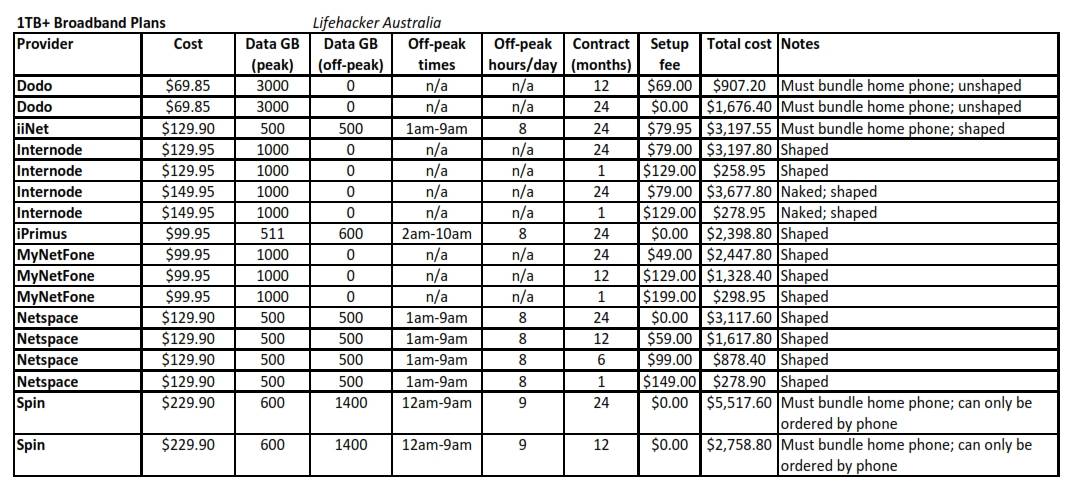
Lifehacker produced a broadband plan breakdown showing the dramatically increasing usage allowances for Australian broadband customers. Traffic shaping continues to be an issue, however. Such speed control measures traditionally target peer-to-peer traffic. Total cost is the total price of the service over the length of the term contract. This chart represents high end plans, typically offering the highest speed tiers. All dollar amounts are in Australian dollars.

[flv]http://www.phillipdampier.com/video/ABC The Gruen Transfer Telco Ads 11-2010.flv[/flv]

The Australian Broadcasting Corporation’s ‘The Gruen Transfer’ takes a humorous look at how phone companies Down Under advertise their services, including a reference about how “capped” services represent revenue gold to service providers.  (15 minutes)

Comcast Bans Twin Cities Wi-Fi Upstart’s Ads After Pointing Out Comcast CEO’s Salary on Billboards

USI Wireless' TV Ad was rejected by Comcast

“Our competitor’s CEO made $27 million last year. Ever wonder why you pay so much for Internet?”

That question is posed on an enormous billboard over downtown Minneapolis.  It comes courtesy of US Internet of Minnetonka, a tiny wireless provider competing against Comcast in Minneapolis.  The Wi-Fi upstart has taken center stage in another dispute with Comcast that threatens to have national implications.

For US Internet, the cable giant is already big enough to throw its weight around, because the Wi-Fi competitor has been notified it is not going to get its television ads seen by Comcast subscribers.

That struck Joe Caldwell, CEO of USI Wireless, as anti-competitive.

“I spent thousands of dollars to get this ad produced, and now Comcast won’t run it,” Caldwell told the Minneapolis Star-Tribune. “I think maybe they’re mad at me because I said the CEO of Comcast made too much money.”

Although Caldwell’s billboard only names Comcast in fine print, barely visible from Minneapolis streets, his company’s door-hangers are more direct:

“We at USI Wireless would like to congratulate Qwest & Comcast for both having sports arenas named after them. Ever wonder why you pay so much for Internet?”

Comcast told Caldwell it could not run his ads because they are a competitor.

USI Wireless charges $14.95 a month for wireless access across the city.  Comcast charges between $40-115 for its standalone broadband service.

It’s not the first ad controversy for USI, which irritated some residents back in May with some edgy billboards featuring a woman some described as a prostitute next to big, bold print: “Fast, Cheap, and Satisfaction Guaranteed.”

USI got into some controversy with its earlier billboards, which raised more than a few eyebrows.

Caldwell’s television ad features Fancy Ray McCloney, head of Minneapolis-based ad agency Chocolate Orchid Productions, as its pitchman, loudly asking, “Why pay $30 to $60 a month when you can get the same quality service for as low as $14.95?”

McCloney adds salt to USI’s wounded bank account because, as he tells it, it was Comcast that invited him to produce the ad and get it running on the system.  McCloney claims a Comcast advertising representative contacted him after seeing the billboard and invited USI to buy TV advertising.

“They saw the billboards, and they asked if they could get some of that advertising business on Comcast cable,” McCloney told the Star-Tribune.

After Caldwell spent $7,500 producing the TV ad, Comcast now says it cannot run on their system.

A local Comcast spokesperson told the newspaper he didn’t know if McCloney’s story was true or not.  A national spokesperson for the cable company said Comcast decides on a case-by-case basis whether to take advertising for services that compete with Comcast.

The dispute threatens to have national implications as Comcast pushes to have its merger with NBC-Universal approved.

With ownership of additional broadcast outlets, would-be competitors to Comcast could find themselves banned from advertising on broadcast stations with ties to the cable operator.

[flv width=”640″ height=”380″]http://www.phillipdampier.com/video/USI Wireless Ad.flv[/flv]

USI Wireless’ “banned” TV ad, which makes no mention of Comcast by name, or the current controversy.  (1 minute)

Search This Site:

Contributions:

Recent Comments:

Your Account:

Stop the Cap!