Home » Providers » Recent Articles:

Verizon Wireless Eliminating “New Every Two” Program; Other Upgrade Discounts Being Phased Out

Phillip Dampier January 5, 2011 Consumer News, Verizon, Wireless Broadband 6 Comments

Verizon's new upgrade policy, courtesy of Android Central.

Verizon Wireless is making changes to their handset upgrade programs, all to the benefit of their bottom line and not to yours.

In training materials obtained by Android Central, Verizon is discontinuing its “New Every Two” handset discount program for customers who sign new contracts after Jan. 16 and will stop allowing customers to obtain early upgrade discounts on new phones before their contract nears expiration.

The “New Every Two” promotion has been a familiar part of Verizon Wireless service for years.  Customers finishing their two year contracts receive a $50 discount on their next new phone with the carrier, as long as they sign a new two year contract.

Early upgrades, which used to qualify customers for discounts during months 13-20 of their 24 month contract, are coming to an end as well.

There is some speculation the early upgrade plan is being curtailed to try and stop a rush on the rumored Verizon iPhone due early this year.

Since many customers upgrade to more expensive smartphones, the “New Every Two” program only delivers a discount, not the new free phone it provided in an earlier era.

Still, the loss of discounts will effectively give the biggest benefits to Verizon Wireless’ bottom line, allowing the company to reduce subsidies it pays on behalf of customers demanding the latest and greatest new phones.

Exclusive: Frontier’s California Confuse-o-rama: Residents Victimized by Frontier’s Changing Stories

Elk Grove, Calif. residents receiving letters from Frontier Communications claiming they are using the company’s Internet service too much are getting confusing responses from the phone company when calling to register complaints about the Internet Overcharging scheme.  Even worse, one company official told a subscriber they have to keep the new usage limits secret “for legal reasons in case we have to change it again.”  But no worries, Frontier explained to one customer: if you exceed the secret cap again, you’ll be notified future overages will be conveniently billed on a future Frontier bill.

Stop the Cap! has been receiving dozens of e-mailed complaints from customers upset that the company’s bait-and-switch broadband also comes with uninformed customer service representatives who can’t deliver straightforward answers to customers trying to understand how they can avoid up to $250 a month for 3Mbps DSL broadband service.

“When I signed up for Frontier DSL, nobody said a thing about usage limits,” writes our reader Trina who lives near Camden Park.  “My small business has DSL from Frontier as well and we were horrified when we received a letter telling us we were over-using their service.”

Trina and her husband have four teenage boys living at home, all sharing their Frontier DSL account.  When she called the company in response to the letter she received, the confusion began.

“The first representative didn’t understand what I was talking about and denied there were any limits and said the letter must have been a mistake,” Trina says. “But my husband noticed others in our area were talking about the letter on area message boards so when he called, he got a representative that confirmed the limits were real.”

Trina was told her home would need to upgrade to Frontier’s $249 monthly DSL service plan, the same one Frontier held over the heads of some customers in Mound, Minn. last year.

“I told them they must be smoking crack — are they serious?  There is no way I am going to pay $250 a month for DSL that gives us 1.5Mbps service — not in this world,” Trina says.  “My husband laughed when I told him, saying Frontier is going to drive themselves out of business from this stupidity.”

Elk Grove reader Stephen also called Frontier after he received a letter stating he used over 100GB in a month.

“Yeah, I used 104GB according to my router’s logs and Frontier deemed me a bandwidth abuser,” Stephen writes.  “Of course the company tried to sell me a plan priced at $100 a month for their lousy DSL service we got suckered into on one of their term contracts.”

Stephen said he’d manage to find a way to shave 5GB off his monthly usage and forego Frontier’s $99 offer until he signs up with a competitor and tells Frontier to take a hike.

“It’s one thing to be abused by a lackluster phone company like Frontier who never did a thing for Elk Grove — it’s another to pay them more for their abuse,” he writes.

Stop the Cap! reader Pete, also in Elk Grove, says he can’t get a straight answer over exactly what the monthly limit is.

“When I called, I was told 5GB by one representative, 100GB by another, but get this — when I logged into the ‘Flexnet’ Usage Meter the company tells you to review, it showed I had a 20GB limit,” Pete says.  “I called Frontier on the phone and told them I was so through with them — I can’t stand their nonsense.”

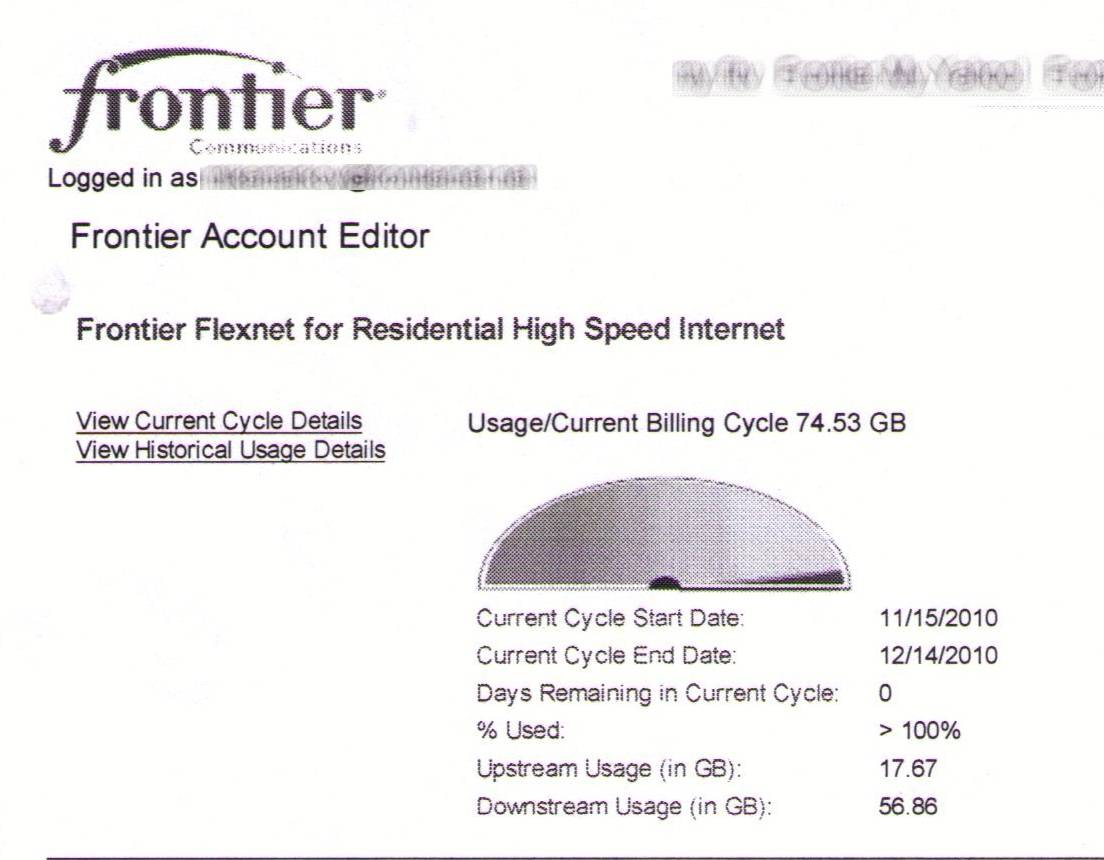
Pete wasn’t alone.  Our regular reader Mike figures his cap was actually 20GB a month if the company’s usage meter was to be believed, and he sent pictures.

“I got their nastygram last month over my usage and now my Flexnet meter shows me over the limit,” Pete says.  “I have been vocal on a local Elk Grove message board so I’m feeling like this is retaliation.”

In fact, Mike’s usage meter depicts him as well over the arbitrary 100GB limit Frontier suggests in their letter, despite not coming close to 100GB of usage.  Ditto for our reader Michelle who lives in Palo Cedro, a community Frontier can largely hold captive thanks to limited competition.

Benjamin, also in Palo Cedro, says Frontier’s move will hurt small businesses in the northern California Shasta County community of 1,200.

“I need high speed Internet to help start my business, which will largely involve uploading and downloading multimedia, (which is hard enough to do on a 1.5 connection) but to increase the cost is absolute insanity,” he says.
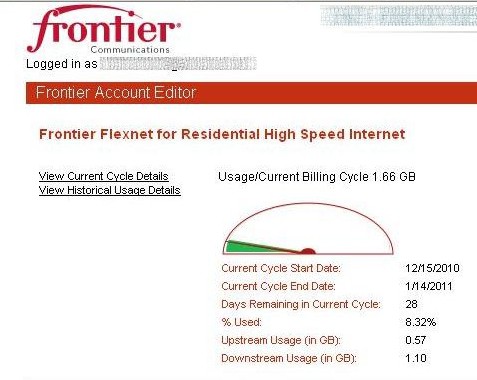
Our reader Mike discovered Frontier's usage meter suggests he has far less than a 100GB monthly usage allowance.

Benjamin’s alternatives barely qualify.

“I can either try Clearwire, which works terribly locally and is known for its speed throttles when congested, or HughesNet satellite-delivered Internet, which is overpriced,” Ben adds.

As our readers already know, satellite fraudband is no replacement for real broadband service, because it comes with a “fair access” policy that isn’t fair and doesn’t deliver much access.

“I will fight this any way I have to,” Benjamin says.

John in Elk Grove writes in to say the entire affair is a Frontier shell game.

“It’s pure bait and switch to sell us broadband without limits and then suddenly impose them while we are supposed to be on ‘price protection agreements’ that the company says will keep our prices stable,” John says. “Now we learn it’s all a shell game — they can say we used too much and that doesn’t count with their price protection scam.”

John adds Frontier can change the limits at will, and customers who choose to depart could still face enormous cancellation penalties.

“The Frontier representative I talked to when I called to cancel service told me I owed $300 for ending my contract early,” he said. “I told them to go to hell and that if they tried to collect, I’d personally make it my life’s work to cost them far more than that in lost business.”

Customer anger only increases after speaking with Frontier’s own representatives.
Uh oh. Frontier suggests Mike has already blown through his monthly usage allowance, despite his carefully reduced use of the service.

“Mr. Brown” shares his experience:

I am an Elk Grove resident and a Frontier DSL internet customer. I received the same letter from Frontier about exceeding the 100gb of bandwidth within a 30 day period. It said that I must reduce the amount of use or bump my account up to the next tier of service, a $99/mo business account.

I called the number on the letter to talk to a customer service representative so that they would not disconnect me for not responding within 20 days. I asked him if there is a maximum bandwidth cap. He told me that there is no cap, but that their terms of service says that they can disconnect you if you are exceeding reasonable usage and that Frontier will determine what is reasonable usage. The representative could not help me any further so he connected me with his supervisor.

The supervisor said that Frontier sent this letter out to about 1,000 customers in Elk Grove and that most of the customers who have called after receiving the letter have not questioned them and said they they will reduce their usage.

He also said that there is no longer any $99/mo plan, the only option is to reduce usage. He said they sent the letters out to the costumers who are using more than a reasonable about of bandwidth telling them to use less Internet. Then if they did not, Frontier will send another letter saying that if they use more than a reasonable amount that they will charge the customer for anything over.

He went on to say that Frontier had to remove the statement about the previous 5GB bandwidth cap in their terms and conditions and that for legal reasons they are not going to tell us what the new limit is, in case they have to change it again in the future.

I tried to get him to admit that there is a cap and to tell me what that limit was, but he would not.  He would only say that I would be okay if I did not go over 100gb/mo and that if I do, to expect to receive another letter with the new terms that would allow them to charge my account for excess bandwidth.

The one thing is common with readers we’ve heard from is their urgent search for a new provider.

Trina canceled all of her Frontier services at home and at her business and switched to SureWest, a fiber to the home provider.  Joining her includes Mike, Stephen, Pete and John.  Together, their combined disconnects will cost Frontier more than $500 a month in lost revenue, all because of broadband traffic that costs Frontier far less than 5 percent of that amount.  If each customer shares their horror story with friends, family, and neighbors, the loss in revenue could cost far more.

For customers like Mike, he can’t wait to get his SureWest service installed.  The company offers to buy out current contracts with companies like Frontier valued at up to $200, and their fiber-delivered broadband service leaves Frontier’s speeds in the dust.  Mike says if Frontier gives departing customers a hard time about early cancellation fees, file a complaint with the California Public Utilities Commission Consumer Affairs Branch.

SureWest offers 3/3Mbps service for $36.99 per month, 25/25Mbps service for $51.99 a month, and 50/50Mbps service for $181.99 a month.  A $3.99 High Speed Internet features and services charge applies.  There are no limits on SureWest’s Internet service.

SureWest delivers several fiber to the home broadband service plans that best Frontier's DSL speeds by a mile.

Frontier offers 3Mbps service with a slower upload speed for $32.99 per month or 10Mbps service for $44.99, both with a required price protection plan and $6.99 monthly modem rental fee.

“Why in the world would you pay Frontier more for less service,” asks Pete.  “Once they pile on the administrative fees, surcharges and taxes, it’s well north of $40 a month, and you don’t even get the speed they advertise, much less the usage limits they don’t.”


MetroPCS Introduces Pay Walls for 4G Users: Web Favorites Locked Out Unless You Spend More

Phillip Dampier January 4, 2011 Broadband Speed, Competition, Consumer News, Data Caps, Editorial & Site News, MetroPCS, Net Neutrality, Online Video, Public Policy & Gov't, Video, Wireless Broadband Comments Off on MetroPCS Introduces Pay Walls for 4G Users: Web Favorites Locked Out Unless You Spend More

Hammer Time: MetroPCS introduces 4G/LTE service plans that establish pay walls for familiar web content.

Want a sneak preview of America’s Internet experience without real Net Neutrality?  Look no further than MetroPCS which has managed to turn the clock back to the early days of “mobile web,” where carriers pre-selected content and blocked much of the rest.  Want access anyway?  Then spend some time with a spreadsheet to figure out what service plan you’ll need and start counting out some ten dollar bills because MetroPCS promises a Long Term Expensive 4G  experience.

The business press focused on MetroPCS’ new pricing — delivering what the company calls “a selection of data access levels to meet customers’ lifestyles.”  But some public interest groups considered today’s announcement the first gauntlet thrown in the Net Neutrality war since the FCC voted to approve a watered down version of the open Internet policy last month.

MetroPCS called their new plans a boon to customers.

“Our customers told us they wanted more video, more sharing of their content and more Web browsing capabilities – they want to have it all with the value and no annual contract that only MetroPCS can deliver,” said Roger D. Linquist, president, CEO and chairman of MetroPCS. “Our 4G LTE network can deliver unlimited voice and mobile broadband data services and, with these new service plans, consumers are in the driver’s seat on how much additional data access and real-time entertainment content they want to pay for on a monthly basis.”

But many customers will discover the company’s road to good intentions pitted with potholes, toll booths, roadblocks, and diversions.

Just getting on this data highway to hell could be very confusing to customers who will need to think about what websites and services they need, want, or can live without, and then finding the corresponding service plan that makes it all work.

MetroPCS says it has three new pricing levels to consider:

  • The $40 service plan offers unlimited talk, text, 4G Web browsing with unlimited YouTube access.
  • The $50 service plan includes the same unlimited talk, text, 4G Web services and unlimited YouTube access as the $40 plan. Additional features include international and premium text messaging, turn-by-turn navigation with MetroNAVIGATOR™, ScreenIT, mobile instant messaging, corporate e-mail and 1 GB of additional data access, with premium features available through MetroSTUDIO™ when connected via Wi-Fi, including audio capabilities to listen and download music and access to preview and trial video content.
  • The $60 service plan provides the same premium features as the $50 plan, plus unlimited data access and MetroSTUDIO premium content such as 18 video-on-demand channels and audio downloads.

You'll need a smart phone to figure out what pricing plan actually delivers the services you need.

A customer could be forgiven if they assumed the $40 plan provided “unlimited web browsing,” which will be interpreted to mean they can access all of the content contained on those websites, but they would be wrong.  Beyond YouTube, MetroPCS customers will need to spend at least $10 more to access embedded video and audio, play online gaming, and access other rich media services.  Want to view videos from a website that isn’t among the carrier’s “preferred content partners?”  Forget it.

What about Skype, Netflix and other popular services?  Nuh uh.

Only the $60 monthly plan delivers unlimited data, along with pre-selected video and audio you can access… or not.

Free Press Policy Counsel M. Chris Riley called MetroPCS’ foray into the toll highway business a profit padding scheme.

“In December, the FCC chose to disregard wireless protections in its Net Neutrality order, and MetroPCS’s new scheme is a preview of the wireless future in a world without protections on the mobile Web. Such blocking of websites, services or applications would clearly be prohibited and deemed unreasonable on a cable or DSL network. Are these the kinds of restrictions the FCC really wants to promote on wireless networks?

“The open Internet order approved in December stated that the FCC was not implicitly approving practices on the mobile Web that violate its rule against unreasonable discrimination – and now we’ll see whether the agency is willing to do anything about such practices. Silence in the face of ongoing violations is no different from outright approval. If MetroPCS is allowed to engage in rampant discrimination and blocking of Internet applications and services, will Verizon be next? Will AT&T extend its history of blocking services like VoIP and Sling on its LTE network in the future?

“MetroPCS’s plan will restrict consumer choice and innovation in a developing mobile market, all for the sake of further padding its bottom line. The FCC must not stand idly by while carriers are engaging in anti-consumer and anti-competitive behavior, and we urge the agency to investigate.”

[flv width=”640″ height=”500″]http://www.phillipdampier.com/video/MetroPCS 1-4-10.flv[/flv]

It’s too bad the company that regularly lampooned their wireless competitors in witty commercials has now adopted the same “gotcha” tricks and traps that will leave customers trying to figure out why they can’t access the web content they thought they paid to receive.  Watch a series of amusing MetroPCS ads and a brief review of the company’s new 4G phone courtesy of TheStreet TV.  “Hello. Hello. Hello.”  (7 minutes)

Telecom Deregulation Fails Canadian Consumers: Mediocre Broadband Now Comes With Limits

The Public Interest Advocacy Centre just released a report that found deregulation in Canada's telecommunications marketplace delivered most of the benefits to providers, leaving consumers holding the higher bill.

Four years after Canada deregulated its telecommunications industry with the promise it would bring competition, better service and lower prices, Canadian consumers are instead paying too much for broadband service that delivers too little.

That is the conclusion of a new report from the Public Interest Advocacy Centre, a non-profit consumer protection organization that compared provider promises with the bills ordinary Canadians ultimately pay for their Internet service.

Michael Janigan, the report’s author told CBC News that deregulation has brought “super-normal” profits for Bell, Telus and Rogers — among Canada’s largest telecom companies — while those same providers continue to increase prices and, in some cases, reduce the amount of broadband usage customers can access before overlimit fees kick in.

“We still have three big players with over 90 per cent of the market, and they’re pretty fat and happy,” Janigan said in an interview with CBC News. “We’re still seeing the incredible clout of the big telcos in relation to their ability to swing competition in their favor.”

Bell, Canada’s largest telecom company, stands to gain even more power over the broadband marketplace with a ruling from Canada’s telecommunications authority that has direct implications for Canada’s independent service provider market.  Most third party providers obtain their Internet connectivity from Bell at wholesale pricing.  Thanks to a now-approved-request from Bell to charge wholesale customers usage-based pricing, providers are now forced to pass along those artificially high prices to Canadian consumers.

“The days of unlimited Internet service are about to become extinct in Canada,” says Stop the Cap! reader Giles in Trois-Rivières, Quebec.  “How surprised can you be that the company that sells access to competitors has managed to find a way to price that competition out of business.”

For one such competitor, Primus, the effect of Bell’s usage-based pricing will have an immediate impact on their customers’ monthly bills.

The company is now notifying customers that effective Feb. 1, the unlimited service plans that appealed to those opposed to usage-limited broadband will be now limited to just 25GB of usage per month.  Primus directly implicated both Bell and the the Canadian Radio-television and Telecommunications Commission (CRTC) for the pricing changes.

Those who exceed the limit face overlimit fees of $2.00 per gigabyte, up to a maximum of $60 per month.

Here today, gone tomorrow: Primus is discontinuing its unlimited use services. Effective Feb. 1, overlimit fees of $2/GB kick in after just 25GB of usage.

Those limits could put Primus at a competitive disadvantage with larger providers delivering lower cost plans with higher usage allowances.

“Why would you still be a Primus customer after this,” asks Giles.

Primus will not be alone among third party DSL service providers — almost all will be forced to adopt similar pricing.  The result? More expensive service for Canadian broadband customers, and major troubles for third party competitors whose new pricing could turn customers away.

The price increase is a direct result of a recent decision by the Canadian Radio-television and Telecommunications Commission (CRTC) to approve Bell Canada’s request to introduce Usage Based Billing on wholesale Internet services. Over the last four years, critics charge the CRTC with abandoning its watchdog role to protect Canadian consumers from unfair and uncompetitive practices and kowtowing to the interests of large telecom companies.

“In 2006 and 2007, the government stepped in to tell the CRTC to deregulate as a priority and to deregulate local telephone service faster promising better deals for consumers. As a our report notes, this did not happen despite all the hype”, said Janigan, author of the report, Waiting for the Dream, The Consumer Brief for Telecom Reform 2010.

In fact, the report concludes that Canada’s performance in telecommunications services such as broadband and wireless has been less than impressive, and the results for customers of cable and satellite services from deregulation of basic service has been the opposite of what should be expected in competitive markets.

“It is one thing to try a course of action that doesn’t work out: it is another to ignore the results and simply try more of the same,” said Janigan. “It doesn’t now make sense to have a government Policy Direction in place that hampers both competition and consumer protection”:

This report concludes that the failure of the regulatory reform of the last two decades to deliver the goods for ordinary residential consumers is not one that has its roots in theory, but in practice. Here, the interests of powerful stakeholders have affected the service landscape. In the same way that incumbent players used their political and economic influence and regulatory capture to get their way in the monopoly era of regulation, the winners have used the market- based system to their advantage. Neither regulation nor deregulation will engineer a thriving telecommunications industry producing innovative and efficient products and services with resultant economic growth for Canada if the decision making processes for each are skewed by conditions and assumptions that favour some stakeholders over others.

Most importantly, the governance and regulation of the telecommunications industry in Canada must respond to results. For the most part, the restructuring of telecommunications has been guided by untested economic theories, largely provided by experts engaged by the largest stakeholders. The relatively poor performance of telecommunications service for ordinary consumers should have long ago engendered a review of the  regulatory framework and market structure that is producing the same. In the last five years, the only acknowledged measure of success has been how fast telecommunications services have been deregulated with predictable market results.

The solution is not a return to old regulation but new models. First of all, there are a variety of consumer issues associated with basic rights for information, quality of service, security of service, disconnections, privacy etc. that should be met by all carriers whether they are incumbent or not. Basic service, obligations to serve, complaints resolution, and burdens of service in uneconomic areas have to be in place for all across the board. The best way to ensure that this occurs is for mandatory licensing for all carriers, with appropriate codes of conduct and enforcement with meaningful force in the form of administrative monetary penalties. The Telecommunications Act should be amended to reflect these improvements.

Interconnection with essential telecommunications facilities should be available for competitors at rates that are fair to users and suppliers. We cannot let abstruse theories supposing innovation and duplication in the absence of access to govern this important issue.

New Jersey Mayor Presses Verizon for Explanation of Extended Service Outage

Phillip Dampier December 29, 2010 Consumer News, Public Policy & Gov't, Verizon 1 Comment

Pagliughi

Avalon mayor Martin Pagliughi wants answers about why Verizon left hundreds of residences and businesses on the Seven Mile Island with intermittent phone service for more than a week, with no notification or explanation forthcoming from the telephone company.

The service outage, which began Oct. 28, extended all the way until Nov. 8, forcing customers to endure incomplete calls, one-sided conversations, and other problems.

Verizon blamed a piece of failing equipment for the outage — a technology card installed at a switching office in central New Jersey.  The result was disrupted service for residents of both Avalon and neighboring Stone Harbor, and Verizon officials never realized it.

Verizon officials claimed technicians missed the failing card because an alarm on the card never sounded.  Dozens of complaints from customers were ignored by Verizon customer service representatives.

Pagluighi wants to know how this could have happened.

“It was very troubling to me that in an era of mass telecommunications and putting men on the moon that Verizon could not be aware of a big problem in Avalon and Stone Harbor while dozens of complaints were coming into their representatives,” Pagliughi told the Cape May County Herald.

He added that many residents told the borough that when they contacted Verizon to complain about the lack of telephone service, Verizon reps told them their complaint was the first one from Avalon.

“This outage is not only about an inconvenience to our community, it’s really about a critical public safety issue,” Pagliughi said. “It’s time for utilities that make a lucrative business in our communities to have a greater level of accountability for the services they are paid to provide,” he said.

The mayor met with public safety officials and representatives from Verizon to create a plan to prevent a repeat occurrence.  Had the winter storm that barreled up the east coast over the weekend struck at the same time as the phone outage, public safety could have been at risk.

The newspaper reports the parties agreed to take the following actions:

  • A total replacement of the technology card that failed during the telephone outage. The card will be replaced by technicians sometime during January 2011 with no anticipated interruption of telephone service;
  • Verizon will draft a plan that will result in greater recognition of a community-wide problem along with proper notification of emergency management authorities in the affected region;
  • A special practice “drill” will be conducted involving county and municipal emergency management officials that will test Verizon’s new contingency plan to notify a community when a phone outage occurs;
  • Verizon will arrange a field trip during the first quarter of 2011 so local officials can talk with staff at a local field office to discuss communication efforts between the utility and local emergency management officials.

Search This Site:

Contributions:

Recent Comments:

Your Account:

Stop the Cap!