No significant expansion for FiOS in 2011, say company officials.
A Verizon spokesman has confirmed Verizon will not be expanding its FiOS fiber to the home service into new areas in 2011, except in those communities where the company already signed franchise agreements.
It’s the second year of Verizon’s hold on fiber expansion, instituted because of objections by Wall Street, a difficult economy, and a less optimistic view by Verizon’s new management that fiber has the capacity to quickly return on investment.
For upstate New York, the end-effect of Verizon’s decision is an odd patchwork of partially-built FiOS-capable communities, mostly in suburbs amenable to Verizon’s franchise terms. Some suburbs have access to FiOS broadband and phone service, but not television. Others have access to all three services, while many other areas have nothing but Verizon’s ordinary copper phone lines.
“If you are big on fiber, there are some outlying towns with real estate agents that list whether or not their properties have Verizon FiOS, and whether that includes television service,” says Lysander, N.Y. resident Jeff, who reads Stop the Cap! “Our town was just glad Verizon picked us for upgrades and we didn’t ask too much of the phone company, quickly agreeing to a TV franchise agreement.”
But residents in the city of Syracuse are less happy — they won’t get competitive video from Verizon and are stuck with a Time Warner Cable wired monopoly because the city “dragged its feet” on franchise negotiations.
“When it comes to bigger cities, they see Verizon’s knock on the door as an opportunity to cash in on freebies from the phone company, like upgrading their video studios for government access channels, paying substantial franchise fees, and agreeing to carry channels the city government wants on Verizon’s cable system,” Jeff says. “When the first cable systems came to town, it was the same story; some communities dragged their feet for years trying to extract more.”
Of course, cities don’t have to wait for Verizon to take care of their growing broadband needs. They can build their own fiber networks and deliver world class service themselves, or open the new networks up to private competitors to deliver bigger bang for your broadband buck.
[flv width=”480″ height=”380″]http://www.phillipdampier.com/video/WSYR Syracuse FiOS availability not planned for Syracuse during 2011 1-6-11.flv[/flv]
WSYR-TV in Syracuse reports it will be a long wait for many in central New York waiting for fiber to the home television service. (Warning: Loud Volume) (1 minute)
Disgruntled AT&T customers, and those with infinite patience for Apple’s iPhone on Verizon Wireless’ network — your long wait appears to finally be over.
After nearly a year of speculation, Verizon Wireless is expected to announce the imminent arrival of the coveted smartphone on the nation’s largest wireless carrier at a press event tomorrow.
The Verizon version of the iPhone could come at a price premium, with some anticipating the entry level version of the phone could be priced as high as $249 — $50 higher than with AT&T. The usual two year contract applies.
Analysts predict a muted stampede, at least at first, by unhappy AT&T customers. As many as two million customers itching to dump AT&T could jump to Verizon in 2011, but they’ll pay dearly to do so. First, their existing AT&T iPhone won’t work on Verizon’s network, so that means a new phone and a new, two year contract with Verizon to get the best price. Second, AT&T locked many of its customers into two year contract extensions with the release of the last iPhone in June. No amount of whining by iPhone users, which has worked to score early upgrades and discounts in the past, will get AT&T to make the price of divorce less expensive. The company’s price to sever ties: more than $200 for most in-contract customers with the latest version of the popular phone.
CNBC discusses the pros and cons of Verizon’s adoption of Apple’s iPhone in these two reports. (8 minutes)
Verizon iPhone users will also give up something else: an iPhone that can multitask. AT&T’s GSM network allowed customers to browse web pages and run applications while you talked on the phone. Verizon’s CDMA network doesn’t support that. As long as you talk on your phone, your data applications won’t update. It’s an either/or proposition, at least for now.
Still, expect the iPhone to be a Verizon hit like none other. Carl Howe, an analyst for the Yankee Group, expects Verizon to sell 16.5 million iPhones in 2011, with more than half — 9 million — coming from Verizon’s own subscriber base.
The question is — can Verizon’s three bedroom house support the entire extended family showing up on their network doorstep?
AT&T’s network suffered from the onslaught of data-hungry iPhone devotees. As millions of Americans adopted the phone, an AT&T exclusive, the company’s wireless network groaned under the usage. With calls dropping, data trickling, and customer service irritating, AT&T scored rock-bottom in consumer ratings.
Some wonder if the same fate could afflict Verizon’s network. Verizon currently has the lowest percentage of smartphone customers using its network among the four major carriers. Verizon’s pricing is typically considered the culprit. Customers insisting on the iPhone ended up with AT&T. But those seeking Android phones had more choices — Sprint’s unlimited data plans at aggressive price points, T-Mobile’s value-oriented family shareplans, or Verizon’s robust network coverage at Cadillac pricing.
Putting the iPhone, already a premium-priced phone some consumers can’t live without, with Verizon’s reputation for high quality service, is expected to be a winning combination, and 16.5 million customers joining Verizon’s existing 30 million smartphone customers in a single year could have a dramatic impact.
“Unless Verizon has done a lot of network upgrades in advance, it may see many of the same capacity problems that have plagued AT&T,” Howe says.
The news AT&T is about to lose its exclusivity for the phone was taken in stride by some company executives, one who used the occasion to take a swipe at Verizon’s slower speed 3G network.
AT&T public relations head Larry Solomon pointed out Verizon’s 3G network relies on 3.1Mbps EVDO Rev. A technology while AT&T delivers 7.2Mbps on its HSPA 3G network.
The iPhone is built for speed, but that’s not what you get with a CDMA phone,” Solomon toldElectronista. “I’m not sure iPhone users are ready for life in the slow lane.”
Verizon Wireless is expected to unveil the new phone Tuesday morning, with its in-store availability expected within a few weeks. For fans of unlimited usage, there is one more piece of good news: Verizon is expected to continue offering unlimited data usage plans to its new iPhone customers. AT&T cashiered its own unlimited data plan last spring, forcing customers to keep usage under 2GB per month if they don’t want an even higher bill. Verizon is reportedly confident its network can sustain the traffic, and will leave its data hungry customers alone… for now.
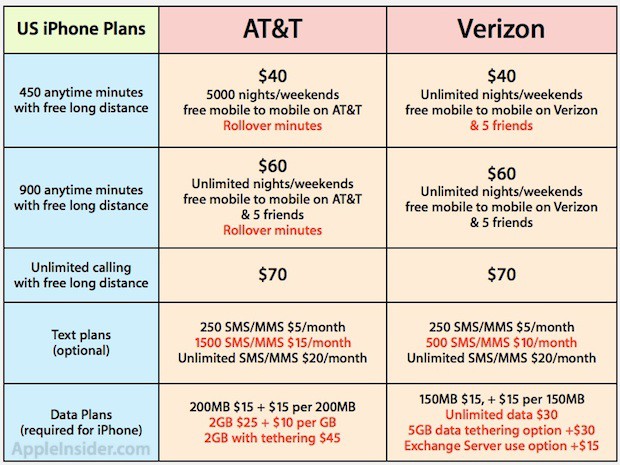
Apple Insider produced this chart comparing Verizon and AT&T's smartphone pricing.
WTTG-TV in Washington delivers the news about the imminent arrival of the iPhone on Verizon’s network in a consumer-friendly fashion, while Bloomberg delves deeper into exactly what impact the move will have on existing and future customers of both AT&T and Verizon. (9 minutes)
What would you do if your broadband bill was the same as your monthly rent?
That’s a question 21-year-old Notre Dame de Grace resident Amber Hunter has been dealing with since the neighbors began hacking their way into her wireless router, gaining access to her cable modem service from Videotron, Ltd., and running her bill into the next province.
It’s the predictable outcome of what happens when Internet Overcharging schemes gain traction, leaving ordinary consumers literally holding the bill.
Videotron sells usage limited broadband service across Quebec, but heavy users who routinely exceed their arbitrary usage caps knew there was a limit on the overlimit fees Videotron charged.
Not anymore.
Videotron left the usage caps on, but removed the limit on how much they can charge customers who exceed their monthly usage allowance.
Videotron sets prices like the OPEC of the Internet -- the sky is the limit
“The sky is the limit, or at least your bank account,” writes our Montreal reader Hei. “The only thing unlimited with Videotron are the overlimit fees.”
Hunter had no idea she was being hacked.
“I had no idea what a gigabyte was, so when I started getting higher bills, I just assumed it was from watching TV shows online,” Hunter says.
Her boyfriend told her otherwise, making it clear it was impossible for her to be running up 350GB a month in usage just from watching a few movies and TV shows.
Since August, Hunter has accumulated more than $1,800 in broadband bills stemming from parties unknown who hacked their way into her wireless router and “borrowed” her Internet account. Videotron itself is directly responsible for part of this debacle, encouraging Hunter to upgrade to a higher tier of service that upgraded her from a 30GB usage allowance to a 100GB usage allowance, with a major catch.
Hunter had become accustomed to paying her usual broadband bill plus the $50 maximum penalty charged for her “overuse.” So a Videotron representative suggested a higher usage allowance plan might lower her bill. But somehow, the Videotron customer service agent forgot to mention that the new plan no longer included a limit on overlimit charges.
When Amber switched plans, her broadband bill exploded. Now the waitress hands over most of her weekly salary to Videotron.
“I’m a student, and I work at a bar, and now most of the money I have goes to pay my Internet bill,” Hunter told the Montreal Gazette. “It’s more than I pay for school and books, and I don’t have a lot of money left for food.”
She still owes the cable company $506 and they aren’t interested in providing her any service credits beyond the $313 they gave her a few months ago.
It took a Videotron help desk employee to finally unravel the mystery of the Internet Overcharges — someone was hacking into her wireless network. Exactly who has been living their online life usage-limit free at Amber’s expense may never be known. Those living in apartment complexes and other multiple dwelling units can often find a dozen or more wireless connections, some password protected, others not.
Hunter’s wireless network was secured with a difficult to guess password using a four year old Linksys router. Unfortunately, older routers often lack robust security and are easily hacked.
A handful of Canadian ISPs still offer unlimited broadband accounts.
As far as Videotron is concerned, it’s all Hunter’s fault — she should have understood what a gigabyte was, how many she was supposed to be using, what the security capabilities of her router were, that they were properly enabled, that she checked her usage on a daily basis looking for anomalies — investing her time, effort, and energy to stop the cable company before it billed her an enormous amount… again.
Speaking for Videotron, Isabelle Dessureault said, “It’s a case where Videotron showed some understanding and listened to what happened. We’re well-renowned in the industry for our technical support team. We credited her account for $313, but at a certain point, we need to share the responsibility. We don’t like these kind of situations.”
Videotron’s responsibility to their customers stopped where their profit margin began. The company could have sent Amber a bill for the wholesale cost of her Internet usage, which she could have paid with a few of her bar tips.
Because Hunter’s broadband bills were now rivaling her monthly rent she decided to invest in her financial future, buying a new router and making sure the wireless was turned off. Today she runs dozens of meters of Ethernet cable between all of her computers, just to keep the neighbors off her connection.
Although Videotron has become intractable, demanding Amber pay up, one of their competitors used the opportunity to score public relations points that Videotron sacrificed.
Jarred Miller, the president of the Internet Service Provider YOUMANO offered to cover all of Hunter’s overage fees amassed over the past year that also includes a free year of Internet service with his company, a generous offer Hunter will take.
YOUMANO is one of a handful of Canadian ISPs still offering unlimited Internet access, and do not think of themselves as the OPEC of the Internet.
The entire affair is a warning to Americans. If you think Videotron is an Internet evildoer, imagine what Verizon, AT&T and Comcast could do to your bank account. If they have their way, you’ll need to become intimately familiar with your router, the concept of a gigabyte, and take a class in “negotiating to win” when fighting over your future enormous broadband bills.
Listen to an interview with Amber Hunter. She appeared on this morning’s Daybreak on CBC Radio Montreal to discuss her experience with Videotron Internet Overcharging. (8 minutes)
You must remain on this page to hear the clip, or you can download the clip and listen later.
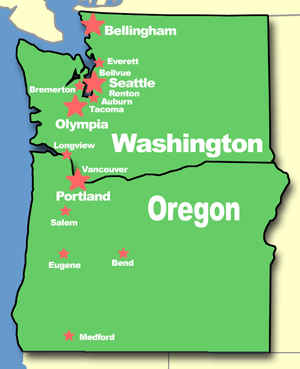
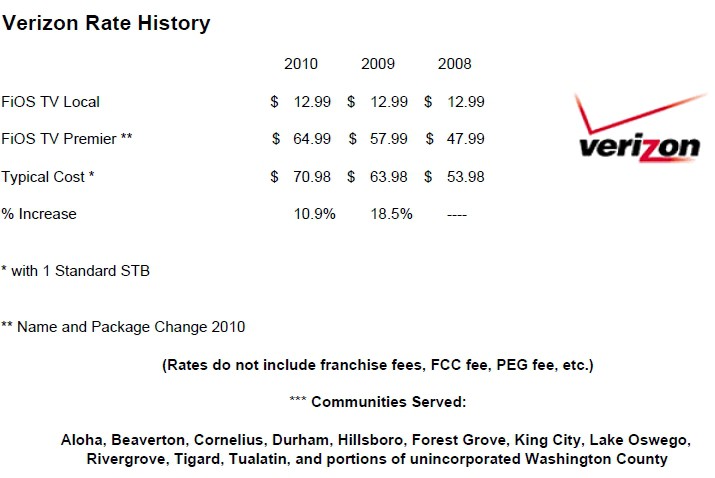
Former Verizon FiOS customers now served by Frontier Communications in Oregon and Washington are receiving word of astonishing rate increases of as much as 46 percent from the phone company. The massive rate increase is being blamed on “increasing programming costs” charged by the cable networks carried on a cable system that competes with Comcast, which charges far less for the same channels.
Frontier’s rate hikes are so dramatic — $30 a month for the popular standard 200-channel package, some customers are wondering whether the company is trying to sabotage their own fiber-to-the-home service.
“They sent us a rate increase letter stating our former standard package, priced at $65 a month, is now going up to a ridiculous $95 a month for basic cable,” says Tom, a regular Stop the Cap! reader. “That’s a rate increase only my health insurance company could love.”
New customers face the new rates immediately, but existing customers have until Feb. 18 before the new high price kicks in. Many are preparing to move back to Comcast, which raised rates this year as well — but is now a relative bargain at $63 a month for a similar package.
“As much as I love FiOS, Frontier has managed to screw it up as badly as the rest of their services and now I am going back to Comcast,” Tom says. “You have to wonder if they are purposely incompetent or if it’s part of a larger plan to sabotage the Verizon FiOS network they inherited. Either way, they’ve priced their service out of the market.”
When Tom called Frontier to complain, the company offered to rip out the advanced fiber network Verizon installed and stick a DirecTV satellite dish on his roof instead.
“Frontier is a real ‘Back to the Future’ kind of company — they just don’t get it,” Tom said. “The operator actually told me she couldn’t understand why I would want to cancel service.”
Customers receiving new customer promotional discounts will get a real case of sticker shock when Verizon’s original promotional rates reset to Frontier’s new regular price.
“Washington County better beef up their hospitals because there are going to be a lot of heart attacks when that bill arrives,” Tom says.
The Oregonian newspaper reports customers are not the only ones to be shocked by Frontier’s enormous rate increase. Regulators promised more competition and cheaper prices as part of Frontier’s purchase of Verizon landlines feel had as well.
“[Frontier’s rate hike] is essentially a white flag surrender and an exit from the head-to-head video competition,” lamented David Olson, director of the Mt. Hood Cable Regulatory Commission.
That’s a far cry from what Frontier Communications CEO Maggie Wilderotter told the newspaper in September when asked if the company would raise FiOS rates.
“That is not our plan. If I look across the board at our basic service pricing, I don’t think we’ve raised prices anywhere in the last four or five years,” she said.
The Oregonian quotes a Frontier representative who says the company’s relatively small customer base disqualifies them from volume discounts Verizon used to receive.
“Part of the challenge we have, compared to other providers, is that our footprint is so small,” said Frontier spokeswoman Stephanie Beasly. “They’re able to spread it out over a much larger customer footprint.”
That can’t be the whole story, said Fred Christ, policy and regulatory affairs manager for the Metropolitan Area Communications Commission, which regulates cable TV in Washington County.
“There’s more to it than programming costs. Anybody in the industry can pretty much figure that out. What more there is, we don’t know yet,” he said. “Unless programmers are trying to run Frontier out of business, why would they jack their rates that much?”
Smaller companies like Frontier generally do not try and buy programming on their own, but join group-purchasing plans like those offered by the National Cable Television Cooperative. Municipal providers routinely purchase programming at substantial discounts. It is not known if Frontier is a member, but they could be.
Frontier’s New Rates for FiOS in Washington/Oregon (courtesy: The Oregonian)
Basic local service package, with local broadcast stations: Rises from $12.99 to $24.99
FiOS TV Prime HD (220 channels, including the most popular sports and entertainment networks): Rises from $64.99 to $94.99
FiOS TV Extreme HD: Rises from $74.99 to $104.99
FiOS TV Ultimate HD: Rises from $89.99 to $119.99.
No rate increases are planned for broadband or telephone service.
Verizon FiOS pricing increased at less than half the rate Frontier will demand from subscribers in 2011. (Source: Metropolitan Area Communications Commission, Tualatin Valley, Ore.)
Phillip DampierJanuary 5, 2011Comcast/Xfinity, Consumer NewsComments Off on Comcast Makes Customers Wait 90+ Days for Refunds of Final Bills
If you were late paying your Comcast bill by three months, the nation’s largest cable operator would shut your service off. But if you decide to cancel service yourself, the company makes you wait up to 90 days for a refund of your credit balance.
“I tried to pay the final Comcast bill at the time that I returned the company’s cable modem and set top box, but was told that I’d have to wait for the final bill to be calculated,” Kusnetzky wrote. “I was told, however, that I’d receive a credit for the unused service rather than having to pay Comcast anything.”
Despite that assertion, Comcast billed him for another month of service anyway, and he never heard about the promised credit when he called the cable company to inquire about the extra unexpected bill.
“When I called Comcast and was finally able to hack my way through the jungle of their voice response system (it took three calls before I was finally able to speak with a human being named “Jaun”), I was told that the credit would be refunded in the form of a check in late March,” according to the columnist. “That means Comcast plans to hold onto the money owed me for three months!”
Comcast’s voice response system leaves a lot to be desired according to Kusnetzky, and he openly wonders why Comcast thinks it’s fine and dandy to demand immediate payment (often in advance) for ongoing service while leaving customers waiting three months or more for their refund to finally show up. That’s time Comcast gets to play with customers’ money, and the ZDNet author believes that is unacceptable.
Be Sure to Read Part One: Astroturf Overload — Broadband for America = One Giant Industry Front Group for an important introduction to what this super-sized industry front group is all about. Members of Broadband for America Red: A company or group actively engaging in anti-consumer lobbying, opposes Net Neutrality, supports Internet Overcharging, belongs to […]
Astroturf: One of the underhanded tactics increasingly being used by telecom companies is “Astroturf lobbying” – creating front groups that try to mimic true grassroots, but that are all about corporate money, not citizen power. Astroturf lobbying is hardly a new approach. Senator Lloyd Bentsen is credited with coining the term in the 1980s to […]
Hong Kong remains bullish on broadband. Despite the economic downturn, City Telecom continues to invest millions in constructing one of Hong Kong’s largest fiber optic broadband networks, providing fiber to the home connections to residents. City Telecom’s HK Broadband service relies on an all-fiber optic network, and has been dubbed “the Verizon FiOS of Hong […]
BendBroadband, a small provider serving central Oregon, breathlessly announced the imminent launch of new higher speed broadband service for its customers after completing an upgrade to DOCSIS 3. Along with the launch announcement came a new logo of a sprinting dog the company attaches its new tagline to: “We’re the local dog. We better be […]
Stop the Cap! reader Rick has been educating me about some of the new-found aggression by Shaw Communications, one of western Canada’s largest telecommunications companies, in expanding its business reach across Canada. Woe to those who get in the way. Novus Entertainment is already familiar with this story. As Stop the Cap! reported previously, Shaw […]
The Canadian Radio-television Telecommunications Commission, the Canadian equivalent of the Federal Communications Commission in Washington, may be forced to consider American broadband policy before defining Net Neutrality and its role in Canadian broadband, according to an article published today in The Globe & Mail. [FCC Chairman Julius Genachowski’s] proposal – to codify and enforce some […]
In March 2000, two cable magnates sat down for the cable industry equivalent of My Dinner With Andre. Fine wine, beautiful table linens, an exquisite meal, and a Monopoly board with pieces swapped back and forth representing hundreds of thousands of Canadian consumers. Ted Rogers and Jim Shaw drew a line on the western Ontario […]
Just like FairPoint Communications, the Towering Inferno of phone companies haunting New England, Frontier Communications is making a whole lot of promises to state regulators and consumers, if they’ll only support the deal to transfer ownership of phone service from Verizon to them. This time, Frontier is issuing a self-serving press release touting their investment […]
I see it took all of five minutes for George Ou and his friends at Digital Society to be swayed by the tunnel vision myopia of last week’s latest effort to justify Internet Overcharging schemes. Until recently, I’ve always rationalized my distain for smaller usage caps by ignoring the fact that I’m being subsidized by […]
In 2007, we took our first major trip away from western New York in 20 years and spent two weeks an hour away from Calgary, Alberta. After two weeks in Kananaskis Country, Banff, Calgary, and other spots all over southern Alberta, we came away with the Good, the Bad, and the Ugly: The Good Alberta […]
A federal appeals court in Washington has struck down, for a second time, a rulemaking by the Federal Communications Commission to limit the size of the nation’s largest cable operators to 30% of the nation’s pay television marketplace, calling the rule “arbitrary and capricious.” The 30% rule, designed to keep no single company from controlling […]
Less than half of Americans surveyed by PC Magazine report they are very satisfied with the broadband speed delivered by their Internet service provider. PC Magazine released a comprehensive study this month on speed, provider satisfaction, and consumer opinions about the state of broadband in their community. The publisher sampled more than 17,000 participants, checking […]


 Subscribe