Home » Providers » Recent Articles:

Pot to Kettle: Cablevision Petitions FCC for A-La-Carte for Themselves While Keeping It Away From You

Phillip Dampier May 31, 2011 Cablevision (see Altice USA), Consumer News, Editorial & Site News, Public Policy & Gov't Comments Off on Pot to Kettle: Cablevision Petitions FCC for A-La-Carte for Themselves While Keeping It Away From You

Rutlidge: One for us, none for you

Cablevision is upset paying for networks it doesn’t want, need, or desire to carry.  But broadcasters are demanding that the cable company pick up lesser-known, unwanted cable networks in return for the stations Cablevision craves.  Sound familiar?  It’s a variation on consumer cable a-la-carte: picking and paying only for the channels and networks you want.  It’s a concept Cablevision wants for themselves, but continues to deny to their customers.

Last week the cable company filed comments with the Federal Communications Commission proposing a ban on “channel bundling” by broadcasters as part of an effort to reform retransmission consent laws.  Cablevision argues they are forced to carry unwanted networks as a result of current agreements.  No agreement, no local stations on the cable dial.

Cablevision chiefly cites major broadcast network owners for pushing these bundled agreements.  The company’s suburban New York City cable system has to reach accommodations with local New York stations that are all owned and operated by the major American networks.  That’s why an agreement to renew WNBC-TV might include the required carriage of a hardly-known network like Sleuth, owned by the same company that owns WNBC: NBCUniversal.  In return for an extension of WABC-TV’s retransmission consent agreement, Cablevision might be asked to carry all of Disney’s lesser-known cable networks.  Disney owns ABC and WABC.

Ironically, the same cable company that refuses to allow a-la-carte themselves is selling their proposal as a boon to consumers:

Cablevision chief operating officer Tom Rutledge says the proposal will “protect consumers from the threat of broadcaster blackouts.” He adds, “consumers are the ones who are harmed when broadcasters pull or threaten to pull their networks from cable systems.”

Cablevision also wants broadcasters to publicly disclose the true asking price for their channels.  Cablevision itself will not disclose its wholesale programming costs for cable networks.

“Broadcasters should not be able to keep the prices they charge hidden or to discriminate between distributors in a given market,” Rutledge said. “Our simple reforms would end these practices.”

They would for broadcasters, but not for the cable company or consumers.

Comcast Buys Universal Orlando Theme Park: +$1 Billion Headed for Latest Acquisition

Phillip Dampier May 31, 2011 Comcast/Xfinity, Consumer News Comments Off on Comcast Buys Universal Orlando Theme Park: +$1 Billion Headed for Latest Acquisition

Don't look now: Comcast is acquiring theme parks!

Comcast is planning to assume full control of NBCUniversal’s Universal Orlando theme park in a deal worth at least $1 billion dollars, according to a source reported by the Orlando Sentinel.  Universal Orlando is NBCUniversal’s most profitable theme park, home to the popular Wizarding World of Harry Potter, which has attracted record crowds.

The company is picking up the stake of its partner Blackstone Group, and will gain full ownership of the theme park when the transaction closes.

CenturyLink’s Phoney Baloney: Asks Employees to Write Thank You Notes to NC Legislators

CenturyLink is asking their employees to write “thank you notes” to North Carolina legislators for passing an industry-written telecommunications bill that will reduce competition and inhibit community broadband competition in the state.

Broadband Reports received a copy of the message from a CenturyLink insider:

With the battle over and under-served North Carolina communities losing, a CenturyLink insider writes us to note the company this week sent employees an e-mail urging them to send their representatives a thank you letter for doing what Time Warner Cable and CenturyLink lobbyists told them to. “We encourage you to send an e-mail to your Representative, thanking him or her for supporting the bill,” says the e-mail to employees. “Opponents of the legislation, including the NC Municipal League and other groups, lobbied fiercely against the bill. So, your Representative’s support of the bill showed courage and conviction,” the letter insists. The e-mail included this recommended form letter:

Dear Representative ______________:
I am an employee of CenturyLink and one of your constituents. I wanted to sincerely thank you for your support of House Bill 129, the Municipal Competition/Level Playing Field bill. The bill’s passage helps ensure that CenturyLink and other private companies continue to invest in broadband and other technologies that make North Carolina such an attractive place to live and work by providing a strong infrastructure for economic development and education.

I know that the bill faced strong opposition, so I greatly appreciate the conviction you showed by supporting it. My company employs 2,350 persons in North Carolina and serves nearly 1 million customer lines. Thanks to the passage of House Bill 129, CenturyLink has gained added confidence to invest in North Carolina and grow our business in the state.

The good news is that CenturyLink at least told their employees to identify themselves in their letters, instead of pretending to be ordinary consumers.  The bad news is those employees, along with everyone else in the state, will pay a high price for the inevitable broadband slowdown this legislation will bring.  At a critical time for North Carolina’s economy, worrying about the business interests of CenturyLink and its employees is understandable, but looking out for the interests of 9.5 million residents about to be mired in a broadband slow lane is far more important.

Remember, no corporate entity the size of Time Warner Cable or CenturyLink has ever been run out of town by a community-owned alternative.  Nothing preserves the drive to invest and innovate faster than a truly competitive marketplace.  Nothing stagnates that marketplace better than a lack of competition, something this legislation will guarantee for years to come in several North Carolina communities.

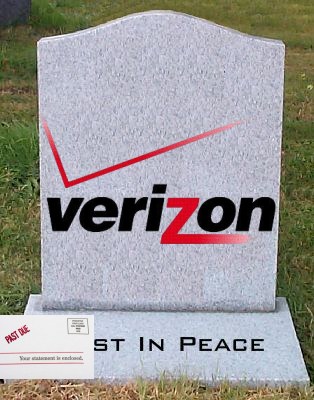
Verizon Bills Dead People: We’ll Settle for Half Because She’s No Longer Among the Living

Phillip Dampier May 31, 2011 Consumer News, Data Caps, Verizon 1 Comment

David Lazarus in the Los Angeles Times relays southern California consumer horror stories regularly in his twice-weekly column, but this week’s news that Verizon provides a 50% discount for past due balances owed by those who have passed away represents a whole new level in customer service failure.

It seems Betty Howard forgot to include disconnecting her Verizon Internet service as part of putting her affairs in order before passing away after a valiant battle against breast cancer.  Verizon ended up billing Howard’s survivors $110.80 for three months of broadband service she was unable to use… because she was dead.

Lazarus reports Verizon considered that an insufficient excuse to waive the charges:

This was the final insult for Howard’s daughter-in-law, Marilynn Loveless, who’d been battling with the phone giant for months over what she termed broken promises and questionable bills, not to mention an inability to grasp that its former customer was no longer among the living.

“I don’t like bullies,” Loveless told me. “That’s what this seemed to be. They bully you and bully you until they get what they want.”

Verizon cut Howard’s bill to $54.82 but then turned it over to a debt-collection firm. Loveless started getting calls from debt collectors trying to recover the cash from her dead mother-in-law.

As the collection calls started coming, Loveless reached out to Lazarus in hopes of giving the story enough exposure to get Verizon to pay attention.  Lazarus quickly uncovered the fact Howard was being double-billed for Internet service — once as part of a standalone account and a second time as part of a bundle Loveless herself pays for.  Neither account worked for even a single day.

No matter, Verizon would now only pony up a credit to reduce the bill to $42.75, even after understanding a reporter from the Times was witnessing this publicity train wreck in the making.

Shortly thereafter, Verizon finally relented and issued a full credit and a brief statement:

“Mistakes were made,” a Verizon spokesman said. “We apologize.”

Lazarus ponders whether Verizon will learn from any of this:

A good first step would be to empower its service reps — many of whom are overseas — to actually deal with specific issues, rather than follow scripts and hope a problem goes away.

Like I say, there’s a reason many consumers view big companies as heartless and unbending. It’s not because these businesses are misunderstood.

It’s because their actions speak for themselves.

New York Times Blasts Verizon Data Roaming Lawsuit: Their Argument is Weak

Phillip Dampier May 30, 2011 Consumer News, Data Caps, Public Policy & Gov't, Verizon, Wireless Broadband Comments Off on New York Times Blasts Verizon Data Roaming Lawsuit: Their Argument is Weak

The New York Times today published an editorial blasting Verizon’s lawsuit against the Federal Communications Commission for requiring the wireless carrier to offer data roaming on commercially reasonable terms:

With text messages, e-mail and other forms of data overtaking voice as the main form of wireless communication, the rule issued in April will preserve competition in a vital communications network.

There are more than 100 wireless providers around the country, mostly tiny carriers with a network limited to a small area. They depend on roaming agreements to stitch together a bigger footprint, which is essential to compete successfully. If Verizon were to prevail — AT&T has, so far, not joined the lawsuit but has criticized the rule — the two dominant players could refuse to deal.

In fact, there is evidence Verizon and AT&T have spent years foot-dragging their way to roaming agreements for data, an increasingly vital service for the handful of independent cellular service providers, almost all operating with limited local service areas.  Although roaming agreements cover voice phone calls, such agreements for data roaming have traditionally been much rarer.  When the FCC threatened to regulate, the pressure was on and both AT&T and Verizon quickly reached agreements with many carriers, some of whom complained about outrageous roaming prices up to $1 per megabyte.

The Times argues that with wireless marketplace concentration accelerating with the impending merger of T-Mobile and AT&T, fair data roaming rules are essential.


Search This Site:

Contributions:

Recent Comments:

Your Account:

Stop the Cap!