Home » Providers » Recent Articles:

Mississippi Public Service Commissioner on Big Telecom $: “We Have a Coin-Operated Government”

Northern District Mississippi Public Service Commissioner Brandon Presley is unhappy with a new state law that will strip oversight over AT&T. Presley plans to personally file suit in Hinds County Circuit Court against the law, calling it unconstitutional.

“It violates the state constitution,” Presley said of the bill during an interview with the Daily Journal. “There’s no doubt AT&T is the biggest in the state, and this bill will allow them to raise rates without any oversight at all.”

House Bill 825 strips away rate regulation of Mississippi landline service and removes the oversight powers the PSC formerly had to request financial data and statistics dealing with service outages and consumer complaints. The law also permits AT&T to abandon rural Mississippi landline customers at will.

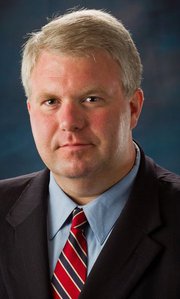
The bill’s author, Rep. Charles Jim Beckett (R-Bruce), told the newspaper he doubts the truth of Presley’s predictions that AT&T will raise landline rates in Mississippi and eventually abandon unprofitable rural sections of the state.

Unfortunately for Beckett, AT&T has a track record of raising rates on basic phone service about a year after winning deregulation in other midwestern and southern states. Beckett’s optimism about AT&T’s benevolence may be slightly colored by $2,500 in campaign contributions he received from the phone company and his extensive involvement with AT&T’s legislative agenda through participation in the American Legislative Exchange Council (ALEC), a group with direct ties to AT&T:

Presley

It seems that Russell and AT&T picked up the food tab for Rep. Jim Beckett and his wife at the ALEC meeting in at the Westin Kierland Resort in Scottsdale, Ariz. from November 30 to December 2, 2011.  AT&T also paid for a few rounds of golf for Rep. Beckett while there.  All said and done, AT&T paid $565.39 to cover expenses for Rep. Beckett and his wife on their three day trip to Scottsdale.

But that’s not all.  AT&T also picked up the tab for $151.70 worth of food and tickets while Rep. Beckett and his wife were at the Spring ALEC meeting in Cincinnati, OH in late April of 2011. AT&T also paid $22.62 for food for Rep. Beckett and his wife while he attended the 2011 Summer ALEC meeting in New Orleans.

The total amount AT&T gave to Rep. Jim Beckett and his wife in 2011 through Randy Russell?  $876.85.  The names of the Becketts appear a total of 36 times in AT&T’s 2011 lobbying report, most of it while the Becketts are at ALEC retreats.

Beckett

Presley has also launched a populist campaign against AT&T, last week telling a fired-up crowd at the Jacinto Festival he will fight AT&T’s bought and paid for law that lets them “raise your rates to whatever they want to.”

Crowds cheered support for Presley as he detailed how AT&T has bought influence with Mississippi state legislators, “just because they pass around money or fly you on jets or buy those big ribeyes.”

Presley has a past history of chasing after utility companies that hire expensive lobbyists and hand out extravagant gifts including golf outings, trips, and even opera tickets to legislators willing to vote their way.

He claims it has gotten so bad, corporate deep-pockets are now shutting out the voices of citizens.

“We have a coin-operated government,” Presley said. “That’s wrong.”
 

AT&T Bills Customer After Canceling, Then Denies It Ever Happened

Phillip Dampier July 10, 2012 AT&T, Consumer News, Video Comments Off on AT&T Bills Customer After Canceling, Then Denies It Ever Happened

AT&T denied it was billing the DeFazio family. (KCBS)

A Sacramento family that continued to receive bills from AT&T more than a half-year after closing their account got an interesting response when they questioned the charges: AT&T denied they were billing the family at all.

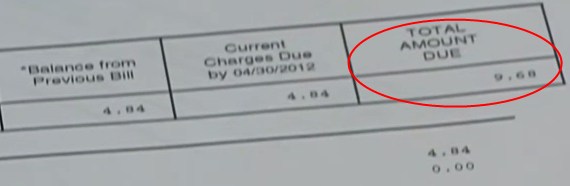
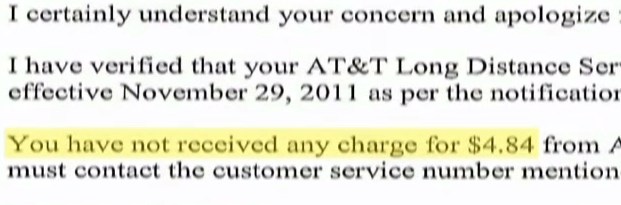
Naomi DeFazio cancelled her service with AT&T in November, but nobody told AT&T’s billing department who continued to faithfully bill her $4.84 a month for long distance service the family stopped using. The family wants the charges stopped, but that proved more difficult than they first imagined when AT&T claimed they were not, in fact, billing her at all.

That was news to DeFazio, who showed a growing pile of AT&T phone bills to a local consumer reporter.

“I think they’re just expecting me to pay it just to get them off my back,” DeFazio told KCBS. “Nobody wants to take responsibility for looking into this.”

KCBS:

AT&T, a communications company, eventually admitted it had a communication problem.

“We inadvertently billed a monthly minimum charge and the taxes and surcharges which should not have applied,” said company spokesman John Britton. “We have corrected it.”

AT&T apologized, wiping out her balance.

“It would have been a lot nicer to have an explanation a lot earlier in this process,” DeFazio said.

If you are getting the runaround from AT&T, call 1-800-791-6661 to reach AT&T’s Office of the President. Those executive level customer service representatives are empowered to get things done for customers that lower level representatives cannot.

[flv width=”640″ height=”380″]http://www.phillipdampier.com/video/KCBS San Francisco ATT Bills Customers for Canceled Service 7-9-12.mp4[/flv]

KCBS shows AT&T’s phone bills to viewers that the phone company denied ever existed. It took a consumer reporter to finally get AT&T to stop billing a Sacramento woman for long distance service she canceled more than a half-year ago.  (2 minutes)

Frontier Promises to Make DSL Available to More of Their Rural Customers

Phillip Dampier July 10, 2012 Broadband Speed, Consumer News, Frontier, Public Policy & Gov't, Rural Broadband Comments Off on Frontier Promises to Make DSL Available to More of Their Rural Customers

Frontier Communications has agreed to bring ADSL broadband service to more of its rural customers, in return for collecting $775 per impacted household from the FCC’s new Connect America Fund, designed to help defray expenses associated with expanding broadband access.

Frontier appears to be the first major phone company in the country to sign on to the new broadband subsidy program funded by telephone ratepayers through a surcharge on their monthly bills.

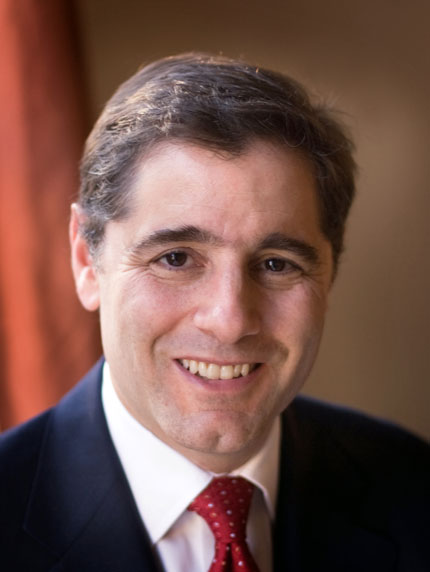
“Today’s announcement by Frontier Communications represents the beginning of that new deployment: approximately 200,000 unserved rural Americans will get broadband for the first time,” said FCC chairman Julius Genachowski. “I applaud Frontier Communications for stepping up to the plate with its commitment to accelerate broadband build-out by increasing private investment in rural communities, in partnership with the Connect America Fund.”

The FCC will hand Frontier nearly $72 million in subsidies to help the company deploy DSL broadband in areas currently deemed not profitable enough to serve. Frontier says it expects to bring service to 92,876 new households across their national service area that never had broadband service before. The company specifically mentions expansions in Michigan, Oregon, Washington and West Virginia, but says customers in at least half of the states where it provides service will benefit from the broadband expansion funding.

Frontier claims it currently offers 80 percent of its customers broadband service, in part thanks to an investment of more than $1.5 billion by the company over the last two years, according to Kathleen Quinn Abernathy, executive vice president of external affairs.

Genachowski

Frontier is a major provider of traditional ADSL broadband service in its rural service areas, typically offering customers 1-3Mbps service. Customers in larger communities can purchase DSL service at speeds closer to 10Mbps, and the company also sells fiber to the home broadband over its acquired FiOS network in parts of the Pacific Northwest and Fort Wayne, Ind.

Under the terms of the Connect America Fund, participating providers must offer customers at least 4/1Mbps service, which means Frontier will need to make some upgrades in its rural network — most likely reducing the length of copper wiring between its central offices and customers.

Frontier has faced challenges maintaining broadband service in some areas, especially in states where the company acquired aging infrastructure from Verizon Communications. West Virginia, where Frontier is the dominant telephone company after Verizon left the state, is still suffering the after-effects of a derecho windstorm nearly two weeks ago. Frontier has brought in repair crews from as far away as New York to assist in clearing thousands of outage reports.

The company has also gotten some justice after Boone County authorities arrested two men for generator thefts. Frontier has been using generators to keep phone service up and running in areas without electricity, but has been victimized by generator thefts across the state. At least six other generators were stolen in New Martinsville in Wetzel County yesterday.

Frontier has a tip line for anyone with information about stolen equipment or copper theft: 1-800-590-6605.

Other telephone companies expecting to apply for broadband funding from the Connect America Fund include: Alaska Communications Systems, AT&T, CenturyLink, Consolidated Communications, FairPoint Communications, Hawaiian Telcom, Virgin Islands Telephone, Verizon Communications and Windstream.

AT&T Shamed to Drop $1 Million Lawsuit Against Customer Over Fraudulent Calls

Phillip Dampier July 9, 2012 AT&T, Consumer News, Public Policy & Gov't, Verizon 3 Comments

ToddTool could have been forced into bankruptcy, taking its 14 employees straight to the unemployment line, had AT&T followed through on its threat to collect a million dollar fraudulent phone bill.

Michael Smith and his 14 employees can now sleep again after AT&T dropped a $1.15 million lawsuit against Smith’s small manufacturing company after the story went viral.

The lawsuit was filed over fraudulent long distance calls placed through Smith’s PBX phone system to the war-torn nation of Somalia over a four day period in 2009.

Smith discovered the fraud after getting long distance bills totaling $891,470 the following month.

More than $260,000 of additional charges were billed by Verizon, Smith’s landline phone company, and Verizon forgave those charges a few months after Smith filed a billing dispute. Verizon noticed the unusual calling activity and temporarily suspended Smith’s international long distance service. The phone hackers then simply used a “dial-around” long distance access code for AT&T to keep the calls going through, resulting in a huge bill from AT&T, which charged $22 a minute for the calls.

Unlike Verizon, AT&T wanted its money and despite multiple attempts to get credit for the fraudulent long distance calls, AT&T refused to relent, filing suit against Smith for the full cost of the fraudulent calls, plus interest.

Smith told a Salem, Mass. newspaper if he paid the bill, it would force his company into bankruptcy and put his 14 employees on the unemployment line.

The company claims in its lawsuit Smith should have known better — securing his PBX system more effectively against international long distance fraud and that under Federal Communications Commission regulations, AT&T is entitled to collect from the owner of the phone line, regardless of who actually made the call.

Smith told The Salem News he’s tried to resolve the matter, even reaching out to the CEO of AT&T, but a secretary at the company called and said that once AT&T refers a case to outside counsel, they are done talking.

AT&T later offered to waive the accumulating interest charges on the unpaid balance (now $197,000 and growing) if Smith paid the company $891,470 for the phone calls to Somalia.

Smith filed a countersuit instead, claiming AT&T is abusing the legal process and violating Massachusetts consumer protection laws. A judge was pushing the case to mediation.

Smith’s interview with the Salem newspaper came at additional risk: AT&T’s lawyers threatened they would take action if he “disparaged” the company’s name in the media.

After the story ran nationwide this morning on the Associated Press wire service, the company suddenly dropped the case.

In a statement sent to the media, AT&T writes it is no longer pursuing its claims against Michael Smith, of Ipswich, “though we are entitled by law to collect the amounts owed.”

Suddenlink’s Magical Mystery Meter: Records 12GB of Usage Even During Power Outage

Easy as counting in the dark.

Suddenlink customers in West Virginia who have been dealing with the aftereffects of a damaging derecho for a week found a nasty little surprise from their cable company when the lights cut back on — gigabytes of usage recorded on the company’s suspect “usage meter,” despite the fact customers were without power for up to a week.

Broadband Reports readers have begun to check back in after extended downtime to report Suddenlink is racking up usage whether customers are using their broadband connection or not:

  • “Tylr” reports he was without power for two days but Suddenlink’s usage meter kept the party going, recording 12GB of phantom usage during the two days the customer was without service;
  • “Jdmm72” found exactly the same thing, shocked to discover he racked up 10.8GB of usage on a day when he and his fellow neighbors in Nitro, W.V., were completely in the dark.

Suddenlink’s usage meter is not verified by any third-party or government agency to ensure its reliability and the company is under no obligation to change this policy. But customers are expected to cover any overlimit fees Suddenlink imposes for “exceeding your allowance.”

Does the company need the extra money? Not really, according to Suddenlink president and CEO Jerry Kent, who earlier admitted the days of expensive system upgrades were over and it was now time to rake in profits:

“I think one of the things people don’t realize [relates to] the question of capital intensity and having to keep spending to keep up with capacity,” Kent said. “Those days are basically over, and you are seeing significant free cash flow generated from the cable operators as our capital expenditures continue to come down.”

Search This Site:

Contributions:

Recent Comments:

Your Account:

Stop the Cap!