Home » Providers » Recent Articles:

Hurricane Sandy’s Wrath on Telecommunications Extends Beyond the Hardest Hit Areas

Hurricane Sandy’s destructive forces of wind and water, combined with extensive electrical outages has wreaked havoc with telecommunications services from Maine to Virginia, leaving some customers potentially without service for weeks.

The storm has flooded Verizon‘s central switching offices in New York City, did extensive damage to Sprint’s wireless network and infrastructure, has left large sections of upstate and downstate New York without cable service, and clocks ticking for wireless cell customers using cell sites currently running on battery backup power.

Some of the worst problems are affecting Verizon’s landline and FiOS networks after the company lost two critical switching centers in Manhattan to extensive flooding. That has contributed to significant problems for Verizon customers across Manhattan, Queens, and Long Island. Further afield, Verizon customers without service can blame power outages and fallen trees that took out overhead wiring. Together, Verizon customers are experiencing significant problems with landline, broadband, and FiOS TV and Internet services in some areas.

Many Verizon Wireless cell sites are operating on battery backup units which maintain service for only a limited time. New York, New Jersey and Connecticut customers report increasing difficulty maintaining cell service signals as those battery backup units start to fail. Verizon engineering crews can restore undamaged cell sites with backup generators once permitted into storm-ravaged areas.

One of the hardest hit wireless carriers

Cablevision‘s business largely depends on areas that took a direct hit from Hurricane Sandy. Cablevision repair crews are encountering extensive power outages and damaged overhead wiring brought down during the storm in Connecticut and Long Island. Its service area closer to New York City has been primarily affected by power outages. Comcast said it was still starting an assessment process and was not prepared to report on the current state of its network, which operates in cities north and south of the New York City metro area.

While Time Warner Cable spokesman Alex Dudley reports little damage to Time Warner Cable’s systems, many remain offline from power interruptions, and Time Warner’s Twitter feed for upstate New York reports isolated outages in Portland, Maine and across upstate New York, primarily due to power losses or damage to infrastructure.

Sprint appears to be the hardest hit wireless carrier with widespread service outages, interruptions and call completion issues throughout the states of New York, New Jersey, Connecticut, Pennsylvania, Washington DC, Maryland, North Virginia and New England. Some customers far away from the worst-hit areas report trouble making and receiving calls on Sprint’s network. Many cell sites are also damaged.

AT&T is assessing damage to its landline operations in Connecticut, where it is the dominant phone company. Many AT&T cell phone sites, like Verizon, are operating on battery backup in power outage areas until AT&T can bring generators online to maintain service.

T-Mobile and MetroPCS report damage and service outages to their cellular networks as well, mostly from power outages.

Lyndhurst, NJ

Even old style communications networks were not spared from Hurricane Sandy. The Northeast Radio Watch reports a large number of broadcasters across the region off the air as of this morning:

  • Outside of WOR (710), most New York City area AM stations are off the air. WOR survived the storm with its recently built three tower site located just above the flood waters. Chief engineer Tom Ray told NERW the water is 10 feet deep at WOR’s transmitter site in the Meadowlands. Many AM stations in New York favor transmitter locations in now-ravaged Lyndhurst and the Meadowlands. The result: indefinite absence of all-news WINS (1010) (it’s now back up — thanks to an update from Scott Fybush), which is now being heard on WXRK (92.3). Also missing: WLIB (1190), WSNR (620), WMCA (570), WNYC (820), WPAT (930), WNYM (970), WADO (1280) and WWRV (1330). FM outlets favor much higher transmitter locations, usually atop large skyscrapers, that escaped flood damage.
  • WABC continues to air the audio portion of its broadcast on WEPN-AM (1050) and FM (98.7) for the benefit of those without power. WCBS studios are currently powered “by candlelight.”
  • The Jersey shore’s FM outlets are mostly silent. Atlantic City was among the hardest hit, and some stations may be off the air for some time while rebuilding.
  • Connecticut stations are also off the air. Powerhouse WICC (600) in Bridgeport has transmitters on Long Island Sound — a poor choice to withstand Sandy. It is likely underwater. Also gone: WGCH (1490 Greenwich), WAXB (850 Ridgefield) and WSHU (1260 Westport) and WALK-FM (97.5 Patchogue).

Repair crews for all concerned will likely only start assessing damage later today, but many will have to wait for power crews to complete work — they have first priority. Those lucky enough to see service restoration once power returns will be in far better shape than others who could wait weeks to get their Internet, television and phone service back.

Correction: Original story included reference to studio power knocked out at WOR-TV. That should have said WOR-AM (radio). 
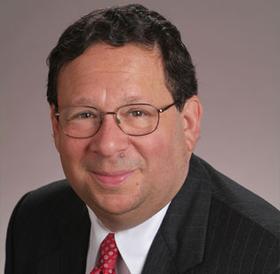
Comcast Stalled Internet Service for Disadvantaged to Help Win NBC Merger Deal

Cohen

Comcast’s chief lobbyist stalled plans to unveil cheaper Internet service for the financially disadvantaged to use as bait to win regulator approval of its 2009 merger with NBC-Universal.

The Washington Post today reports David Cohen’s influence at the cable operator as its chief of lobbying has helped the cable company achieve its status as America’s largest cable operator and entertainment conglomerate.

Cohen has friends in high places thanks to his status as a Democratic Party money bundler. A self-styled “consigliere” to the Roberts family that controls the company, Cohen has overseen a transformation of Comcast from one cable operator among many into a high-powered force not to reckoned with in Washington or Silicon Valley.

Comcast’s growth into a mega-corporation with $58 billion in annual revenues came, in part, from dealmaking that won regulator approval in D.C. Maintaining good relations with those regulators is a Cohen specialty. It did not take the Post too long to find former FCC officials giving Cohen high praise:

  • “Every meeting with David is incredibly substantive,” Eddie Lazarus, former chief of staff to the FCC told the newspaper. “He always comes with a willingness to find solutions.”
  • “David loves politics, he loves government and he has incredible situational awareness — a 360-degree view of business,” said Blair Levin, a former senior adviser to FCC Chairman Julius Genachowski. “He’s just so good at what he does.”

Under Cohen’s leadership, Comcast has spent lavishly on its corporate lobbying and legal team. Today, 20 full time lobbyists work under Cohen’s direction, with dozens of others available on retainer. The company spent $8.3 million of its subscribers’ money solely on lobbying. The Post reports that makes Comcast the ninth biggest K Street spender, above Verizon.

The poor and disadvantaged had to wait for Comcast to seal the deal on their $30 billion acquisition of NBC-Universal before affordable Internet could become reality for them.

In 2009, Comcast insiders were hard at work on a discount program for the disadvantaged who could not afford Comcast’s regular prices for broadband service. But the program was stalled at the direction of Cohen, who wanted it to be a chip with regulators to win approval of its acquisition of NBC-Universal. The program, sure to be popular among advocates of the digitally disadvantaged, was a key part of approving the $30 billion deal.

“I held back because I knew it may be the type of voluntary commitment that would be attractive to the chairman [of the FCC],” Cohen said in a recent interview.

Regulators promoted Comcast’s “concession” to offer the discounted Internet service as a win for consumers as part of the final approval of the deal. In reality, Comcast was planning to offer the service anyway and finally introduced it in 2011 — two years after first being proposed inside the company.

That fact is a slight embarrassment to current FCC chairman Julius Genachowski, who has told audiences the discounted Internet program was partly to his credit.

“This particular program came from our reviewing of the Comcast NBC-U transaction,” Genachowski said in a speech. “Comcast embraced it as good for the country, as well as good for business. And I’m fine with that.”

Cohen defends Comcast’s lobbying expense as part of the company’s effort to combat scrutiny and challenges to its all-or-nothing video business model, denying customers access to a-la-carte programming.

Comcast’s scope has now grown so large, it has become a force few companies are willing to challenge, and those that try are quick to run into a blockade of Comcast lawyers, lobbyists, and carefully constructed contracts that protect the company’s bottom line from would-be competitors.

Deep pockets like Verizon, Apple, Netflix and Google have all tried… and failed to recast the cable television experience with on-demand programming, a-la-carte channels, and cord-cutting technology.

In response, Comcast has kept competitors tied down to the same cable packages that require subscribers to pay for everything, even if they seek only a few channels. Comcast leverages its broadband network with usage limits that effectively curtail cord-cutting among consumers looking to skip the TV package. Anyone seeking a place in today’s entertainment industry ends up dealing with Comcast sooner or later.

“They are hugely important because they can singlehandedly sink or swim multiple businesses that rely on the Internet ecosystem by virtue of controlling the dissemination of information through their pipes and now by supplying so much of the content,” said Joel Kelsey, a policy director at consumer interest group Free Press. “So many companies have come to us and ask we fight their battles for them because they are afraid of retribution.”

Cohen is well-compensated for his effectiveness. His latest three-year contract makes him one of the highest paid corporate lobbyists in Washington, with a $15 million annual compensation package and $3 million in bonuses, not including his ample stock holdings in Comcast.

His influence extends to the highest levels of the Obama Administration. Last summer, the family hosted a $1.2 million campaign fundraiser for President Obama, and the Cohens have separately contributed $877,000 to various campaigns. Comcast itself has spent $3.3 million in campaign contributions so far this year.

Competition? Comcast Announces It Will Sell Ads on Behalf of AT&T U-verse

Phillip Dampier October 29, 2012 AT&T, Charter Spectrum, Comcast/Xfinity, Competition 1 Comment

In another sign competition between cable and phone companies may not be as robust as they would have you believe, Comcast last week announced a deal to sell local advertising on behalf of AT&T U-verse.

Under the agreement, Comcast’s Spotlight ad sales division will now sell local advertising slots on behalf of AT&T’s U-verse in cities where both companies provide service.

Comcast says the agreement will cover 21 cities, including:

  • Atlanta
  • Champaign-Springfield-Decatur (Ill.)
  • Chicago
  • Detroit
  • Flint-Saginaw-Bay City (Mich.)
  • Fresno-Visalia (Calif.)
  • Grand Rapids-Kalamazoo-Battle Creek (Mich.)
  • Hartford-New Haven (Conn.)
  • Houston
  • Indianapolis
  • Jackson, Miss.
  • Jacksonville (Fla.)
  • Lansing (Mich.)
  • Little Rock-Pine Bluff (Ark.)
  • Memphis
  • Miami-Ft. Lauderdale
  • Monterey-Salinas (Calif.)
  • Nashville
  • Sacramento-Stockton-Modesto (Calif.)
  • San Francisco
  • West Palm Beach-Ft. Pierce (Fla.)

This leaves Comcast with a lock on local ad sales for both its own cable and AT&T’s U-verse systems. Most major cable networks offer their affiliates opportunities to insert local commercials during certain advertising breaks. The ad insertions provide a lucrative revenue stream for pay television providers, which can target viewers of specific cable networks or run the same messages across hundreds of cable channels.

The deal will save AT&T from having to hire additional employees to handle local ad sales and will let advertisers cover one or both systems in a single ad buy.

But critics wonder if Comcast cooperating this closely with AT&T is good for competition.

The deal is not unprecedented, however. AT&T has also partnered with Charter Cable to cross market local ad sales in cities where U-verse and Charter compete head to head.

Verizon Making Storm Preparations for Sandy’s Impact on Landline/Wireless Network

Phillip Dampier October 29, 2012 Consumer News, Verizon, Wireless Broadband Comments Off on Verizon Making Storm Preparations for Sandy’s Impact on Landline/Wireless Network

Verizon Communications is on high alert to monitor the potential impact of Hurricane Sandy on the company’s landline, FiOS, and wireless networks — primarily from line damage and extended power outages that could come as a consequence of the slow-moving Category 1 hurricane. Top wind speeds from Sandy have been upgraded this morning to 90mph, making the storm’s impact even more severe for residents along the Atlantic coastline.

Verizon retail outlets are stocking up on car phone chargers and universal charging devices to help customers who endure extended power outages, but some retail stores may close early or stay closed if local weather conditions warrant.

Non-essential construction projects and internal training programs have been suspended so the company can focus on network repairs, as needed.

Verizon wireline and wireless business units have activated national and regional command and control centers, enabling Verizon operations teams to monitor the storm’s progress and company operations, including network performance. Verizon has established communications with power and other service providers to ensure proper coordination in the event of storm damage. The company also has contacted vendors and other outside partners so that critical communications equipment and supplies can be prioritized, stocked and shipped as needed.

Company equipment — including poles, fiber-optic and copper cable, portable cell sites that can replace a damaged cell tower and mobile emergency generators that can be used when local electrical power fails — is being staged in and around the mid-Atlantic and Northeast regions.

Verizon is the dominant phone company and wireless provider in the northeastern U.S.

In addition, Verizon managers are communicating the company’s storm preparation efforts and coordinating pre-planned response activities with the public-safety community, as well as state, county and municipal agencies along the East Coast and the Midwest.

“Verizon Wireless stands ready to serve our customers, and I urge everyone first and foremost to stay safe,” said Dan Mead, president and CEO of Verizon Wireless. “We live and work in the towns and cities in the storm’s path, and we are dedicated to keeping our friends, families and neighbors connected in times like these. We prepare for situations like this year-round, and pride ourselves in our ability to be there for our customers when they count on us most.”

As Sandy’s track came more into focus, the company began communicating with its customers on Friday, posting consumer tips on various company websites, issuing a news release to media outlets in the threatened region and nationally, engaging customers through social media such as Twitter and Facebook, and sending emails to consumers, with key links for troubleshooting and reporting service problems.

Bob Mudge, president of Verizon’s Consumer and Mass Business division, said: “In addition to communicating with customers and ensuring that we will be working to keep the network operating and responding quickly to issues as they arise, we have reminded our employees of the need to work safely, be alert, and help our customers in any way they can. But our people know this well and are at their best in these critical situations when our customers depend on us the most.”

Mudge noted that even though Verizon technicians may be ready to repair storm-damaged Verizon facilities, they may have to wait for approval from local power companies, first-responders or law enforcement before beginning restoration work.

Customers may contact Verizon online at www.verizon.com/outage to report any wireline service-related issues; or call 1-800-VERIZON (1-800-837-4966). Business customers are advised to contact their regular customer service centers or account teams as needed.

Transforming AT&T: Declining Growth in Wireless Means Strategic Redirection for Company

With a declining number of Americans willing to pay AT&T’s prices for smartphones and wireless service plans, AT&T’s future revenue growth will increasingly depend on getting the company’s current customers to pay more for data and adopt new types of wireless communications services.

After a quarterly earnings report found AT&T subscriber growth falling far behind its larger rival Verizon Wireless, AT&T appears ready to concede there is a finite number of new customers to be won from endless battles for market share.

AT&T was expected to add 358,000 new customers in the previous quarter, but only managed to attract 151,000. Demand for the latest Apple iPhone has yet to meet available supply, with most iPhones obtained by AT&T allocated to existing customers. AT&T exclusively launched the iPhone in the United States in 2007 and retains the largest share of iPhone owners, even after the phone became available from other carriers. Verizon Wireless had fewer problems adding new customers because it is not nearly as dependent on Apple.

de la Vega

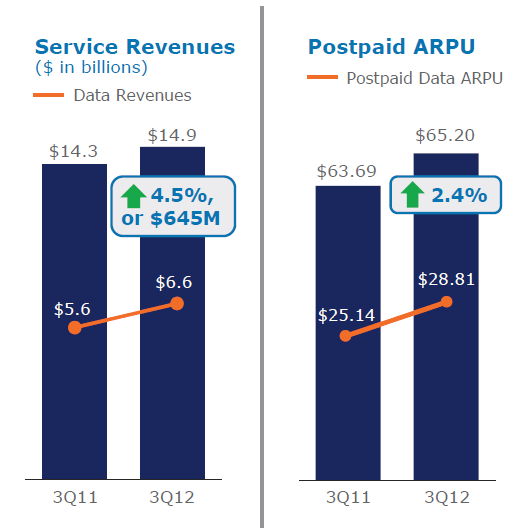
Despite lackluster subscriber growth, AT&T reported stellar revenue during the quarter, partly from rate increases and the launch of usage-limited, family share plans. AT&T also continued to benefit from  tax savings, share buybacks, and refinancing debt at lower interest rates. With fewer customers adding subsidized phones, AT&T also paid fewer subsidies.

AT&T’s profit rose to $3.64 billion, or 63 cents per share, up from $3.62 billion, or 61 cents per share — $.03 ahead of Wall Street expectations.

AT&T can thank its wireless data services for a significant chunk of their earnings, with more to come.

The company reported more than 2/3rd’s of their customers (28+ million) are now on usage-based pricing plans. That is 10 million more than a year ago. The company’s new mobile share plans have attracted almost two million subscribers during the first five weeks they were on offer. More than one-third of those customers are choosing the company’s 10GB data allowance, which costs the customer $150 a month with unlimited talk and texting ($30 a month for each additional smartphone on the account.) Around 15% of new mobile share customers are choosing to abandon their grandfathered unlimited data plans.

AT&T’s forthcoming strategic redirection, to be announced Nov. 7, is likely to center around increasing revenue from the company’s wireless data network.

The average AT&T customer’s wireless broadband data bill is on the increase.

Ralph de la Vega, president and CEO of AT&T Mobility and Consumer Markets, told investors it is taking “this massive data growth and building products and services on top of that.”

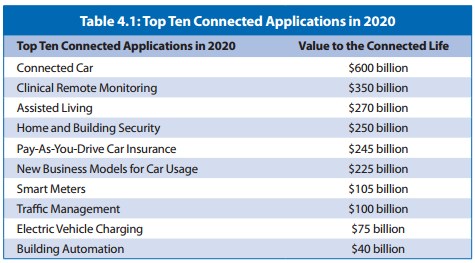
“One of the best examples I can give you is our launch of Digitize that will happen next year,” de la Vega said. “It leverages this huge smartphone database and adds services on top of it and not just data access, but services that differentiate us from the competition. So you’re talking about connecting the home with service automation and security monitoring. We’re talking about connecting your car with all kinds of entertainment services.”

That means AT&T sees its future revenue coming mostly from existing customers paying more.

“Those services are not dependent on adding more customers per se, but connecting more houses, connecting more cars and connecting more things that drive significant revenue streams with good margins for us,” de la Vega said. “In terms of what we see happening with others in the industry, I don’t think anything we have seen changes our plan. We’re going to execute [and] let others react to our plan, instead of us reacting to them.”

AT&T seemed unconcerned by competition in the current marketplace, especially from those offering cheaper plans. de la Vega predicted other carriers will come around to AT&T and Verizon’s way of thinking about mobile plan pricing.

“I think these mobile share plans are very compelling to customers,” de la Vega told investors. “And I think those that don’t put them in, in the industry will probably have to rethink down the road because I think the reception has been exceptional.”

John Stephens, AT&T’s chief financial officer, called AT&T’s data growth important, as long as those customers are on tiered data plans. With three-quarters of their customers buying “higher-priced plans,” AT&T can grow revenue by encouraging data usage that forces customers into ever-higher allowance plans that deliver revenue boosts indefinitely.

“I think some of the things driving our pricing and the price moves we made almost a year ago where we increased our data pricing are driving our revenue growth,” de la Vega admitted. “But we’re also seeing people sign up for more data. And the fact is, as you sell more smartphones or more tablets, people need more data. Usage-based data pricing means as usage goes up, we can see some of that lift also coming from additional average revenue per customer. So not only do we feel good where we are, but I feel really good about where we’re going, because you have to have that base of usage base in order to be able to monetize the data growth that we foresee in the future.”

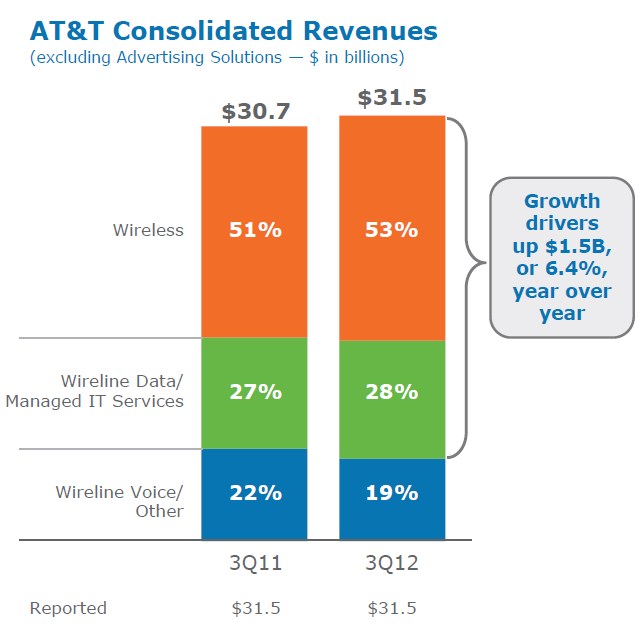
AT&T continues to depend primarily on its wireless division for most of its revenue, but as growth slows, the demand for ever-increasing average revenue from each customer will have to come from increasing prices or finding new services to sell that customers want.

Applications that wireless carriers seek to monetize

Some other highlights:

  • AT&T was questioned by Wall Street about its decision to voluntarily contribute a $9.5 billion preferred equity interest in AT&T Mobility into the Pension Plan Trust. Some analysts consider that amount unnecessary and above the amount required by law, despite the company’s assertion this would help protect the long-term health of AT&T’s pension fund. But some retirees note AT&T’s generosity benefits itself — the company’s contribution to the pension plan is invested entirely in AT&T’s wireless business;
  • AT&T now has 7.4 million U-verse subscribers, driving wireline revenue growth to levels not seen in more than four years. But AT&T still only averages less than a 15% market share in the cities where U-verse is available, suggesting cable operators are maintaining their market dominance;
  • AT&T’s new upgrade policy, which curtails early upgrades and imposes new upgrade fees, is having a dramatic impact on discouraging customers from upgrading their phones. That has kept AT&T’s upgrade rate at a steady 7%, even with the introduction of the wildly popular new iPhone. AT&T has effectively cut their subsidy costs and took a 28% increase in equipment revenue from new upgrade fees to the bank;
  • Capital expenditures are on target at $13.8 billion, with more than half of that invested in the wireless business. Landlines and U-verse upgrades took a back seat.
  • AT&T receives enough iPhones to activate 5,000-10,000 new iPhone customers a day and still that is insufficient to meet demand;

[flv width=”640″ height=”380″]http://www.phillipdampier.com/video/ATT Quarterly Earnings 10-24-12.flv[/flv]

AT&T’s Ralph de la Vega explores the company’s latest quarterly earnings, focused on its profitable wireless business.  (3 minutes)

Search This Site:

Contributions:

Recent Comments:

Your Account:

Stop the Cap!