Home » Providers » Recent Articles:

Rogers’ Sticks It to Independent ISPs – Increased Speeds Not Easily Available to Competition

Share and share alike is a concept unfamiliar to Rogers Communications, at least in the eyes of the independent Internet Service Providers who have wholesale bandwidth agreements with eastern Canada’s largest cable operator that are supposed to guarantee speed parity.

The Canadian Network Operators Consortium (CNOC) last week announced it filed a complaint with the Canadian Radio-television and Telecommunications Commission (CRTC) accusing Rogers of withholding speed increases from independent ISPs.

In 2006, the CRTC made it clear that cable companies must treat its wholesale customers fairly:

The Commission determines that should a cable carrier introduce a speed upgrade to one of its retail internet service offerings with no corresponding price change, it is to issue at the same time, revised [third-party ISP access] tariff pages that match these retail service speed changes with no corresponding price change.

According to CNOC, Rogers wants independent ISPs to pay higher prices for the faster speeds it is providing its own customers for no additional charge.

That leaves providers like TekSavvy at a competitive disadvantage, according to the provider.

Peter Nowak explains Rogers is attempting to hurry independent ISPs to move to “aggregated points of interconnection,” part of the foundation of the CRTC’s earlier decision on usage-based billing. Independent ISPs were given two years to complete the transition and Rogers wants that change to move at faster pace:

Rogers wants indie ISPs to move onto the aggregated method, something it says the CRTC essentially ordered at the conclusion of the big usage-based billing fiasco a year ago. Here’s what a spokesperson told me:

We are not denying TPIAs access to our new speeds provided they have moved to a single point of connection, called an aggregated point of interconnection (POI). As part of the usage based billing rulings in November of last year, TPIAs were given two years to move from a disaggregated POI to an aggregated POI. The sooner this happens, the sooner we can provide those speeds to these third party ISPs.  Rogers will continue to provide access at existing speeds on the old network architecture until November 15, 2013.

The dispute, as usual, boils down to whether or not Rogers’ move can be considered anti-competitive. The small ISPs argue that it is, since Rogers’ own retail customers are getting the benefit of higher speeds without higher prices, yet the indie companies – and their own subscribers by extension – are being expected to pay more.

If it’s uneconomical for the indies to sell the faster speeds, they won’t, in which case the big network owners like Rogers will hold a distinct advantage since internet access is sold largely on speeds. Since they’ll simply perish if they can’t keep pace, the indie ISPs will ultimately have no choice but to accept the higher prices being pushed on them – and that effectively neutralizes the entire point of their existence, which is to provide a competitive check to the big guys.

CNOC has asked the CRTC to make an expedited ruling on the controversy as soon as possible to mitigate competitive damage.

Cash Out: Verizon Wireless Pays $8.5 Billion Dividend to Owners

Phillip Dampier November 14, 2012 Consumer News, Verizon, Vodafone (UK), Wireless Broadband Comments Off on Cash Out: Verizon Wireless Pays $8.5 Billion Dividend to Owners

Verizon Wireless announced Monday it will pay a dividend of $8.5 billion to owners Verizon Communications and Britain’s Vodafone Group PLC, by the end of the year.

Together with an earlier dividend paid in January, an extremely profitable Verizon Wireless will return a combined $18.5 billion to investors in 2012.

Verizon Communications, owner of Verizon landlines and fiber optic network FiOS, owns 55 percent of the wireless operation. Britain-based Vodafone Group owns a 45 percent minority interest. Verizon Wireless, like many U.S. corporations, has used excess cash to pay down or refinance debt at historically low interest rates, reacquire stock, or pay dividends to shareholders in lieu of major infrastructure and hiring expansion.

Verizon Communications needs its share of the wireless dividend to help cover dividend payouts to its own wired shareholders. Verizon Communications has been unable to command the kind of high profit margins its wireless counterpart has succeeded in delivering to investors.


Fox and Google Make Amends With Fiber TV Agreement; AMC, HBO Still Missing

Phillip Dampier November 13, 2012 Consumer News, Google Fiber & Wireless Comments Off on Fox and Google Make Amends With Fiber TV Agreement; AMC, HBO Still Missing

Google recognizes that television lineups still matter. The Kansas City gigabit fiber broadband project is not just about faster Internet access, and some KCMO and KCK residents have made it clear if Google Fiber lacks the television channels they want to see, they won’t switch providers.

Since late summer, Google has been quickly signing deals with the remaining holdout programmers to present a television lineup nearly equivalent to what its competitors Time Warner Cable and AT&T U-verse offer.

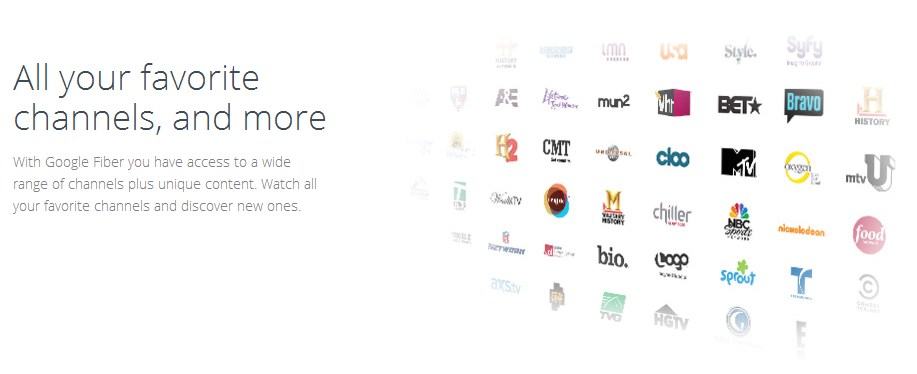
In early September, Google announced an important deal with Disney which brought ABC Family, ABC News Now, Disney Channel, Disney Junior, Disney XD, ESPN, ESPN Buzzer Beater, ESPN Classic, ESPN Deportes, ESPN Goal Line, ESPN2, ESPNews, and ESPNU to the lineup. The company also signed deals for the important regional sports channel The Longhorn Network, and niche channels Ovation, SOAPnet, TBN, TBN Enlace, and Velocity.

In mid-September, additional deals with Time Warner (Entertainment) and its Turner division netted Google Fiber TV: Boomerang, Cartoon Network, CNN, CNN en Español, CNN International, HLN, hTV, infinito, MLB Network Strike Zone (as part of an add-on package),TBS, TCM: Turner Classic Movies, TNT and truTV.

On Monday, Google landed a deal with News Corp., parent company of Fox, for a bunch of additional sports, news, and general entertainment channels. The latest additions: BabyTV, Big Ten Network, Fox Business Network, Fox College Sports Atlantic, Fox College Sports Central, Fox College Sports Pacific, Fox Deportes, Fox Movie Channel, Fox News Channel, Fox Soccer, Fox Soccer Plus, FS Kansas City, Fuel TV, Speed and FX. Other additions also announced: HSN2, KPXE-TV DT2 – Qubo, KPXE-TV DT3 – ION Life, Nat Geo Mundo, Nat Geo WILD, National Geographic Channel, and Utilisima,

The deal for Fox programming shows Google and News Corp. coming full circle. News Corp. used to call Google a “parasite” for aggregating copyrighted content in search engine results and other features. Google opposed broad-reaching piracy legislation earlier this year. News Corp. was a strong supporter.

The latest programming deals narrow the gap between Google and its television competitors. The most notable remaining network missing from the lineup is HBO. Google has also yet to conclude a deal with AMC Networks, which shares close ties with Cablevision Industries. Until Google reaches an arrangement, AMC, the Independent Film Channel, WEtv, and the Sundance Channel will not be on the Google TV lineup.

CenturyLink CEO Thinks AT&T Has a Tough Road Ahead Cutting Off Rural Landlines

CenturyLink CEO Glenn Post does not think much about AT&T’s plans to shift its most rural landline customers to wireless in its efforts to decommission traditional landline service.

“From a regulatory standpoint, that could be a tough go,” Post explained to Wall Street investors on a conference call last week. “There may be some areas that will have better service with wireless in some ways. As far as a competitive threat, we don’t see that being a real issue for us because just the bandwidth requirements and the limited wireless access or capability in a lot of areas.”

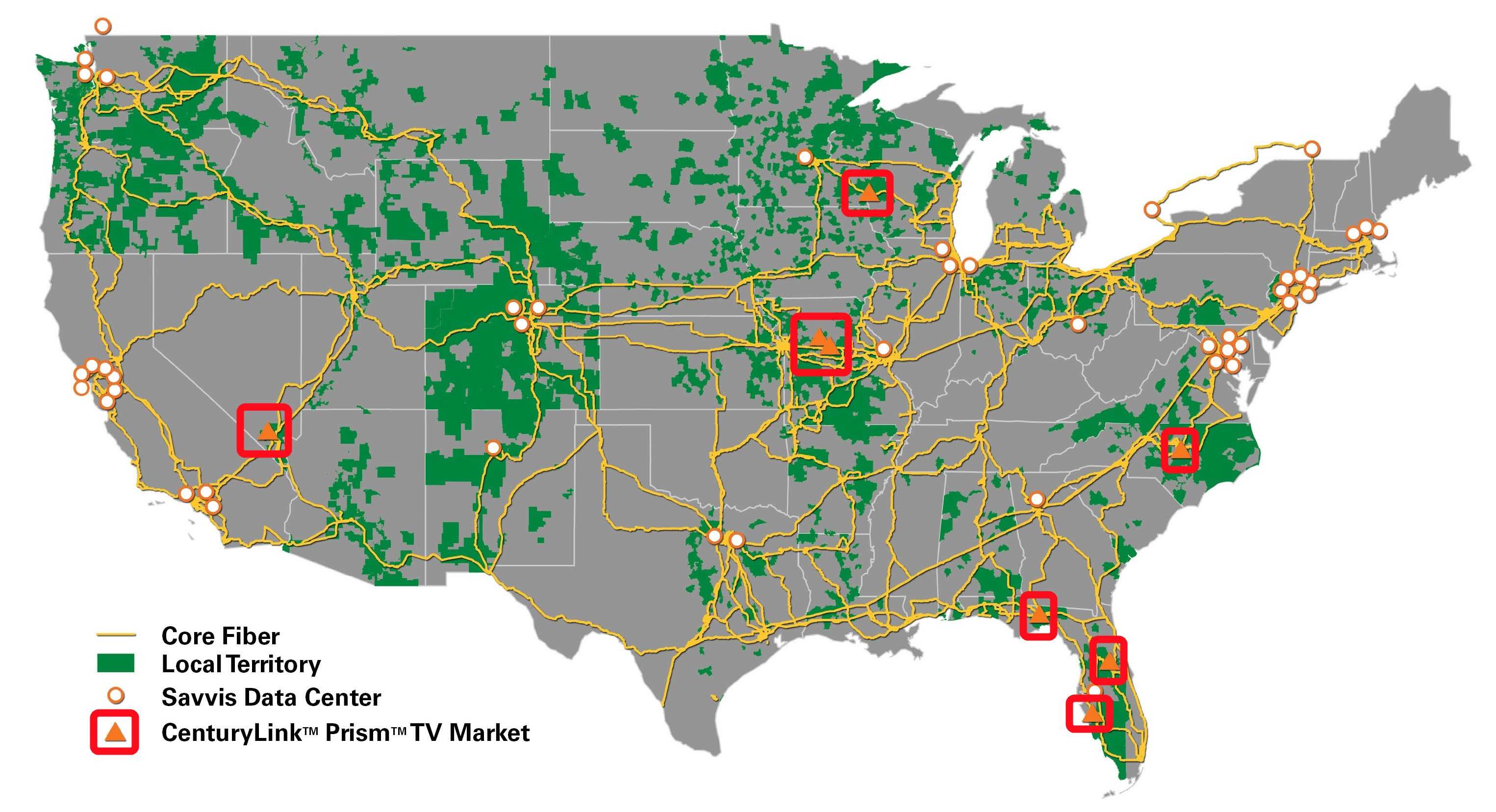
CenturyLink, one of four large independent phone companies and owner of former Baby Bell Qwest, is doubling down on its wired infrastructure to reach customers. The company recently announced Phoenix would be the latest city to get its fiber-to-the-neighborhood service Prism TV — the first legacy Qwest market to get IPTV service from CenturyLink. The service soft-launches in Phoenix this month, with a second city in the region or Pacific Northwest slated to get Prism sometime next year.

The company has spent much of 2012 investing in broadband, managed hosting and cloud computing for business customers, and fiber expansion to reach more than 15,000 cell towers across CenturyLink’s national service area, depicted in green on the accompanying map.

But CenturyLink executives stress their investments are “strategic” — made in areas that are most likely to deliver quick returns for the company.

While CenturyLink spends money to secure video franchising agreements in metro Denver and Colorado Springs for Prism TV service, it is moving at “a snail’s pace” to deliver broadband service in northeastern North Carolina’s Northampton County. County officials there anticipate CenturyLink will take years to deploy basic DSL service to communities outside and around Conway and Gaston.

The broadband problem in income-challenged parts of North Carolina illustrate the conundrum for county officials, who have to advocate for broadband improvement while combating misleading broadband maps that suggest access is not a problem in the state.

Donna Sullivan with the Department of Commerce notes that broadband maps in states like North Carolina have a census block granularity which does not always reveal the true picture of broadband availability.

“That means if one household in that census block can receive broadband services, the entire census block is considered covered—even though there very well may be households who cannot receive broadband to that location,” she told the Roanoke-Chowan News-Herald.

Northampton County, N.C.

CenturyLink is in no hurry to expand broadband to the 1,921 households in the county of 22,000 who cannot buy broadband service at any price.

Derek Kelly, a CenturyLink spokesman, said the company is working to expand broadband services in the region, but noted the costs to lay down a fiber network to help reach the unserved is “one of the largest costs.”

That cost is much less of a problem if the customer at the end of the line happens to be a wireless company like Verizon or AT&T.

Company officials admit they are spending enormous sums “investing in fiber builds to as many [cell] towers in our service area as economically feasible.” In the third quarter alone, more than 1,000 cell towers received fiber upgrades for a total of 3,300 so far this year. The company hopes to reach 4,000-4,500 cell towers by New Year’s Eve.

The reason why CenturyLink chases wireless business while allowing rural and income-challenged service areas to go without broadband is a simple matter of economics. Cell phone companies sign lucrative, multi-year contracts for fiber connectivity to cell towers to support forthcoming 4G service. In contrast, CenturyLink was surprised to find an astounding 94 percent of families with children in Northampton are qualified for the company’s special Lifeline Program which delivers slow speed, discounted broadband service for families on public assistance.

Post

For CenturyLink’s more urban and prosperous service areas, the news for broadband service improvements is better.

As CenturyLink continues to extend its middle mile fiber network, broadband speeds are gradually improving.

Over 70 percent of CenturyLink customers can receive at least 6Mbps DSL service, more than 57% can receive at least 10Mbps and 29% can access the Internet at 20Mbps speeds or better, according to Post.

But the more urban and prosperous a service area is, the greater the chance a cable competitor has successfully poached many of CenturyLink’s DSL customers with the promise of better speed.

Post said he recognizes the company must do better to remain competitive.

“We’re shooting for 20-25Mbps for a very large percentage of our areas,” Post said. “But with [pair] bonding, we can virtually double the broadband capacity and speeds in our markets. We’re already doing bonding in a number of markets today. So where we have 20Mbps, we could have 40Mbps.”

CenturyLink’s fiber to the neighborhood network, essential where it plans to roll out Prism TV, can also support faster broadband speeds if a customer wants broadband alone and does not care about television service.

Nationwide, the company added 10,000 Prism TV subscribers in the third quarter and has a total customer base of around 104,000 subscribers. But that represents a penetration rate of just over 10%, hardly noticed by still-dominant cable operators.

CenturyLink executives were asked to comment on AT&T’s strategic plan to transform their landline network announced last week in New York. Post found little in common between CenturyLink and AT&T’s vision for the future and does not think the company has to respond to AT&T’s attempt to redefine rural America as wireless territory.

“We don’t see that as a major investment for us or a major risk at this point.”

Ho-Ho-Horrible: Your Holiday Gift from Santa Bell is a Substantial Rate Hike

Bell has the perfect gift for themselves this holiday season: significant rate increases on phone, broadband and television service that will leave some customers paying at least $120 more a year for service.

Stop the Cap! reader Alex Perrier shared the bad news with us:

“What a great Christmas gift,” Perrier writes. “With few exceptions, all Bell home services get a ‘price update.'”

Home phone customers may be in for some bill shock if they happen to use on-demand calling features or directory assistance. Some of those rates are increasing by more than 500%.

Home phone packages

The monthly fee for all Bell Home phone packages (Home phone Lite, Home phone Basic, Home phone Choice, Home phone Complete) are increasing by $2.03 effective January 1, 2013.

Long distance plans

Bell long distance plan Effective January 1, 2013, the monthly price will increase by:
Canada and U.S. 500 Minute Block of Time $2
Canada and U.S. 1000 Minute Block of Time $2
Digital Bundle $2
Anytime Block of Time $3

Features

Effective January 1, 2013, the price of Home phone pay-per-use calling features (Last Call Return, Busy Call Return and Three-Way Calling) will increase by $0.45 to $2.95 per use. The monthly cap on Home phone pay-per-use calling features will also increase to $29.50

Effective January 1, 2013, Directory Assistance will increase by $0.50 to $3.00 per use.

Bell TV

Bell Satellite TV and Bell Fibe TV Effective January 1, 2013, the monthly price will increase by:
Good $2.14
Select $2.22
Better $3.28
Best $3.45
All other TV plans $3.00
Super Écran Rate will be $15.15 as of January 1, 2013

Bell Internet

Bell Internet Effective January 1, 2013, the monthly price will increase by:
All Dial-up services $2.00
All Bell Residential Internet services (excluding unlimited usage services)

  • High Speed (limited usage)
  • Ultra (limited usage)
  • Basic
  • Basic Lite
  • Performance
  • Optimax
  • Supreme
  • Max
  • Essential
  • Essential Plus
  • Bell Fibe Internet
$3.00
High Speed and Ultra unlimited usage services $5.00

Note: Bell Internet 5 and Bell Internet 5 Plus are excluded from the price increase.

Search This Site:

Contributions:

Recent Comments:

Your Account:

Stop the Cap!