Home » Providers » Recent Articles:

Half of Your Cable TV Bill Pays for Sports Programming; $200/Month Cable Bills on the Way

Phillip Dampier November 19, 2012 Comcast/Xfinity, Consumer News, Online Video 5 Comments

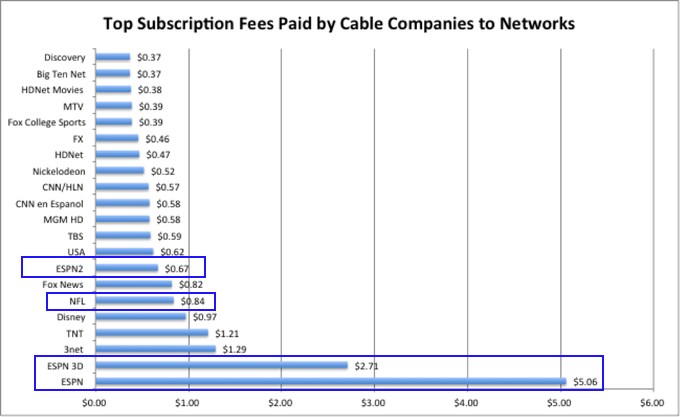
Cadillac prices for some sports networks you pay for whether you watch or not. (Early Summer 2012 – Prices have since risen for some networks)

About 50 percent of your monthly cable television bill covers the cost of live sporting events and the networks that cover them, and the price is not going down anytime soon.

At least $21 of that bill is split between more than 50 national and regional channels covering every imaginable sport.

What customers may not know is that a handful of self-interested giant corporations and major sporting leagues have successfully bid up the price to carry those events using your money.

The Philadelphia Inquirer took a hard look at spiraling sports programming costs last weekend, discovering a lot of cable subscribers are paying for sports programming they will never watch.

“Here is a little old lady who wants to watch CNN,” Ralph Morrow, owner of Catalina Cable TV Co. in Avalon, Calif., a 1,200-subscriber system, told the newspaper. “But I can’t give it to her without $21 a month in sports.”

In the last 20 months, some of the biggest names in sports programming including Comcast/NBC, Fox, ESPN, CBS, and Turner have agreed to collectively pay $72 billion in TV rights to air pro, college, and Olympic events over the next decade. Costs are anticipated to soar to $100 billion or more once those contracts come up for renewal.

To cover the growing expense, the pay television industry’s business model insists that every subscriber must pay for sports networks as part of the “basic package” whether they watch or not. Nothing fuels annual rate increases faster than sports programming, and there is no end in sight.

Many contracts specifically prohibit operators from selling their networks “a-la-carte” or in special “sports tiers” that carry extra monthly fees.  Any additional costs are quickly passed onto subscribers in the form of regular rate hikes.

Charlie Ergen from Dish Networks suggests at the current pace of sports programming rate increases, it won’t be long before subscribers will face cable bills up to $2,000 a year, just to watch television.
If you don’t believe him, consider estimates from NPD Group, which predicts the national average for cable TV bills could reach $200 a month as soon as 2020. That is up from the already-high $86 a month customers pay today, after all costs and surcharges are added up.

It was not always this way. As late as the 1980s, the overwhelming majority of marquee sporting events were televised on “free TV” networks like ABC, CBS, and NBC. For decades, major broadcast networks largely had only themselves and the economics of advertiser supported television to consider when submitting bids to win carriage rights.

With the advent of cable sports networks, supported by dual revenue streams from both advertising and subscriber fees, ESPN eventually amassed a back account large enough to outbid traditional broadband networks. If another network moves in on ESPN’s action, the cable network simply raises the subscription fee charged to every cable subscriber to up the ante.

Broadcasters have enviously watched this dual revenue stream in action for several years now, and have recently insisted they be treated equally. Today, cable operators face demands for similar monthly payments from television stations and their network owners. In effect, customers are paying both sides to outbid one another for sports programming.

Consider ESPN as a case study in sports programming inflation. From 1989-2012, ESPN rates increased 440 percent. Today, every cable subscriber pays at least $5.13 for ESPN alone. In fact, the actual amount is considerably higher, because ESPN has successfully compelled most cable and satellite programmers to also carry (and pay for) several additional ESPN-branded networks also found on your lineup.

But why do cable companies agree to pay astronomical fees for sports networks, only to later alienate customers with annual rate hikes?

First, because customers watch sports. If a cable company does not carry the network showing a game or team a customer wants to see, that company will likely hear about it, either in a complaint call or cancellation.

Second, watching live sporting events is not easy for a cord-cutter. With fewer games appearing consistently on broadcast television, a cord cutting sports fan risks missing the action only available from a pay television provider.
In a defensive move, many cable and satellite companies assume the more live sports a  provider offers, the lower the chance a sports enthusiast will consider canceling service.

Cross-ownership also muddies the water for consumers. Comcast, the largest cable operator in the country, has an obvious self-interest loading its systems up with its own sports programming and compelling customers to pay for it.

Comcast owns about a dozen regional sports networks, NBC, NBC Sports Network and Golf.

Other large cable operators are concluding if you can’t beat ’em, join ’em. Time Warner Cable found one lucrative reason to own its own sports networks: its ability to charge competing cable and satellite providers sky high prices to carry that programming.

Time Warner is asking fellow cable, telco, and satellite providers to pay $3.95 a month for its SportsNet English and Spanish language networks, which feature the Los Angeles Lakers. For good measure, the same cable company that routinely complains about being forced to pass on mandatory sports programming costs from others insists companies place both of their sports channels on basic lineups, which guarantees every subscriber will also pay the price for two more sports channels, one in Spanish, they may have no interest in watching.

Cancel Your Cable TV and Watch Your Broadband Bill Skyrocket; $20 More Without TV Service

Phillip Dampier November 16, 2012 Comcast/Xfinity, Competition, Consumer News, Verizon, Video 10 Comments

Major cable and phone companies are rolling out new bundled packages and promotions designed to protect their cable television packages from cord cutting.

Verizon, Comcast and Time Warner Cable have all run promotions that carry a clear message: cancel your cable television and your wallet gets it.

The Wall Street Journal shared the story of Comcast subscriber Cathy Vu, who decided she no longer wanted cable TV and tried to downgrade to a broadband-only account.

Comcast gave her an offer she could not afford to refuse when the representative explained canceling cable television would increase her monthly bill $20. As a result, Vu decided she would save more money keeping her cable television turned on.

Welcome to the new world of double and triple play bundled pricing promotions that bring downgrade penalties customers cannot ignore.

The idea of repricing cable service to protect vulnerable cable television and phone service began in earnest after analysts like Sanford Bernstein’s Craig Moffett began noticing customers were no longer addicted to keeping cable television, no matter the cost. He proposed a solution: price broadband service higher and cut the cost of cable television.

The result: carefully constructed promotional and bundled package offers that entice customers to purchase services they might not even want, to get the best (and sometimes lowest) price. Gone were promotions that offered phone, broadband, and television service for $33 each. In their place, new pricing that charges $60-70 for the first service, and heavily discounted prices for each additional service.

You know the pitch:

“Yes, I am calling to sign up for broadband service,” you say.

“Certainly, I would be glad to help you with that. But did you know that for just $20 more a month, you can also get cable television?”

“Really, it’s only $20 more? Sure.”

“I am thrilled to hear you say that. But I hope you are sitting down because I have more good news. For just $10 more, we can give you a phone line with unlimited local and long distance calling. How much do you pay the phone company now?”

“Too much, that sounds like an amazing deal, so I get everything together for $99 a month?”

“You sure do, for the first 12 months anyway.”

One year later when the promotion ends, you call to begin downgrading service to lower your bill. But cable and phone companies are increasingly ready for you.

First they will offer you a slightly less attractive promotional retention offer to keep your business. If you accept, the company gets to book the extra revenue and probably locked you into an annual service agreement.

If you don’t bite and insist on a downgrade, they have some bad news for you — that broadband service you still want will now cost you $60-70 a month, including the modem fee.

If you bail early on a promotional discount offer, the bite on your wallet can be significant.

The Journal found unbundling just does not pay:

  • Comcast: TV + Internet for about $50/month for the first 6 months vs. standalone same speed Internet for about $70/month.
  • Verizon FiOS: TV + Internet for about $85/month (two-year contract) vs. standalone Internet for about $80/month.
  • Time Warner Cable: TV + Internet for about $50/month for 12 months vs. standalone Internet for about $45/month for 12 months, then up to $60 after that.

At the end of the day, Moffett and the rest of Wall Street get their wish — preservation of the all-important growing average revenue (ARPU) collected from each customer. Downgrades lower ARPU, so they must be discouraged at all costs.

Cable operators “recognize that their most advantaged product is broadband,” said Moffett. “They don’t want to sacrifice that advantage by giving the opportunity for customers to cherry pick their best product at a low price and take the rest of your services from somebody else. In effect, they are pricing the broadband at a price that discourages you from taking broadband only.”

Customers primed for cord cutting (or who have never bought cable TV) are likely to receive targeted mailings from Verizon, Comcast and Time Warner Cable encouraging subscriptions to cable TV and prices that nearly give the service away.

Comcast’s Blast Plus promotion in selected markets delivers 30Mbps broadband with Digital Economy television service, both for $50 a month for six months. Internet-only customers would pay $70 per month for the same speeds without television.

Time Warner Cable in New York City wants to be your cable TV supplier so much, it offers a package of broadband and throws in Broadcast Basic service for just $5 more per month. Combined, Turbo Internet and television will cost $49.99 a month for a year. Standalone Internet on a promotion runs $45 a month for 12 months.

On a strict cost basis, charging more for Internet does not make sense. The Journal reports that about 90% of your monthly broadband bill is pure profit for cable operators, because the cost of delivering the service has continued to plummet to all-time lows. Cable television is no longer the cash cow it used to be for cable operators because programmers increasingly demand a piece of the profit pie. Today, cable operators only get to book about 35% of your monthly cable television payment as profit.

[flv width=”640″ height=”369″]http://www.phillipdampier.com/video/WSJ Cable Cord Cutting Less Attractive 11-13-12.mp4[/flv]

The Wall Street Journal examines the trend towards repricing broadband service so that customers feel compelled to keep their cable television package or face even higher bills.  (5 minutes)

Charter Cable Sniffing Around Optimum West; Could Acquire Western Systems from Cablevision

Cable customers in Montana, Colorado, Utah, and Wyoming can be forgiven if they cannot remember the name of the cable company that provides them with service. Originally Bresnan Communications, then Cablevision’s Optimum West, customers are now learning Charter Communications could soon be their new service provider.

James Dolan, CEO of Cablevision Industries, last week acknowledged he had received “unsolicited interest” in the cable properties in the western United States, and told investors he may sell the systems for an undisclosed amount.

Cablevision acquired the systems formerly owned by Bill Bresnan two years ago, investing tens of millions in upgrades to bring them closer to modern standards. Cablevision has received praise from many subscribers for improved service and more competitive rates. But a sale could change that. Charter Cable is perennially rated among the worst cable companies in the United States by Consumer Reports.

Should Charter acquire the systems, it will also inherit a major tax fight initiated by Cablevision, protesting its Montana property tax bills for 2010 and 2011.

Cablevision is upset tax authorities defined the Optimum West operation as a single telecommunications company, not a cable company. That decision effectively doubles its tax rate from 3 to 6 percent — the same rate CenturyLink pays in the state.

If an appeals process finds the state erred in its decision, 29 counties will have to refund millions that Cablevision paid under protest.

Tax officials warn if Cablevision’s tax rate is cut in half and other companies reap similar rewards, homeowners and small businesses will cover the difference. Revenue director Dan Bucks warned that could mean annual tax bills $110 higher on a home assessed at $200,000.

Three Wireless Competitors in Alaska is ‘Too Many’; Who Will Buyout ACS?

With Verizon Wireless poised to launch 4G LTE service in Alaska for the first time, Alaska Communications (ACS) and AT&T are hurrying wireless broadband expansions to protect their market turf. But Wall Street investors are unhappy, especially with ACS’ investments in its landline network and the recently announced suspension of its dividend payout. Some are now asking whether ACS’ lucrative wireless business should be up for sale, primed for a buyout by AT&T or Verizon Wireless.

Alaska Communications has soft launched its LTE 4G service in 10 cities: Anchorage, Fairbanks, Homer, Juneau, Kenai, Palmer, Seward, Soldotna, Wasilla and Whittier.

AT&T operates a mix of LTE and slower HSPA+ networks in Alaska and is expanding 4G service to Prudhoe Bay and Deadhorse for the benefit of short-term oil company employees working on the North Slope. But the company is also still expanding its existing 3G network along more remote Alaskan highways.

They are coming.

The investment frenzy is seen by many as a defensive maneuver to keep existing customers happy before Verizon Wireless arrives in Alaska sometime next year.

ACS and GCI, Alaska’s homegrown phone and cable companies now jointly operate their wireless operation together. AT&T is their principle competitor. But Verizon Wireless’ impending arrival in Alaska has shown it is no shrinking violet. There are persistent rumors Verizon is trying to acquire ACS’ wireless operations. Verizon has also announced partnerships with Copper Valley Telecom and Matanuska Telephone Association to potentially expand LTE service in those communities as well.

Investors hope ACS considers any Verizon offer carefully. Wireless is a revenue center for the landline phone company, which continues to see declines in home phone and business customers.

Since June, ACS lost just shy of 2,000 residential landlines and 753 business lines. The company still has 57,000 residential customers and 81,000 business customers.

ACS faces the same problems other phone companies do: network upgrades require significant investments, and investors question whether it will ultimately pay off. Many are also unhappy ACS suspended its dividend payout, refocusing $8 million on debt payments.

Cablevision Subject of $250 Million Lawsuit Over Lack of Automatic Sandy Refunds

Phillip Dampier November 15, 2012 Cablevision (see Altice USA), Consumer News Comments Off on Cablevision Subject of $250 Million Lawsuit Over Lack of Automatic Sandy Refunds

Two Cablevision customers in Nassau and Suffolk counties are the lead complainants in a $250 million class action lawsuit filed Tuesday in New York State Supreme Court alleging the cable operator is illegitimately charging customers for service knocked out by Hurricane Sandy.

The suit claims that unlike other cable and phone companies in New York and New Jersey extending automatic service outage credits to impacted customers, Cablevision is only giving credits to customers who self-report outages within 30 days.

Cablevision was the hardest hit cable operator in the region, with its coastal service areas on Long Island, Connecticut, and New Jersey receiving the brunt of storm surges and wind-related damage. At least half of the company’s three million customers were without service after the storm hit Oct. 29. Nearly 80,000 customers are still without power and utilities are signaling some may wait until after Christmas before lights are back on. Some of the most devastated areas are not scheduled for restoration at all because those properties will have to be abandoned or rebuilt.

The plaintiffs claim Cablevision, “only agreed to rebate some of its most favored customers on a discretionary basis and in varying amounts, and only after the customers’ contacted Cablevision for the rebate.” The suit also alleges customers threatening to cancel service are getting the most generous rebates.

The suit suggests Cablevision should have known not to bill or accept money from customers that remain without service. Many Cablevision customers are on the company’s electronic billing and autopay programs, which will continue to deduct money from bank accounts for services customers cannot actually receive.

“The lawsuit misstates the facts and is without merit,” Cablevision said in a statement. “But lawsuits aside, we have an extremely broad and customer friendly credit policy following Sandy. Blanket or arbitrary credits for cable outages could shortchange customers because each case is different and our policy covers the entire period of time when Cablevision service was out, including when the service interruption was caused by the loss of electrical power.”

Cablevision says the amount of damage to its facilities is so extensive, it could impact the next quarter’s financial results. Company officials also admit some of their customers will not be coming back because their homes and businesses no longer exist.

Search This Site:

Contributions:

Recent Comments:

Your Account:

Stop the Cap!