Home » Providers » Recent Articles:

Charter’s Idea of Customer Service Improvement: Fire the Social Media Team in Cost-Cutting Maneuver

Phillip Dampier December 5, 2012 Charter Spectrum, Consumer News 1 Comment

A source today told Broadband Reports Charter Communications plans to eliminate the company’s social media department that handles customer complaints and concerns on Facebook, Twitter, and elsewhere in a broader move to cut costs.

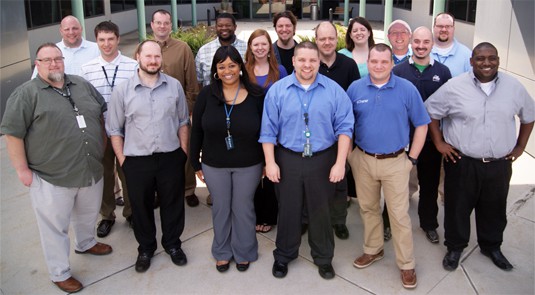
Charter’s social media team

The insider reports company executives informed the Umatter2Charter social media team in Town and Country, Mo. they could move to new positions at Charter’s customer call center or leave the company starting Jan. 1.

The source claims Charter’s new management team of mostly ex-Cablevision executives is behind the decision.

Charter Communications’ decision to scale back on customer relations comes even though the company is regarded as one of the nation’s worst cable operators by customers who give it poor marks year after year.

Investors don’t think too highly of the company either. Charter reported a wider third-quarter loss in November, losing $87 million compared with $85 million lost during the same quarter last year. Executives tell Wall Street  the company was in chaos before new management under Tom Rutledge took over operations. Rutledge’s priorities are to invest in new set top boxes, convert more of its systems to digital, raise prices on services, cut back on promotions and retention offers, and centralize customer support operations.

That centralization process seems to be the reason behind the change.

“Charter will no longer have a customer care team tasked specifically with resolving matters raised on social media,” Charter’s social media manager Eric Ketzer told Broadband Reports. “We communicate with thousands of customers each day on the phone and in person, and that’s where we’ll focus our efforts.”

Happy Holidays AT&T-Style: Third Annual Holiday Job Cuts Announced in Connecticut

Phillip Dampier December 5, 2012 AT&T, Consumer News, Public Policy & Gov't, Video 1 Comment

For the third year in a row, AT&T is celebrating the holidays by telling more than 100 New Haven-area employees they will be spending a lot more time with their families this Christmas, without a job.

In mid-November, AT&T announced it was cutting 100 telephone operators. Now the company is back for more — telling 106 employees, many hard at work cleaning up storm damage from Hurricane Sandy, their services as AT&T technicians are no longer required.

As shell-shocked employees left AT&T’s New Haven headquarters with “early retirement” papers, the local union representing many of the technicians vowed to fight the layoffs.

“Many of the guys losing their jobs are the ones who go out in trucks and restore your service after a storm,” CWA Local 1298 president Bill Henderson told WTNH-TV. Henderson says the next time your U-verse or phone service goes out in Connecticut, you better be very patient because it could take a lot longer for service to be restored.

AT&T says many of the workers involved were no longer needed as consumers move away from traditional landline and wired service in favor of wireless, but Henderson wondered if that were the case, why were many of his workers forced to work mandatory overtime through much of November restoring service after Hurricane Sandy.

Division EEO  JG Job Titles Targeted for Layoffs Total
Network Services F11 Installation & Repair Technician 76
Consumer E17 Service Order Specialist 18
E16 All Distance Specialist 7
E16 Billing Investigation Rep 1
D15 Telemarketing Specialist 3
D15 Telemarketing Specialist (Spanish Language Skills) 1
Total 106

State regulators are already reviewing the performance of utility companies that left many residents with extended outages. Some communities said utilities were woefully unprepared to deal with the storm. Now the union wants the state’s telecommunications regulator to review the layoffs to determine if AT&T’s service in the state will decline further. The impact could be much more than an inconvenience to customers.

Off to the unemployment office we go, unless we’re willing to work elsewhere in the state.

“When we had hurricane Irene, it took our state down economically for a week and a half, and we can’t afford to do that going into the future,” Henderson argues. “We have to do better, we can’t do worse.”

An AT&T spokesman denied the company was laying off any worker, and claimed the company is offering employees access to other positions in other parts of Connecticut.

“The affected employees all have a guaranteed job offer that ensures they will be offered another job in Connecticut,” said spokesman Marty Richter. “All employees declared surplus in Connecticut in the last two years have either found other jobs with the company, continued to work in their current job while awaiting a guaranteed job offer, or elected to take a voluntary retirement package.”

Richter suggested some the affected technicians probably won’t be moved too far away.

“It’s likely that many will be offered jobs as U-verse technicians, in which case they could still be pulled in if needed for network restoration in extreme circumstances like a big storm,” Richter said.

AT&T used to employee at least 4,000 operators in the state of Connecticut alone. Today that number is down to less than 100. When telecommunications companies look for “cost savings,” getting rid of workers or slashing salaries and benefits remain favorite targets.

“It seems like they do it every year at this time,” Henderson said. “This is a company that made $13 billion last year and is on pace to make $17 billion this year and just gave a $2 million bonus to its CEO. They’re important jobs to keep. This is a corporation that only cares about the bottom line.”

[flv width=”640″ height=”380″]http://www.phillipdampier.com/video/WTNH New Haven ATT announces major job cuts 11-30-12.mp4[/flv]

WTNH in New Haven says more than 100 AT&T employees will lose their jobs right before the holidays. It could ultimately affect the quality of your AT&T service, union officials warn.  (2 minutes)

3 Owners in 3 Years And Lawrence, Kansas Still Stuck With Harshly-Capped Cable Broadband

Phillip Dampier December 4, 2012 Broadband Speed, Consumer News, Data Caps, WOW! 2 Comments

Top-rated WOW! only delivers service in a handful of cities in the midwest, but is getting larger after acquiring Knology.

Lawrence, Kansas can’t catch a break. While their neighbors in Kansas City are preparing for Google’s unlimited-use gigabit broadband, the three different owners of the area’s cable operation in the last three years have stuck local residents with usage caps as low as 5GB per month.

What began as Sunflower Broadband, formerly owned by the The World Company, which publishes the daily Lawrence Journal-World, has now been sold to a new owner that plans to leave the current caps in place.

Knology of Kansas Inc., a division of West Point, Ga.-based Knology acquired the Sunflower operation for $165 million in 2010. This week, WideOpenWest (WOW) announced it had completed a system-wide acquisition of Knology, including the former Sunflower system for $1.5 billion.

Consumers in Lawrence hoping for something better from one the nation’s top-consumer-rated cable operators will apparently have to wait. The company announced it was planning no immediate changes to its services or rates, said Rod Kutemeier, who currently remains general manager of the operation.

“Which means while Kansas City becomes a gigabit broadband city with unlimited-use broadband ranging in price from free to $70 a month, we’re stuck with this lousy cable operation that wants $53 a month for 18/2Mbps service with a nasty 50GB data cap and up to $1/GB overlimit fee,” says former Knology customer Sam. “I switched to U-verse, which is only mildly less criminal with their 250GB cap.”

Sam’s price represents standalone broadband service and includes Knology’s $5 monthly modem rental fee. If he purchased video service from the company, his broadband rate would be $10 lower.

Sunflower Broadband introduced one of the country’s first broadband Internet Overcharging schemes, limiting customers on the company’s lowest speed tier to 5GB of usage per month. The company later introduced devotees of unlimited, flat rate access to a reduced priority unlimited option for just shy of $60 a month, with no quoted speed or promise of performance.

Lawrence cable subscribers were hopeful the new owners would adopt pricing and service similar to what WOW offers elsewhere. WOW tells its other customers it does not impose usage limits or consumption-based billing of any kind. But that doesn’t hold true in Lawrence.

“They need to get rid of the current management which continues this ripoff scheme and bring in the same WOW mindset that gave them top ratings in magazines like Consumer Reports,” shares Stop the Cap! reader Sam.

WOW currently offers most customers broadband speeds of 2/1, 15/1, 30/3, and 50/5Mbps. Knology of Kansas offers service at speeds of 5/1, 18/2, and 50/5Mbps — all usage capped.

Pricing and packages for Lawrence, Kansas’ local cable company will remain the same… for now.

Frontier Stymies Broadband Grants to Independent ISPs; Complains They Duplicate Service

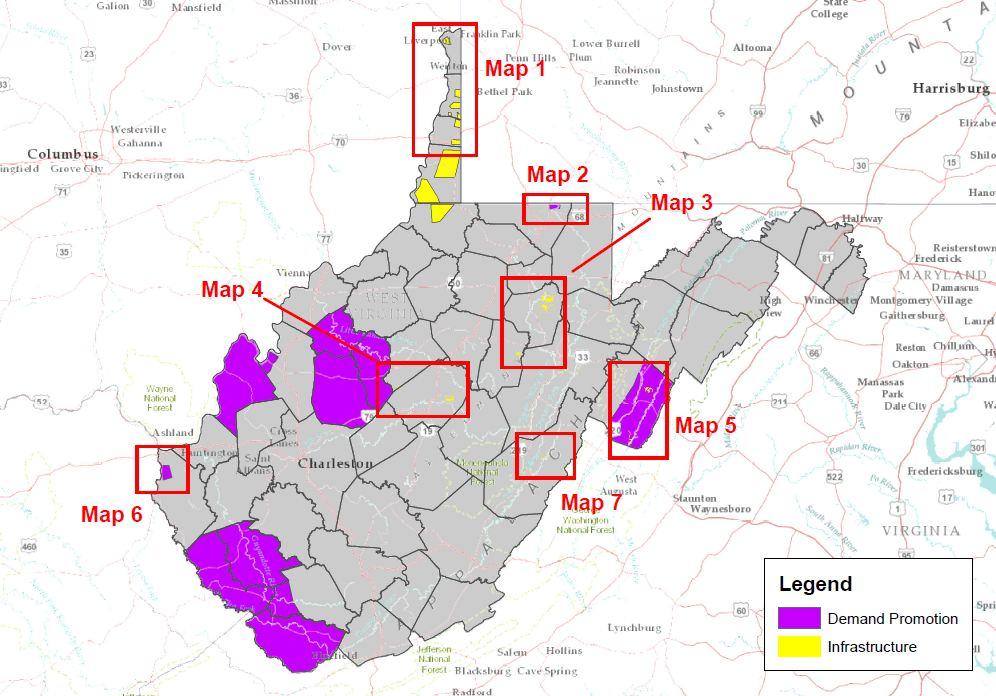
Areas in yellow are Wireless ISP projects seeking funding to expand. Most of them are in the panhandle region of northern W.V. The areas shaded in purple are grant proposals to promote the benefit of subscribing to broadband service.

Frontier Communications has forced a West Virginia broadband improvement council to temporarily suspend plans to distribute $4 million in funding to independent ISPs planning to expand service in rural areas after a company official objected that the funding would duplicate broadband service Frontier already provides itself or through its satellite broadband partner.

The West Virginia Broadband Deployment Council ended up postponing its broadband awards program after Frontier Communications executive Dana Waldo, who serves on the Council, objected to the money being distributed.

Waldo noted state code prohibits the board from awarding grants for projects in areas already provided service.

That state code, passed by the West Virginia legislature in 2008, came courtesy of a coalition of phone, cable, and broadband equipment companies like Cisco working with then-Gov. Joe Manchin to push the broadband bill into law. Verizon was the most influential supporter, serving as West Virginia’s largest telecommunications company before selling its landline network to Frontier.

The code Waldo refers to:

The council shall exercise its powers and authority to bring broadband service to those areas without broadband service. The council may not duplicate or displace broadband service in areas already served or where private industry feasibly can be expected to offer services in the reasonably foreseeable future. In no event may projects or actions undertaken pursuant to this article be used to finance or support broadband or other services in competition with private industry.

The Council relied on broadband map data provided by Frontier Communications to help score and rank projects that appeared to be outside of Frontier’s broadband service area. When the project rankings were first announced in September, Frontier executives immediately claimed their map data was outdated and subsequently updated map data voluntarily supplied by Frontier, not independently verified, showed many of the high-ranking independent projects would compete with Frontier’s DSL service, disqualifying them from further consideration.

Waldo

Waldo declared he was not comfortable with the broadband awards because “many of those areas are currently served or can be reasonably served by Frontier.”

State officials were hopeful a new list of qualifying projects could be developed in accordance with the latest Frontier map data and were scheduled to be announced on Dec. 12.

But Waldo noted that Frontier could end up unhappy with many of those projects as well.

He noted Frontier technically already offers every household in West Virginia broadband access through its new partnership with a satellite Internet Service Provider. Frontier began offering rural customers satellite Internet service earlier this year.

“If our mission is to increase broadband access, we need to consider satellite,” he told the Council. “We have hundreds of [satellite] customers.”

While Frontier considers satellite broadband a solution in the most rural areas where it is unlikely to provide service anytime soon, it could prove even more valuable as a weapon against potential competition in a state that prohibits public funding of competing services.

The biggest losers should Frontier prove its case are rural Wireless Internet Service Providers, who have requested $3.1 million in grants to build antenna towers. An additional $923,000 was expected to fund programs that promote the benefits of signing up for high speed service. Frontier has ties to four of those projects, and has stated no objections to them.

Frontier has also not objected to the much larger $126 million federal grant to construct an institutional statewide fiber broadband network. Frontier is the primary vendor that will sell access on that network.

West Virginia’s Conundrum Proves Inflexible Broadband Grants, Poor Planning Wastes Taxpayer Money

Still keeping their fingers on the pulse of West Virginia’s broadband.

The state of West Virginia has a money problem.

In 2009, the state applied for and won a $126 million federal Broadband Technologies Opportunity Program (BTOP) grant to expand broadband service in a state plagued with some of the worst Internet access around. That grant will expire Jan. 31, without all of the money spent and equipment in place.

Whatever money is left unspent will be returned to the federal treasury and lost for good. That represents the absolute worst-case nightmare scenario for government officials loathe to leave money on the table. As a result, the state continues to hurry depleting the remaining grant funds before the clock runs out, even if it results in controversial spending decisions.

Last week, the chairman of the West Virginia Broadband Deployment Council openly admitted the state does not have a unified, coherent broadband deployment plan and has been running the broadband expansion effort on an ad hoc basis. That’s a big mistake in the eyes of Dan O’Hanlon, a retired Cabell County circuit judge who leads the Council.

It should not be this difficult. Ask virtually any consumer in rural West Virginia about what needs to be done and the answer is always the same: expand access in unserved areas and raise speeds for those who already have the service.

Unfortunately, $126 million of consumers’ tax dollars will be spent without really doing either.

The Obama Administration’s efforts to expand rural broadband came with lofty rhetoric, but far too often failed to directly address the problem. Consumers and small businesses want Internet access, and the local phone company simply won’t deliver it. Forget about cable broadband — most rural areas without Internet access are not served by any cable operator.

Phillip “Verizon and Frontier have built West Virginia’s taxpayer-funded broadband network in their own image” Dampier

That leaves the federal government in the position of trying to fund rural Internet connections in ways that don’t appear as blatant corporate welfare — paying off phone companies to provide service where they have simply refused for revenue and cost reasons. Competitors are also outraged at the precedent of directly subsidizing certain players but not others, and a lot of taxpayers might question why their tax dollars are going to the phone company.

As a result, the government has discovered a politically palatable alternative: throwing money at non-controversial “institutional” networks built to serve local governments, hospitals, public safety agencies, libraries, and schools. They also have political cover funding obscure “middle mile” networks that interconnect telecommunications company offices, but don’t directly serve any homes or businesses.

Since most people don’t understand the differences between these types of networks and the services they actually provide, broadband expansion projects offer politicians headache-free ribbon cutting ceremonies, applause, and positive publicity from local media reports that mistake institutional and middle mile networks with broadband finally coming to rural towns and villages. Long after the cartoon-sized ribbon-cutting scissors are put away, rural residents still find themselves stuck with dial-up or satellite fraudband.

Last week, the Joint Committee on Technology overseeing the BTOP grant learned the state lacks a plan to get the most broadband bang for the buck, despite hiring some big dollar Verizon subcontractor-consultants that are supposed to be experts at this kind of thing.

As Stop the Cap! reported in May, the state decided to spend $24 million of taxpayer money to buy 1,064 overpowered Cisco routers built (and priced) for big city university use. Imagine the surprise of rural schools and libraries when routers valued at $22,000 each arrived to serve a handful of concurrent users that would have been just as well-served with equipment you can find at Best Buy. Those routers were coincidentally supplied by a familiar vendor: Verizon Network Integration.

Two years later, more than 300 of those routers were in storage, unused. As of this week, 175 are still there.

This $22,000 router, paid for at taxpayer expense…

Two rural librarians in May told Stop the Cap! they were in a quandary over the equipment installed in their tiny libraries because they had no idea how to switch them on, much less maintain them over the long term. Even worse, both told us, they cannot begin to afford the ongoing monthly service fees that are required to participate in the new broadband network.

“We are getting a Hummer network on a Kia operating budget,” one librarian told Stop the Cap! last spring. “The network sounds great, but in our case we have to find the money to pay the bill to run it every month, and that money is hard to find in a library with five outdated public terminals.”

Seven months later and not a lot has changed.

“We have complained to our local leaders this has created more problems for us than it solved,” that same librarian, who could not use his name because of local politics, told Stop the Cap! “If you have worked in government or community service as long as I have, you cringe whenever you have one of these grants because you have to follow the federal government’s rules and you end up spending the money where it least needs to be spent.”

…will provide service for this rural library’s four public terminals. (Image: West Virginia Gazette)

Committee members echoed that sentiment, observing facilities are ending up with equipment they don’t know how to use or cannot afford because monthly service charges for upgraded broadband from Frontier Communications, the state’s largest phone company, are unaffordable.

One proposed solution to cut further taxpayer expense would be to sell the excess network capacity, deemed significant in many communities, to third party Internet Service Providers to directly resell to individual homes and businesses. After all, taxpayers are footing the bill for the $126 million grant that largely paid for the network and independent ISPs would help solve the problem of extending broadband to the unserved.

No deal. Frontier claims it is selling the project broadband access far below normal commercial rates, offering high capacity speeds at an unspecified “entry-level” price. Allowing third party companies to resell that service would put independent ISPs in direct competition with Frontier.

Unfortunately, well-intentioned members the West Virginia Broadband Deployment Council, the Joint Committee on Technology, and other government officials are in over their heads and increasingly appear captive to the design, recommendations, and implementation of a network plan heavily influenced by high-paid Verizon consultants and implemented on a broadband network owned and operated by Frontier Communications.

That left Gale Given, the state’s chief technology officer claiming critics of earlier spending decisions were engaged in “second guessing.” With the expensive routers mostly already in place, Given offered it was better for schools and other institutions to have more capacity than they need now so they won’t be hamstrung if they ever want to expand.

“Only one problem: Ms. Given assumes we can afford to turn the key on the network they are building us now,” said one librarian this week. “Only we can’t. Worrying about what we can do tomorrow is pointless when we can’t even afford to do it today.”


Search This Site:

Contributions:

Recent Comments:

Your Account:

Stop the Cap!