
Home » Providers » Recent Articles:

Comcast Advertises Unlimited Calling That Isn’t; Blind Woman Warned She’ll Be Cut Off

Phillip Dampier December 10, 2012 Comcast/Xfinity, Consumer News 2 Comments

Comcast continues to advertise its phone service as offering “unlimited nationwide talk,” when in reality the company will hang up on any customer who consistently spends more than two hours, forty-five minutes a day on the phone.

That may sound like a lot of talking, but for one blind customer in Chambersburg, Pa., it is a raw deal.

“They should tell you right off the bat it’s not unlimited,” said Mindy Hartman. “It’s really something that has to be addressed across the industry. Comcast is not the only company who has done this to people.”

Hartman received a phone call from Comcast Security warning her she exceeded their usage cap of 5,000 minutes per month. That was news to Hartman, who told the Chicago Tribune she specifically asked Comcast about any calling limits before signing up, and company representatives repeatedly told her there were none.

Comcast assured Hartman, ‘Oh, no, you can talk on the phone 24/7 if you want. We have no caps.'”

Comcast Security warned Hartman if she tried, the company will promptly cut her off. In fact, Comcast is ready with the scissors right now if Hartman does not reduce her calling immediately.

Comcast claims its 5,000 minute cap is mentioned in the fine print, effectively rendering the company’s prominent claims of “unlimited calling” moot.

“I’m blind, and most people don’t look at that when they’re told by customer service it’s unlimited,” Hartman told the newspaper. “It was nice they had the courtesy to call me, but I wasn’t very happy when they called.”

Hartman wants Comcast to fully disclose its call limit and provide customers with access to the number of minutes customers have used during each month, so they can manage their calling.

The Phoenix Center’s Myopic Arguments Favoring Usage Pricing Ignore Marketplace Reality

Phillip “It’s hard to trust a group that so spectacularly flip-flopped on Internet policies when its benefactor AT&T changed its tune” Dampier

When Republican FCC Commisioner Ajit Pai turned up last week at a telecom symposium to warn a more activist FCC could ruin broadband providers’ efforts to charge consumers more money for less service, he was speaking to a very friendly audience.

The conservative Phoenix Center, which ran the event, has been spewing out industry-friendly “research reports” for years that attempt to justify the country’s sky-high broadband pricing. It also promotes a “hands-off” mindset on industry oversight, calling it common sense and consumer-friendly.

Unfortunately for the group and its supporting authors, it has a serious credibility problem — exposed as an industry-funded “think tank” operating as a mercenary research arm for AT&T and other phone companies. In fact, the same group that today generates endless research condemning Net Neutrality had a very different position in 2004 when it published an Op-Ed entitled, “Net Neutrality: Now More Than Ever.”

What changed? Its benefactor. In 2004, AT&T was a competing long distance carrier fighting local phone companies. Today it –is– one of those phone companies. With its Baby Bell owners controlling AT&T’s purse-strings starting in 2006, the Phoenix Center dutifully flip-flopped to maintain continuity with the ‘new AT&T,’ strongly opposed to most forms of broadband regulation.

So it comes as no surprise the Phoenix Center continues pumping out cheerleading “research reports” that attempt to bolster credibility to forces opposing Net Neutrality and supporting an Internet Overcharging free-for-all with the help of usage billing and caps.

One particular bit of nonsense that completely ignores marketplace reality came in Phoenix Center Chief Economist Dr. George Ford’s report, “A Most Egregious Act? The Impact on Consumers of Usage-Based Pricing.

For example, Ford argues:

A prohibition of differential pricing renders a single price that lies between the low price for the restricted service and the high price for the unrestricted service. Therefore, prohibitions against usage based pricing forces some consumers to pay more for services they do not want or use, while others are allowed to pay less for services they do. The prohibition, in effect, results in a transfer of wealth from one group of consumers to another, and profits are also reduced. Overall consumer welfare is diminished, even though some consumers are better off.
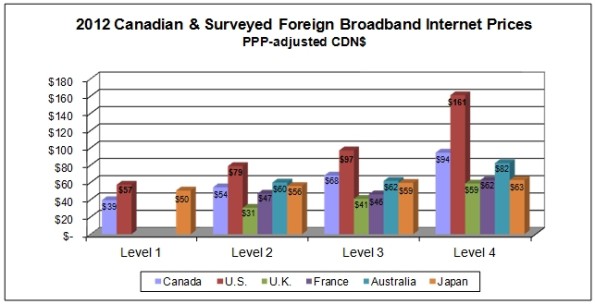
We’re number one… in prices, even with the increasing prevalence of usage-based pricing Ford believes benefits consumers. (Image: CRTC)

But Ford completely ignores the current conditions in today’s broadband market that have made it easy for providers to promulgate an unpopular end to flat rate, unlimited broadband in favor of a highly-flawed, usage-based billing policy:

  1. Ford ignores the broadband market is essentially a duopoly for most consumers and effectively a monopoly in rural America. That gives providers what they call “pricing power,” the ability to increase prices at will and change pricing models because consumers are dependent on the service and have limited options to take their business elsewhere;
  2. The only “transfer of wealth” involved here is from consumers to providers. While profits soar and costs drop, Ford complains that those using the service more are somehow subsidized by lighter users, when it fact providers enjoy a 90-95% gross margin on broadband. As Time Warner Cable CEO Glenn Britt admitted, the most significant cost attributed on the cable company’s balance sheet for broadband comes from its backbone traffic costs, which are minuscule in contrast to the increasing prices the cable company charges for its broadband service;
  3. Consumer welfare is reduced primarily from the high costs charged by providers, made possible by scant competition that would otherwise drive prices downwards, not from expenses associated with broadband traffic;
  4. Ford is careful not to advocate for a true usage-based billing system that would be a revenue nightmare for his benefactors. In a strict usage-based pricing model, customers would pay a small fee for infrastructure, support, and equipment expenses and a variable charge based on actual usage. But no provider in the United States advocates for this system. Instead, providers force consumers into tiered broadband plans that include different usage allowances the vast majority of customers will either not exhaust or will exceed, which raises profits even higher with usage overlimit penalties. With no unused usage rollover, most customers are in the same position Ford claims will diminish consumer welfare: paying for service they do not want or use;
  5. Most consumers favor unlimited, flat use plans even if they could save money with a usage-constrained pricing model. Since keeping customers happy with a more expensive unlimited plan they like instead of a lower priced plan they don’t want would seem to enhance provider profits. But Ford ignores this reality, perhaps understanding providers are actually laying the groundwork to broadly monetize Internet usage. Whether a provider adopts usage-based billing or a strict cap on usage, which is growing in most households, the inevitable result is still the same: more profits, less cost from constrained usage. Inevitably this will force customers into higher-priced, higher-profit upgrades that deliver a higher usage allowance, again something consumers simply do not want. This is already a reality in the wireless marketplace, and is well-acknowledged by both AT&T and Verizon Wireless.


Time Warner Cable Officially Unveils 15Mbps Speed Increase; Some Markets Just Getting DOCSIS 3

Phillip Dampier December 6, 2012 Broadband Speed, Consumer News, Earthlink 5 Comments

Although “soft-launched” several weeks ago in many markets, Time Warner Cable has officially unveiled its holiday gift for 2012: a free 50% speed increase for Standard tier customers: 15/1Mbps service.

The speed increase is now complete across New York, New Jersey, New England, the Carolinas, Virginia and Alabama. Customers can activate the higher speed by briefly unplugging their cable modem for 10 seconds, plugging the cord back in, and in some cases rebooting their computer.

Customers outside of these areas can try this as well. Stop the Cap! has received reports from readers in the midwest, Texas, and California that the speed increase has arrived in their areas as well. All Time Warner Cable systems across the country should be providing the new speed by the end of this month.

Earthlink customers using Time Warner Cable should also see an identical speed increase.

Some Time Warner Cable customers are only now getting upgrades to DOCSIS 3 service, which open the door to 30/5 and 50/5Mbps speed tiers. The latest: Binghamton, N.Y. and surrounding southern tier communities. Customers further upstate have had that option for 1-2 years.

AT&T’s and Verizon’s Tax Windfall Could be Ending; AT&T Paid No Federal Tax Last Year

Phillip Dampier December 6, 2012 AT&T, Consumer News, Public Policy & Gov't, Verizon 1 Comment

Although Americans are paying higher cell phone bills than ever before, some of America’s largest wireless providers have been saving a fortune, enjoying near-tax-free status thanks to an economic stimulus package that allowed companies to write off expenses associated with expanding their businesses.

Under accelerated depreciation, both AT&T and Verizon have been able to slash tax obligations by claiming deductions for capital investments most analysts believe they would have made with or without the income tax windfall. Despite this, both companies have raised prices and have cut jobs and employee benefits.

Washington lawmakers are now debating tax policies that could reduce or end corporate subsidies and raise their tax payments.

The stimulus incentives were designed to promote spending and investment by large corporations retrenching in the face of the Great Recession. Through a combination of special interest amendments guaranteed to favor certain businesses and creative accounting, the two largest wireless companies in the country wrote off investments originally planned before the stimulus package was enacted.

Without the corporate welfare package, telecom analyst Craig Moffett predicted AT&T would have paid a 35% tax rate over the past four years, amounting to $29.3 billion in taxes. Instead, it paid $13.3 billion total. Last year it paid 0% — nothing.

Verizon Wireless has skirted around its tax bill thanks to its offshore partner Vodafone. By shifting certain money overseas, and through other creative measures, Verizon ended up paying a 6% tax rate — $1.3 billion total taxes in four years. Not bad for America’s largest wireless operator. Two years ago, Verizon was estimated to have paid nothing at all.

Citizens for Tax Justice and the Institute on Taxation and Economic Policy claim corporate tax subsidies effectively cost taxpayers $14.5 billion for AT&T and $12.3 billion for Verizon Wireless over the past four years. Only one company benefited more than AT&T and Verizon: mortgage underwriter Wells Fargo.

If the ability to take accelerated depreciation were to be withdrawn in current tax negotiations, AT&T and Verizon would both find themselves paying taxes at rates comparable to many upper-middle class Americans.

AT&T would see its tax rate rise from 13.3% in 2013 to 29 percent by 2016. Verizon will pay 25% in 2013 and 27% by 2016. Both companies would still continue to aggressively pursue loopholes and other write-offs, including larger contributions to both companies’ pension plans which would reduce cash liabilities.

WIND Mobile Saves One Rural Canadian $160/Month Over Rogers’ Wireless Broadband

Phillip Dampier December 6, 2012 Broadband Speed, Canada, Competition, Data Caps, Online Video, Rogers, Rural Broadband, Wind Mobile (Canada), Wireless Broadband Comments Off on WIND Mobile Saves One Rural Canadian $160/Month Over Rogers’ Wireless Broadband

In spring of this year, rural Canadian access to the Inukshuk Wireless system was terminated, forcing many to usage-capped wireless plans from companies like Rogers Communications that cost a lot more.

Kevin, a Stop the Cap! reader dropped us a line this week to remind Canadians they don’t have to pay Bell, Rogers or Telus big dollars for a small wireless usage allowance.

“After a bit of shopping, I signed up for WIND Wireless and it has been a positive experience,” Kevin writes. “Their customers service is leaps and bounds better than the big three and I get 10GB of usage for $35 a month.”

Once Kevin exhausts his usage allowance, he keeps right on browsing because Wind does not charge overlimit fees — they throttle speeds downwards, but not to the punishing dial-up-like speeds of most other providers.

“I’ve streamed music and video after I’ve hit 10GB,” Kevin writes, although he admits YouTube can be a bit problematic with buffering issues at the slower speeds.

Kevin says if he stuck with Rogers he would be paying them around $195 a month for the same usage he pays $35 for with WIND.

“Who cares about the speed of Rogers’ LTE network when you pay that much,” Kevin adds.

WIND Mobile is one of a handful of upstart independent cell phone providers challenging the dominance of incumbent telecommunications companies that have set the standards for high Canadian broadband pricing and low usage caps. Kevin wishes more Canadians would consider switching away from dominant providers to send them a message they have to compete with lower prices and better service.

Search This Site:

Contributions:

Recent Comments:

Your Account:

Stop the Cap!