
Home » Providers » Recent Articles:

Frontier Settles Oregon Class Action Lawsuit Over Unjust FiOS Video Late Fees; Refunds Coming

Phillip Dampier January 16, 2013 Consumer News, Frontier 2 Comments
The case involves late fees charged to Frontier FiOS video customers in the state of Oregon.

The case involves late fees charged to Frontier FiOS video customers in the state of Oregon.

Frontier Communications FiOS video customers that paid late fees for service in the state of Oregon may be entitled to a partial refund after the telecom company settled a class action case.

The settlement, announced today will cover both current and former customers.

Some key points:

  • Customers that are potentially included in this class action settlement will receive a separate notice in the next 60 to 90 days;
  • The separate notice will include additional information and instructions regarding steps they can take if they are eligible for a refund;
  • A claims administrator will be identified and responsible for providing notices to former and existing customers;
  • Customers must wait until they receive a notice regarding the settlement from the claims administrator which outlines additional steps that must be taken.

The company was accused of unjustly charging and collecting late fees for video customers whose payments were processed late as the company assumed control of the FiOS service from Verizon Communications.

An internal memo sent to Frontier employees and obtained by Stop the Cap! suggests the company is expecting calls from customers inquiring about the settlement. Other than telling employees to express empathy, company officials have asked customer service representatives to avoid speculating about the case and referring customers to forthcoming communications from the settlement administrator within the next two to three months.

The lawsuit only covers Oregon residents.

Cox Cable: “It’s Our Priority to Add Value”… While Jacking Up Your Rates in 2013

Phillip Dampier January 16, 2013 Consumer News, Cox Comments Off on Cox Cable: “It’s Our Priority to Add Value”… While Jacking Up Your Rates in 2013

COX_RES_RGBCox Cable customers in Arizona, Florida and beyond face a significant rate hike for cable, broadband, and phone service in 2013 according to a notification from the company. Rates are going up for most individual services, although customers in selected package bundles or on promotions will avoid increases for now.

Cox claims “increasing programming expenses” and the “rising costs of doing business” are responsible for the forthcoming higher bills.

In Arizona, Cox’s prices change as follows:

Cox TV and Advanced TV:
Cox TV Essential will change from $60.79 to $63.99.
Advanced TV will change from $62.59 to $63.99.
Preferred TV will change from $69.59 to $73.99.
Super Mix will change from $69.59 to $70.99.
Premier TV will change from $80.59 to $83.99.
Ultimate TV will change from $122.58 to $125.99.
Advanced TV standard definition receivers will change from $6.99 to $8.50.

Plus Package fee will change from $10 to $5. (only decrease)
Variety Pak will change from $7.00 to $10.00.
Sports and Information Pak will change from $7.00 to $8.50.
Single premium channel rate will change from $14.99 to $15.00.
Two premium channels rate will change from $23.49 to $25.00
Three premium channel rate will change from $31.99 to $34.00.
Four premium channel rate will change from $39.49 to $42.00.

Telephone:
Cox Digital Telephone Essential will change from $19.99 to $21.99.
Voice Mail will change from $7.99 to $8.99.
To comply with federal regulatory guidelines for the Access Recovery Charge, the FCC Access Charge will increase by $0.12. Toll Restriction will change from $2.75 to $1.49.
Simply 5 Long Distance will change from $3.99 to $4.95.
For information on other telephone rate changes, please visit Cox.com

Internet:
Starter will change from $25.99 to $26.99.
Essential will change from $37.99 to $39.99.
Preferred will change from $53.99 to $55.99.
Premier will change from $64.99 to $67.99.
Ultimate will change from $94.99 to $99.99.

(Thanks to ‘BryanInPHX’ for compiling the changes.)

In Florida, Cox customers will pay $68.49 for “Advanced TV” service — nearly $70 for what some would consider “basic cable.” Equipment is going up as well.

Advanced TV standard definition receivers increase from $6.99 to $8.50 a month. Advanced TV High Definition and DVR receivers rise from $7.99 to $8.50.

Many Cox Internet customers in Florida will also pay between $3-4 a month more for their broadband service.

Comcast Buys Part-Ownership in Cable Equipment Manufacturer Arris

Phillip Dampier January 16, 2013 Comcast/Xfinity, Consumer News Comments Off on Comcast Buys Part-Ownership in Cable Equipment Manufacturer Arris

arrisComcast Corporation has announced its intention to pay $150 million for part-ownership of Arris Group, Inc., which manufacturers set top boxes and cable modems.

Comcast will own 10.6 million shares of Arris when the deal is complete.

The investment comes at the same time Arris is completing its acquisition of Motorola Home Business, which has been a major supplier of cable equipment for years.

With the investment, Comcast is signaling its intent to remain committed to Arris and Motorola brand equipment, but also more strongly influence its future development.

Cable operators have often griped about proprietary software powering set top boxes and the cost of buying and maintaining equipment. Many operators plan to leverage their broadband networks to develop new, cloud-based software to improve the user experience and reduce the cost of equipment.

“This investment by one of our largest customers is a strong indication of customer support for the Motorola Home acquisition and its potential to accelerate innovation to the benefit of the industry and consumers,” said Bob Stanzione, Arris chairman and CEO.

CenturyLink Concedes Publicly-Owned Broadband Networks Offer Better Service Than They Do

CenturyLinkA CenturyLink official made a remarkable concession in the state of Minnesota last week when he admitted the state’s community-owned broadband networks are better equipped to deliver 21st century broadband speeds that CenturyLink simply cannot provide.

Duane Ring, midwest region president for CenturyLink publicly told an audience at a Minnesota High Tech Association-sponsored discussion in Minneapolis that community-owned networks don’t have to meet shareholder demands for return on investment and other corporate metrics that have left CenturyLink broadband customers with far lower speeds than municipal broadband customers. Minnesota Public Radio was on hand:

Noting that CenturyLink wants every customer it can find, Ring pointed out that the company nonetheless needs a return on investment that satisfies shareholders and meets the demands of larger commitments and fiduciary responsibilities.

The small phone companies that have laid high-speed fiber networks, some of whom are cooperatives whose customers are the owners “can make decisions that maybe the economic return is 25 years,” Ring said. “They can do that.”

CenturyLink admits they offer better speeds over a superior network.

CenturyLink concedes Paul Bunyan offers better speeds over a superior network.

Only 62 percent of Minnesotans can today purchase what qualifies as broadband service. Those lucky enough to be served by public providers like Paul Bunyan in the Bemidji area and Farmers Mutual Telephone in western Minnesota benefit from some of the fastest broadband speeds in the state. That is because those cooperatives and public ventures laid fiber optic cables connected to individual homes. Those in rural Minnesota served by CenturyLink or Frontier get much less from slow speed, copper-based DSL, if they can get broadband at all.

CenturyLink has proven itself an obstacle for community broadband, opposing the construction of improved networks in areas they already service, condemning rural customers to substandard broadband speeds indefinitely. While the company says it is not opposed to public-private partnerships, any attempt to bypass them will result in a hornet’s nest of legal protests and blocking actions.

While community-owned networks struggle for financing and approval in a hostile atmosphere created by incumbent providers, the government is handing out money to companies like CenturyLink to get them to extend their slow speed DSL network. CenturyLink is spending $11 million in Connect America funds in Minnesota alone.

In other areas, residents have no interest in waiting around for single digit DSL speeds. In Lac qui Parle County in western Minnesota, local officials have joined Farmers Mutual Telephone to build a fiber network.

CenturyLink’s admission proves it answers first to shareholders, much later to customers.

Why is a Michigan Public Service Commissioner Carrying AT&T’s Water?

Phillip Dampier January 15, 2013 AT&T, Competition, Data Caps, Editorial & Site News, History, Public Policy & Gov't, Wireless Broadband Comments Off on Why is a Michigan Public Service Commissioner Carrying AT&T’s Water?
ori

Isiogu

A current member of the Michigan Public Service Commission is penning guest editorials featuring AT&T’s favorite talking points: promoting the company’s deregulatory agenda and providing false memes about Internet Overcharging schemes like usage caps and consumption billing.

Orjiakor N. Isiogu, co-vice chairman of the National Association of Regulatory Utility Commissioners Committee on Telecommunications and member and immediate past chairman of the Michigan Public Service Commission wrote nearly identical pieces appearing in The Hill, the Detroit Free-Press and the Battle Creek Enquirer that included misleading claims that could have come straight from an AT&T lobbyist’s “fact sheet.”

A sample:

The federal government has used the telecom industry as a model of how competition could be a better elixir than the guiding hand of government regulation. And the results are impressive. The high-speed Information Superhighway touches 95 percent of the U.S., and most consumers can choose from among six or more wireless or wireline providers (90 percent can choose from at least two). And the price of Internet access — measured by megabits per second — has fallen 87 percent since 1999, even as the speed has increased tenfold;

80 percent of U.S. homes now have access to download speeds of 100 megabits per second, and 4G wireless service will soon be available nationwide, with speeds of up to 20 megabits per second;

Despite the evidence, however, there are those who wonder whether there is sufficient competition for Internet access, whether speeds are too slow and prices too high. Others object to new pricing plans that allow a consumer to purchase the amount of bandwidth that best suits his needs.  In fact, some have asked the government to stop these new tailored pricing plans, even though these plans save nearly all consumers from having to underwrite the “outliers” whose monthly usage is gigantic — over 300 GBs a month or the equivalent of over 500 standard definition movies;

And if Teddy Roosevelt were with us today, he would likely argue that we can walk and chew gum at the same time, pointing to the banking industry as an example of industry excesses in need of a public check and the telecom industry as an example of how private competition, with occasional nudges, could better make the markets work.

In reality, if Teddy Roosevelt were alive today, he’d ask why a state commissioner working for the public is instead carrying water for the large telecommunications companies he oversees.
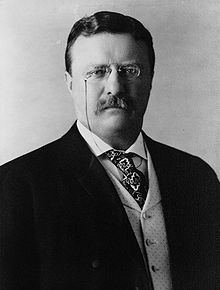
Did Roosevelt advocate the government keep their hands off AT&T and other consolidating telecom companies?

Did Roosevelt advocate the government keep their hands off AT&T and other consolidating telecom companies?

Isiogu doesn’t know his history either.

Roosevelt made no distinctions between the excesses of one industry over another. He strongly believed all major interstate corporations (and that would cover Isiogu’s friends at AT&T, Comcast, and other big telecom companies) should be subject to federal regulation and, in some cases, have their rates set by the government to ensure the public was charged fairly for the services they received. Roosevelt learned his lesson well from the oil, railway, and tobacco trusts his government sued to break up after years of consolidation and rapacious greed at the public’s expense. Those companies all claimed to be competitive as well.

Few industries have consolidated faster than the telecom sector, which is gradually rebuilding the Bell System in AT&T and Verizon’s image and a cable cartel that agrees never to compete directly with other cartel members.

Isiogu’s “facts” are disturbingly incomplete and misleading for a telecom regulator ostensibly serving the public interest.

For example, his claim that Americans can choose among six or more different providers ignores the fact AT&T and Verizon are counted twice (wired and wireless), no competition exists among multiple cable operators or phone companies, and many of the other options Isiogu counts (almost always wireless) do not provide coverage in suburban and rural Michigan. The average consumer in the U.S. has two practical choices for broadband — the cable or phone company.

While Isiogu sings the praises of American broadband, the rest of us have watched the price of Internet service continue to increase, whether customers want faster speeds or not. The industry itself admits it can raise prices because the competitive landscape and consumer love of broadband gives companies “pricing power.”

He also doesn’t mention the price of 100Mbps service or the fact it is not offered by either AT&T or (outside of one city) Time Warner Cable — both industry leaders. Wireless is no panacea either. 4G service may offer faster speeds, but usage plans that start with just a 1GB allowance make it hard (and expensive) to take advantage of the technology improvements. Just a few years ago those plans offered unlimited access.

Isiogu also tapdances around the fact no broadband provider in the country wants to sell a “pay for what you use” plan. Instead, companies create usage allowances that come with steep overlimit fees and, as AT&T executives have told shareholders, deliver limitless potential revenue growth as subscribers are forced to upgrade as their usage grows.

Most consumers favor and appreciate unlimited-use plans for predictable pricing and ease of mind. But flat rate plans ruin providers’ goals to monetize broadband usage and are usually eliminated when consumption pricing arrives, another fact Isiogu does not bother to disclose.

Isiogu has gotten remarkably cozy with the industry he oversees, even resorting to mind-bending pretzel logic that calls regulation for the banking sector a good idea and oversight of his industry friends a disaster.

What is disturbing is while Isiogu pens these industry friendly guest editorials in his spare time, he is also in a position of power to oversee and regulate these same companies in the public’s interest.

That represents a clear conflict of interest Teddy Roosevelt could see and feel from his grave.

Search This Site:

Contributions:

Recent Comments:

Your Account:

Stop the Cap!