
Home » Providers » Recent Articles:

Snow Day: Missouri Businesses Temporarily Close Because Kids Home Online Clog Windstream’s DSL

Phillip Dampier January 28, 2013 Broadband Speed, Competition, Public Policy & Gov't, Rural Broadband, Windstream Comments Off on Snow Day: Missouri Businesses Temporarily Close Because Kids Home Online Clog Windstream’s DSL

Fiber Dreams are Gone With the WindstreamWhen inclement weather forces Wayne County, Mo. schools to close, some area businesses in Piedmont also send employees home because their Windstream Communications’ DSL Internet speeds slow to a crawl.

“People feel they are paying for a service they are not getting,” Missouri state Rep. Paul Fitzwater told Windstream. “I get emails every day, letters, telephone calls. The other day there was a water main break and school was closed. Some of the businesses had to shut down because of reduced Internet speeds because the kids were online playing games.”

Fitzwater complained to Windstream officials that broadband issues are so bad in the region, it is affecting the local economy.

“McAllister Software is a major employer, employing around 140 people,” Fitzwater said. “They are vital to the local economy and they need Internet service. There were about 45 hours last year that they had to shut their doors because they had no Internet.”

Fitzwater

Fitzwater

Windstream plans broadband feast or famine for southeast Missouri’s Wayne County, with well-populated communities getting some broadband service improvements while more rural areas continue to go without high speed Internet.

“Windstream has made it clear that they have no plans to invest in areas where they don’t feel they can be profitable,” said Piedmont Area Chamber of Commerce president Scott Combs.

With no cable broadband competition in rural parts of Missouri, customers can take Windstream DSL or leave it. With no major competitive pressures, Windstream has taken its time to manage capacity upgrades and extend service.

When the kids are home from school, browsing speeds crawl because Windstream lacks sufficient capacity in the region. The company’s last fiber backbone upgrade made little difference, according to the Journal-Banner. Customers regularly find DSL speeds in the Piedmont area slow to 80-100kbps, about twice what dial-up customers receive. The speeds also degrade during evenings and weekends, when more users are online.

“Obviously, this is a problem in the area,” Fitzwater said. “There are a lot of people that come through the Piedmont area annually due to tourism—two to three million each year. When I was going door-to-door campaigning, Internet speed was the number one issue of constituents. Everyone I met with, the Internet was all they wanted to talk about.”

At the local Wal-Mart, customers compete to tell the worst Windstream DSL horror story.

Windstream’s rural service area in southeast Missouri is served by 11 remote switches. Only one — provisioned for McAllister Software — is fed by fiber. The others are served by copper. The city of Piedmont is served by three D-SLAMS which help extend Internet to more distant sections of town. Even Windstream admits their current infrastructure is inadequate and plans to improve Piedmont’s broadband service in the near future.

But after Piedmont’s service is upgraded, the rest of southeast Missouri will just have to grin and bear it. Windstream says it plans no further upgrades in 2013 and beyond because spending money on extending improved Internet service costs too much and is not financially feasible.

piedmontFor rural customers who remain without service, Windstream suggests they sign up for satellite broadband service, which also delivers slow speeds and very low usage allowances.

In 2009, Windstream won a $10.3 million grant for rural broadband projects. The money was not spent in Piedmont, however. Instead, Windstream used the funds for projects in Greenville and Wappapello, which also suffer from inadequate service.

Without further upgrades, customers are guaranteed additional speed degradation throughout the county. Those customers are angry.

Combs says Windstream is effectively engaged in bait and switch broadband marketing, promising customers 3Mbps service and delivering a small fraction of that speed during peak usage periods.

“I believe that Windstream, by taking money from customers that are being billed for 3Mbps download service (and greater), are obligated to provide that service,” Combs writes. “It is unethical and possibly illegal to charge customers for services that you have no capability or intention of delivering.”

Despite admissions from the company it faces growing usage and capacity issues, Windstream keeps marketing its broadband service to new customers, and charges voice-only customers more than those who bundle both voice and broadband, which only increases demand further.

“[Windstream has] no qualms about selling new accounts or ‘upgrading’ services on a system [it knows] cannot handle the additional pressure. How can this possibly be anything short of fraud?” asks Combs.

AT&T Shutting Down Its Alaskan WiMAX Service Jan. 31

wimaxAT&T’s WiMAX Internet service in Alaska will be switched off Jan. 31, forcing rural Alaskan customers to find an alternative for inexpensive wireless service in areas where DSL or cable broadband is unavailable.

The company stopped signing up new customers last March and has been repeatedly notifying existing customers they will need to find an alternative service soon.

AT&T is shutting off the aging WiMAX network, which delivered up to 2Mbps service at prices starting at around $20 a month, in favor of newer wireless broadband services, including AT&T’s LTE 4G service and Wi-Fi hot spots.

AT&T is recommending customers switch to one of its mobile broadband plans. But WiMAX customers are likely to experience sticker shock when they see the difference in price.

AT&T charges $40 a month for just 1GB of usage plus an additional $20 a month device fee on its Mobile Share Device Data Plan.

Cox Tells Customers “No Refunds” and “Your Problems are Yours to Solve”

Phillip Dampier January 17, 2013 Consumer News, Cox Comments Off on Cox Tells Customers “No Refunds” and “Your Problems are Yours to Solve”

cox Cox Cable, on the heels of announcing another rate increase, is earning customer ire for downright nasty customer service.

Customers dealing with two different service blackouts and a flood have gotten a thumbs-down response from Cox when looking for some service credits and understanding.

‘We don’t give refunds,’ came the reply from one customer service agent called by Stop the Cap! reader Jennifer from Providence, R.I. Her service went out in mid-December after a burst water pipe in the neighborhood flooded their home, making in uninhabitable until a mold mitigation team completed repairs. After fleeing to stay with relatives, it suddenly dawned on Jennifer that Cox Cable kept her waiting on hold so long, she hung up and forgot to call them back.

“All I needed to do was notify them we were not going to be using our Cox service for about a month and we needed to suspend our account,” Jennifer tells us. “When I finally got a customer service agent, the first thing I heard was him blowing his nose several times before he finally introduced himself.”

The surly agent was not interested in Jennifer’s plight or her request to suspend service.

Don't Care“Your flooding problems are yours to solve and we can’t help you with suspending service unless you are going away for much longer than that,” came the reply. “And we are certainly not able to give you a refund either. It isn’t our fault.”


Jennifer was stunned at the nasty attitude she got, especially after other companies were far more understanding.

“I had nothing but sympathy from Verizon, the power company, and even the newspaper which we also stopped,” she says. “Cox could not have cared less and we did not even create the problem.”

Cox customers in Ohio also got the same special touch from Cox’s representatives.

Rev. Dave Connor from Lakewood was looking for a $1.50 credit for a few local channels that were stripped off his cable lineup because of yet another carriage-for-money dispute. Raycom wanted more cash for its two local channels and Cox did not want to pay so off they went from the lineup, at least temporarily. But the cable operator did not want to give any refunds for the missing channels customers had been paying to receive.

It took several escalating phone calls before Cox finally relented to a one-time credit, putting a sour taste in the Rev. Dave’s mouth.

“Some ‘friend in the digital age,’” he told the Lakewood Patch, referencing the company’s ad slogan.

Before others got the idea they deserved a refund as well, Dana Alexander Nolfe, director of communications for Cox, hurried out to let customers know they can just forget it.

Nolfe told the Patch the refund granted Connor was a one-time “gesture of goodwill,” adding no one else will likely be given a similar refund.

“We are not crediting our customers as a result of the Raycom dispute,” Nolfe said. “We offer a package of channels, not individual channels on our lineup. We regularly make changes to our lineup, mostly with additions, but at times, regrettably, when a channel is removed from our lineup.”

Ian King called Cox “the worst,” noting the company refused refunds for customers left without service for days after the remnants of Hurricane Sandy meandered across Ohio.

“Cox is nothing but a PR campaign that constantly tells us how wonderful they are, but in reality they could care less,” King said.

Jennifer says she won’t forget.

“After we move back, one of the first things I will be doing is dropping them and their smug representative on their heads.”

Signing Up for Verizon FiOS in a Tent in Northern Philadelphia

Phillip Dampier January 17, 2013 Comcast/Xfinity, Competition, Verizon Comments Off on Signing Up for Verizon FiOS in a Tent in Northern Philadelphia

New Yorkers who want fiber optic broadband will need to buy it from Verizon on their FiOS network.

Although Verizon Communications has stopped expanding its FiOS fiber-to-the-home service outside of areas it already committed to serve, its gradual rollout continues in Philadelphia.

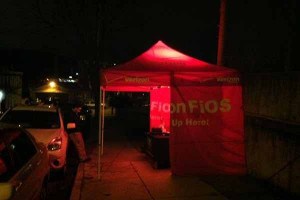
Gradual is right. On Kalos Street in the Wissahickon section of Philly, it all depends on which side of the road your house resides. Odd-numbered customers were in luck this week as Verizon took its marketing efforts to the street, with a temporary tent emblazoned with Verizon’s logo installed on the sidewalk, giving pedestrians a few minutes of warmth from a portable heater.

FiOS tent (Courtesy: J. Chakars/WHYY NewsWorks)

FiOS tent (Courtesy: J. Chakars/WHYY NewsWorks)

Inside the tent, would-be customers are given a preview of the fiber optic service and some free gifts just for stopping by on the cold winter night. Those who took Verizon up on its offer walked away with free ice skating tickets. Those that didn’t got a refrigerator magnet and a tote bag as consolation prizes.

Verizon’s sales force, braving the weather, has made inroads in the city that is home to Comcast’s corporate headquarters.

Joanne Weill-Greenberg told WHYY/NewsWorks she called Comcast to deal for a lower rate and Comcast refused to match Verizon FIOS’ introductory offer. She is now an ex-Comcast customer, and not just for the money. She explained FiOS offers channels Comcast does not carry, and because FiOS also carries Comcast’s regional sports channel, there is nothing holding them to the cable company.

The Verizon tent does not stay in any one location too long.

In a few days, they will relocate to another neighborhood that is now primed for fiber upgrades from the phone company.

Pennsylvania residents can just be thankful the winter weather has not gotten brutal enough for Verizon to deploy its inflatable igloo.


Turnabout: Verizon’s RISK Security Team Ferrets Out Employee Outsourcing His Own Job to China

Phillip Dampier January 17, 2013 Consumer News, Verizon 2 Comments
Downtown Shenyang

Downtown Shenyang

When corporate executives discover the merits of outsourcing jobs to overseas workers in China or India, that wins them a large bonus for improved efficiency and successful cost-cutting. When an enterprising employee does the same thing, that is a heinous security risk.

Verizon’s RISK Team, which sells enterprise-level security services to large companies, discovered a “severe” security threat when it went to work for a “critical U.S. infrastructure company” (which goes unnamed) that found some unusual activity in its private network logs.

It all started when the company began shifting employees away from in-office work towards cheaper telecommuting. To allow this to happen, a secure virtual private network was established allowing developers to manage their work from home.

When the company began reviewing the network logs, it discovered a curious workday connection being established almost daily originating from Shenyang, China. The company hired Verizon’s RISK Team to consider the implications.

Company security personnel were initially concerned the Chinese had infiltrated their private network even though network access required the use of a rotating token RSA key fob. Even harder to understand, security officials watched the employee working at his office desk at the same time.

Was it a Chinese intelligence agency break-in? Malware? Hackers?

No, it turned out the employee, who Verizon calls “Bob,” had simply outsourced his job responsibilities to a contracting firm in China.

Company officials authorized some infiltration of their own, asking Verizon to review a forensic image quietly obtained from Bob’s workstation. Verizon security officials were surprised when they found hundreds of .PDF invoices sent from the third party contractor-developer… in Shenyang, China. Verizon’s RISK blog explains further:

verizon businessAs it turns out, Bob had simply outsourced his own job to a Chinese consulting firm. Bob spent less than one fifth of his six-figure salary for a Chinese firm to do his job for him. Authentication was no problem, he physically FedEx’d his RSA token to China so that the third-party contractor could log-in under his credentials during the workday. It would appear that he was working an average 9 to 5 work day. Investigators checked his web browsing history, and that told the whole story.

A typical ‘work day’ for Bob looked like this:

  • 9:00 a.m. – Arrive and surf Reddit for a couple of hours. Watch cat videos
  • 11:30 a.m. – Take lunch
  • 1:00 p.m. – Ebay time.
  • 2:00 – ish p.m Facebook updates – LinkedIn
  • 4:30 p.m. – End of day update e-mail to management.
  • 5:00 p.m. – Go home

Evidence even suggested he had the same scam going across multiple companies in the area. All told, it looked like he earned several hundred thousand dollars a year, and only had to pay the Chinese consulting firm about fifty grand annually. The best part? Investigators had the opportunity to read through his performance reviews while working alongside HR. For the last several years in a row he received excellent remarks. His code was clean, well written, and submitted in a timely fashion. Quarter after quarter, his performance review noted him as the best developer in the building.

Search This Site:

Contributions:

Recent Comments:

Your Account:

Stop the Cap!