
Home » Providers » Recent Articles:

John Malone’s Vision of Cable’s Future: Mergers/Acquisitions/Bring Back the ‘Cable Mafia’

Time Warner Cable and Cablevision customers may one day end up as Charter Cable customers if John Malone has his way.

Time Warner Cable and Cablevision customers: Is Charter Cable in your future?

The best way the cable industry can grow revenue in the lucrative broadband business is to bring back the same type of collusion and control cable companies maintained over video programming 20 years ago.

Dr. John Malone did not want to sound nefarious in his recent interview with CNBC’s David Faber, but the new part-owner of Charter Communications has built a reputation as cable’s Darth Vader over the last 30 years. His detractors consider his way of doing business akin to a nationwide cable mafia, complete with exclusive, non-competitive territories that assure operators can charge sky-is-the-limit prices.

Malone is now back in the cable business in a big way, and analysts expect he will quickly amass influence in an industry he once led as CEO of the nation’s then-largest cable operator — Tele-Communications, Inc. (TCI).

[flv]http://www.phillipdampier.com/video/CNBC Malone is Back Into Cable 4-13-13.mp4[/flv]

Why is John Malone back in the cable business and why buy a piece of Charter Cable? Malone tells CNBC’s David Faber Charter is a company with enormous growth potential through mergers and acquisitions. CNBC says Malone could be targeting Time Warner Cable and Cablevision for acquisition by Charter as early as next year. “There is consolidation yet to be done,” Malone hints.  (7 minutes)

Malone notes the cable industry is on the cusp of transformative consolidation through collaborative agreements, mergers, and outright acquisitions both here and abroad. CNBC speculated that could begin with efforts to further reduce the number of cable operators in the United States, perhaps beginning with a deal by Charter Communications to acquire both Time Warner Cable and Cablevision, which could combine under Malone’s stewardship and Charter’s executive leadership to “compete” with Comcast.

Dr. John Malone

Dr. John Malone

CNBC reporters note Malone has high praise for Thomas Rutledge, CEO of Charter Communications. Rutledge’s earlier experience working for both Time Warner Cable and Cablevision could be an asset in combining all three companies into one. Analysts speculate such a deal could be pitched as early as 2014 when Time Warner Cable will undergo a management makeover with the departure of CEO Glenn Britt. CNBC also noted Cablevision’s imminent sale has been rumored for years, and current leader and family patriarch Chuck Dolan is 87 years old. With cheap credit and Malone’s business savvy, both companies could find themselves part of a Malone-engineered takeover that would vastly expand Charter Communications into the second largest cable operator in the country.

Malone sees the days of traditional cable television coming to an end as consumers turn to “over the top” online video for an increasing share of their viewing time. As cable television rates continue to increase, customers are cutting the cord. Malone believes today’s bloated cable packages are ripe for an upheaval from a-la-carte pricing or theme-based programming bouquets that break expensive sports programming or movie channels out of the traditional basic cable lineup. Malone even suspects a challenge to the industry’s current price models could surprisingly come from the programmers themselves.

Sports networks will be among the first to notice their affiliate revenue collected from cable and satellite companies (and passed on to customers in the form of higher rates) will stagnate as customers drop cable television. Declining viewer ratings also mean lower ad revenues. Malone believes at some point sports teams and/or programming networks will decide that the biggest barrier to winning new viewers is the $70-80 asking price for basic cable. If sports programmers find they can reach new audiences selling their programming online, direct-to-consumer, for $5-10 a month, the basic cable all-for-one-price model will quickly collapse.

“As the cable guys and the satellite guys start to lose customers to the over-the-top guys, some of those economics will be reflected back on the sports guys,” Malone said. “They’ll start losing advertising revenue. They’ll lose affiliate revenue. And they have to face reality that maybe you need to segregate your market like everybody else.”

[flv]http://www.phillipdampier.com/video/CNBC Malone on Unbundling Cable 4-13-13.mp4[/flv]

John Malone predicts the demise of the traditional bundle of cable television programming within five years. The future is streamed video online, declares Malone, so it is important the cable industry move to manage that competitive threat by acquiring streaming competitors or launching their own services to assure video programming revenue can be protected.  (5 minutes)
non competeMalone sees the future sustainability of the cable industry dependent on the high revenue broadband business.

“I think it is at a point in history when the most addictive thing in the communications world is high-speed connectivity,” Malone told CNBC. “Everywhere in the world that we operate, we’ve just seen the public want more and more data rate. Whether it’s wireless or wired. There’s a big appetite for it. Cable technology right now is the most cost-effective way to deliver that growth in speed.”

Malone believes there is also plenty of room for revenue growth and cost-cutting, which he said can best be accomplished by getting other cable operators together to “cooperate” and “coordinate” broad scale broadband projects that counter competitive threats from third parties.

Malone helped pioneer the cable industry business practice of “don’t compete in my backyard and I won’t compete in yours,” an informal agreement among operators to stay within their own specific territories, safe and secure from competition. In the 1980s and 1990s, Malone’s TCI was one among many cable operators buying and swapping cable systems to build large, regional system “clusters” where only a single cable company provides service, winning economy of scale and a formidable presence that discouraged other wired competitors from entering the business. In most cities, only the deep pockets of AT&T (U-verse) and Verizon (FiOS) have managed to shake things up.

[flv]http://www.phillipdampier.com/video/CNBC Bring Back the Cable Mafia 4-13-13.mp4[/flv]

Bring back the cable mafia? CNBC’s David Faber gets John Malone to admit vertical and horizontal integration — controlling the content and the pipeline — are important factors to protect cable revenue and expand American dominance in cable internationally. Malone is also a big supporter of industry consolidation and believes mergers and acquisitions are necessary to shrink the number of cable operators in the United States. (5 minutes)
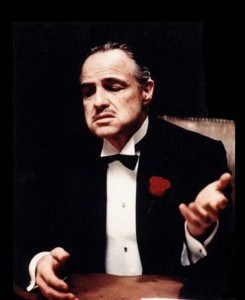
John Malone's "cable mafia."

The cable mafia?

Malone wants broadband to be carefully managed under the industry’s own control and direction.

Faber asked if Malone wanted to bring back the days of the “cable mafia.”

“Yes, I think we do want to bring back the days of @Home, the days of Ted Turner, the days when we all got together, because together we provided national scale,” Malone said. “Now I think we have the opportunity to create global scale,” he said. “The goal is not to be bigger. The goal is to be more cost-effective.”

One significant way cable can push broadband and protect video revenue is to acquire or directly compete with online video providers like Netflix and Hulu.

“People aren’t going to stop watching TV,” Malone said. “They’re just going to watch it coming over the top.”

With easy credit at cheap rates and enormous cash on hand, Malone recommends cable operators get out their mergers and acquisitions checkbook and remember the days when cable operators controlled both cable television systems and most of the programming carried on those systems. For broadband, that means making sure companies control the pipeline and the content that travels across it.

[flv]http://www.phillipdampier.com/video/CNBC When the Money is Cheap Use It 4-13-13.mp4[/flv]

Washington tax policies originally designed to expand access to cheap capital for business investment, hiring and expansion are instead being used to leverage buyouts and mergers. John Malone says Charter Communications will use “cheap money” at interest rates well below 5% and favorable corporate tax policies to fuel the next wave of cable industry consolidation. (2 minutes)

Updated AP Breaking News: Officials Order Cell Service Switched Off in Boston, But We Have Doubts

Another reason to keep your landline. During major events, cell phone networks are quickly overwhelmed while wired phone lines still work.

Another reason to keep your landline. During major events, cell phone networks are quickly overwhelmed while wired phone lines still work.

The Associated Press is reporting minutes ago that a law enforcement official has ordered all cellphone service in the Boston area temporarily suspended to prevent any possibility of remote detonations of any other improvised explosive devices. But we have our doubts and in fact was able to reach one of our Boston readers by cell phone in downtown Boston just a moment ago.

“I can’t make calls on Verizon without getting a fast busy signal, but I am getting calls regularly at the moment,” reports Jim, one of our regular readers. “The cell networks are totally jammed with everyone on the phone in this city.”

Jim says a number of his co-workers had no idea there were two explosions at the finish line of the Boston Marathon this afternoon, but word-of-mouth office gossip spread the news over the last hour or so.

“Landlines are working fine, which is another reason you cannot and should not rely on cell phones alone during a major news event or disaster, because they are highly vulnerable to capacity crushes,” Jim said. “Our Internet access at work has also slowed to an absolute crawl and you cannot access a lot of local news websites, so we’ve watched the coverage on over the air television.”

Numerous press reports speculate the two explosions that killed two and injured at least two dozen were the result of some type of explosive device, but law enforcement officials have refused to confirm those reports so far.

As of 5:15pm EDT, Sprint and Verizon Wireless reported they were attempting to maintain service as best as possible despite the flood of wireless calls, and no carrier has confirmed they have been asked to switch off service.

“We are experiencing call blocking due to what’s happening,” Mark Elliott, a Sprint spokesman told the Boston Globe. “The network is blocking calls because the number of calls coming in exceeds the capacity. There’s no way the network can handle that kind of traffic.”

Elliott is asking cell phone users to text messages to friends and loved ones and avoid voice calling until capacity improves. This can keep lines open and clear for emergency and law enforcement officials.

Verizon Wireless, meanwhile, issued a statement, saying: “Verizon Wireless has been enhancing network voice capacity to enable additional calling in the Copley Square area of Boston. Customers are advised to use text or email to free up voice capacity for public safety officials at the scene. There was no damage to the Verizon Wireless network, which is seeing elevated calling and data usage throughout the region since the explosions occurred.”

Update 5:54pm EDT: The Associated Press has officially retracted their earlier story. There has been no request to suspend cell phone service, but carriers are impacted by heavy call volumes.

Dish Network Offers $25.5 Billion for Sprint, Topping Softbank’s Bid; Will Keep Unlimited Data Plans

Phillip Dampier April 15, 2013 Competition, Consumer News, Dish Network, Public Policy & Gov't, Sprint, Video, Wireless Broadband Comments Off on Dish Network Offers $25.5 Billion for Sprint, Topping Softbank’s Bid; Will Keep Unlimited Data Plans

Dish Network holds MVDDS licenses to serve more than three dozen communities across the country.

Satellite television provider Dish Network today offered $25.5 billion for Sprint Nextel Corp., in an unsolicited bid that surprised the wireless industry.

The bid, announced by CEO Charles Ergen, is $5.5 billion higher than that offered by Japan’s Softbank, which already had a pending deal to take a 70 percent stake in the third largest wireless carrier.

The bidding may not yet be over if Softbank decides to counter with a higher offer or if other bidders emerge in the coming weeks.

Ergen has signaled his interest in entering wireless markets to compensate for slowing earnings in the satellite television business.

“He is trying to transform his own business,” Vijay Jayant, an analyst at International Strategy & Investment Group in New York told Bloomberg News. “He’s trying to reinvent himself, moving from satellite to wireless.”

sprintnextelErgen’s vision would include a bundled package of satellite television, broadband wireless Internet and cellular telephone service. Providing suitable wireless broadband Internet in rural areas may be the biggest challenge because of Sprint’s more limited network coverage, but a marketing deal combining satellite television from Dish and Sprint cell phone service would be easier to carry out.

Ergen’s offer includes $8.2 billion in stock and $17.3 billion in cash. Ergen’s company has stockpiled at least $10 billion from selling bonds over the last year. He intends to borrow the rest.

Ergen earlier had attempted to disrupt a deal that would have consolidated Clearwire into Sprint. Ergen offered $3.30 a share for Clearwire, 33 cents higher than the $2.97 per share offer from Sprint. Ergen also reportedly approached both MetroPCS and Deutsche Telekom’s T-Mobile USA looking for a deal to no avail.

Some analysts question whether Ergen has enough experience to manage a major wireless company with only his past involvement selling satellite TV subscriptions. But he arrives with more than just cash and stock options. Ergen has acquired mobile spectrum from bankrupt TerreStar Networks and DBSD North America. Ergen says he has no interest in building his own wireless network, but a combined Sprint/Dish could manage the spectrum through Sprint’s existing operations.

Ergen told Bloomberg News combining the spectrum Dish owns with the spectrum owned by Sprint and Clearwire would assure Americans of a robust wireless data platform that will not have capacity constraints or require individual device fees. That is in keeping with Sprint’s existing marketing as a provider of truly unlimited wireless data plans.

Several Wall Street analysts told CNBC and Bloomberg News the deal with Softbank may be more ideal for shareholders and consumers, because it would strengthen Sprint’s leverage with equipment manufacturers to offer cheaper and more robust devices.

Consumer advocates have mixed feelings. Dish has no prior association to the wireless industry so the deal does not represent direct, competitive consolidation. It also would boost Sprint as a more formidable competitor to AT&T and Verizon Wireless. But it could also further orphan T-Mobile USA.

“Right now, we have two giants and two also-rans, and now you’re getting potentially three giants dividing up the American market place, with T-Mobile lagging far behind,” Susan Crawford told the New York Times.

[flv width=”640″ height=”380″]http://www.phillipdampier.com/video/Bloomberg What Does Dish See in Sprint Thats Worth 25B 4-15-13.flv[/flv]

Bloomberg News explores what Dish sees in Sprint that is worth a bid of $25.5 billion to acquire the country’s third largest mobile company.  (2 minutes)

[flv width=”640″ height=”380″]http://www.phillipdampier.com/video/Bloomberg Dish Bids 25-5 Billion for Sprint to Challenge Softbank 4-15-13.flv[/flv]

Bloomberg says Dish has been stockpiling $10 billion in cash for new acquisitions to transform its business away from a satellite TV-only company.  (2 minutes)

[flv width=”640″ height=”380″]http://www.phillipdampier.com/video/Bloomberg All Things Are on the Table for Sprint 4-15-13.flv[/flv]

Christopher Marangi, of Gabelli Asset Fund talks with Bloomberg’s Erik Schatzker about Dish Network’s unsolicited $25.5 billion offer for Sprint and what options are available to Sprint with the offers it has on the table. (2 minutes)

[flv width=”640″ height=”380″]http://www.phillipdampier.com/video/Bloomberg Dish Bid for Sprint Lacks Capital Chaplin Says 4-15-13.flv[/flv]

Jonathan Chaplin, an analyst with New Street Research LLP, thinks Softbank’s original offer is superior to the one from Dish.  (6 minutes)

[flv width=”640″ height=”380″]http://www.phillipdampier.com/video/Bloomberg Bidding for Sprint Is Not Over Fritzshe 4-15-13.flv[/flv]

Jennifer Fritzsche, Managing Director of Equity Research at Wells Fargo Securities, discusses the likelihood of other players making bids. (2 minutes)

[flv width=”640″ height=”380″]http://www.phillipdampier.com/video/Bloomberg What Did Dish CEO Ergen Say About Sprint Bid 4-15-13.flv[/flv]

A Bloomberg News reporter interviewed Charlie Ergen about why he wants to enter the wireless business.  Ergen’s vision includes no nickel and diming customers with monthly device fees and usage charges. (4 minutes)

Canada’s Independent Wireless Providers Capitulate With “For Sale” Signs; Telus Interested

Phillip Dampier April 15, 2013 Canada, Competition, Consumer News, Koodo, Mobilicity, Public Mobile, Public Policy & Gov't, Telus, Wind Mobile (Canada), Wireless Broadband Comments Off on Canada’s Independent Wireless Providers Capitulate With “For Sale” Signs; Telus Interested

mobilicityCanada’s effort to expand mobile competition has likely failed with news that three of the most significant new independent entrants have put themselves up for sale, with one likely to be acquired by Telus, western Canada’s largest phone company.

With Bell Canada, Rogers Communications, and Telus dominating at least 90 percent of Canada’s wireless marketplace, breaking up the triopoly was unlikely to be easy, but three of Canada’s newest players that acquired spectrum just five years ago are already looking for exit strategies.

Bloomberg News reported Friday that Mobilicity is in talks to be imminently acquired by Telus for between $350-400 million. Public Mobile has hired investment bankers to find a buyer. Vimpelcom, Ltd., which owns Wind Mobile, announced it was “exploring its options, including divestment.”

telus bullThe three companies have competed with the dominant players for about three years with little success. Combined, the three have not managed to achieve even a combined 10 percent market share. Most sell unlimited talk and text plans to customers that would normally buy prepaid service.

Potentially slowing any sale is a requirement that none of the independent companies can transfer their spectrum licenses until 2014, a condition of the 2008 special spectrum auction that reserved prime frequencies for new competitors and put them off-limits to larger mobile companies.

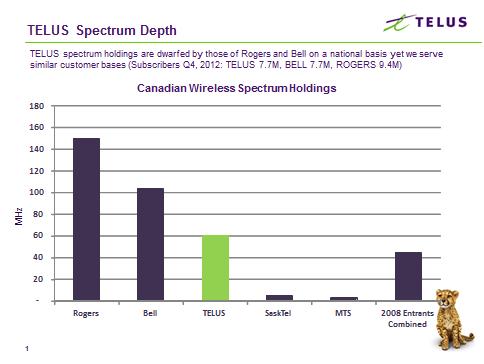
Telus remains the most likely suitor of independent providers because the company lacks the spectrum assets of its larger competitors Bell and Rogers.

Mobilicity operates its HSPA+ “4G” network on Advanced Wireless Services (AWS) frequencies in the 1,700MHz range. Although Telus has considerable spectrum in British Columbia and Alberta — its home territory — the provider has considerably less in eastern Canada, particularly in large metropolitan cities. Mobilicity has a tiny market share in the Greater Toronto Area, yet its AWS spectrum equals that of Telus in the city. Telus could find an acquisition of Mobilicity the easiest way to bolster its available spectrum for future 4G deployment and expansion.

TELUS-Spectrum-Depth

Three small independent wireless providers hold almost as much combined spectrum as Telus holds today.

Any exit of a combination of Canada’s newest wireless players will likely be seen as a failure of the government’s efforts to bolster competition. The dominance among the three largest providers has left Canadians with high-cost plans and a wireless service contract that lasts one year longer than America’s standard two-year service agreement.

Industry Canada, the economic regulator fostering a growing, competitive and knowledge-based Canadian economy, had little to say about the news.

“Any transaction that requires regulatory approval will be considered accordingly,” said Alexandra Fortier, a spokeswoman for Industry Minister Christian Paradis. “We cannot comment on speculation.”

[flv width=”640″ height=”380″]http://www.phillipdampier.com/video/BNN Canadas newest wireless players seek buyers 4-12-13.flv[/flv]

BNN reports industry consolidation is likely forthcoming in Canada’s wireless marketplace as Telus seeks to acquire independent provider Mobilicity. A financial analyst says the move is designed to curb budget-priced wireless service in Canada. Mobilicity would likely eventually be merged into Telus-owned Koodo Mobile, the company’s prepaid mobile division.  (5 minutes)

[flv width=”640″ height=”380″]http://www.phillipdampier.com/video/Globe and Mail Feds aim to open up wireless market 3-13.flv[/flv]

Too little, too late? Industry Minister Christian Paradis says the Harper government wants to open up the wireless market to more players with another wireless spectrum auction. But now several of Canada’s newest independent providers are all up for sale, and the country’s dominant three may end up owning one or more of them.  (2 minutes)

[flv width=”640″ height=”380″]http://www.phillipdampier.com/video/Globe and Mail Market View Why we love to hate our wireless companies 3-13.flv[/flv]

The Toronto Globe & Mail explores why Canadians hate their cell phone and mobile broadband providers so much.  (2 minutes)

FCC Orders Deregulated Rates for Ohio and Calif. Time Warner Cable Customers

timewarner twcThe Federal Communications Commission has opened the door for Time Warner Cable to raise basic cable rates in several parts of Ohio and California after ruling the company faces effective competition from Dish Networks and DirecTV.

Under FCC rules cable rates for the broadcast basic tier, which includes local television stations and a handful of basic cable networks, remain regulated by the government until a cable operator can prove at least 50 percent of their service area is covered by a competing provider and 15 percent of its would-be customers are signed up with a competitor.

Cable companies have requested rate deregulation in countless communities as satellite and television service from phone companies penetrates their markets. Once rates are deregulated, cable operators can raise them to whatever price they believe the marketplace will bear.

In several affected communities, Time Warner Cable’s service is so uncompelling, almost half of the households have signed up for satellite service instead.

The communities affected in Ohio:

  • City of Bellefontaine
  • Howard Township
  • Village of Huntsville
  • Village of Lakeview
  • McArthur Township
  • North Bloomfield Township
  • Village of Russells Point
  • Stokes Township
  • Washington Township
  • Village of Zanesville

In California:

  • Bradford

Search This Site:

Contributions:

Recent Comments:

Your Account:

Stop the Cap!