


Home » Providers » Recent Articles:

Why Google Chose Provo as the Next Google Fiber City

google fiberTo many, Provo, Utah might seem an unusual choice to follow on the heels of Google’s earlier announcement its gigabit fiber network was headed to Austin, Tex.

Provo is only the third largest community in Utah — Salt Lake City and West Valley City are bigger — and the community already has a fiber network called iProvo. So why build another one?

Google won’t have to.

But first some background:

iProvo was envisioned a decade ago as a public-private partnership — a fiber to the home network owned by the public with private service providers using it to sell broadband and other services . iProvo taught an early lesson about municipal broadband — large cable and phone companies routinely boycott participation in any network they do not own and control themselves.

In 2003, the president of Qwest’s Utah division made clear their intentions: “Fiber optic’s capabilities are way more than what most consumers need in their homes. Why provide a Rolls Royce when a Chevrolet will do?”

Comcast, the dominant local cable operator, also “went ballistic” according to former mayor Lewis Billings.

iProvo can be yours for just $1.

iProvo can be yours for just $1.

“One hired a PR firm and a telemarketing company to make calls to citizens,” Billings recalled. “They also placed full-page ads and ultimately hired people to picket City Hall. It was a bruising fight.  My favorite picket sign had a piece of telephone wire taped to it and read that I and one of my key staff members were, ‘a Twisted Pair.’”

With both Qwest and Comcast wanting nothing to do with the project, smaller independent ISPs had to fill the gap. It was a difficult sell, particularly because Qwest and Comcast blanketed Provo residents with a misinformation campaign about the network and pitched highly aggressive retention offers to keep customers with the phone and cable company. iProvo has been in financial distress ever since.

Former Provo city councilwoman Cynthia Dayton remembers being on the council when iProvo was approved and believes the public-private network was a decade before its time.

“Ten years ago it was worth the vote on iProvo,” she told the Daily Herald. It was one of the most difficult decisions but it was for the future.”

More than a year ago, Google noticed the city of Provo issued a request for proposals on what to ultimately do with iProvo.

Google became interested because Provo is seen as a city with hundreds of technology start-up companies and maintains a vibrant tech hub. The city also ranked highly for the enormous value it places on connectivity and community — something the approval and construction of iProvo demonstrated.

[flv width=”640″ height=”380″]http://www.phillipdampier.com/video/Provo Google Fiber 4-13.mp4[/flv]

Why Provo? Google considers the city’s rankings. (1 minute)

iprovo_logo.jpg.pagespeed.ce.grIF_VVvuACity officials and Google executives began quietly talking more than a year ago about Google buying the public-private network. A key selling point: the city was willing to let the operation go for a steal — just $1.00. In return, Google promised to invest in and upgrade the network to reach the two-thirds of Provo homes it does not reach. Google says iProvo will need technology upgrades in the office, but the existing fiber strands already running throughout the city are service-ready today.

Val Hale, President of the Utah Valley Chamber of Commerce, said a quick “back of the envelope” estimate put Google’s anticipated investment in iProvo network upgrades at $18 million, according to the Deseret News. Unfortunately, taxpayers will still need to pay off about $40 million in bonds the city accumulated for iProvo’s initial construction costs.
Curtis

Curtis

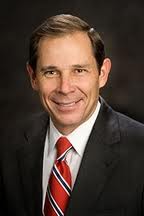
Current Mayor John Curtis says he has made the best out of a difficult situation.

“We have maximized what we have here today,” said Curtis. “It’s about maximizing what we have. I believe in the long-term it will pay dividends many times greater than what we paid into it, but it’s going to take a while to realize that dream.”

Google promised free gigabit Internet service to 25 local public institutions including schools, hospitals, and libraries. Residential customers will be expected to pay $70 a month for 1,000Mbps service or get 5Mbps broadband service for free up to seven years.

Google’s investment in Provo is anticipated to be far lower than in Austin and Kansas City — cities where it needs to build a considerable amount of fiber infrastructure from scratch. With existing fiber already in place in Provo, Google’s gigabit service will be available by the end of this year, at least six months faster than in Austin.

With reduced construction costs, Google will only ask new customers for a $30 activation fee, far less than the $300 Google will ask Austin and Kansas City residents to pay if they do not sign a multi-year service contract or only want basic 5Mbps service.

Google sees the opportunity to use its fiber network in an ongoing effort to embarrass other broadband providers into investing in speed upgrades.

[flv width=”640″ height=”380″]http://www.phillipdampier.com/video/KSL Salt Lake City Google Fiber Coming to Provo 4-17-13.flv[/flv]

KSL in Salt Lake City reports Google Fiber is coming to Provo. Last year Google began talking with the city to acquire its iProvo municipal fiber network.  (3 minutes)

[flv width=”640″ height=”380″]http://www.phillipdampier.com/video/KSTU Salt Lake City Google Fiber coming to Provo 4-17-13.flv[/flv]

KSTU in Salt Lake City reports taxpayers are still on the hook for around $40 million in bond payments to cover the construction costs of iProvo. But Google Fiber will stop other Internet providers from “cheating everyone” says one local Provo resident.  “[Other ISPs] give you the slowest connection possible and charge you a ridiculous amount for it,” said Haley Cano. (4 minutes)

[flv width=”480″ height=”380″]http://www.phillipdampier.com/video/KTVX Salt Lake City Google Fiber in Provo 4-17-13.mp4[/flv]

KTVX in Salt Lake had some trouble navigating the difference between a gigabit and a gigabyte, and confused what Google services will be sold and which will be available for free in this report, but the ABC affiliate covered the unveiling with both city and Google company officials on hand.  (2 minutes)

[flv width=”480″ height=”380″]http://www.phillipdampier.com/video/KTVX Salt Lake City Google Fiber Details in Provo 4-18-13.mp4[/flv]

This morning, KTVX did a better job in this interview with the mayor of Provo and Google’s Matt Dunne, who says Google believes speed matters and current ISPs simply don’t offer enough.  A key factor to attract Google’s interest is a close working relationship with the cities that want the service. (2 minutes)
Breaking News: Provo, Utah the Next City Slated for Gigabit Google Fiber

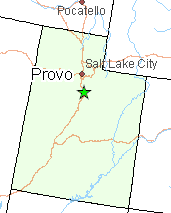
provoProvo, Utah will be the third city in the country to get Google’s gigabit fiber network, in part because fiber infrastructure installed by a defunct provider that ran into money problems is now likely available for Google’s use.

The announcement came from Provo Mayor John Curtis this afternoon.

The choice of Provo was a surprise even to area residents, who speculated the “epic announcement” promised by Provo’s deputy mayor Corey Norman involved the opening of a new Popeye’s Chicken location or a second Red Lobster headed to town. Instead, it is only 1,000/1,000Mbps broadband for a likely price of $70 a month.

Provo’s existing fiber infrastructure, now owned by the local government, was likely a major reason in selecting the city of 115,000 for a Google-style upgrade.

The announcement came a little over a week after Google announced Austin, Tex. as the second stop for Google’s fiber upgrade. The surprise announcement may create waves in the telecom industry that earlier assumed Google was only interested in developing a demonstration project in Kansas City. It is now likely Google has bigger plans than that.

Communities that own, control, or manage their own fiber networks — institutional or available to the public — may be the next to be courted by Google.

Google will face off against Comcast Cable and CenturyLink (formerly Qwest) in the city.

[flv width=”480″ height=”380″]http://www.phillipdampier.com/video/KTVX Salt Lake City Provo Getting Ready for Epic Announcement 4-16-13.mp4[/flv]

KTVX in Salt Lake City reports Provo is getting ready for “an epic announcement.” It turns out Google’s gigabit fiber network is coming to the city of 115,000.  (2 minutes)

Virgin Media’s New Speed Throttle Spreadsheet = Bait and Switch Broadband

virgin saltStop the Cap! has hammered ISPs for a long time for promising “unlimited” broadband but sneaking in “traffic management speed throttles” they call a matter of fairness and we call deceptive marketing.

Virgin Media’s UK broadband customers have just been introduced to the extreme absurdity of selling “insanely fast” fiber broadband that comes with a sneaky spreadsheet guaranteed to confuse all but the most observant byte counters.

Some customers suspect Virgin Media is just retaliating for repeated findings from British regulators that the company runs dodgy advertising that promises one thing and delivers something entirely different in the fine print. More than two dozen of their TV commercials and print advertisements have been banned for deceptive ad claims, ranging from the “fastest broadband in Britain” (not exactly) to promotions promising “free service” that actually costs around £15 a month (what is a dozen quid or so among friends).

So why does Virgin Media need traffic management? They have oversold the service to too many customers and won’t invest enough in upgrades to keep up with demand.

Network overselling is more common that you might think. ISPs understand that all of their customers will not be online at the same time, so there is only a need to provision enough bandwidth to support their assumptions about anticipated usage. If your ISP serves a gated Luddite community, it won’t need the same data pipe required to provide access along University Row. The trick is to use real science and math to correctly anticipate user demand, but many ISPs answer first to their investors, who simply hate spending good money on upgrades. Expansion proposals are about as popular as North Korea’s Kim Jong-un. The result is “good enough” broadband service that is susceptible to overcrowding during prime usage times.

You already know what happens next. Once the kids are home from school and dinner is finished, your online experience quickly s l  o   w    s     t    o     (buffering).

In Britain, some ISPs are notorious for overselling broadband service that advertises speeds in the dozens of megabits, but can’t even break 1Mbps during peak usage times.

How can this be fixed? With investment in upgrades. What do ISPs do instead? They slap on usage caps and “network management” speed throttles that artificially slow browsing speeds for those considered “heavy users.”

Virgin Media was supposed to be a breath of fresh air from usage caps. Instead, the company promises a truly unlimited experience, with limitations.

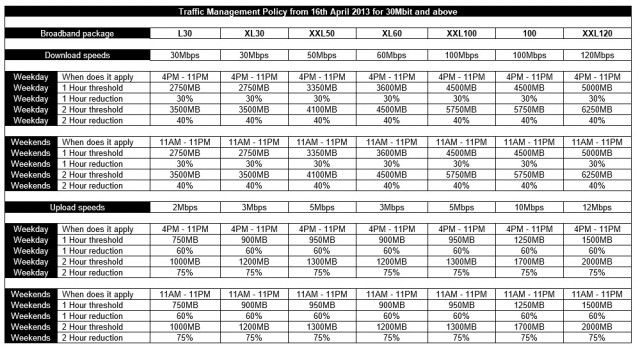
Virgin’s latest iteration of its “peak time usage policy” resembles a tax table from the Internal Revenue Service. Can you understand it?

Data-traffic-management-limits-Virgin

Despite this, Virgin calls its broadband service “to all intents and purposes, completely unlimited.”

Where is that British regulator, again?

The company claims less than 3% of its customers will ever be affected by these limits. They might be right if customers avoid online video, downloading large files or games, cloud storage, or allowing other family members to use their connection at the same time. If one is subjected to the speed throttles, Virgin will take away nearly half of the speed customers were sold.

Here is Virgin’s position on all this:

“Our 100Mb customers receive speeds up to 104.6Mb, proven by Ofcom, and even if you’re one of the 2.3 per cent of heavy users we sometimes, temporarily traffic manage you’ll be receiving speeds of around 60Mb — so you can download and stream as much as you like.Today’s update makes it more flexible and responsive to how people are using our services and is designed to reduce the time customers may spend in traffic management, it could be just one hour. We do not have caps, nor do we charge customers more.”

That is true, but Virgin is charging a premium for broadband service speeds they are prepared to automatically take away when a customer persists in using the service they paid to receive.

Virgin could pay their experts to conjure up speed management charts like the one above, or they could invest in network upgrades that make such network management techniques unnecessary.

Comcast Encrypting Everything; No Box? We’ll Cancel Your Cable TV Service

scrambled

Comcast: Get a box or lose your cable TV service

Comcast will encrypt the entire lineup of its cable television service, including local channels, starting with two markets in New England and gradually rolling out this summer across all of Comcast’s service areas.

The encryption will obsolete cable reception of QAM signals, which some cable customers use to avoid paying for set-top equipment.

Comcast called FCC approval of its encryption request a victory for consumers because it will “allow us to automate certain system functions and will reduce the need for scheduled in-home appointments, providing greater convenience for our customers.” Comcast also candidly said it will dramatically reduce signal theft and unauthorized viewing by past due customers, which can now be shut off from the cable office instead of dispatching technicians to the home to disconnect service.

Consumer and Comcast customer Brier Dudley begs to differ. In two columns in the Seattle Times, Dudley writes Comcast is tightening the screws on its customers, forcing them to get unwanted equipment that will eventually cost them monthly rental fees set “at market rates.”

Comcast began requiring digital adapters to unscramble digital signals in 2009. Since then, it steadily has been converting more of its system to digital, scrambling more channels and expanding the requirement to use some kind of a cable box or adapter on every TV.

This requirement received the FCC’s blessing last year. The agency agreed to let cable companies scramble all of their channels and require descramblers on every set.

The FCC’s justification was muddled. Scrambling would purportedly prevent stealing content, though the FCC requires conventional television broadcasters to beam their shows freely over the air.

The FCC also made a tortured environmental argument for the move, saying the mandatory adapters allowed cable companies to remotely activate and deactivate service, reducing service calls and their carbon footprint.

Unmentioned is the environmental effect of factories in China making adapters that must be delivered, attached to every TV and continuously plugged in.

Comcast is attempting to mitigate customer anger about the necessary new equipment, offering free boxes for a limited time. But customers might need a road map to find what they qualify for without having to pay an even higher cable bill:

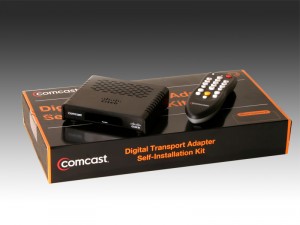
comcast-cisco-dtaLimited Basic customers with no set top boxes in their homes will be eligible for up to two DTAs (standard definition digital signal adapters), at no charge for two years (five years if you also receive Medicaid), if they request DTAs beginning 30 days before the date of encryption and no longer than 120 days after encryption. New customers, customers who already have DTA devices or those who request them after the offer period will likely be subject to rental fees much sooner, if not immediately;

Customers who subscribe to a higher level of service and receive Limited Basic service on a secondary TV without Comcast supplied equipment are eligible for one device at no charge for one year;

All other customers are subject to Comcast’s new $1.99 per month “additional outlet service charge” for each outlet registered to a DTA. In Seattle, customers who want to watch local channels in HD have to fork over another $2.50 a month for a special HD version of Comcast’s DTA box.

What if you don’t want the extra equipment and return it? Comcast will automatically cancel your cable TV service.

“Customers who do not have digital equipment on their account will not be able to view any channels after Limited Basic channels are encrypted. For this reason, XFINITY TV service will be removed from the account,” warns Comcast. “This may affect multi-product package rates or discounts.”

The encryption will also cripple third-party set-top devices like older versions of Boxee (not compatible with Comcast’s DTA) and TiVo, which will now need a mind-numbing, complicated workaround to keep operating.

Comcast customers will receive written notification as the company gets ready to encrypt service in each area.

Exiting Rogers CEO Gets $18.5 Million Retirement Package While Your Rates Increase

Phillip Dampier April 17, 2013 Canada, Consumer News, Rogers Comments Off on Exiting Rogers CEO Gets $18.5 Million Retirement Package While Your Rates Increase
Mohamed

Mohamed

Exiting Rogers Communications CEO Nadir Mohamed won’t be hurting when he leaves one of Canada’s largest telecom companies next year.

Documents filed with securities regulators disclose Mohamed’s golden retirement package includes:

  • $5.5 million in cash;
  • $6.8 million in non-transferable stock that can be liquidated later;
  • Another $6.2 million in stock options.

Mohamed has also signed a non-compete agreement to stay out of the telecom business for a year after he leaves Rogers.

Last year, Mohamed earned $8.21 million from a combination of his $1.2 million salary and various bonuses and stock awards.

Last spring, Mohamed presided over job cuts of 300 management and head office positions.

Rogers increased its rates in January to cover “increasing costs.”

Search This Site:

Contributions:

Recent Comments:

Your Account:

Stop the Cap!
