
Home » Providers » Recent Articles:

Comcast’s Usage Cap Suspension Passes First Anniversary (Except in Nashville, Tucson)

Phillip Dampier May 29, 2013 Broadband "Shortage", Broadband Speed, Comcast/Xfinity, Competition, Data Caps, Online Video Comments Off on Comcast’s Usage Cap Suspension Passes First Anniversary (Except in Nashville, Tucson)

Comcast-LogoMore than a year ago, Comcast temporarily suspended its nationwide 250GB usage cap to study its impact and consider what to do about increasing broadband traffic.

For the majority of Comcast customers, this means the provider has ditched its usage cap altogether, allowing customers to use their broadband service without limits.

“This is the way it should have been all along, especially considering how much I spend every month for Comcast broadband,” says Comcast customer Geoff Cox. “I think usage caps at these prices are unacceptable. If Comcast stops antagonizing me, I will reward them with more of my business.”

For Cox, that meant one week after the cap was lifted, he upgraded his service from Performance to Blast. His usage did not immediately increase that much and Comcast now gets more of his money.

“We do about 280GB a month today between me, my wife and our four kids,” Cox tells Stop the Cap! “When the third one becomes a teenager, we will probably upgrade again to Extreme because of all the streamed media being used in this house.”

meterBut if Comcast brings back the cap, Cox will downgrade his service back to where he started.

“AT&T U-verse isn’t much competition for Comcast broadband because U-verse is slower and their 250GB cap I can see getting enforced when AT&T smells money,” Cox tells us. “As I have told my family, usage caps are not acceptable and we have to take a stand somewhere and let them know caps will cost them business, not earn them more money.”

Whether Comcast will listen remains unknown. The company has said little about its usage cap program since suspending it May 17, 2012. At that time, Comcast did say they had not given up on usage caps in principle — they just wanted a more flexible approach while managing those caps.

Last May, the company announced two trials to test which direction Comcast would take with respect to limiting broadband usage.

In Nashville, Comcast increased the usage allowance for all tiers to 300GB per month and planned to sell additional gigabytes in increments of $10 per 50GB;

In Tucson, Comcast adopted variable usage allowances depending on the type of service a customer selected:

  • Economy 300GB
  • Economy Plus 300GB
  • Internet Essentials 300GB
  • Performance Starter 300GB
  • Performance 300GB
  • Blast 350GB
  • Extreme 50 450GB
  • Extreme 105 600GB

The rest of Comcast customers get to test unlimited service, at least until the company determines whether it actually needs caps at all. Cox does not think the company does.

“Cable broadband upgrades have really made neighborhood congestion a non-issue and while the company keeps raising the price of broadband service, their costs keep dropping.”

Rogers Giveth New $2 Paper Bill Fee, Taketh Away Two Popular Channels

Phillip Dampier May 29, 2013 Canada, Consumer News, Rogers Comments Off on Rogers Giveth New $2 Paper Bill Fee, Taketh Away Two Popular Channels

Toonie-reverseRogers customers may now have to pay to read their monthly bills.

Eastern Canada’s biggest cable company wants you to use your broadband service to check your balance, unless you are willing to pay a $2 monthly “paper bill fee.”

Rogers had charged new wireless customers (along with anyone making changes to their account) a $2 paper billing fee since 2011, but now everyone will pay if they want a hard copy.

At the same time the company is adding a new billing fee, it is taking away two popular cable channels in a move the company describes as part of “our ongoing commitment at Rogers to deliver a superior television experience.”

Fewer channels might bring better value if the company reduced the cost of your cable package, but don’t worry about that:

“Please be assured that there will be no change to your Rogers cable TV rates and all other aspects of your service(s) will remain the same,” a company letter said. “We apologize for any inconvenience these changes may cause.”

give takeThe inconvenience will be greatest for fans of BBC World who will now have to upgrade to a high-end package to keep watching the popular global news channel. It was stripped out of the basic lineup.

Spike is also getting the spike, kicked into a higher-end package at the same time existing customers see no corresponding decrease in their rates.

The sneaky price increase is not going over well with many Rogers customers, according to the Toronto Star.

“I locked into a year’s contract at a specific price for the VIP package,” Sara Harrel told the newspaper, “and Rogers changed what I get for that price.”

Another reader, David Dorken, found when he called Rogers that BBC World News would cost an extra $2.79 a month and Spike TV was in a package that would cost an extra $5.99 a month.

“That’s right, folks, same television for only $8.78 extra a month or $105.36 a year. I’ve cancelled my cable and Internet,” he said.

Rogers spokeswoman Patricia Law countered that most customers (although not all) would see some new channels — such as ABC Spark and FX Canada — added to their service as they were losing Spike TV and BBC World.

How many customers were clamoring for either replacement is unknown, but the effects of complaining are not. Rogers customers threatening to walk often get special concessions like a lower rate or more channels to compensate.

W.V. Governor Cancels Audit Amid Allegations Taxpayers Funded a Frontier Fiber Monopoly

icf_logoDespite findings from an independent consultant that reported West Virginia wasted millions on a broadband expansion effort that effectively built a private, taxpayer-funded fiber network for Frontier Communications, the governor’s office abruptly canceled a 2011 follow-up state audit of the $126.3 million project.
The Charleston Gazette reports Gov. Earl Ray Tomblin’s office said it dropped the audit because Frontier “answered or addressed” issues raised in a memo produced by an out-of-state independent consulting firm.

ICF’s document was so scathing of the state government’s handling of federal broadband stimulus funds, the governor’s office kept it secret until a copy was independently leaked to the Charleston newspaper. The governor’s office said it initially withheld the “internal memorandum” produced by Vienna, Va.-based ICF International because it proved “embarrassing to some people.”

frontier wvAmong ICF’s findings:

  • Taxpayers underwrote the construction of a Frontier Communications’ owned and operated fiber broadband network so fragmented in its construction, the only entity likely to benefit is Frontier Communications;
  • ICF found West Virginia’s broadband grant program created an “unintended monopoly” for Frontier Communications, and an unusable ‘open access’ network except for Frontier;”
  • Frontier’s documentation and expense reports, submitted for reimbursement by taxpayers were inadequate and could have resulted in double billing;
  • Frontier overbuilt its network with excessive numbers of fiber strands three to six times above industry standards, driving up construction costs.

Frontier’s called the ICF report “worthless” and accused the consultant of using inaccurate and stale comments that repeat “previously repudiated allegations.”

Frontier also produced its own company-sponsored “external audit” of its work on the $126.3 million broadband project that found “no material deficiencies.”

But ICF says it is standing by its report, and documented instances where the state authorized Frontier to spend significant sums to build fiber connections to community institutions that were later scaled back by the company. Whether Frontier was paid for the originally scheduled work, or for the scaled back construction eventually completed, is unknown.

At this point, ICF reports it is resigned to the fact Frontier will be a major beneficiary of the taxpayer-funded fiber infrastructure and the state has few options to fix the problems they created. The consultant firm says the only workable option would be a joint effort by Frontier’s competitors to build, at their own expense, a “middle-mile, open-access network” that can interconnect with Frontier’s taxpayer-funded network, assuming Frontier will allow it.

Citynet_ColorA major critic of the broadband stimulus program in West Virginia, Citynet President Jim Martin, has long said the broadband project was primarily going to benefit Frontier.
In September 2010, Martin told the Gazette, “Frontier is going to have the state’s business forever. No other company will have the money to come in and build the network.”

Two months later, Martin was back ringing the alarm bell before more than $126 million in taxpayer funds were spent.

“The state represented it would build a ‘middle-mile’ network reaching 700,000 homes and 100,000 businesses, and it would be this great new superhighway and do all the things the federal government is seeking,” Martin told the Gazette. “But afterward, Citynet and others got to look and it looks like it is a windfall for Frontier Communications only.”

“We’ll ultimately prove this was a complete sham and didn’t benefit anybody,” Martin said. “We’re here. We’re not going anywhere. We totally recognize this is going to be a long battle unless the Broadband Council or the new governor or the next governor does something. We’re going to be on this for however many years it takes. We’re going to hold the state accountable for every single dollar they’re spending. At the end of the day we will show that no jobs were created, there’s no benefit to the citizens of West Virginia. Hopefully we’ll show this was all about Frontier.”

Three years later, Martin is still trying to get accurate broadband maps that depict exactly where Frontier has laid its publicly funded fiber infrastructure. Apparently they are secret, too.

Goodnight Irene: N.J. 95-Year Old Dumping Verizon 6 Months After Waiting for Phone Service

pearly gates closed“I will be dead in the ground before Verizon gets around to restoring my phone line, and I have been their customer for 72 years,” says Irene, 95, one irate now-ex Verizon customer in New Jersey.
She, like many others, lost her Verizon landline during Hurricane Sandy and has waited for its return ever since.

“She has the patience of a saint, but if Verizon was in charge of admitting people beyond the Pearly Gates, there would be a line stretching endlessly across the heavenly clouds,” shares Irene’s daughter Agnes.

Irene and her late husband had their telephone hooked up by Verizon’s predecessor three days before Pearl Harbor. For the non-history initiated, that was Dec. 4, 1941.

President Franklin D. Roosevelt called Dec. 7, 1941 a Day of Infamy. Irene’s family calls Oct. 29, 2012 “The Day After Infamy” after Hurricane Sandy slammed ashore in the northeast and wiped out phone service up and down the tri-state coastal area. She is still waiting for her dial tone to return on her 1972 rotary dial phone.

“Everyday I pick it up just to see if there is anyone there, and of course there isn’t,” Irene tells Stop the Cap! “I used to worry about the cat knocking the phone receiver on the floor, but it does not make much difference anymore.”

Irene cannot understand why Verizon is allowed to get away with such shoddy service.

“Just a few years ago, if your phone was out for three days you would have a supervisor apologizing and sending repairmen out even if their supper was waiting on the table getting cold,” Irene remembers. “Those days are over I suppose.”

Irene lives with her daughter in a home that escaped the worst of the storm, but unfortunately her phone service was not so lucky. Verizon has not provided fiber optics in her part of New Jersey yet either, so FiOS is not an option.

“You call Verizon and they are very apologetic on the phone and keep writing up service calls, but unfortunately nobody ever comes and nobody will tell us anything,” Agnes said. “We even tried praying, but Verizon answers to a different God.”

out-of-serviceIrene’s great-grandchildren visit with cell phones in hand and cannot understand why Irene still bothers with her home phone, and the family purchased her a cell phone for Christmas to use in the interim but Irene has thrown it in a drawer.
“My phone has been with me since Richard Nixon was in the White House and it is all I have ever needed or wanted,” Irene says. “Agnes will answer the cell phone and hand it to me but the sound on it is terrible, like everyone is in the shower when they are calling.”

Agnes also dials outgoing calls for Irene, and her grandchildren helped her compose the e-mail sent to Stop the Cap! asking if we could help.

“My kids told me Verizon has installed these wireless boxes and screwing them into the wall and I don’t want that,” Irene insisted. “I just want them to fix the phone line and leave it be.”

Irene adds she has paid The Phone Company more than her fair share during the last seven decades.

But during a recent emergency family meeting, a decision was made to deal with a half-year of the “Verizon Problem” once and for all. After corresponding with us, they are signing up for Comcast phone service instead.

“The man at Comcast said I could keep my current phone and I don’t have to have an ugly box screwed into my wall, which suits me fine, but they should know I don’t care for their prices or all of that nonsense they put on the television.”

Comcast installed the family’s phone service yesterday and all is well, at least until the cat knocked the phone off the hook again.

Irene asked her last name be omitted for privacy.

Cricket Takes On AT&T/Verizon With Deceptive ‘Unlimited’ Plan With a Throttle After 1GB

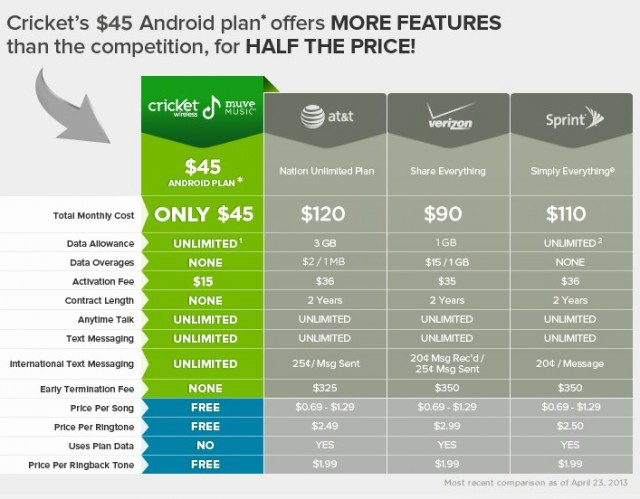
cricket planCricket wants to convince you that paying AT&T or Verizon $90-120 a month for a cell plan with unlimited calling, texting and a 1-3GB data plan is too much, because it can sell you an “all-unlimited plan” for $45.

Cricket this week launched its “Half Is More” marketing campaign online, as well as in print and television advertisements.

“When we go out and talk to a lot of consumers, we hear a lot of angst from post-paid subscribers,” Cricket senior vice president Tyler Wallis told CNET. “They’re not happy with the service they’re getting and they’re feeling like they’re getting gouged.”

They also might not like finding out their “unlimited use” data plan actually comes with a barely disclosed speed throttle that kicks in after only 1GB of usage, reducing speeds to near dial-up for the rest of the billing cycle.

Cricket defends the claim they offer “unlimited” data service by stating they do not completely sever a customer’s data connection when they reach the limit, or charge them overlimit fees. They just slow the service down… a lot. Cricket customers tell Stop the Cap! Cricket’s wireless Internet becomes almost unusable once they are placed in the usage penalty box.

Cricket also depends heavily on Sprint for roaming coverage outside of the small number of home markets where Cricket owns and operates its own network. For many customers, that means frequent roaming on Sprint’s 3G network, which is not rated well for its speed and performance.

Once throttled, customers are stuck in the slow lane until their next billing cycle begins.

Customers with light data needs might find Cricket’s plan an option, assuming they have good coverage either from Cricket itself or roaming on Sprint’s network.

Cricket’s campaign noticeably avoids comparing their plan against T-Mobile, which offers a $70 monthly truly unlimited plan or for ten dollars less, a 2GB plan with unlimited calling and texting.

[flv width=”640″ height=”500″]http://www.phillipdampier.com/video/Cricket Ad Unlimited 5-13.mp4[/flv]

How easy can you read the white fine print disclaimer on the white background in Cricket’s ad? Cricket advertises unlimited data but keeps its speed throttle mostly to itself. (1 minute)

Search This Site:

Contributions:

Recent Comments:

Your Account:

Stop the Cap!