
Home » Providers » Recent Articles:

Comcast Seeks Patent on Human Wi-Fi, Roving Rental Car, Bicycle-Based Hotspots

Phillip Dampier July 24, 2013 Comcast/Xfinity, Consumer News, Wireless Broadband Comments Off on Comcast Seeks Patent on Human Wi-Fi, Roving Rental Car, Bicycle-Based Hotspots

comcast wifiComcast has filed a patent application that would let the company expand its Wi-Fi network by turning customers into human Wi-Fi hotspots and convincing them to offer Comcast Wi-Fi from rental cars, bicycles, and buses.

FierceCable found the patent application, called “Mobile WiFi Network” that would let the cable company build a dynamic mesh network of mobile hotspots that could be used by its customers. But instead of placing permanent Wi-Fi antennas on buildings or light posts, Comcast wants a patent to extend its network by using vehicles and people that can be positioned exactly where Comcast needs better wireless coverage.

In one example, Comcast’s proposed roving rental car fleet would use incentives to convince renters to activate the car’s built-in hotspot in return for free or discounted services.

“The offer may indicate that if the rental car is dropped off at one or more designated parking spots, the driver will receive a discounted car rental rate, free parking, a coupon for items sold at the designated parking spot, etc. In this manner, the driver may be incentivized to assist in managing the network of transceivers to improve the coverage area. A driver wishing to accept the offer may press a button on the car’s computing display, or other computing device (e.g., using a smart phone application) to respond to the offer with an acceptance,” Comcast states in the patent application.

Comcast-LogoIf a driver says no, Comcast can up the ante with an even better offer in response. If that does not work, Comcast can expand its Wi-Fi network dynamically in other ways.

“It should be understood that the process could be implemented by placing transceivers in or on any other mobile unit, such as bicycles, Segways, buses, police cars, taxis, boats, persons, dedicated vehicles, etc. or any combination of such mobile units,” Comcast wrote.

Last month, Comcast announced it would activate a public Wi-Fi network over wireless routers supplied to customers on a secondary channel.

OMGFAIL: Cablevision Pulling Plug on Wireless Broadband Service in South Florida

Phillip Dampier July 24, 2013 Broadband Speed, Cablevision (see Altice USA), Competition, Consumer News, OMGFAST, Wireless Broadband Comments Off on OMGFAIL: Cablevision Pulling Plug on Wireless Broadband Service in South Florida

omgfastCablevision has begun notifying Florida customers it is pulling the plug on its market trial OMGFAST wireless broadband and voice services Aug. 19.

The cable operator launched the venture in 2012 advertising $29.95 broadband service delivered over Multichannel Video and Data Distribution (MVDDS) frequencies it won in a 2004 FCC auction.

FierceCable learned the service had not been a runaway success, attracting only 1,600 customers in the market test conducted in Broward and Palm Beach counties.

The writing may have been on the wall for the future demise of the service after the company laid off workers at its Pompano Beach headquarters at the end of June. The 10,000 square-foot building reportedly housed about 60 employees.

Cablevision sold its MVDDS spectrum to Dish Network last fall. Dish had been leasing the spectrum back to Cablevision to keep the service up and running.

Cablevision said it was still in the process of notifying customers they will have to get their phone and broadband service from somewhere else starting next month.

OMGFAST marketed up to 50Mbps service for $29.95 a month, charging an extra $10 a month to lease the required equipment.

Frontier Communications Wins Rate Deregulation in Washington State

Phillip Dampier July 24, 2013 Competition, Frontier, Public Policy & Gov't Comments Off on Frontier Communications Wins Rate Deregulation in Washington State

frontierFrontier Communications Northwest, Inc., has won an end to rate regulation, arguing sufficient competition exists between telecom companies in Washington State to make the oversight unnecessary.

The Washington State Utilities and Transportation Commission approved the request this week, adding it would allow more pricing flexibility for Frontier services in the state.

“Washington’s competitive classification statute requires that we examine the conditions in the marketplace to determine the level of regulation necessary to ensure that consumers have access to telecommunications services at fair, just and reasonable rates, terms, and conditions,” UTC commissioners said in the written order. “If alternative providers of telecommunications services exist and the company no longer serves a significant captive customer base, we will substantially reduce historic regulation, particularly economic regulation, in favor of the disciplines of an effectively competitive marketplace.

Although the majority of Washington is served by CenturyLink, which acquired the assets of Qwest, Frontier has 321,000 customers in Redmond, Kirkland, Everett, Bothell, Woodinville, and other smaller communities. Most of Frontier’s customers were acquired from Verizon Northwest in 2010 after the company exited the landline business in the state.

Frontier must still adhere to Washington’s consumer protection laws. Customers with unresolved problems with Frontier services, including its adopted FiOS fiber network, can call the Commission’s HelpLine at 1-888-333-9882.

Ohio Residents Use an Average of 52GB of Data Each Month; Nearly Double 2012 Rate

Phillip Dampier July 24, 2013 AT&T, Competition, Data Caps, Editorial & Site News, Public Policy & Gov't, Rural Broadband, Verizon, Wireless Broadband Comments Off on Ohio Residents Use an Average of 52GB of Data Each Month; Nearly Double 2012 Rate
Phillip "What's $520 a month between friends" Dampier

Phillip “What’s $520 a month between friends” Dampier

The average Ohio household consumes 52 gigabytes of data per month — the equivalent of more than five million emails or surfing the Internet for about 100 hours monthly — up from 28GB in 2012.

Demand for broadband and mobile communications continues to skyrocket as consumers in urban Ohio dump traditional landline phone service at an accelerating rate.

Since 2000, the industry group Ohio Telecom Association reports 64 percent of landlines have disappeared in the state since peaking in 2000. An additional 6-10 percent continue to cut the cord every year, either when elderly customers pass away or when consumers decide to switch to a wireless, cable telephone, or a broadband Voice over IP alternative like Vonage.

Some telephone companies, particularly AT&T and Verizon, argue the ongoing loss of landlines means the service is becoming technically obsolete — a justification to drop old copper phone networks in rural areas in favor of wireless and switching to fiber-fed IP networks like U-verse in urban and suburban areas. But copper landlines do more than just connect telephone calls.

Broadband usage statistics suggest rural customers in Ohio could find their Internet bills exploding if AT&T succeeds in forcing those customers, least likely to face competition from cable providers, to the company’s highly profitable wireless network.

AT&T currently sells rural landline customers DSL service starting at $14.95 a month. A usage cap of 150GB per month technically applies, but remains unenforced.

Customers switched to AT&T wireless service will pay much more for much less.

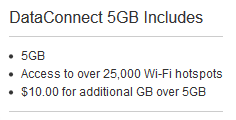
dataconnectAT&T’s DataConnect plan, suitable for fixed wireless home use, starts at $50 a month and includes a usage allowance of 5GB per month. With the average Ohio resident now consuming 52GB a month, switching to wireless broadband is a real budget-buster. AT&T’s overlimit fee is $10/GB, so the average resident would face a monthly Internet bill of $520 a month this year. Assuming usage growth continues at the same pace, in 2014, AT&T customers will need to write a check for around $780 a month.

Ohio’s broadband and wireless usage statistics are familiar because they echo the rest of the country. According to Connect Ohio, wireless-only residents are 81 percent urban or suburban, where cell networks provide the best reception; 84 percent are under age 44; 58 percent have a college education; and 63 percent earn more than $25,000 annually.

Those affected by a forced transition to a wireless-only solution are least financially equipped to handle it.

“The least likely to convert to a wireless-only solution would be an older, rural, less educated, lower-income individual,” said Stu Johnson, executive director of Connect Ohio. “Those are probably also the most expensive copper customers.”

EastLink Delivers Minor Speed Increases, Higher Prices to Its ‘Clueless Customers’

Phillip Dampier July 23, 2013 Bell Aliant, Broadband Speed, Canada, Competition, EastLink 1 Comment

Our customers often don't have a clue what speeds we give them now. -- EastLink

EastLink customers in Nova Scotia are getting three things from their local cable company: slightly faster Internet speeds, a higher bill, and insulted.

EastLink has mailed letters to subscribers in certain parts of Atlantic Canada notifying customers they are now getting speed boosts on the company’s lower speed tiers.

Basic Internet customers subscribing to 1.5Mbps service will now see 5Mbps, while those at 5Mbps are getting upgraded to 10Mbps service.

EastLink said the upgrades target its budget-minded customers who are also getting pelted with competing mailers from Bell Aliant, which sells fiber service in the region. But the speed upgrades don’t come for free. In a move EastLink denies is tied to the broadband speed improvements, the company is also notifying customers of its annual general rate increase.

EastlinkLogoAtlantic Canada enjoys some of the fastest Internet service in the country, often without any usage caps. EastLink offers, in addition to its budget Internet tiers, service at 20, 40 and 80Mbps. Their primary competitor is Bell Aliant, which operates its FibreOp broadband at speeds of 50, 80, and 175Mbps.

“Our customers have told us that they want and need faster internet service,” Isabelle Robinson, media relations with Bell Aliant said about the company’s higher Internet speeds. “Things like file sharing, uploading, video streaming have really become commonplace. The demand for both speed and bandwidth has been exploding.”

Nonsense, responds Jordan Turner, EastLink’s public relations coordinator. He said subscribers often have no comprehension about the broadband speeds they get now, and certainly don’t need anything faster than what EastLink now provides.

“Frankly, that is plenty of speed and all the speed customers need,” Turner told Halifax NewsNet. “When you read what they suggest people are going to do with the Internet, you can already do that with our standard Internet offering. It’s not like, because you have faster Internet, you’re going to watch a three-hour movie in half an hour.”

Search This Site:

Contributions:

Recent Comments:

Your Account:

Stop the Cap!