Home » Providers » Recent Articles:

Why Time Warner Cable Can Jack Up Rates Willy-Nilly: Lack of Competition

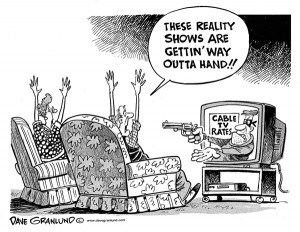
cable ratesAlthough cable and phone companies love to declare themselves part of a fiercely competitive telecommunications marketplace, it is increasingly clear that is more fairy tale than reality, with each staking out their respective market niches to live financially comfortable ever-after.

In the last week, Time Warner Cable managed to alienate its broadband customers announcing another rate increase and a near-doubling of the modem rental fee the company only introduced as its newest money-maker last fall. What used to cost $3.95 a month will be $5.99 by August.

The news of the “price adjustment” went over like a lead balloon for customers in Albany, N.Y., many who just endured an 18-hour service outage the day before, wiping out phone and Internet service.

“They already get almost $60 a month from me for Internet service that cuts out for almost an entire day and now they want more?” asked Albany-area customer Randy Dexter. “If Verizon FiOS was available here, I’d toss Time Warner out of my house for good.”

Alas, the broadband magic sparkle ponies have not brought Dexter or millions of other New Yorkers the top-rated fiber optic network Verizon stopped expanding several years ago. The Wall Street dragons complained about the cost of stringing fiber. Competition, it seems, is bad for business.

In fact, Verizon Wireless and Time Warner Cable are now best friends. Verizon Wireless customers can get a fine deal — not on Verizon’s own FiOS service — but on Time Warner’s cable TV. Time Warner Cable originally thought about getting into the wireless phone business, but it was too expensive. It invites customers to sign up for Verizon Wireless service instead.

timewarner twcThis is hardly a “War of the Roses” relationship either. Wall Street teaches that price wars are expensive and competitive shouting matches do not represent a win-win scenario for companies and their shareholders. The two companies get along fine where Verizon has virtually given up on DSL. Time Warner Cable actually faces more competition from AT&T’s U-verse, which is not saying much. The obvious conclusion: unless you happen to live in a FiOS service area, the best deals and fastest broadband speeds are not for you.

Further upstate in the Rochester-Finger Lakes Region, Time Warner Cable faces an even smaller threat from Frontier Communications. It’s a market share battle akin to United States Cable fighting a war against Uzbekistan Telephone. Frontier’s network in upstate New York is rich in copper and very low in fiber. Frontier has lost landline customers for years and until very recently its broadband DSL offerings have been so unattractive, they are a marketplace afterthought.

Rochester television reporter Rachel Barnhart surveyed the situation on her blog:

Think about this fact: Time Warner, which raked in more than $21 billion last year, has 700,000 subscribers in the Buffalo and Rochester markets. I’m not sure how many of those are businesses. But the Western New York market has 875,000 households. That’s an astounding market penetration. Does this mean Time Warner is the best choice or the least worse option?

Verizon-logoThat means Time Warner Cable has an 80 percent market share. Actually, it is probably higher because that total number of households includes those who either don’t want, need, or can’t afford broadband service. Some may also rely on limited wireless broadband services from Clearwire or one of the large cell phone companies.

In light of cable’s broadband successes, it is no surprise Time Warner is able to set prices and raise them at will. Barnhart, who has broadband-only service, is currently paying Time Warner $37.99 a month for “Lite” service, since reclassified as 1/1Mbps. That does not include the modem rental fee or the forthcoming $3 rate hike. Taken together, “Lite” Internet is getting pricey in western New York at $47 a month.

Retiring CEO Glenn Britt believes there is still money yet to be milked out of subscribers. In addition to believing cable modem rental fees are a growth industry, Britt also wants customers to begin thinking about “the usage component” of broadband service. That is code language for consumption-based billing — a system that imposes an arbitrary usage limit on customers, usually at current pricing levels, with steep fees for exceeding that allowance.

frontierRochester remains a happy hunting ground for Internet Overcharging schemes because the only practical, alternative broadband supplier is Frontier Communications, which Time Warner Cable these days dismisses as an afterthought (remember that 80 percent market share). Without a strong competitor, Time Warner has no problem experimenting with new “usage”-priced tiers.

Time Warner persists with its usage priced plans, despite the fact customers overwhelmingly have told the company they don’t want them. Time Warner’s current discount offer — $5 off any broadband tier if you keep usage under 5GB a month, has been a complete marketing failure. Despite that, Time Warner is back with a slightly better offer — $8 off that 5GB usage tier and adding a new 30GB usage limited option in the Rochester market. We have since learned customers signing up for that 30GB limit will get $5 off their broadband service.
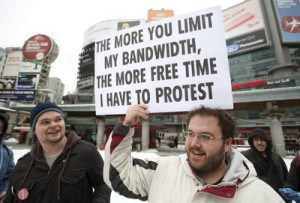
internet limitIn nearby Ohio, the average broadband user already exceeds Time Warner’s 30GB pittance allowance, using 52GB a month. Under both plans, customers who exceed their allowance are charged $1 per GB, with overlimit fees currently not to exceed $25 per month. That 30GB plan would end up costing customers an extra $22 a month above the regular, unlimited plan. So much for the $5 savings.

Unfortunately, as long as Time Warner has an 80 percent market share, the same mentality that makes ever-rising modem rental fees worthwhile might also one day give the cable company courage to remove the word “optional” from those usage limited plans. With usage nearly doubling every year, Time Warner might see consumption billing as its maximum moneymaker.

In 2009, Time Warner valued unlimited-use Internet at $150 as month, which is what they planned to charge before pitchfork and torch-wielding customers turned up outside their offices.

Considering the company already earns 95 percent gross margin on broadband service before the latest round of price increases, one has to ask exactly when the company will be satisfied it is earning enough from broadband service. I fear the answer will be “never,” which is why it is imperative that robust competition exist in the broadband market to keep prices in check.

Unfortunately, as long as Wall Street and providers decide competition is too hard and too unprofitable, the price increases will continue.

Frontier Having a Bad Week of Service Outages in Washington, Illinois, W.V., Tenn. and N.Y.

Phillip Dampier July 30, 2013 Consumer News, Frontier, Rural Broadband, Video 1 Comment
Frontier's headquarters in Rochester, N.Y.

Frontier’s headquarters in Rochester, N.Y.

Tens of thousands of Frontier Communications customers have dealt with the loss of their broadband and phone service in five states because of cable damage, copper theft, and overselling broadband service with insufficient capacity.

Upstate New York

Officials in Oswego County report Frontier phone and broadband service was disrupted Monday for customers in several central New York communities. At least 3,400 customers were unable to dial outside of their home exchanges in Fairhaven, Hannibal, Cato and Lysander. Frontier said a cable owned and maintained by Verizon was responsible, and they were unaware when Verizon would complete repairs.

Tennessee and Illinois

Frontier Communications acknowledged a “major outage” was affecting customers in both Tennessee and Illinois today. As of late this afternoon, Frontier said it was still attempting to restore service to both states’ customers.

Washington

Frontier Communications has reported copper lines stolen in Snohomish, Skykomish and Granite Falls, causing temporary outages for thousands of customers throughout north King and Snohomish counties. It’s the tenth copper wire theft affecting Frontier so far this year.

West Virginia

Ongoing problems in the Panhandle region of West Virginia have left Frontier broadband customers without service, sometimes for days. Customers have been told copper thefts were responsible for outages in mid-July, but some Frontier technicians have also told customers that slow speeds that persist month after month are a result of too many customers trying to use Frontier broadband at the same time. Other customers in the Shepherdstown area report persistent, ongoing problems with broadband outages as well.

[flv width=”640″ height=”380″]http://www.phillipdampier.com/video/KCPQ Seattle Frontier Copper Theft 7-25-13.flv[/flv]

KCPQ in Seattle reports Frontier has been a repeated victim of copper thefts in Washington state. At least 10 instances of copper theft have left thousands of customers without service until the company can string new cable.  (3 minutes)

Philly’s Bloggers, Strippers Taxed While Comcast Given Tens of Millions in Gov’t. Handouts

Phillip Dampier July 30, 2013 Comcast/Xfinity, Editorial & Site News, Public Policy & Gov't Comments Off on Philly’s Bloggers, Strippers Taxed While Comcast Given Tens of Millions in Gov’t. Handouts
Their dollars equals custom-written corporate welfare bills that you will eventually pay for.

Comcast is in hog heaven thanks to Pennsylvania’s generous handouts from its corporate welfare system.

This week, Philadelphia residents are pondering why the city is hounding entrepreneurs and middle class, at-home workers with new taxes and fees while the nation’s largest and richest cable company, Comcast, is receiving enormous tax breaks and government handouts.

Welcome to the United Corporations of America, where taxpayers front at least $80 billion in corporate welfare handouts, according to the New York Times. Comcast is the fourth biggest recipient of corporate welfare in Pennsylvania, dwarfed only by a giant oil company and two Hollywood studios that have learned how to cash in by filming movies inside the Keystone State. The average Pennsylvanian contributes $381 in taxes per year that gets diverted to multi-billion dollar corporations. At least 18 cents of every dollar in the state budget is now spent on corporate welfare programs.

The budget busting handouts have continued without interruption, even during The Great Recession. Elected officials believe the only way to keep big business from picking up and moving to another city or state is to keep making them offers they cannot afford to refuse. But local taxpayers can’t afford to make up the difference. While the economy was melting down from 2008-2010, Philadelphia-based Comcast scored $18 million in tax abatements, credits, and other government handouts. At the same time, local officials faced with upside down city budgets enacted controversial new taxes and business fees on some of the city’s smallest businesses, ranging from bloggers, freelance writers, to independent contractors and consultants.

Pennsylvania is easily among the top-tier of states handing out corporate welfare. In 2011, the Commonwealth collected $4.89 billion in business taxes. But it promptly returned $4.84 billion in tax credits to the state’s biggest businesses. Government benefits for Philadelphia for-profits totaled over $200 million that year alone. Many of the state’s biggest companies receive nearly as much in tax credits, grants, and other benefits that they pay in state and local taxes. Some incentive programs are so broadly written, businesses doing “business as usual” qualify for enormous tax breaks.

Take, for example, Comcast subsidiary QVC. Pennsylvania’s “film incentive program” handed the home shopping network $7.05 million in tax credits just for hawking jewelry from studios inside Pennsylvania. It did not matter QVC had been pitching products from those studios before, during and after the subsidy program handed out the award. Comcast had no plans to move the studios either, but it pocketed the corporate welfare just the same.

While Comcast was building up enough financial resources to acquire NBC-Universal, Philadelphia’s city budget was in tatters. Officials looking for creative ways to boost the local tax base didn’t tap Comcast for the money. Instead, they declared bloggers were now required to get a “business license” to operate within city limits. In fact, the city argued, every person, partnership, association and corporation engaged in a business, profession or other for-profit activity within the city of Philadelphia must now file a Business Privilege Tax Return. The cost just to apply for the business license? $300. Sorry Nathanial, the lemonade stand has to close because you didn’t cough up the $300 before erecting the card table in the front yard.

Comcast-LogoThe “blogger tax” appeared to be sufficiently overreaching (thanks to excoriating coverage in the local media) to provoke the city to begin to phase it out, but no worries — Philadelphia has since found another source of revenue — Comcast? No, of course not. The real money is in taxing strippers. From The Philly Post:
So Mayor Nutter’s effort to tax lap dances—which reached its, er, climax last week in a Philadelphia courtroom — might be somewhat sympathetic if it had been cast as a way to crack down on the general level of skeeviness in the city. After all, it’s a fairly common rule of economics that if you want less of something, just tax it. That’s the logic behind Nutter’s anti-obesity effort to put a tax on sugary drinks, after all.

But nobody’s making that argument. (To be fair, City Hall hasn’t made much of a public argument of any sort, with officials saying they can’t comment on pending litigation.) So we’re forced to assume that the city, always desperate for revenue, is simply finding new ways of taxing its citizens — going after strippers the way you and I might check the folds of the couch for loose change.

And since strip club attendees already pay the city’s amusement tax just to enter the strip club, it seems reasonable to conclude that asking them to pay again when they witness actual stripping is thus a direct tax on stripping itself. It’s a tax on work.

There probably are not enough deep-pocketed lap dancers inside the City of Brotherly Love to cover Comcast’s tax tab. Just for building its new headquarters in Center City Philadelphia, the company was awarded an extra $42.75 million in government subsidies. But it did not stop there. In 2011, the cable company received an extra $18 million in miscellaneous gratitude corporate welfare categorized generally as “assorted grants and credits.” No other Philadelphia business came close to competing with Comcast’s taxpayer-provided gift basket. In return, Comcast showed its gratitude to Pennsylvania by declaring itself a Delaware-based corporation that was exempt from paying the state’s corporate income tax.

Consolidation: AT&T Acquires Siouxland’s Long Lines Wireless

Phillip Dampier July 29, 2013 AT&T, Competition, Long Lines, Public Policy & Gov't, Video, Wireless Broadband Comments Off on Consolidation: AT&T Acquires Siouxland’s Long Lines Wireless

long linesAT&T has continued its efforts towards wireless industry consolidation with today’s announcement it has acquired Iowa-based Long Lines Wireless (formerly Cellular One of Iowa) for an undisclosed amount.


“We concluded that Long Lines could best serve our customers by focusing our attention and investing our resources in providing new features for our non-wireless services including voice, broadband services, and cable TV, and in expanding our fiber optic network to reach more communities and customers,” said Long Lines CEO Brent Olson.

The rural telecom company has served Siouxland since 1941 and today provides wireless, landline service, cable television and broadband to residents in Iowa, Minnesota, Nebraska, and South Dakota.

Customers have not suffered doing business with a small independent provider like Long Lines. The company operates a fiber optic network providing business customers up to 40Gbps broadband and residential customers up to 100Mbps Internet service. Those services are not available from the much larger telephone companies that also serve these states, including AT&T, Frontier, and CenturyLink.

Despite the availability of infrastructure that can rival any large city, Long Lines concluded it could simply not succeed in its wireless business.

“Regional wireless providers have limited access to the latest smartphones and other devices, and it has become increasingly difficult to for Long Lines Wireless to meet the digital mobile needs of our customers,” Olson said.

The sale to AT&T means Long Lines wireless customers will eventually be a part of AT&T’s wireless network, with access to its 4G network and a wider selection of phones.

Long Lines intends to invest its resources in providing new features for non-wireless services including voice, broadband services, and cable TV, and in expanding its fiber optic network to reach more communities and customers.

[flv width=”640″ height=”380″]http://www.phillipdampier.com/video/KCAU Sioux City Long Lines Sold to ATT 7-25-13.mp4[/flv]

KCAU in Sioux City reports on the sale of Long Lines Wireless to AT&T Mobility. (1 minute)

Rogers Admits Charging More for Your Internet Access/Usage is Where The Big Money Is

Phillip Dampier July 25, 2013 Canada, Competition, Data Caps, Rogers 1 Comment
Bruce

Bruce

Charging usage-based pricing and monetizing your use of the Internet is key to enhanced profits and higher earnings as broadband becomes the key product for cable operators.

That is the view of Robert Bruce, president of the communications division of Rogers Communications, eastern Canada’s largest cable operator.

“[The Internet] is the key to the future of our business, hence monetizing the increased bandwidth usage will rapidly become the future across all our businesses, whether it is wireless or wireline,” Bruce told a financial analyst in response to a question about ongoing Internet rate increases from the cable company. “There are clearly some unlimited offers out there and we think they are fairly shortsighted as the Internet is the future of the business.”

Bruce believes there is plenty of room for future rate increases, especially as the cable company boosts Internet speeds and ends network traffic management, improving the perceived quality of Rogers’ Internet service.

“We have significantly enhanced the value of this product and over time it is our plan to monetize it accordingly,” Bruce explained to the analyst. “The price increase that you receive in the mail would have just been one step in the monetization that we think will continue as Internet service becomes the backbone product in the home.”

Rogers admits it will continue to lower the bar on customers with usage caps and higher broadband pricing.

Rogers admits it will continue to lower the bar on customers with usage caps and higher broadband pricing.

Ironically, Rogers is currently offering its own unlimited use plans, primarily in response to a competing offer from Bell.

Dr. Michael Geist, a broadband industry observer and law professor at the University of Ottawa notes competition is the only thing keeping Rogers’ pricing and usage caps in check.

“If the Bell offer disappears, so will the Rogers plan,” Geist predicts. “With limited competition, favorable pricing plans will come and go, with executives anxious to increase prices and implement usage caps. The only solution is sufficiently robust competition that all players are continually forced to improve service and keep pricing in check to retain and attract customers.”

Rogers may tell the public Canadian broadband is robustly competitive but the company signals something very different to the investor community. With OECD data already showing Canada among the ten most expensive countries for broadband service in the developed world, Rogers is primed to raise prices even higher as it further tightens Internet usage caps.

Rogers’ improvements in its broadband service do not necessarily correspond with the company’s pricing power. As consumers increasingly consider Internet access an essential utility in the digital economy, Rogers is finding it can set prices as it likes and regularly increase them without effective subscriber backlash. With most Canadians buying service from the cable or phone company, if both providers avoid a pricing war, investors will be able to extract OPEC-like earnings from the barely regulated service.

Providers routinely claim rate increases are tied to costly upgrades, but Rogers’ own financial statements and comments to shareholders say otherwise. The cost to deliver broadband service in Canada is dropping, but the price charged for Internet access and the overlimit fees collected when customers exceed their usage limit will continue to rise as a growing percentage of company revenue now depends on broadband service.

Search This Site:

Contributions:

Recent Comments:

Your Account:

Stop the Cap!