Home » Providers » Recent Articles:

Common Cause-NY Wants Anti-Corruption Commission to Review Big Telecom’s Political Contributions

Phillip Dampier September 23, 2013 AT&T, Cablevision (see Altice USA), Comcast/Xfinity, Consumer News, Public Policy & Gov't, Verizon Comments Off on Common Cause-NY Wants Anti-Corruption Commission to Review Big Telecom’s Political Contributions

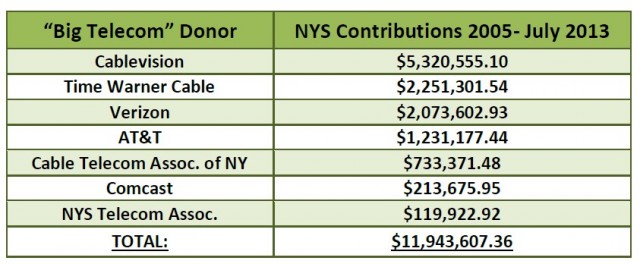
donor contributionsSince 2005, five cable and telephone companies and their respective lobbying trade associations have donated nearly $12 million to New York politicians, making Big Telecom companies among the biggest political donors in the state. Now a government reform group wants an investigation by the state’s anti-corruption commission.

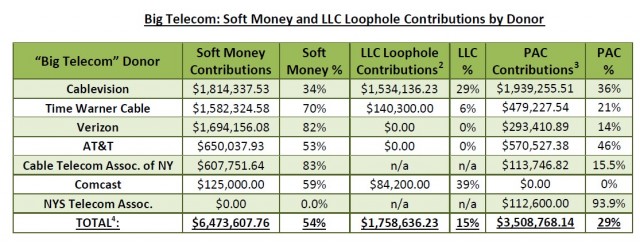
By exploiting giant loopholes in New York’s campaign finance laws, telecom companies that used to live with annual campaign finance limits of $5,000 are now donating millions to powerful political leaders in Albany – the majority conferences in the legislature, the state party committees, and the governor. Some are using secretive “housekeeping” accounts controlled by political parties. Others hide behind shadowy contributions from “limited liability corporations” (LLCs) established by some of the state’s biggest cable and phone companies and treated under current law as living, breathing people.

“Big Telecom exemplifies the pay-to-play culture which has come to define Albany, giving generously to the leadership in exchange for veto power over bills which favor the public interest,” said Common Cause-New York executive director Susan Lerner.

The Optimum donor to state "housekeeping" accounts among telecom providers is Cablevision.

The Optimum donor to state “housekeeping” accounts among telecom providers is Cablevision.

No telecom company donates more in New York than Cablevision, which has given more than $5.3 million in contributions to state politicians since 2005 as it fights its way through union problems, fierce competition from Verizon, and complaints from subscribers about rising cable prices and questionable service. The cable company doesn’t just donate in name-only. Common Cause-NY discovered Cablevision using eight different LLCs to evade contribution limits, handing over $1.5 million to candidates and committees. Gov. Andrew Cuomo received $130,000 from four different Cablevision-controlled LLCs between July and October 2010. On April 29 of this year, former Nassau County executive Tom Suozzi’s campaign received $190,000 from three Cablevision-controlled LLCs on that single day.

Verizon (82%) and Time Warner Cable (70%) prefer to quietly give the largest percentage of their political donations to the parties’ secretive, soft money “housekeeping” accounts. The Republican and Democratic recipients are not using the money to buy Endust, mops or spare light bulbs, although the average voter might assume as much.

Corporations with an agenda just love New York’s hush-hush “housekeeping” accounts because they come without dollar limits or complete disclosure about how the money was ultimately spent.

The State Board of Elections says “housekeeping” money is supposed to go toward maintaining a party’s headquarters and staff or “ordinary activities that are not for the express purpose of promoting the candidacy of specific candidates.” Unfortunately, nobody bothered to require detailed accounting, allowing funds to disappear down a political rabbit hole, to be distributed at each party’s discretion.

Comcast (59%) and AT&T (53%) are considerably smaller players, in part because neither company serves many wired cable/broadband customers in New York.

Verizon’s corporate PAC also likes to raise relatively large numbers of small contributions given in the name of company executives or employees, not necessarily mentioning the company itself. Campaign finance disclosures may list only the individuals’ contribution(s), not the company that signed their paycheck.
loophole

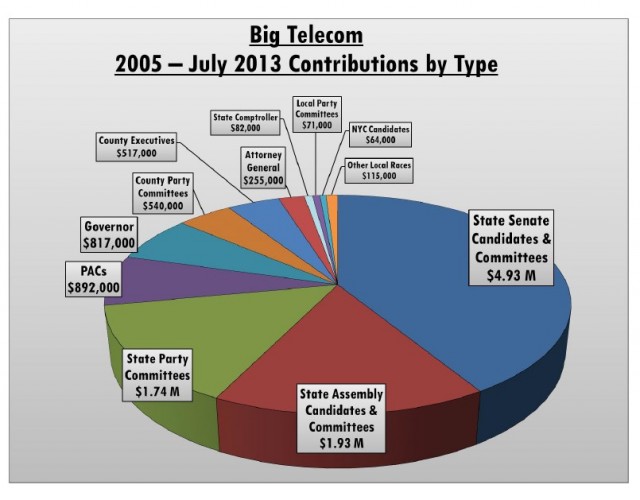
contribution by typeWhere does all the money go?

Common Cause-NY says most of the money is channeled to the most influential politicians in the state, with minority parties and unelected candidates typically getting much less.

To gain influence on the state level, Big Telecom companies contribute to the governor, attorney general, and the majority parties controlling the state Assembly and Senate, with Republicans getting the lion’s share (over $3.5 million) in the Senate and Democrats (over $1.6 million) in the Assembly.

For local issues of interest to the state’s local cable and phone companies, contributions are funneled to influential county-level political machines, perhaps helpful in making life difficult for a competing Wi-Fi project, a municipal fiber network, or helping to cut red tape to place a cell tower in a controversial location.

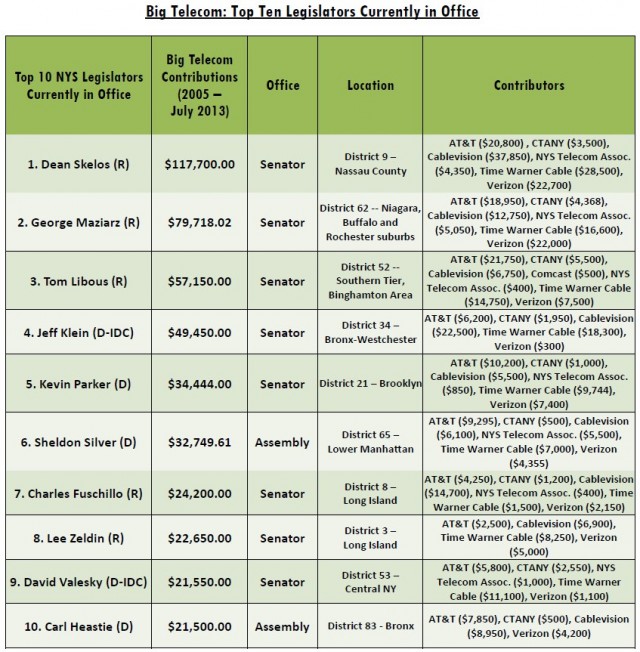
The top six recipients of Big Telecom’s political cash in the legislature:

  • Key Party Leaders: Dean Skelos ($117,700), Tom Libous ($57,150), Jeff Klein ($49,450), and Sheldon Silver ($32,749.61)
  • Current and former Chairs of the Senate Energy and Telecom Committee: George Maziarz ($79,718.02) and Kevin Parker ($34,444.00).

Common Cause-NY notes the corporations involved don’t give money without expecting something in return. After generous contribution checks were deposited, a number of telecom consumer protection bills mysteriously died in committee or never made it to the floor. The same fate did not meet bills offering special tax breaks for cable and Internet Service Providers that have cost New York taxpayers nearly $500 million and counting.

“Multi-million dollar campaign contributions clearly help Big Telecom maintain the status quo of corporate control, high prices, and lax regulation,” Common Cause-NY concludes.
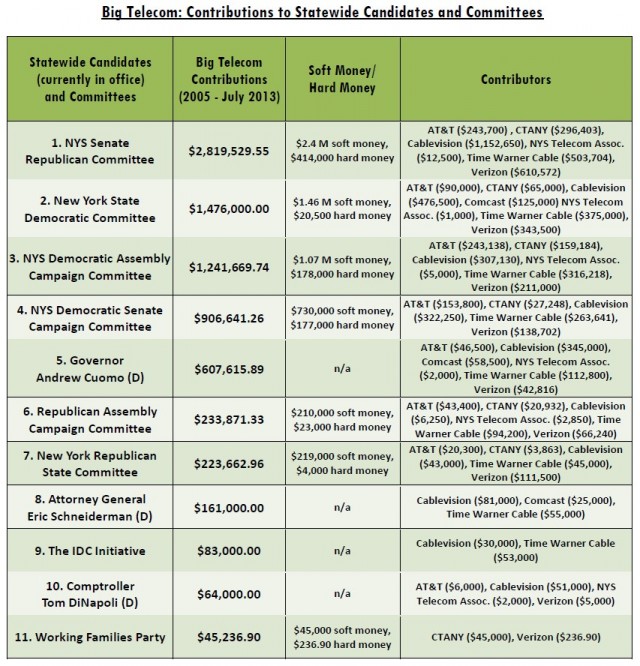
where is the money going

top ten recipients

The legislature is rife with examples of bills that would have likely passed with popular support but suddenly or “mysteriously” didn’t:

  • common cause nyA 7635-A / S5630-A: Establishes a moratorium on telephone corporations on the replacement of landline telephone service with a wireless system.
    • The “VoiceLink” moratorium bill, passed the Assembly, had broad bi-partisan support in the Senate but never came to a vote.
  • S542: Relates to enacting the “Save New York Call Center Jobs Act of 2013,” which requires prior notice of relocation of call center jobs from New York to a foreign country; directs the Commissioner of Labor to maintain a list of employers who move call center jobs; prohibits loans or grants.
    • The “Call Center Jobs Act” would take away tax breaks and state grants if companies move a call center to another country. The bill passed the Assembly in 2012 (A9809) and had bipartisan support in Senate but was blocked. The 2013 bill died in Senate committee.
  • fair electionsA6003/S5577 — Directs the Department of Public Service to study and report on the current status of cable television systems providing services over fiber optic cables.
    • Bipartisan support in Assembly for further oversight of broadband but gets little support in Senate, the same bill was also blocked in 2012.
  • A5234/S1075 — Enacts the “Roadway Excavation Quality Assurance Act” demanding utility companies or their contractors shall use competent workers and shall pay the prevailing wage on projects where a permit to use or open a street is required to be issued.
    • Bipartisan support in the Senate and Assembly but no passage in either 2012 and 2013.
  • A6239/S4550 — Creates the State Office of the Utility Consumer Advocate to represent interests of residential utility customers.
    • Bipartisan support in Assembly, dies in Senate.
  • A6757/S4449 — Requires providers of electric, gas, steam, telephone and cable television services to issue standardized bills to residential customers; provides the standards for such bills shall be established by the Public Service Commission.
    • Bipartisan support, passes Assembly, dies in Senate.

“Here’s the evidence that giant telecom companies are taking advantage of huge loopholes and lax regulations so they can increase profits, often at the expense of everyday New Yorkers,” said Karen Scharff, executive director of Citizen Action of New York on behalf of the Fair Elections for New York campaign. “It’s time for our leaders in Albany to acknowledge the ever-growing wealth of evidence that we need to fix our broken campaign finance system and pass a comprehensive Fair Elections system centered around publicly financed elections.”

Comcast Hires ‘Internet Guy’ to Embrace Broadband Innovation; Start By Killing the Usage Cap

Phillip Dampier September 23, 2013 Broadband Speed, Comcast/Xfinity, Consumer News, Data Caps, Editorial & Site News, Net Neutrality Comments Off on Comcast Hires ‘Internet Guy’ to Embrace Broadband Innovation; Start By Killing the Usage Cap
Phillip "Unlimited Innovation depends on Unlimited Access" Dampier

Phillip “Unlimited Innovation depends on Unlimited Access” Dampier

Comcast wants to embrace innovation and change. Before it can succeed, the cable company needs to permanently retire usage caps and consumption billing schemes, now being market-tested for possible reintroduction nationwide.

Comcast today announced it created a new executive position — vice president of consumer services for video, phone, Internet, and home products and appointed Marcien Jenckes to the position. His role is to oversee development of ideas for new products and services that can be sold to Comcast customers.

Jenckes says Comcast’s product lines are blurring as convergence between television and broadband continues. His role is to keep customers of both services happy by embracing innovation and change.

He will find his hands tied should Comcast bring back its usage cap, now under serious consideration. Limiting residential broadband limits customers’ interest in innovative new online applications that carry the threat of a wallop to one’s wallet from overlimit fees. Comcast ditched its arbitrary 250GB usage cap in the spring of 2012, but continues to think about bringing it back. This year, Comcast has tested a new 300GB cap in certain states tied to an overlimit fee for customers exceeding their usage allowance.

Customers don’t like usage caps one bit. Neither should Comcast “innovators” like Mr. Jenckes.

The future of Internet innovation is likely to be developed on a platform that delivers faster Internet speeds, opening up new high bandwidth applications not easily possible today. Usage caps are anathema to that kind of innovation because customers will be unlikely to embrace new services that blow their usage allowance away.

If Mr. Jenckes is seriously interested in promoting a new spirit of innovation at Comcast, he should start by pressing his fellow executives to ditch usage caps and consumption billing once and for all. The future of unlimited innovation in broadband has its best chance of success with unlimited access.

Post TWC-CBS Dispute, Other Networks Preparing to Demand Their Own Increases

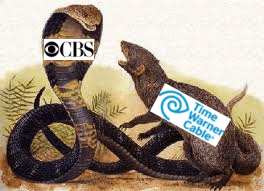
cbs twcJust weeks after Time Warner Cable and CBS settled a dispute over retransmission fees, other broadcasters and networks are preparing to make new demands for increased compensation from their cable, satellite, and telco IPTV partners at prices likely to provoke more blackouts.


Despite repeated protestations from Time Warner that over-the-air stations and networks deserve lower fees than cable-only networks, once the two parties went behind closed doors, the cable company quickly agreed to pay considerably more for CBS programming. Sources say CBS made a deal that will run up to five years and includes more than $1.50 in fees per subscriber, up from between 50-85 cents per month, depending on the city served, under the old contract. CBS had asked for about $2 a month. Effectively, the company will earn more than that because Time Warner also agreed to renew both the CBS Sports Network and Smithsonian Channel, which cost extra.

“There is a new template here. Two dollars is the new holy grail,” Wunderlich Securities analyst Matthew Harrigan told Reuters.

Fox was the highest paid network before the CBS deal, collecting close to $1.25 per month per subscriber. ABC receives 50-65 cents and NBC less than that.

Harrigan predicts the other networks will race to raise their own prices, with Time Warner Cable (and others) likely forced to raise rates early next year to cover increased costs.

In the war for compensation, programmers hold most of the leverage.

[flv width=”392″ height=”244″]http://www.phillipdampier.com/video/WSJ Lessons Learned CBS 9-2-13.flv[/flv]

The Wall Street Journal reports the dispute between Time Warner Cable and CBS set new industry precedents on the value of broadcast stations and networks and how their programming is distributed on digital platforms. (2 minutes)

There have already been local station blackouts in 80 cities so far this year, with the likelihood last year’s record of 91 markets will be broken before Thanksgiving. In almost every instance where a popular network is involved, the pay television provider eventually capitulates because of subscriber complaints or cancellations.

Moonves

Moonves

Time Warner Cable admits its dispute with CBS cost the company business, both from prospective new customers going elsewhere and customer disconnects. Time Warner also spent money advertising its side of the dispute and paid to distribute free antennas to affected subscribers.

CBS’ Les Moonves had predicted Time Warner would eventually meet most of the network’s compensation demands before football season arrived. He was right.

“CBS is the winner. Content owners always win these negotiations, it’s just a matter of how much they won,” said Craig Moffett of Moffett Research. “They have all the leverage. Consumers don’t get mad and trade in their channel when these fights drag on. They go looking for a different satellite or telephone company.”

Almost 200,000 Time Warner Cable television customers left during the second quarter, and company officials admit that trend continued during the third quarter as the dispute dragged on. Time Warner Cable is likely to end the year with fewer than 11.5 million video subscribers, a loss of several hundred thousand this year.

Sources say one major sticking point that kept CBS off Time Warner Cable systems for nearly a month wasn’t about money. Instead, it was about digital distribution rights.

Time Warner Cable wanted CBS on its TV Everywhere app TWCTV and was also concerned about CBS selling content to online video streaming competitors that could accelerate cord-cutting.

Time Warner Cable did win permission to offer Showtime on its digital streaming platform and on apps for portable devices. But Time Warner will not get to carry local CBS-owned stations on streaming platforms, a significant blow. The cable company will also have to pay more for streamed and on-demand content.

In the end, CBS got almost everything it wanted and Time Warner Cable was handed back its largely unfulfilled wish list and a bigger, retroactive bill subscribers will eventually have to pay.

“We wanted to hold down costs and retain our ability to deliver a great video experience to our customers,” Time Warner Cable CEO Glenn Britt said in defense of the agreement. “While we certainly didn’t get everything we wanted, ultimately we ended up in a much better place than when we started.”

Moonves gloated to various trade publications and investors that CBS went unscathed after the month-long dispute.

“Our national ad dollars did not go down,” Moonves told attendees at the recent Bank of America/Merrill Lynch Media Communications & Entertainment Conference. “There were no such things as make-goods and there was no harm done financially to CBS Corporation.”

[flv width=”640″ height=”380”]http://www.phillipdampier.com/video/Bloomberg Moonves CBS Got Fair Value for Our Content 9-7-13.flv[/flv]

CBS’ Les Moonves has won his dispute with Time Warner Cable, says Les Moonves in this interview with Bloomberg TV. (10 minutes)

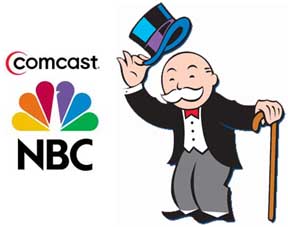
Comcast owns both NBC and the cable companies that carry its local affiliates.

Comcast owns both NBC and the cable companies that carry its local affiliates.

Cable rate increases are not likely to stop with the agreement with CBS. Analysts predict NBC, ABC, and FOX will be seeking similar rates when their contracts come up for renewal. Altogether, every cable, telco IPTV, and satellite subscriber could see rates increase up to $6 a month for the four major American networks.

“Any time one of these larger networks sets the new standard in terms of pricing for their programming, the rest follow,” Justin Nielson, an analyst for SNL Kagan, told Hollywood Reporter. “In most cases it’s been CBS and FOX trailblazing what the rates should be and then ABC and NBC following.”

Comcast-NBC’s Steve Burke is already there. Burke told investors affiliates should be paying 20 to 25 percent more for cable networks such as USA, Bravo, SyFy, CNBC and MSNBC .

“We’re not paid as much as we should be given our rating and positioning by cable and satellite companies,” Burke said. “I see no reason why we won’t sort of draft behind the other broadcast networks and get paid in a similar way.”

Burke predicts NBC will earn between $500 million to $1 billion annually from increased retransmission consent fees comparable to what CBS and FOX receive.

Next week, DISH Networks faces the expiration of their contract with ABC/Disney-owned channels, including the Cadillac-priced ESPN. The outcome of renewal negotiations may serve as an indicator for where rates are headed in the world of retransmission economics.

A growing number of elected officials in Washington are paying attention as they and their constituents live through one programmer blackout after another. At least four pieces of legislation have been introduced to deal with the problem in very different ways, according to Bloomberg News:

The Satellite Television Extension and Localism Act

This law, known as STELA, dates to 2004 and gives satellite companies a license to provide local TV stations, just as cable operators do. The current law is set to expire at the end of 2014, with most observers calling its reauthorization a near certainty. The debate is mainly over how “clean” the STELA reauthorization bill will be as it emerges from the legislative process, with the pay TV companies urging lawmakers to address the issue of retransmission disputes. Broadcasters are working for a “clean” bill, written narrowly to address the satellite companies’ immediate needs. “There’s nothing clean about the current retransmission system,” says Brian Frederick, a spokesman for the American Television Alliance, a coalition of pay-TV companies. Two House committees held hearings on the law this week. A final bill and vote are expected next year.

Video CHOICE (Consumers Have Options in Choosing Entertainment)

Representative Anna Eshoo, a Democrat who represents much of Silicon Valley, introduced this bill Sept. 9 aimed at ending blackouts. “Recurring TV blackouts, including the 91 U.S. markets impacted in 2012, have made it abundantly clear that the FCC needs explicit statutory authority to intervene when retransmission disputes break down,” Eshoo said in a press release. (The FCC gets involved now only if one party accuses the other of negotiating in bad faith.) The bill would unbundle broadcast stations from a cable package and prohibit a broadcaster from requiring a pay TV operator to take affiliated cable channels to obtain more popular channels. That issue is at the heart of why Cablevision sued Viacom in February, following a contentious negotiation.

Eshoo’s bill would also require the FCC to study programming costs for sports networks in the top 20 regional sports markets. The rising fees for sports programming—led by ESPN—is considered one of the major influences behind rising cable bills and the power that content creators such as Disney hold in negotiations. Cable companies have praised Eshoo’s bill, while broadcasters are not fans. Don’t expect to see it get far in a Republican-led House.

Television Consumer Freedom Act of 2013

This bill, introduced in May by Senator John McCain (R-Ariz.), would end the long era of the cable television bundle, that phenomenon by which you pay for hundreds of channels and find yourself watching only about two dozen, or fewer. This summer, Connecticut Senator Richard Blumenthal signed on as a Democratic co-sponsor, but there’s been no similar sponsors on the House side. Blumenthal explained his support of the bill in an August interview with the Hollywood Reporter:

“What I hear from cable consumers overwhelmingly is, ‘give us freedom of choice. Don’t make us pay for something we don’t want and won’t watch. Why am I paying for—you name a channel you don’t like or five or ten or them—just so I can watch the one I do want.’ That’s overwhelmingly the sentiment of people who buy this product. So this bill just gives voice and force to that sentiment.”

Next Generation Television Marketplace Act

This bill from Representative Steve Scalise, a Louisiana Republican, and former South Carolina Senator Jim DeMint, also a Republican, dates to December 2011 and would deregulate the entire television market, top to bottom. It would repeal compulsory copyright licenses, the legal mechanism by which content owners are required to let pay TV companies carry their programs, if they are paid a fee for the content. The bill, which would also dismantle the system of retransmission fees, is essentially an exercise in carrying free-market ideology to its logical conclusion. The problem? It would require a countless number of individual deal negotiations—any radio or television station that wanted to carry programming (i.e., all of them)—would need to strike deals with every programmer, yielding an inefficient system that would likely prove unworkable. Lawyers would love the bill, but don’t expect it ever to pass Congress.

In fact, none of these bills are expected to pass through both the gridlocked House and Senate this year.

[flv]http://www.phillipdampier.com/video/CNBC Les Moonves Says It Would Be Dumb For Lawmakers To Change Retransmission Rules 9-4-13.flv[/flv]

CNBC also talked with CBS’ Les Moonves about CBS’ views towards compensation and distributing content online. (13 minutes)

Cox Closes Down Summer Trial of flareWatch, An Online Video Alternative to Cable TV

Phillip Dampier September 19, 2013 Competition, Cox, Data Caps, Online Video Comments Off on Cox Closes Down Summer Trial of flareWatch, An Online Video Alternative to Cable TV

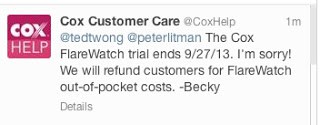
flare-logoCox has pulled the plug on its summer trial of flareWatch, an over-the-top virtual cable TV service that works over an existing broadband connection. The sudden end of the trial, now scheduled for Sept. 27, comes several days after new participants found orders for the accompanying Fanhattan-made set-top box canceled without warning. Customers who paid $99.99 for the box, later reduced to $49.99, are supposed to be getting refunds according to Cox Customer Care.

“This limited trial was conducted as part of Cox’s ongoing customer research to determine how to best evolve our offerings to meet customers’ changing needs,” according to a Cox official. “We remain focused on helping customers discover and connect to the things they care about in ways that are easy-to-use and reliable and we will continue to test and explore new products. We will continue to evaluate the flareWatch trial results to determine how this might impact future product plans.”

Flarewatch over

Peter Litman got confirmation flareWatch has been put out.

Customers visiting Cox’s website dedicated to the IP-based video service found only a “Service Unavailable” message greeting them.

Cox’s flareWatch service offered about 100 channels (many over-the-air) for $34.99 a month, with a cloud-based DVR feature, and was available only to Cox customers in Orange County, Calif., with Preferred Internet service. Use of the service counted against your monthly Cox broadband usage allowance.

Later in the trial, Cox raised the price by $5 a month and bundled Rhapsody’s streaming music service and a small video-on-demand feature. It also cut the purchase price of the hardware in half.

Trial participants report the notification Cox was terminating the service seemed sudden and perhaps unplanned.

Cox says otherwise.

“As planned, the Orange County trial has successfully completed. We collected excellent customer feedback and usage data to inform our broader deployment of Fan TV,” said a Cox spokesperson. “As announced in May, Fanhattan plans to work directly with pay TV service providers to distribute Fan TV. Making sure it’s ready for primetime requires rigorous testing, trial customer feedback and constant iteration. This limited trial was a small, early step in that direction.”

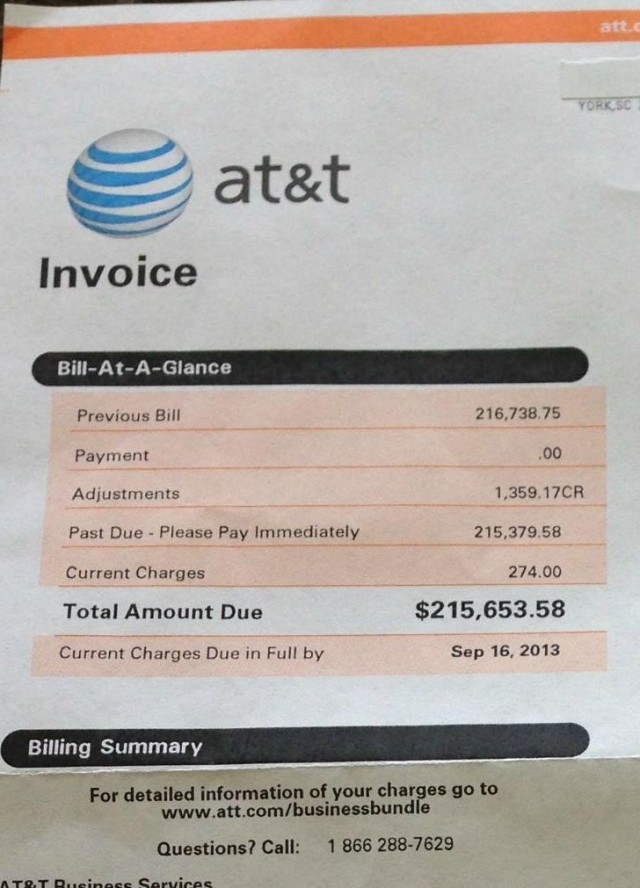
AT&T Bill Shock — Total Amount Due: $215,643.58 (After a $1,359.17 Adjustment Credit)

Phillip Dampier September 19, 2013 AT&T, Consumer News Comments Off on AT&T Bill Shock — Total Amount Due: $215,643.58 (After a $1,359.17 Adjustment Credit)

att bill

Another ex-AT&T customer deals with bill shock: “Dishekie” reports he disconnected AT&T service in March after the phone company failed to get his small company’s Voice over IP phone system functioning properly. “I was reassured my contract was nullified because the VoIP phones never worked,” says the customer. Wrong. AT&T claims the bill is for fraudulent calls placed over the company’s hacked phone system. AT&T has not been willing to resolve the charges, which continue month after month, but hasn’t turned the customer over to collections either, leaving “Dishekie” opening one eye-popping bill after another. He took his case to Reddit, which seems to have finally gotten the attention of a vice president of finances at AT&T who may have a solution, or not.

Search This Site:

Contributions:

Recent Comments:

Your Account:

Stop the Cap!