Home » Providers » Recent Articles:

Sprint’s ‘Clear’ Raises Prices for Its Throttled and Litigated WiMAX Network

Some ex-Clearwire customers were not happy when their speeds were reduced to 250kbps on the company's overcrowded network.

Some Clearwire customers remain unhappy when speeds are throttled to “manage” the network.

Clear (formerly known as Clearwire) has announced a general rate increase of about 10 percent for customers using its legacy 4G WiMAX broadband service.

As a result, most customers will pay about $5 more per month for fixed wireless or “on the go” broadband service.

“We instituted this to remain competitive and manage our costs,” a Sprint representative told Broadcasting & Cable. “Like our competitors, we must respond to customer trends, and provide a good user experience, and as a result we will make adjustments to fees and services from time to time. Our offer is still comparable to other offerings in the marketplace.”

Some customers would argue with Sprint’s definition of a “good user experience,” as complaints continue about heavy-handed throttling of Clear’s service that makes high bandwidth applications painful or impossible to use in the evening.

Stop the Cap! reader Akos contacted us this week to complain Clear still advertises and contracts for “unlimited data and top speeds,” while not exactly being upfront about targeting certain traffic for a prime time speed throttle that effectively keeps customers from streaming video.

“They openly admit their service is being throttled by software at each tower site that activates when it detects streaming video services like Netflix, reducing speed from 1.3Mbps to as little as 20kbps, rendering it unusable,” said Akos.

The speed throttle is usually active from 8pm-1:30am daily, when traffic is anticipated to be highest. Clear speaks about its network management speed throttle in the fine print: its Acceptable Use Policy.

Akos complains Clear’s speed throttle makes it easy to blame the streaming service, not Clear itself, because customers running speed tests will not see throttled speeds.

“It fools people to think the problem is on their end or with the streaming service, so customers don’t complain to Clear,” says Akos.

As a result, people using streaming video services get about 30 seconds of uninterrupted video before the throttle kicks in bringing extensive buffering delays.

Clearwire’s Speed Throttle Subject of Lawsuits
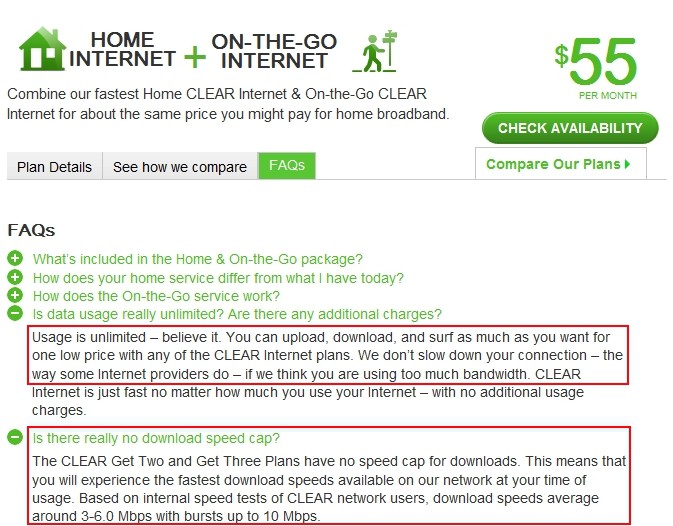
Clear's own 2010 marketing promises unlimited usage with no speed reductions, like those "other" providers.

Clear’s own 2010 marketing promises unlimited usage with no speed reductions, like those “other” providers.

Clearwire’s speed throttle has been a part of life with the wireless service since 2010. Clearwire had significant legal exposure over its choice of network management because the company routinely advertised “unlimited service” with no speed throttles or overlimit fees. At least three lawsuits were filed against the company for its undisclosed throttling practices, eventually condensed into a single class action case that was finally settled last month.

Under the terms of the settlement, Clear admits no wrongdoing, but will clearly disclose it uses “network management” practices — a term that generally means usage caps and/or speed throttles — and will give customers information about the speeds they can expect when the throttle is active. As of today, Clear has not done that. Clear also volunteered to suspend term contracts and waive early termination fees for customers complaining about speed issues.

At least seven law firms handling the case will split a total award fee of $1,887,792.91 and expenses of $62,207.09. Individual representative plaintiffs each receive up to $2,000. Everyone else identified as part of the class action case that returned a claim form prior to Jan. 3, will receive an average of less than $30:

  • a 50% refund of any early termination fee charged after a customer canceled service because of speed throttling;
  • a rebate of $14 for customers signing up for Clearwire before Sept. 1, 2010 and experiencing speed throttling or a rebate of at least $7 for Clearwire customers signing up on or after Sept. 1, 2010;
  • plus varying amounts for each month of service prior to Feb. 27, 2012 during which Clearwire’s records show it throttled a customer’s Internet speed. Customers throttled at 0.25Mbps will receive $5.00 for each month throttled, 0.60 Mbps: $3.00, and 1.0 Mbps: $2.00.

Court documents reveal of the 2,733,406 customers identified in Clearwire’s records as being speed throttled, only 83,840 submitted timely claims as part of the class action case. This represents a claims rate of about 3.1%. Of those, 76,199 were for speed throttling, 2,331 were requests for reimbursement of early termination fees.

The Future of Clear’s WiMAX and Sprint’s 4G

LTE: AT&T's wireless rural broadband solution?

Sprint purchased the assets of Clearwire Corporation in July, rebranded the network “Clear,” and as of the end of August, stopped selling WiMAX devices to customers. Although Clear will still activate existing equipment, potential new customers are being marketed broadband plans on the Sprint network instead.

Former Clear dealers have received word Sprint plans to eventually decommission its acquired WiMAX network as early as 2014, most likely by gradually converting portions of the 2.5GHz spectrum Clear’s WiMAX service now uses in favor of Sprint’s 4G LTE service in urban and high congestion areas. Clearwire itself was in the process of adopting a variant of 4G LTE technology that would gradually replace the outdated WiMAX standard when Sprint acquired the company.

Although Sprint runs its own 3G network, it partnered with Clearwire to provide 4G WiMAX for Sprint customers. In 2011, Sprint announced it would stop selling devices with built-in support for WiMAX and announced it would launch its own 4G LTE network. Sprint will adopt the same version of LTE other North American carriers are using: FD-LTE, or Frequency Division LTE, which requires one transmit channel and one receive channel. But it will also support and continue Clearwire’s upgrade to TD-LTE, or Time Division LTE, a slightly different standard that supports receiving and transmitting signals on a single frequency at slightly different time intervals, providing enhanced spectrum efficiency. At least 5,500 towers should be active with TD-LTE service by the end of this year. End users will care only to the extent their devices support one or both standards.

Sprint’s 4G LTE rollout will depend primarily on higher frequency spectrum that is disadvantageous indoors and over extended distances. Sprint’s competitors AT&T and Verizon Wireless primarily depend on lower 700MHz frequencies that penetrate buildings better and can serve a larger coverage area. But a combination of Sprint and Clearwire’s spectrum assets give Sprint the most wireless spectrum of any U.S. carrier, which means potentially faster speeds and more capacity.

  • 1900MHz: Sprint’s primary 4G FD-LTE service is now available in 151 cities on more than 20,000 cell towers;
  • 2500MHz: Now used by Clear’s legacy WiMAX network, will see a transition towards Sprint’s TD-LTE service which will be targeted to urban and high congestion areas from “small cell” sites;
  • 800MHz: The former home of now-shuttered Nextel, Sprint will eventually launch FD-LTE service on this band which will offer better indoor and marginal area reception.

Customers can expect devices that support both FD-LTE and TD-LTE in 2014.

CenturyLink’s Broadband Issues Color Company’s Deregulation Request in Washington

Phillip Dampier October 15, 2013 Broadband Speed, CenturyLink, Community Networks, Competition, Consumer News, Public Policy & Gov't Comments Off on CenturyLink’s Broadband Issues Color Company’s Deregulation Request in Washington

centurylinkCenturyLink is seeking “greater flexibility” to set its own prices, terms and conditions of service without a review by Washington State regulators, even as its broadband customers complain about bait and switch Internet speeds and poor service.

Three years after the Monroe, La., based independent phone company purchased Qwest — a former Baby Bell serving the Pacific Northwest — CenturyLink continues to lose customers to cell phone providers and cable phone and broadband service. Since 2001, CenturyLink and its predecessor have said goodbye to 60 percent of their customers, reducing the number of lines in service from around 2.7 million to just over 1 million.

CenturyLink is apparently ready to lose still more after upsetting customers with a notice it intended to seek deregulation that could lead to rising phone bills.

Docket UT-130477, filed with the Washington Utilities and Transportation Commission (WUTC) proposes to replace currently regulated service with what CenturyLink calls “an Alternate Form Of Regulation.” (AFOR)

broadband wa

If approved, CenturyLink will “normalize” telephone rates in Washington State, language some suspect is “code” for a rate increase. For CenturyLink customers in cities like Seattle, Spokane, and Tacoma, the maximum rate permitted for basic phone service for the next three years will be $15.50 (unless a customer already pays more), before calling features, taxes, and surcharges are applied. Most observers, including the state regulator, suspect CenturyLink will limit rate hikes to $1-2 if approved. A higher increase might provoke more customers to leave.

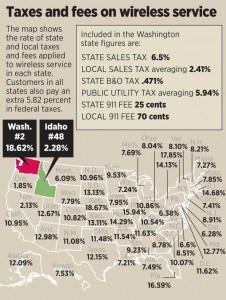
Washington residents already pay the nation's second highest taxes on wireless service. Now landline customers also pay more.

Washington residents already pay the nation’s second highest taxes on wireless service. Now landline customers also pay more. (Graphic: The Spokesman)

“We don’t think they can do much because, in our view, all (a big rate increase) is going to do is accelerate people dropping the landline into their homes,” Brian Thomas, a spokesman for the Washington Utilities and Transportation Commission told The Spokesman-Review. “A lot of people are cutting the cord.”

Frontier Communications, which previously won its own case for deregulation within its service areas including Everett, Wenatchee, and Tri-Cities, raised rates about $1 beginning this month.

A spokesman for the company confessed Frontier’s phone service is becoming obsolete.

“It’s safe to say plain old telephone service is in the process of becoming archaic for some people,” Frontier’s Carl Gipson said. “Five years from now, it will be almost – but not quite – extinct.”

Every rate change seems to provoke a review of whether landline service is still necessary.

Earlier this year, CenturyLink jumped on board legislation that purposely increased phone rates by several dollars a month by removing the sales tax exemption on residential telephone service. Wireless companies did not enjoy the same exemption and sued for parity.

A confidential settlement with state regulators made Washington phone customers, instead of telecom companies, liable for the sales tax starting in August. As a result, some residential phone bills went up at much as $5 based on retroactively charged sales tax.

Customers sticking with CenturyLink often say it is the only broadband provider in rural towns across the state. Although better than satellite broadband, the lack of regulatory oversight and technology investments have allowed CenturyLink to sell Internet speeds it cannot provide to customers.

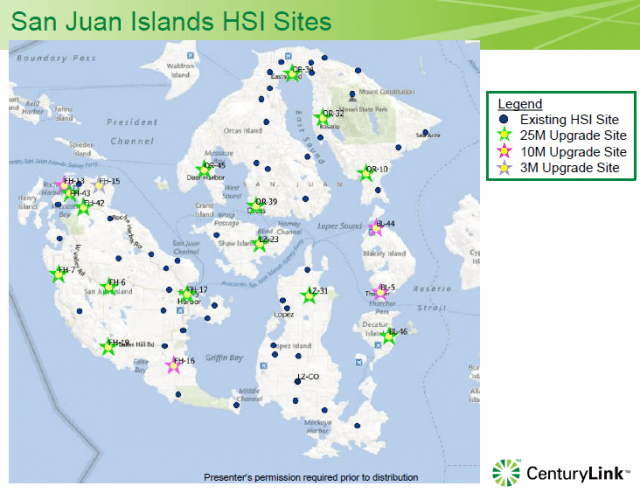
At a hearing held this week by the San Juan County Council, members criticized CenturyLink officials on hand for selling fast service but delivering slow speeds to the group of islands between the mainland of Washington State and Vancouver Island, B.C.

Hughes

Hughes

“Last night I did a speed test at my house and I am paying for 10Mbps but only getting 4.74Mbps,” complained Councilman Rick Hughes (District 4 – Orcas West). “I am paying for 10 and I am only getting 5Mbps, so how is that fair? There has been a ton of frustration over the last two years we have worked on this broadband issue. Everywhere I go and every meeting I talk to all I hear is complaints about CenturyLink. No matter what they are paying for, it’s a poor broadband connection to the end customer.”

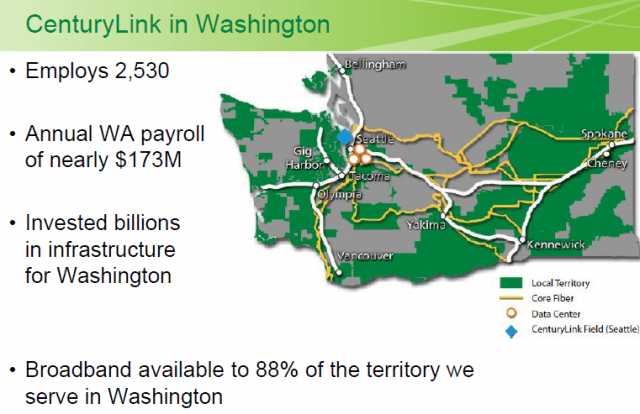
CenturyLink provides broadband to 88% of the territory the company serves in Washington. Like most telephone companies, CenturyLink relies on DSL in much of its footprint and has upgraded central offices, remote equipment, and the telephone lines that connect them. On the San Juan Islands, most customers used to receive 1-3Mbps, but CenturyLink claimed at this week’s hearing it spent billion on infrastructure improvements that can now deliver faster Internet service across the state. In San Juan County, CenturyLink claims:

  • 58% of all qualified addresses were upgraded to 10-25Mbps;
  • 66% now qualify for more than 10Mbps (but less than 25Mbps) versus 46% prior to upgrades;
  • 29% of customers now qualify to sign up for 25Mbps service.

CenturyLink warned the council its speed claims were not to be taken literally, noting DSL “speed is dependent on distance from equipment; speeds drop quickly as distance increases.”

san juan hsi

Hughes told CenturyLink officials residents appreciated the investment, but customers were still disappointed after being promised higher speeds than actually received.

“When people call customer service, there is always an excuse about why there is a problem,” said Hughes. “If people are paying for something, they want to receive it.”

opalco“For our long-term financial interests in this county, we need to have reliable 10-25Mbps service to customers on any part of the islands,” Hughes added. “My goal has always been 90+ percent should be able to get 25Mbps or better connectivity in the county.”
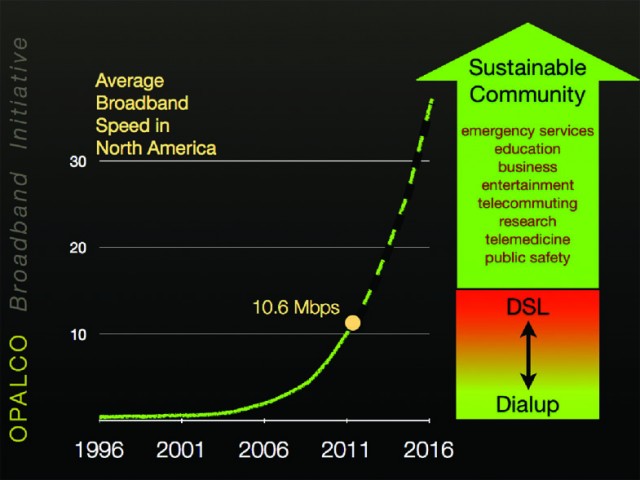
The problem for CenturyLink is the amount of upgrade investment versus the amount of return that investment will generate. San Juan County is disconnected from the mainland and collectively house only 15,769 residents. But it is also the smallest of Washington’s 39 counties in land area, which can make infrastructure projects less costly.

CenturyLink committed to continue investment in its network “where economically feasible.”

San Juan County’s Orcas Power & Light Cooperative (OPALCO), a member-owned, non-profit cooperative electric utility may have a partial solution to the problem of meeting Return on Investment requirements.

BB-growth-chartOPALCO originally proposed a hybrid fiber-wireless system designed to reach 90% of the county with a $34 million investment, to be built over two years. When completed, all county residents would pay a $15 monthly co-op infrastructure fee and a $75 monthly fee for broadband and telephone service. To gauge interest, OPALCO asked residents for a $90 pre-commitment deposit. By the annual meeting in May, the co-op admitted only 900 residents signed up and it needed 5,800 customers to make the project a success.

Some residents balked at the high cost, others did not want wireless broadband technology, and some local environmental activists wanted OPALCO to focus on clean, affordable energy and avoid the competitive broadband business.

The lack of commitment forced the co-op to modify its broadband plans, offering a “New Direction” to residents in June 2013.

OPALCO elected to stay out of the ISP business and instead announced a public-private initiative, providing fiber infrastructure to existing service providers. In effect, the co-op will cover the cost of building fiber extensions where CenturyLink is not willing to invest. For a $3-5 million investment from the co-op, ISPs like CenturyLink will be able to commission OPALCO to build fiber in the right places to make DSL service better. CenturyLink would have non-exclusive rights to the fiber network and would have to pay the co-op a service lease fee.

Unlike ISPs in other communities that have shunned publicly funded fiber infrastructure, CenturyLink says it will contemplate a trial — buying bandwidth from OPALCO instead of enhancing its own fiber middle mile network — to test what level of improved service CenturyLink can offer customers.

Regardless of CenturyLink’s plans, OPALCO is moving forward installing limited fiber connections as part of an effort to develop a more modern electric grid.

logo_broadband“Our data communications network brings exponential benefit to our membership,” OPALCO notes. “It includes tools that allow the co-op to: control peak usage and keep power costs down, remotely manage and control the electrical distribution system, manage and resolve power outages more efficiently, integrate and manage community solar projects and improve public safety throughout the county.”

There are some drawbacks, reports Wally Gudgell from The Gudgell Group.

“It will take longer to implement, and will impact fewer businesses and households,” Gudgell writes. “While about two-thirds of the islands will eventually be covered, more remote areas will have to work with a local ISP and potentially pay more for service.  DSL coverage for homes that are further than 15,000 feet from CenturyLink fiber-served distribution hubs will be challenging. Some homeowners may need to pay for fiber to be run to their homes by Islands Network (fiber direct is costly, estimated at $20/foot).”

WOW! Cable Expands in Ohio, Michigan; Local Officials Appealed for More Competition

Phillip Dampier October 14, 2013 Competition, Consumer News, Public Policy & Gov't, WOW! 1 Comment

Better

Efforts by local officials to attract more cable competition are paying off in suburban Cleveland, Ohio and Detroit, Mich. where customers will soon be able to choose between two cable companies or AT&T for cable service.

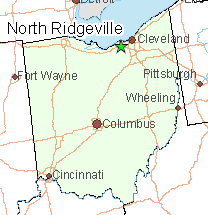
WOW!, a Denver-based cable overbuilder, has announced it will expand service to Lathrup Village, Mich. and Sheffield Lake, Brunswick, and North Ridgeville, Ohio between now and the middle of next year.

North Ridgeville City Council president Kevin Corcoran last week announced WOW! would begin head-to-head competition with Time Warner Cable starting in 2014. Corcoran told The Chronicle Telegram the city began looking for a competing cable provider after hearing complaints from residents about Time Warner Cable’s poor customer service and reliability. He approached WOW!, which has provided competitive service in parts of the greater Cleveland area, about expanding in North Ridgeville.

north ridgeville“My only pitch was that people are dying for some competition,” Corcoran told the newspaper.

Corcoran met informally with WOW! officials to discuss the prospects of expanding into North Ridgeville before more formal meetings were held with city officials including the mayor and the safety-service director.

Making life easier for WOW!’s entry is the presence of existing utility easements, which means WOW! can run cable on existing utility poles without formal approval by the city council. But WOW! will still need certain permits from the Building Department to move forward with wiring. The company will use Ohio’s statewide video franchising law, originally pushed by AT&T for U-verse, to obtain video service permits and a franchise agreement with the Ohio Department of Commerce.

WOW!’s regular prices are much lower than Time Warner Cable’s promotional prices for new customers:

  • Standard triple play (15/1Mbps Internet, Cable TV, phone) costs $105.98/month from Time Warner ($118.97 with DVR), $85/month from WOW! ($92 with DVR);
  • Standard double play (15/1Mbps Internet, Cable TV) still costs $105.98/month from Time Warner ($118.98 with DCR), $75/month from WOW! ($82 with DVR);
  • Internet-only service (15/1Mbps) costs $40.98/month from Time Warner Cable, $30/month from WOW! (promotional pricing expires after 12 months).

Time Warner Cable said it welcomes the competition.

NORTH RIDGEVILLE – Residents who have long griped about poor cable television service can look forward to some competition next year.

City Council President Kevin Corcoran on Friday that

WOW! Cable TV is planning to begin giving Time Warner Cable, the city’s current cable TV provider, some competition starting in 2014.Talks between the city and WOW! Cable began in late summer and continued into September where the company announced it would go ahead with plans to begin offering digital and HDTV cable service to residents next year.

WOW! Cable’s Matthew Harper, who serves as the company’s systems manager for the Cleveland market, confirmed the Denver-based firm’s plans to begin serving a portion of the city by the end of 2014.

“We’re in the process of doing a walk-out, which involves gathering information about the number of (utility) poles and distances between them, and the number of homes we are able to get built out for next year,” Harper said. “Our goal is to build out the entire city over the next few years.”

Because the company will use existing utility easements to run wiring over utility poles, its plans do not require formal approval by City Council, according to both Corcoran and Harper.

Permits for construction of equipment and attaching wiring to power poles will need to be obtained from the city Building Department.

WOW! Cable will obtain required video service and state franchise agreements through the Ohio Department of Commerce, Harper said.

Under the firm’s universal pricing structure, North Ridgeville customers can expect to pay $60 a month for any two services such as cable TV and phone service, or $70 a month for three services including cable TV, phone, and high-speed Internet service, according to Harper.

More specific details and pricing for the company’s numerous packages of services can be found at www.wowway.com, Harper said.

Wow! Cable currently serves about 4,300 customers in AvonLake, and just completed work on a system to serve SheffieldLake, Harper said.

Cost figures for the North Ridgeville project were not disclosed.

Corcoran said he began to investigate prospects for bringing another cable TV provider to town after he and others heard periodic complaints from residents about the cable TV service they had from Time Warner.

“We’d heard that Time Warner doesn’t always have the greatest reputation for customer service and reliability, and that people were going off to Dish and DirecTV,” Corcoran said. “My only pitch was that people are dying for some competition.”

Realizing that “a lot of people like to stick with cable for various reasons,” Corcoran met informally with WOW! officials before more formal meetings were held with city officials including Mayor David Gillock and Safety-Service Director Jeffry Armbruster.

Time Warner spokesman Mike Pedelty said the company has been aware of WOW! Cable’s plans to enter North Ridgeville.

“We are well aware of them coming in and compete with them in other locations,” Pedelty said.

When asked about Corcoran’s comments concerning Time Warner’s poor service, Pedelty said “it’s hard to respond to that comment.”

“We respect all competitors, but are really driven by making sure we provide the type of services our customers expect at a good value,” he said.

– See more at: http://www.chroniclet.com/2013/10/11/new-cable-company-offering-service-in-north-ridgeville-in-2014/#sthash.L6ciWB1H.dpuf

Time Warner Cable: AT&T, Verizon Cannot Meet Broadband Demand With 4G Wireless Technology

Phillip Dampier October 10, 2013 AT&T, Broadband "Shortage", Broadband Speed, Comcast/Xfinity, Consumer News, Data Caps, Public Policy & Gov't, Verizon, Video, Wireless Broadband Comments Off on Time Warner Cable: AT&T, Verizon Cannot Meet Broadband Demand With 4G Wireless Technology

freewifiA new research report issued by Time Warner Cable concludes cell phone companies like AT&T and Verizon Wireless cannot meet the future data demands of customers over their 4G LTE wireless networks without punitive usage caps and high fees to deter usage, even with new spectrum becoming available for the wireless industry’s use.

The report, authored by Michael Calabrese of the New America Foundation, finds an answer to this problem in Wi-Fi, which can offload wireless traffic and deliver wireless service customers already prefer:

There is simply not enough exclusively licensed spectrum to meet the rapidly rising demand for wireless data, to sustain a competitive market, and to keep prices at an affordable level.

Major mobile carriers are increasingly coming to grips with this reality. The Wireless Broadband Alliance, a global industry group, reports that Wi-Fi offloading has become an industry standard as “18 of the world’s top 20 largest telcos by revenue have now publicly committed to investing in deploying their own Wi-Fi Hotspot networks.” The industry is shifting steadily toward what it calls heterogeneous networks (HetNets)—i.e., a combination of licensed and unlicensed infrastructure—in order to meet their customers’ insatiable demand for data while keeping costs down.

Alcatel-Lucent forecasts an increase of “87 times [the current] daily traffic on wireless networks” over the next five years, with 50 percent of that traffic on cellular networks “while the remaining 50 percent will be offloaded to Wi-Fi.”

Cisco’s own studies back Calabrese’s findings on consumer preference towards Wi-Fi.

twc“Given a choice, more than 80 percent of tablet, laptop, and eReader owners would either prefer Wi-Fi to mobile access, or have no preference,” Cisco concluded. “And, just over half of smartphone owners would prefer to use Wi-Fi, or are ambivalent about the two access networks.”



The Cisco surveys found users are choosing Wi-Fi over mobile connectivity for reasons of cost, “because it doesn’t impose data-usage caps or reduce their mobile data plan quotas.” But the primary reason for choosing Wi-Fi “is that respondents find it much faster than mobile networks.” And since Wi-Fi traffic travels over increasingly upgraded wireline networks, that speed differential may only increase as more and more homes, businesses and retail outlets upgrade to fiber optic or other high-speed connections of 100Mbps or more.

America’s largest wireless carriers have fallen far behind offering Wi-Fi services to customers compared to their overseas colleagues:

  • AT&T: More than 32,000 Wi-Fi hotspots are available at partnered retail businesses, restaurants, and high-traffic areas like stadiums and major tourist destinations;
  • Verizon Wireless: Verizon has an insignificant Wi-Fi presence, with a small number of unadvertised hotspots in selected venues like airports and convention centers;
  • Japan’s NTT DOCOMO: Up to 150,000 hotspots, up from only 8,400 in 2o12.
  • China Mobile: More than 2 million hotspots are up and running carrying 70 percent of the company’s data traffic.
  • France’s Free Mobile: More than 4 million residential hotspots are available through Free’s parent – Iliad.
Comcast could soon be the nation's largest Wi-Fi hotspot provider.

Comcast could soon be the nation’s largest Wi-Fi hotspot provider.

Calabrese argues it is important for the United States to set aside significant spectrum for unlicensed wireless networks like Wi-Fi to meet future wireless demands. Currently, some Republican members of Congress are opposed to significant spectrum set asides they feel could best be monetized for private use through the spectrum auction process.

It is no coincidence that Calabrese’s findings would be released by Time Warner Cable which itself is growing a Wi-Fi presence in certain cities where it provides cable service.

The wireless carriers’ collective lack of interest in an aggressive nationwide Wi-Fi deployment may have provided a strategic opening for cable operators to fill that gap with Wi-Fi networks of their own. Cable operators consider them a useful tool to retain customer loyalty — access is typically free and unlimited for current customers.

This summer, Comcast announced a “neighborhood hotspot initiative” that will turn millions of customer cable Internet connections into shared Wi-Fi hotspots using a dual-use wireless home gateway. The equipment will offer two separate Wi-Fi signals — one intended for the customer and the other open for use by any Comcast customers in the neighborhood. The cable company will provision extra bandwidth for the open Wi-Fi network to ease concerns that guest users could theoretically slow down a customer’s own Wi-Fi channel. In a relatively short period, Comcast could become the nation’s biggest Wi-Fi network offering more than 20 million hotspots hosted by the company’s own broadband customers.

Calabrese points to the future of seamless transitions between wired, wireless 4G and Wi-Fi network access without dropping calls or data connections. Many customers won’t even know the difference.

The author recommends the FCC think about reserving space for new unlicensed “citizens band” frequencies dedicated for public and private Wi-Fi networks:

  • The FCC should reorganize the UHF TV band to ensure the availability of at least 30 to 40MHz of unlicensed spectrum in every media market, perhaps including Channel 37 (now reserved for radio astronomy) and eliminating two dedicated channels reserved for wireless microphones;
  • Open the grossly underutilized 3.5–3.7GHz federal band for unlicensed small cell antennas delivering a ‘Citizens Broadband Service.’ This band is now mostly used for offshore naval radar, allowing both services to co-exist without mutual interference;
  • Expand unlicensed access to the 5GHz band by allocating the 5.35–5.47 and 5.85–5.925GHz bands providing contiguous, very wide channels useful for the 802.11ac Wi-Fi standard that can support very high-speed wireless services.

[flv width=”640″ height=”380″]http://www.phillipdampier.com/video/XFINITY Wireless Gateway Powers Connected Home Summer 2013.flv[/flv]

Comcast talks about their new X3 Wireless Gateway which is capable of providing two separate Wi-Fi networks, one for the customer and another for the neighborhood. (2 minutes)

Stolen/Lost Wireless Device? Verizon Wireless Charges California Customer Fees to Suspend/Transfer Service

Phillip Dampier October 10, 2013 Consumer News, Public Policy & Gov't, Verizon, Video, Wireless Broadband Comments Off on Stolen/Lost Wireless Device? Verizon Wireless Charges California Customer Fees to Suspend/Transfer Service

They are coming.

If your smartphone goes missing or gets stolen, should you still have to pay Verizon Wireless for service you no longer have?

Verizon Wireless apparently thinks you do, even if you are beyond your two-year contract and pay month-to-month.

KGO-TV’s consumer reporter discovered Verizon Wireless dings customers coming and going.

Bonnie Mich, a Verizon Wireless customer in Healdsburg, was stunned when Verizon insisted she had to keep paying service charges on a cell phone she no longer owned.

“I said, ‘I don’t have a phone. I’m not under contract. I have no service from you. That is ridiculous,'” Mich told 7 On Your Side reporter Michael Finney. “I was angry. I didn’t think it made sense.”

Although Verizon did agree to suspend the calling plan portion of her bill for the missing phone, it wouldn’t agree to do it for free:

surchargeA charge of $15.35 was applied six days after her phone was stolen. The explanation? Verizon charges a fee when a customer service representative temporarily suspends service on a lost or stolen phone.

The following month, Mich decided to take her business to another wireless company, but Verizon Wireless was ready for that possibility. Verizon Wireless placed a block on number transfers, meaning Fich wasn’t going anywhere until Verizon was paid an extra $17.51 in service charges to remove the phone number transfer block.

Mark Toney, executive director of the Utility Reform Network told KGO Verizon had no justification for charging those fees and called the situation “a total rip off.” Toney advised customers to complain directly to state regulators and demand Verizon Wireless credit the charges and/or refund the customer.

When KGO called Verizon, an apology came quickly:

“We did not meet our own standards and reiterate our apology to our customer,” Verizon said in an e-mail message to the television station, promising a refund.

Mich reports she is still waiting.

[flv width=”640″ height=”380″]http://www.phillipdampier.com/video/KGO San Francisco Do you have to pay the bill if your cellphone gets stolen 10-3-13.mp4[/flv]

KGO in San Francisco reports a stolen or lost Verizon Wireless cell phone can be cost you more than you think. (3 minutes)

Search This Site:

Contributions:

Recent Comments:

Your Account:

Stop the Cap!