Home » Rural Broadband » Recent Articles:

AT&T: Basic Telephone Service In Death Spiral – Deregulate Us For 21st Century Upgrade

Phillip Dampier

In a remarkable statement to the Federal Communications Commission in Washington, AT&T has joined Verizon in predicting the imminent demise of Ma Bell’s classic telephone network.

AT&T writes in its 30 page comment, “That transition is underway already: with each passing day, more and more communications services migrate to broadband and Internet Protocol (IP)-based services, leaving the public switched telephone network (“PSTN”) and plain-old telephone service (“POTS”) as relics of a by-gone era.”

AT&T claims abandoning the old legacy phone network would help the company devote its full resources into staying relevant by constructing a broadband, IP-based network that would deliver voice, data, and video to consumers, presumably over its U-verse platform.  That, according to AT&T, could help the company achieve universal broadband coverage in its service areas, but only if investment-friendly regulations are supported by Washington policymakers.

The Commission has been charged by Congress with formulating a National Broadband Plan that will result in broadband availability for 100% of the United States. That auspicious goal is within reach, but […] will not be met in a timely or efficient manner if providers are forced to continue to invest in and to maintain two networks. Broadband is dramatically changing the way Americans live, work, obtain health care, and interact with the government. Congress and the Commission have rightly made universal broadband access a core national priority. But achieving this goal will take an enormous investment of capital. Private investment from network operators has brought broadband access to over 90% of Americans, and these operators will continue to play a pivotal role in bringing broadband to the remaining 8-10% of citizens who do not currently have broadband access. It is accordingly crucial that the Commission pursue forward-looking regulatory policies that remove disincentives to private investment and encourage operators to extend broadband to unserved areas.

While broadband usage – and the importance of broadband to Americans’ lives – is growing every day, the business model for legacy phone services is in a death spiral. Revenues from POTS are plummeting as customers cut their landlines in favor of the convenience and advanced features of wireless and VoIP services. At the same time, due to the high fixed costs of providing POTS, every customer who abandons this service raises the average cost-per-line to serve the remaining customers. With an outdated product, falling revenues, and rising costs, the POTS business is unsustainable for the long run.

AT&T cites a growing number of Americans cutting their wired phone line service — 22% according to the National Center for Health Statistics.  Craig Moffett from Bernstein Research pegs it closer to 25%, with an additional 700,000 phone lines being disconnected every month.  With a shrinking customer base, the viability of companies providing only wired phone service has come into question.  Verizon and AT&T, the nation’s largest phone companies, have made the judgment it’s a dying business.  Conversely, Frontier Communications and a few other independent phone companies remain believers in rural copper wire phone networks, and are willing to buy the discarded, mostly rural regions their bigger counterparts can’t wait to exit.

But AT&T’s advocacy for an end to “plain old telephone service” is just a tad self-serving when one explores their “To-Do” list for Washington regulatory agencies and lawmakers.  AT&T suggests their future plan benefits all Americans.  Critics would contend it mostly benefits AT&T and its shareholders, especially in light of AT&T’s future revenues being directly impacted by customers disconnecting their AT&T phone lines.  AT&T themselves note collective industry revenue for basic phone service fell from $178.6 billion in 2000 to $130.8 billion in 2007, a 27% decrease.

AT&T’s Action Plan to Avoid Obsolescence Explored
AT&T's U-verse system represents AT&T's broadband-based network
At the heart of AT&T’s proposal for 21st century telephone service is an end to analog telephone service, designed more than 100 years ago to carry voice calls, and the launch of broadband-based service to every home in their service area.  From this new platform, AT&T can deliver telephone, television, and Internet service over a single network.  In fact, they already do in several cities where AT&T’s U-verse has launched. Instead of getting one revenue stream from basic phone service, AT&T can now earn from any number of services a broadband platform can support.

AT&T compares their plan with the transition from analog to digital television, except you won’t have to trade in your existing phones or attach converter boxes to every telephone in the house.  Just like the switch to digital television, AT&T wants a date certain to pull the plug on Ma Bell’s old phone network, the sooner the better.

But AT&T’s plan has plenty of strings attached.

First, the company believes the only path to private investment and a successful transition is a near-complete deregulation of the telephone industry.  It wants the federal government, specifically the FCC, to take control of oversight of phone companies across America, if only to end a patchwork of state regulations and service requirements.  Remember, the Ma Bell most Americans grew up with was a regulated monopoly.  In return for guaranteed profits, phone companies agreed to meet service obligations, provide service to any home or business that wanted it, serve the disabled, and provide discounted phone service to the economically disadvantaged.  Rural customers were assured they would have access to phone service and at reasonable prices, and if something stopped working, government oversight ensured problems would be repaired to the customer’s satisfaction.

In AT&T’s view, such requirements are quaint and outdated, and it wants to bear few of those burdens going forward.  Indeed, in a too-cute-by-half aside, the company argues that since it will design the network to operate under the same protocol the unregulated Internet uses, it should be unregulated as well.

Such deregulation could impact a myriad of policies governing phone service that most Americans take for granted — minimum service standards, requirements that telephone companies complete calls between one another – even if competitors, and reasonably priced basic phone service even in the most remote locations.  But AT&T is asking for even more – a comprehensive review and possible elimination of any regulation that could be interpreted as interfering with the transition to an all-broadband telephone network.  AT&T includes everything but the kitchen sink in this category, ranging from service quality requirements, reporting, recordkeeping, data collection, accounting, and depreciation and amortization rules governing how quickly the company can write off obsolete equipment.

Ma Bell's network is due for a retirement, advocates AT&T

Ironically, AT&T wants deregulation -and- access to public taxpayer dollars to construct their new network.  The company advocates government-funded award programs to promote universal broadband access.  One would provide money for wired broadband service, perfect for companies like AT&T that want to build those networks, and another for wireless mobile projects to expand service into unserved or underserved areas, also perfect for AT&T Mobility — the same wireless carrier slammed by Verizon Wireless for largely ignoring rural America with 3G wireless data upgrades.

While there is some justification for a review of federal and state rules that may no longer realistically apply to today’s telecommunications marketplace, AT&T goes out of its way to be self-serving in its recommendations.  It dangles the bright and shiny object of a 21st century broadband-based telephone network, but only if they get to run it essentially “no questions asked,” with little oversight and an infusion of public taxpayer dollars to compliment private investment.

AT&T may be correct that the days for Ma Bell’s “plain old telephone service” are indeed numbered.  But for a company that earns billions in profits and answers to shareholders demanding maximum return, shouldn’t their long term well-being first be a question between AT&T management and shareholders?  Are they incapable of a private course correction that makes their future relevance more secure?  AT&T’s U-verse did not require public tax dollars to be successful, and the company spent generously on lobbyists and astroturf campaigns to smooth the way forward with “statewide franchising,” bypassing local government oversight.

The real question on the table is how far does the Obama Administration and the FCC want to go to achieve universal broadband?  AT&T suggests that only massive deregulation will entice private investors to step up and make the investments required to help achieve whatever definition of “universal broadband” the Commission comes up with.  But that price is way too high to pay.  AT&T answers first and always to its shareholders.  If they want public tax dollars funding, even in part, their transition to an all-broadband future, they must also answer to the other “stockholders,” namely the American people helping to foot the bill.


Action Alert For Washington State Residents: Tell The Utility Commission Frontier Must Dump 5GB Acceptable Use Limit

Several staff members working for the Washington Utilities and Transportation Commission (WUTC), the regulatory agency reviewing the proposed Frontier purchase of Verizon territories in Washington state, have reversed their opposition to the Frontier-Verizon deal because of concessions they believe will better serve consumers impacted by the deal.  But the provisions don’t come close to protecting consumer rights and do not sufficiently protect local telephone and broadband service.

The WUTC must be told that broadband expansion from a service provider that insists on a 5 gigabyte usage limit in its Acceptable Use Policy makes such expansion barely worth the effort.  The WUTC must insist on a permanent exemption from any usage limits for Washington state consumers, especially because many may find Frontier DSL to be their only broadband option for years to come.  To allow a company with such a paltry limit to be the monopoly provider of broadband puts Washington residents and small businesses at a serious economic disadvantage in the digital economy.

Would you choose to reside or locate your business in a community with one broadband provider offering a limit so low, your broadband usage will be limited to web page browsing and e-mail?

High Speed Internet Access Service

Customers may not resell High Speed Internet Access Service (“Service”) without a legal and written agency agreement with Frontier. Customers may not retransmit the Service or make the Service available to anyone outside the premises (i.e., wi-fi or other methods of networking). Customers may not use the Service to host any type of commercial server. Customers must comply with all Frontier network, bandwidth, data storage and usage limitations. Frontier may suspend, terminate or apply additional charges to the Service if such usage exceeds a reasonable amount of usage. A reasonable amount of usage is defined as 5GB combined upload and download consumption during the course of a 30-day billing period. The Company has made no decision about potential charges for monthly usage in excess of 5GB.

Frontier will be a part of the lives of almost 500,000 state residents, including those in Wenatchee and other parts of North Central Washington.  That covers a lot of rural residents with no hope of cable competition or other broadband options.  Verizon is the second-largest local telephone service provider in Washington, serving cities such as Redmond, Kirkland, Everett, Bothell, Woodinville, Kennewick, Pullman, Chelan, Richland, Naches, Westport, Lynden, Anacortes, Mount Vernon, Newport, Oakesdale, Republic and Camas-Washougal.  Currently, Verizon has approximately 1,300 employees in Washington, who would be transferred to Frontier once the deal is complete.

Frontier’s concessions don’t come close to assuring residents they can get the kind of broadband service they need in the 21st century, especially from a company that could easily find itself swamped in debt.  Let’s look at what Frontier has offered:

  • Invest $40 million to expand high-speed Internet access in Washington.
  • Submit quarterly financial reports to identify merger savings.
  • Branding and transition costs to be paid by stockholders, not ratepayers.
  • Increase financial incentives to prevent a decline in service quality.
  • Adopt Verizon’s existing rates and contracts for at least three years.

Frontier would also be required to pay residential customers $35 for missed service repairs or installation appointments. That’s $10 more than Verizon now pays. Current Verizon customers would also have 90 days after the transition to choose another provider without incurring a $5 switching fee. Low-income customers who qualify through the Washington Telephone Assistance Program will also receive a one-time $75 credit if the company fails to offer appropriate discounts or deposit waivers.

Our take:

  • Investing $40 million in low speed DSL service with a 5GB usage allowance saddles residents with yesterday’s technology with a usage allowance that rations the Internet.
  • Customers don’t care about merger cost reductions because they’ll never enjoy those savings, but they’ll feel their impact if they include layoffs and reduction in investment.
  • Consumers will be more concerned about what happens to their phone and broadband service when the “transition” results in service and billing problems.  Will stockholders pay inconvenienced customers?
  • Vague promises of increased financial incentives for a company to do… its job, without declines in service quality, exposes just how unnecessary this deal is.  Why not offer incentives for Verizon to stay?
  • Freezing rates for three years doesn’t prevent massive increases to make up the difference in year four and beyond.

The WUTC staff had it right the first time when it opposed the deal.  A healthy, financially secure Verizon is still a better deal than a smaller independent company saddled with debt.  Frontier seals the fate of Washington state residents from the benefits of fiber optics wired to the home, delivering high speed broadband for the future because Frontier doesn’t do fiber to the home on its own.  With a tiny usage allowance, just waiting for the company to decide to enforce it means you won’t be using your broadband account too much anyway.

The WUTC is accepting comments and you need to start calling and writing.  Make sure to tell the Commission it must secure a permanent exemption for Washington from any Internet Overcharging schemes like consumption/usage-based Internet billing and any usage limits Frontier defines in its Acceptable Use Policy.  Better yet, tell them Frontier’s concessions don’t come close to making you feel good about Verizon turning over your phone service to a company that is traveling the same road three other companies took all the way to bankruptcy.

Customers who would like to comment on the provisions can call toll-free: (888) 333-9882 or send e-mail to [email protected]. The deadline for comments is January 10th.

CenturyLink Opposing Broadband Stimulus Applications That Might Overlap Its Person County, NC Limited Service Area

Person County, North Carolina

For north-central North Carolina, it’s often not a matter of how many choices you have for broadband service — it’s whether you can obtain any service at all.

Person County, located just south of the Virginia border, is a good example.  The county’s 36,000 residents technically reside in North Carolina’s Research Triangle, a high-tech growth area.  You wouldn’t know it from the broadband options available in many parts of the county, however.

The dominant phone company, CenturyLink (formerly EMBARQ), offers DSL service in the larger communities in Person County, but wide areas remain without any service at all.

Randy King

A Roxboro-based computer store and Internet Service Provider decided that with CenturyLink unwilling to expand into low population density areas to supply service, they would, with the help of broadband stimulus funding available from the Obama Administration.

Randy King, president of Electronic Solutions, Inc. (ESI), planned to expand broadband into 26 previously unserved Person County areas, and filed a stimulus application requesting $3 million in funding to begin construction.

King believes wireless broadband is the most cost-effective way to reach parts of the 400 square mile county that are simply too rural to upgrade wired service.  Today, that’s nearly 40 percent of the county that still does not have access to broadband service. The Person County High Speed Internet Committee and the County Commissioners endorsed ESI’s proposal.

But CenturyLink would have none of it, despite the fact it was not willing to provide service to those unserved areas either.  The phone company filed an objection with the agency administering the stimulus program claiming ESI would be overbuilding a competing broadband provider in its service area:

CenturyLink can certify that its affiliates currently offer broadband service in some or all of the applicant’s proposed service areas. We attach a representative sample of areas where the application overlaps our existing broadband deployment. This data is not exhaustive; the application may include other areas also currently served with broadband by CenturyLink or other providers. We will provide additional information on request if that will further assist the agency’s review.

CenturyLink also provides data showing broadband availability in local telephone exchanges within the proposed service areas. This includes areas served by CenturyLink and/or other broadband providers. This data further shows the applicant would duplicate and overlap existing broadband services in the proposed service areas.

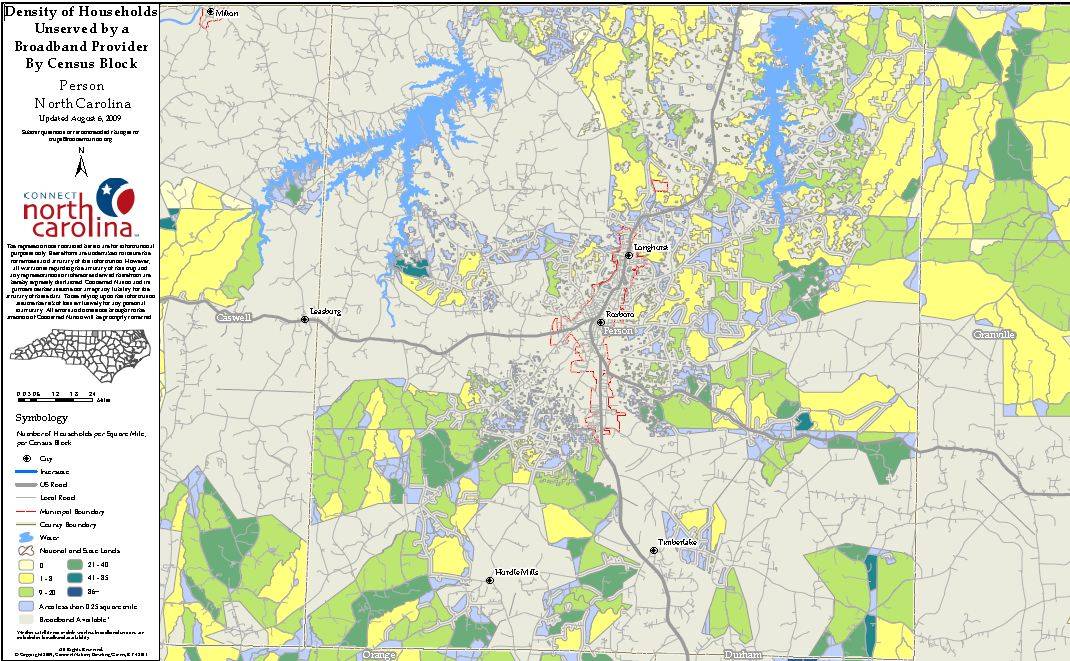
Connected North Carolina's map shows large areas in grey that suggest broadband service is already available. (click to enlarge)

Because the government will judge the merit of applications based, in part, on reaching the unserved, map data purporting to illustrate who does and who does not have access to broadband service is critically important to applicants.  Some providers have used map data produced by a politically well-connected group filled with telecom industry executives that has spent millions of taxpayer dollars and produced maps that are less than illustrative of the true nature of broadband service.  When a map from Connected Nation’s North Carolina chapter can show citizens have access to broadband, even when they do not, what’s a regulator to do but consider that stimulus grant application unnecessary.

Randy King, President of ESI, has responded to the CenturyLink opposition:

“We are extremely disappointed that CenturyLink has opposed the Person County project. The project would provide high speed Internet (broadband) in areas that currently do not have service in our county. CenturyLink as recently as April 2009 met with county officials and members of the public and stated that they did not intend to expand DSL in low density areas which do not make economical sense.  We are now aware that CenturyLink is not only not going to serve these areas but is attempting to block anyone else from serving these areas.”

ESI claims its wireless system could deliver more capacity to Person County’s rural unserved than CenturyLink provides its more urban counterparts.

“It should be noted that the wireless system will have at minimum 50-100Mbps capability at each tower site which far exceeds current DSL speed of 1-10Mbps. This allows customers to have sufficient bandwidth to have services such as VOIP, IPTV and streaming capabilities whereas DSL is not capable,” King writes.

King is also concerned that CenturyLink won’t provide true detailed maps of exactly what service it provides in what areas.

Person County and area residents have been requesting street level coverage maps from CenturyLink and Charter (the city’s cable company) for years without success. King wants the ability to review these maps, preferably in color with speed capabilities identified down to the 911 address location.  That way, he says, he can work on building capacity to areas not getting service at all.

Providers have traditionally been loathe to disclose this information to the public, and even government regulators, claiming it represents proprietary, competitive information.  That leaves everyone but providers guessing about what broadband service really looks like across America.

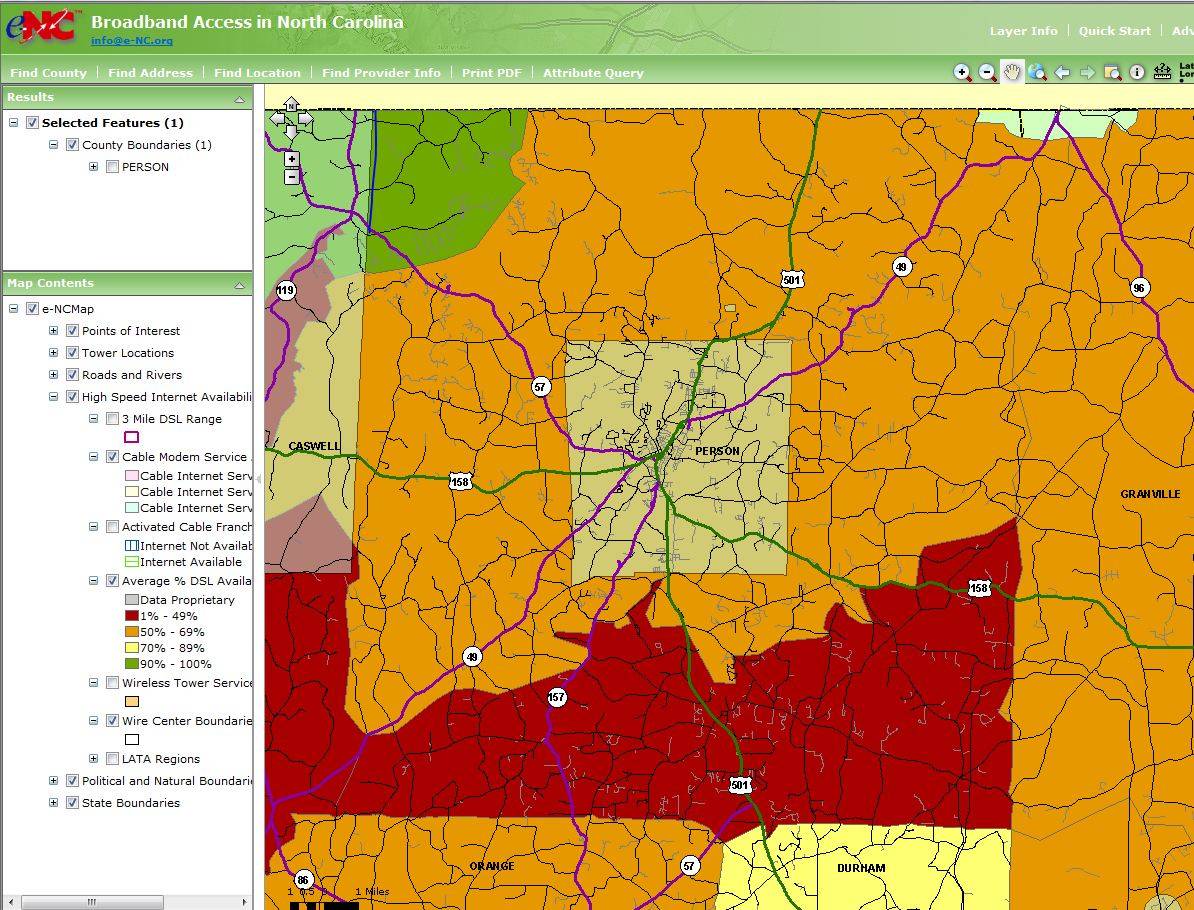
The more credible e-NC mapping project shows large swaths of southern Person County without any broadband options at all. (click to enlarge)

Kevin McCarter, CenturyLink’s general manager for central North Carolina seems primarily concerned with potential government funding of his competition.  McCarter told The Courier-Times CenturyLink “interpreted that” the towers King proposed to place in order to provide wireless service “would cover 95 percent” of the entire county. King explained that his intent was not to cover the whole county with wireless access, but to place towers so that those living in areas of the county not currently served by DSL lines would have the option of wireless broadband. He said he never intended his service to replace the DSL lines CenturyLink has in place.

That ESI doesn’t seem intent on competing directly with CenturyLink may have resulted in a breakthrough this month.  The two companies met December 15th to discuss their respective broadband plans for Person County, and may have come to an agreement that could divide up the unserved and get them broadband service from one company or the other, but likely not both.

Jamie Averett Mitchell, spokesperson for CenturyLink, issued the following statement Monday:  “On Tuesday, Dec, 15, representatives from CenturyLink met with Randy King, president of Electronic Solutions, Inc., to review broadband coverage for Person County. Maps detailing both existing and planned coverage areas were presented and reviewed by both parties. Areas that were not covered on either company’s maps were discussed and both companies are aware of those sites. CenturyLink and ESI are working together to determine the most efficient way to provide 100 percent of the population in Person County with the best broadband coverage possible.”

So it seems that broadband applications that do not challenge incumbent providers are acceptable, but those that could expand the quality of service to those living with rural, slow speed DSL service are not.

Windstream’s Acquisition of Iowa Telecom Continues Telephone Company Consolidation, Worries Employees

Phillip Dampier December 18, 2009 Broadband Speed, Rural Broadband, Video, Windstream 3 Comments

iowatelecomWindstream Corporation has agreed to acquire Newton, Iowa-based Iowa Telecom for $530 million in stock and cash, making it the fourth acquisition for the rural-focused Windstream in 2009.  It will also take on $600 million of Iowa Telecom’s debt as part of the transaction, which caused Standard & Poors to reduce Windstream’s credit rating to junk status – BB.

Like Frontier Communications, Windstream is engaged in aggressive expansion to stake out its position serving rural America.  The company has spent $1.3 billion on acquisitions in just the last six months, trying to keep up with other large independent providers like Frontier and CenturyLink.

“Our whole investment thesis was to grow scale in rural America,” Windstream Chief Executive Jeff Gardner told the Wall Street Journal. “I still think there’s a great deal of consolidation left with smaller players, where the pressure is the most obvious.”

Windstream, based in Little Rock, Arkansas, serves customers in 16 states, mostly in the midwest and south.  Iowa Telecom serves former GTE service areas in Iowa and Minnesota.

For employees in Newton, east of Des Moines, the purchase brings fear of significant job reductions.  Iowa Telecom has 800 employees, and comments by Windstream’s Gardner suggest downsizing is forthcoming.  Windstream expects $35 million in cost savings annually, and some of that will be achieved by dispensing with unneeded Iowa Telecom workers post-merger.  Windstream has only promised to maintain a call center in Iowa.

[flv width=”512″ height=”308″]http://www.phillipdampier.com/video/WHO Des Moines Iowa Telecom Bought 11-25-09.flv[/flv]

WHO-TV Des Moines reported Windstream’s buyout of Iowa Telecom was like “lightning striking twice” for Newton residents, leaving an economically-challenged community in fear. (11/25/09 – 2 minutes)

windstreamlogoIowa Telecom provides customers with a familiar bundle of services common among independent phone companies.  As well as providing traditional wired phone lines, Iowa Telecom markets Xstream DSL at speeds up to 15Mbps in some areas, and resells DISH Network satellite service for customers looking for a video option.

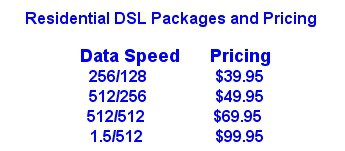
Lexcom's DSL price chart shows budget-busting prices for relatively slow DSL service

Lexcom's DSL price chart shows budget-busting prices for relatively slow DSL service

Windstream provides DSL service up to 12Mbps in some areas.

Before Iowa Telecom, Windstream’s earlier acquisitions included:

  • D&E Communications of Pennsylvania — Windstream fetched the independent provider in a stock and cash transaction that added about 150,000 additional telephone lines to Windstream’s portfolio in Pennsylvania.
  • Lexcom — Windstream picked up this Davidson County, North Carolina independent for $141 million.  Lexcom needs serious technology upgrades to improve service.
  • NuVox — A Greenville, South Carolina-based business services provider.

Windstream has hinted they’re not done with acquisitions yet, fueling some speculation their next targets may be Consolidated Communications, which provides service in Illinois, Pennsylvania, and Texas or Alaska Communications Systems, another business service provider.

[flv width=”640″ height=”380″]http://www.phillipdampier.com/video/KCCI Des Moines Will $1.1B Iowa Telecom Sale Mean Job Losses 11-24-09.flv[/flv]

KCCI-TV Des Moines reported residents of Newton were “shocked” and “disturbed” about the Iowa Telecom buyout, because of potentially staggering layoffs to come after Windstream closes the deal.  (11/24/09 – 2 minutes)

Not everyone is singing the blues about Windstream’s buyout of Iowa Telecom.  Despite the transaction’s impact on Windstream’s credit rating, Wall Street has supported Windstream with a strong stock price, owing to the company’s relentless desire to deliver dividends to stockholders.

[flv]http://www.phillipdampier.com/video/CNBC Cramer on Windstream 12-7-09 1025.flv[/flv]

CNBC’s Jim Cramer loves the “massive dividends” Windstream provides to stockholders.  But Cramer also issues some caveats, reminding viewers of FairPoint Communications, another former high-dividend stock… until it went bankrupt.  Cramer interviews Windstream CEO Jeff Gardner about the company and the future of independent phone companies in general.  (12/7/09 – 10 minutes)

[flv]http://www.phillipdampier.com/video/CNBC Windstream Profile NASDAQ 12-10-2009 222.flv[/flv]

CNBC reports on Windstream’s move to the NASDAQ and interviews CEO Jeff Gardner about the future for the telecom industry in general.  (12/10/09 – 2 minutes)

Frontier: What Fiber? Company Officials Claim Frontier Serves “Some Customers” With Fiber Service

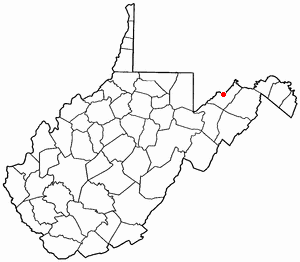
Keyser, West Virginia

Keyser, West Virginia

Frontier Communications’ West Virginia roadshow continued this week as company officials continue to sell the company’s plan to take over telephone service from Verizon across much of the state.  But have they stretched the truth to sell state officials on the deal?

Paul Espinosa, general manager of Frontier, told a West Virginia newspaper the company “prides ourselves in taking good care of our customers,” claiming 95 percent of their current residential customers have broadband Internet.

“In some areas it’s DSL. In other markets we do offer fiber,” he told the Mineral Daily News-Tribune in Keyser.

Keyser, a community of just over 5,000, considers broadband high on its list of concerns.  They want it, but they also want to know it is the kind of broadband that will keep Mineral County competitive, particularly for small businesses that depend on it to reach customers.  The county created a Communications Infrastructure Council (CIC) to review broadband communications options considered vital to the community’s economic development.

Rick Welch, who serves on the CIC,  said the economic future of Mineral County depends upon high speed or fiber-optic Internet and not DSL, or Internet service which utilizes existing telephone lines.

Verizon West Virginia has bypassed the state for FiOS development, which provides a fiber-optic connection to the home, claiming the infrastructure costs are too high at today’s prices to satisfy Return On Investment requirements.  Frontier has never had an ambitious broadband agenda centered on fiber optics.

Frontier traditionally offers 1-3Mbps DSL service in most of the smaller communities they serve.  Frontier’s claim that they are currently providing customers in “other markets” with fiber broadband brings these questions:

  • Exactly where?
  • Under what terms?
  • Is this true fiber-to-the-home service, or simply fiber connected central offices?
  • Are advanced levels of service are provided to these fiber customers, or are the plans, terms, and speeds identical to traditional DSL plans?

If the deal goes through, Frontier would assume ownership of pre-existing Verizon FiOS deployments, but those were proposed and planned by Verizon, not Frontier.

“DSL will not bring anything to Mineral County as far as economic development is concerned,” he said, noting that high technology businesses require far faster speeds than DSL traditionally provides.

A Verizon representative tasked with trying to sell the deal that gets the company out of the West Virginia’s phone business said that something is better than nothing.

“To hear you say that DSL is not the future is troubling,” Verizon’s John Golden said. “If you are without broadband, DSL would be the future.”

The Mineral County Commission was unimpressed with Golden’s statement.  Commission president Wayne Spiggle told the News-Tribune a lot of businesses and those who work from home would not consider coming to Mineral County when they discovered only low speed DSL service available, commonplace more than a decade ago in other areas. Spiggle said real broadband service was essential to attract the kind of businesses Mineral County needs to succeed.

“Our mission and responsibility to Mineral County is to create an entrepreneurial garden, and high-speed broadband is essential to that,” he said.

The Communications Workers of America are also been fighting to warn state and local officials about the gamble West Virginia will take with Frontier Communications.  Considering the last three deals resulted in bankruptcy for all three, it’s a risk the CWA doesn’t think is worth taking.

“Frontier will wind up taking on at least $3.4 billion in debt from Verizon,” said John Johnston, speaking on behalf of the CWA. “Frontier has said they’ll expand broadband, but will they? With $3.4 billion in debt, that’s a lot of money,” he said.

Chuck Fouts, who serves as local CWA president said bankruptcy brings job losses.  “If you go bankrupt, the first thing that goes is people,” he said.

The union says the state should join their efforts to force Verizon to “do what they said they were going to do” and provide a plan to upgrade the state’s telecommunications system to fiber optics.

As it stands, Verizon sees higher returns from cherry-picking more urban areas for its FiOS service, and isn’t willing to provide the kind of universal service throughout its service areas that phone companies have traditionally provided for decades.

“How can Frontier provide the fiber they claim to offer in “other markets” when Verizon’s deeper pockets have thus far been turned out empty for residents in West Virginia?” asks Stop the Cap! reader Hyatt.

Investment firm D.A. Davidson downgraded Frontier’s stock last week, reporting they felt the deal would be bad for Frontier shareholders.

Moving the stock rating back to “underperform,” the firm was skeptical Frontier would be able to pull off the cost-savings it promised as part of the deal.  They also anticipated Frontier will have to finance as much as $3.3 billion of the debt (at 8-9%) it will take on as part of the transaction.  Perhaps more revealing is their prediction that Verizon shareholders who receive distributed shares of Frontier stock will likely dump them as fast as possible, remembering earlier Verizon deals that quickly led to falling stock prices and eventual bankruptcy.  D.A. Davidson warned potential Frontier investors to “at least move to the sidelines” during the anticipated grand sell-off, moving back into the stock only when it bottoms-out.

Search This Site:

Contributions:

Recent Comments:

Your Account:

Stop the Cap!