Home » Issues » Recent Articles:

Harper Gov’t Issues Statement on Usage-Based Billing Cable Company Misrepresents As Approval

Clement

On Monday, the Federal Minister of Industry Tony Clement issued a statement about Internet Overcharging that was so non-committal, media companies are interpreting his comments as “for” and “against” usage-based billing.

Tony Clement’s full statement:

“On Tuesday, January 25, 2011, the CRTC announced its decision to allow wholesale and retail internet service providers to charge customers for exceeding the monthly usage of data transfer permitted with their broadband Internet package. This will mean, for the first time, that many smaller and regional internet service providers will be required to move to a system of usage-based billing for their customers.

I am aware that an appeal has been initiated by a market participant. As Canada’s Industry Minister, it is my job to help encourage an innovative and competitive marketplace, and to ensure Canadian consumers have real choices in the services they purchase. I can assure that, as with any ruling, this decision will be studied carefully to ensure that competition, innovation and consumers were all fairly considered.

The Harper Government is committed to encouraging choice and competition in wireless and internet markets. Increased choice results in more competition, which means lower prices and better quality services for Canadians. We have always been clear on our policies in this regard and will continue on this path.

Our Conservative Government is focused on the economy and creating a positive environment for job creators and business to flourish. Canadians can count on us to do what is in the best interest of consumers.”

AgenceQMI and Videotron are both owned by Quebecor Media

CBC Radio made mention of Clement’s comments and indicated the minister had expressed concerns about the billing scheme, but readers of wire service reports from AgenceQMI are getting an entirely different view — Clement’s approval of the new pricing scheme.

In a French language story headlined, “Minister Clement justifies the end of unlimited Internet packages,” the news agency got just a little creative in interpreting Clement’s statement (roughly translated from the French original):

He also argues that billing based on actual usage would more efficiently manage Internet traffic and bandwidth and provide a better experience for light users, currently impacted by massive data exchanges among the Internet’s heaviest users.

Minister Clement, who supports this decision, said in a statement that it is his duty to encourage a more competitive market.

It’s hardly a coincidence that AgenceQMI‘s creative spin of Clement’s statement just happens to match the position of Videotron, Quebec’s largest cable company.  They are both owned by Quebecor Media.  Videotron engages in Internet Overcharging that left one Montreal student with an $1,800 broadband bill.


Wi-Fi Ripoff? NYC Parks Hand Over Wireless Space to Time Warner and Cablevision

NY City Council members are reviewing an application by Time Warner Cable and Cablevision to offer Wi-Fi services in 32 New York-area parks… for a fee that could bring the companies as much as $10 million dollars a year in new revenue.

The controversial proposal would frustrate efforts by the nonprofit group NYCWireless to find free Wi-Fi providers to deliver service in New York’s public parks.

In September, the city of New York renewed franchises for both Cablevision and Time Warner Cable that included a commitment to spend $10 million to install Wi-Fi service in area parks.  But nobody said the companies had to provide the service for free.

Instead, users will only get free samples — up to three ten-minute sessions per month.  Additional time on the network will cost 99 cents per day.  Cable customers will get unlimited access for free.

Dana Spiegel, executive director of the nonprofit NYCWireless, says handing over the wireless space in public parks to private fee-based providers is “absolutely unconscionable.”

City council members don’t have a final say over the deal — a state commission does — but intends to investigate the deal and its fairness to New York residents.

Verizon FiOS has a growing presence in New York City, and those customers would be locked out of free Wi-Fi access on the proposed park network.

NYCWireless offered the council several reasons why relying on cable companies to deliver public park Wi-Fi was not a great deal:

First, the plan does not establish any form of “Free Public Wi-Fi”, an amenity of New York City parks since NYCwireless began our work, and one replicated by the Parks Department and many other organizations around the City. Free Public Wi-Fi Hotspots were a very significant recommendation of the Diamond Consulting “Broadband Needs Assessment Study,” and the “Free” part of these public hotspots are exactly the part of these amenities that make them so valuable and essential for local residents.

Make no mistake: DoITT’s plan establishes a $1 per day fee for internet service in parks. There may be a few free 10-minute blocks per month, and there may be ways to hide the $1 per day charge in a resident’s cable service internet bill, but with DoITT’s plan, NYC won’t have Free Wi-Fi. We’ll have $1 per day Wi-Fi, delivered to public spaces that are maintained by our tax dollars, paid to a couple of huge private corporations.

In fact, Cablevision and Time Warner Cable stand to make tens of millions of dollars per year providing this service. Central Park gets about 25m visitors per year, and if we ignore all other parks, and figure that fewer than half of those visitors buy one day of internet service per year, Time Warner Cable and Cablevision get paid $0.99 x 10 million visitors = $10,000,000.

Second, the industry standard for gaining access to such types of subscription service as are contemplated by DoITT and the cable companies requires that a prospective user of a fee-based Parks Hotspot will need to create an account and enter their billing information. This requires the submission of identity, address, and credit card information into a web form prior to gaining access to the hotspot. Essentially, by promoting this solution, DoITT is pushing NYC citizens and visitors to hand over deeply personal and secure information to a private organization over which neither the user nor DoITT has any control.

Contrast this to the way that NYCwireless offers free Wi-Fi to citizens: we do require registration of a user account so that we can track agreement to our Acceptable Usage Policy. However we require only a valid email address. No billing address, no credit card, no other identity information.

Personally, I am fearful of handing over such information to such private organizations, though I have in the past. But I am more fearful for the harm that will be done to those that depend more significantly upon Park Hotspots. How many city residents don’t have a credit card? How many children in playgrounds who couldn’t get a credit card even if they wanted to? Adults? How many city residents live in neighborhoods that are otherwise safe, but in which they would prefer not pulling out their wallet and a credit card just to get what should be Free Internet Access? How many city residents depend upon Free Wi-Fi because they live below the poverty line, and because they can’t afford or don’t want cable internet, cannot afford the $5 it would cost them to get internet access in a city park during the week?

Lastly, because of DoITT’s “whole package solution”, most NYC residents and visitors won’t see any Wi-Fi, for free or for fee, for years, since local organizations that would otherwise have sponsored the creation of a Free Public Wi-Fi Hotspot say “oh, well, the city is going to do this someday, so we won’t bother doing this now for our community.” If past experience is any predictor of future performance, it will be years before the first Paid Wi-Fi Hotspot is opened, and many more before many others are opened, if at all. Meanwhile, DoITT’s actions will have stopped in its tracks any plans for more hotspots that local organizations may be contemplating.

[flv width=”640″ height=”500″]http://www.phillipdampier.com/video/NY 1 Time Warner Cable Offers Free WiFi Hotspots For City Customers 3-26-10.flv[/flv]

NY1 reported on Time Warner Cable’s expanded Wi-Fi hotspots in New York in this story from last March.  (1 minute)

Patent Trolls Want a Piece of Your Rising Cable Bill

Gertraude Hofstätter-Weiß February 1, 2011 Public Policy & Gov't Comments Off on Patent Trolls Want a Piece of Your Rising Cable Bill

A company claiming to own a broad patent covering ‘storage and retrieval playback systems’ has sued six large cable companies claiming they are infringing its patents.

Comcast, Time Warner Cable, Cox Communications, Bright House Networks, Charter Communications, and Cablevision have all been accused of violating patents that could cover their respective video-on-demand systems.

Pragmatus, whose website is “under construction,” acquired the patents from Intellectual Patents, which has extracted more than a billion dollars in licensing fees on broad-based general patents.  Law.com calls both firms “patent trolls,” because they exist largely to collect money from deep pocketed technology companies.

The lawsuit covers patents 5,581,479 and 5,636,139 which describe technology that uses “information service control points” that send blocks of data to remote stations.  That could cover just about any server.

As proof of infringement, the legal filing simply includes the URL’s of websites that promote video-on-demand services.

Many lawsuits eventually settle out of court quietly, with licensing deals that extract a portion of each subscriber’s monthly payment and send it on to companies like Pragmatus.

Harry Cole, who has dealt with these nuisance suits before, says they are a product of a broken patent system.

“[A patent trolls does] not produce anything. It does not sell anything bought or processed, nor does it buy anything sold or processed, nor does it process anything sold, bought or processed, nor does it repair anything sold, bought or processed … All the company does is speculate on patents, which it purchases on the secondary market in the hope that one such patent will hit it big.”

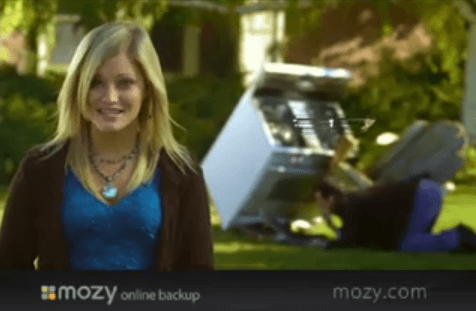
Mozy Drops a Stove on Unlimited Backups: New Capped Backup Plans Arrive

Phillip Dampier February 1, 2011 Consumer News 2 Comments

Mozy has announced the days of its unlimited backup service are limited.  What the online backup provider used to sell “for the price of a hamburger” ($4.95 a month) is about to match Angus Beef prices.

Why the price increase?  Because people actually used the service to backup their hard drives.

“There has been a change in consumer behavior,” Russ Stockdale, Mozy’s vice president of product management, told CNET News. “What we have seen since we launched an unlimited service five years ago is there has been an explosion in digital content, specifically digital photos and video.”

The new plans, to be unveiled today:

  • Mozy Basic: $5.99/mo for up to 50GB of data.  Each additional 20GB increment will cost $2 more per month;
  • Mozy Multi-Machine: $9.99/mo for up to 125GB of data from up to three computers.  Each additional 20GB increment is also $2 more per month.

Earlier days.

CNET columnist Stephen Shankland is taking personal responsibility for the company’s price increase, noting he is among the service’s top 0.3 percent of users, backing up nearly 600GB of his digital media files — exactly the kind of customer Mozy wants to charge more.  His multi-year discount means the $3.40 a month he used to pay will now rise to $60.

Mozy’s competition:

  • Google Docs costs $1,400 a year for 400GB;
  • Google’s Picasa Web Albums costs $100 per year for 400GB.
  • Jungle Disk, which provides a front end to storage using Amazon’s S3 service, charges a flat rate of $3 per month plus 15 cents per gigabyte per month.
  • Carbonite, perhaps Mozy’s best-known competitor, throttles down bandwidth for big-data users.
  • Dropbox charges $20 per month for 100GB.

Update #2: An Even Better Deal from Time Warner Cable: $80 Triple Play

Phillip Dampier February 1, 2011 Competition, Consumer News, Editorial & Site News 19 Comments

Haggling for a better deal from your telecommunications provider is beginning to resemble buying a car.

Less than a day after writing up our experiences with the Customer Retention Department of Time Warner Cable, there have been new developments.

Because our account was configured for a disconnect, a Time Warner retention specialist called us, this time from Albany, N.Y.  His role — to win us back as a Time Warner customer.  His office formerly called customers who turned in their equipment and canceled service, but now that the company is losing more cable-TV customers than it adds, they are now trying to stop disconnects at all costs.

Incredibly, this high-level office was authorized to provide deals even Time Warner’s regional office could not touch.

The best deal we could negotiate with the Buffalo office included the company’s triple play package, Road Runner Turbo, one DVR box and one digital set top box for $132 a month.

That was until we received a call this morning with an offer that blew that out of the water — $79.95 a month for the company’s triple-play package including a year of free DVR service. Putting the two packages together to compare pricing, Albany’s Time Warner office was willing offer that same package for $106.90, plus tax.

That’s a difference of $25 a month.

That’s quite a difference.

But then, on cue, Time Warner proved our earlier point about confusing and conflicting information being thrown at customers.

Minutes after agreeing to that offer, which would have cut some additional red tape from the earlier deal, we were called back and told the deal fell apart, at least temporarily.

It seems customers who agree to an earlier offer end up locking themselves out from something even better.  Because we worked with another retention specialist who partially entered an order into the system, and despite the fact the company called us with something better, they reneged on the better offer.

“I can’t even begin the order,” we were told.  “As long as a pending order is in place, there is nothing we can do.”

We found it odd the company would call us with an offer we couldn’t get.  We were then told that office is authorized to make offers to customers who:

  • downgrade to one service;
  • have a pending disconnect order;
  • actually disconnect service.

We asked if we pulled out of our earlier retention deal, would we then be qualified to proceed with his?  He repeated the three conditions and said he’d love to offer us something but until one of those conditions were in place, he could not.

Hint. Hint.

It’s remarkable Time Warner would offer customers one deal they insist was the best available price, only to have another employee cut $25 off the top without breaking a sweat.  It’s quickly reminding me of my last car buying experience — always a major headache.  So many tricks, traps, and games.

We’ll be bringing this whole matter up with the company shortly.

In the meantime, we’re going to modify our advice to customers searching for a better deal.  Call and schedule a disconnect or downgrade of your service two weeks out, tell the agent you are not prepared to discuss a retention deal, and then wait for them to call you a few days later.  Ours originated from the Time Warner Sales Center at 1-877-726-0712, for those who check caller ID.

Ask about the triple play $79 offer that includes a year of free DVR service.

Oh, and about the free “DVR service.”  We learned Time Warner no longer considers the “service” the same as the “box.”  This word salad means customers pay about $8 and change for the DVR hardware, but get the “service” that let’s you record shows on the equipment for free — a $3 value.

We told you it was confusing.

[Updated: 1:02pm ET — We just spoke with Time Warner Cable, who apologized for the confusion over pricing and the follow-up retention call we received.  Time Warner Cable will honor any offers made by any of their agents, so with the assistance of a supervisor, we were able to take advantage of this offer after all.  They even threw in free Turbo service for a year, free Showtime, and gave us a “whole house DVR” at a special rate, bringing the total out of the door price to around $116 a month, including all equipment.  When Road Runner Extreme (30/5Mbps) service arrives, that will run an additional $10 per month.  The entire ordeal netted us almost $60 a month in savings, more if we didn’t upgrade to the “whole house DVR.”]

Search This Site:

Contributions:

Recent Comments:

Your Account:

Stop the Cap!