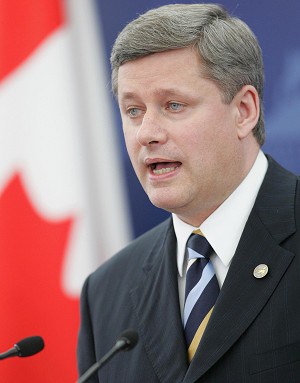
Prime Minister Harper's government is facing an open revolt by Canadian consumers over Internet Overcharging.
A full-scale revolt among consumers across Canada has brought the issue of Internet Overcharging to the highest levels of government.
A spokesman for Prime Minister Stephen Harper said the government is very concerned about a decision from the Canadian Radio-television and Telecommunications Commission that has effectively forced the end of unlimited use broadband plans across the country.
Both the Liberal and NDP parties have made a point of protesting the CRTC decision, which happened under the Conservative Party’s watch. Harper’s Industry Minister Tony Clement stepped up his remarks this morning which hint the government is prepared to quash last week’s decision by the CRTC, which has already forced price increases for broadband service across the country.
“The decision on its face has some pretty severe impacts,” Clement told reporters in Ottawa after NDP and Liberal critics in the House of Commons repeatedly pounded the government on the issue of so-called “usage-based billing.”
“I indicated the impacts on consumers, on small business operators, on creators, on innovators. So that’s why I have to work through a process, cross my T’s, doc my I’s. When you’re dealing with a legal process, that’s what you have to do. But I will be doing that very, very quickly, and getting back to the prime minister and my colleagues very, very quickly,” said Clement.
As of this morning, more than 286,000 Canadians have signed a petition protesting the Internet Overcharging schemes.
The protest movement has now been joined by small and medium-sized business groups who fear the impact new Internet pricing will have on their businesses.
Richard Truscott, with the Canadian Federation of Independent Business, normally a group that prefers less government action, said his members are demanding a stop to the pricing schemes before they get started.
“The vast majority of small businesses rely on reasonably-priced Internet service to conduct their operations,” he said. “Generally this is the sort of thing that hits the most innovative sector with higher costs.”
Most cable and phone companies are lobbying Ottawa politicians to keep the new usage-based billing schemes, and several are pretending the protest movement doesn’t exist.
AgenceQMI, a cable-company owned wire service, is also coming under fire for misrepresenting Clement’s positions on the pricing schemes in a news report issued yesterday. The wire service claimed Clement supported the CRTC’s position, something Clement adamantly denied this morning.
The National Post, a self-described conservative newspaper, this morning published an editorial supporting usage-based pricing, claiming a handful of users were creating a problem that light users should not pay to solve. But many readers leaving comments on the article strongly disagreed, claiming the newspaper is out of touch.
Although the regime of usage caps, speed throttles, and overlimit fees have been in place with most major providers for at least two years, the culmination of several events in the last six months have brought the issue to the boiling point:
- The arrival of Netflix video streaming, which provides unlimited access for a flat monthly fee;
- The ongoing limbo dance among several providers who are reducing usage allowances when competitive threats arrive;
- The increase in providers now enforcing usage limits by billing consumers overlimit fees that spike broadband bills;
- Recent examples of bill shock, which have left some consumers with thousands of dollars in Internet charges.

Bill Shock
Kevin Brennan, a graphic designer who works from home and downloads large files from clients, was first hit with extra charges in November, which cost him $34 above his usual Shaw bill.
“I’d never been contacted about going over before,” he told the Calgary Herald, adding he was also over in December. “Thirty-four dollars doesn’t seem like much, but over the course of a year it adds up.
“What concerns me, outside my own business, is the lack of innovation people will be able to do. And it makes Shaw a monopoly. . . . if you watch TV or the Internet, you pay more to them.”
Shaw reduced its usage allowance for customers like Brennan late last year from 75 to 60GB on its most popular broadband plan. It also now enforces a $2/GB overlimit fee.
John Lawford, counsel for the Public Interest Advocacy Centre, told the Herald the concern isn’t just that smaller companies can no longer offer unlimited plans, which reduces competition.
“The phone and Internet and cable companies of the world are playing it both ways. They’re saying, ‘Well, there’s these big data hogs that are using too much, we’ve got to punish them to keep the price down.’ On the other hand they’re buying media companies so they have stuff to shove down the wires, which doesn’t count toward your cap,” Lawford said. “That’s anti-competitive.”
Most Canadian media companies are now tightly integrated with large telecommunications companies. CTV, Canada’s largest commercial network, is now owned by Bell, the country’s biggest phone company. Rogers, Shaw, and Videotron — the largest cable companies in Canada own cable and broadcast stations, newspapers, and magazines. They also control cellphone companies, Wi-Fi networks, and have interests in satellite providers as well.
When a competitor like Netflix arrives to challenge the companies’ pay television interests, turning down consumers’ broadband usage allowances discourages cord-cutting.
 The CRTC’s decision to allow Bell to charge usage-based pricing for wholesale accounts was the final death blow to unlimited Internet according to several independent service providers, because virtually all of them rely on Bell — a company that received taxpayer subsidies to build its broadband network — for access to the Internet.

Canadian Parliament
TekSavvy, a company that used to offer unlimited use plans, can do so no more. In a statement to customers, TekSavvy laid blame on regulators for being forced to increase prices.
“From March 1 on, users of the up to 5Mbps packages in Ontario can expect a usage cap of 25Gb (60Gb in Quebec), substantially down from the 200Gb or unlimited deals TekSavvy was able to offer before the CRTC’s decision to impose usage based billing,” read a statement sent to customers.
TekSavvy spokeswoman Katie do Forno said the CRTC decision is a disaster for Canadian broadband in the new digital economy.
“This will result in unjustifiably high prices and a reduction in innovation,” said do Forno. “I think it’s going to change behavior about how people use the Internet.”
The company underlines the point by including “before and after” pricing schedules on its website, an unprecedented move. Shaw, western Canada’s largest cable company, was heavily criticized for trying to hide their reduction in usage allowances.
Ottawa residents are planning direct action to protest the decision this Saturday. Shawn Pepin is organizing the protest rally.
“What they’re doing right now looks like a cash-grab scheme, and people aren’t going to take it,” he said.
[flv width=”640″ height=”388″]http://www.phillipdampier.com/video/CBC News Pay As You Go Tony Clement 2-1-11.flv[/flv]
Minister of Industry Tony Clement was pressed by CBC Television about the Harper Government’s stand on Internet Overcharging. The CBC asks why Canadians are paying some of the world’s highest prices for broadband and why Clement is finally getting involved. Watch as he mysteriously avoids stating the obvious: Canadians are in open revolt and politicians from competing parties are taking their side. (9 minutes)


 Subscribe
 Select smartphone customers will soon be able to connect multiple devices from their smartphone – via Wi-Fi – with AT&T’s new Mobile Hotspot application. Starting Feb. 13, customers bundling the Hotspot application with the AT&T Data Pro plan will get up to 4GB of data for $45 per month.
 AT&T also announced a new trade-in program: