Home » Issues » Recent Articles:

Cox Begins Pestering Customers With Their Data Usage Tool, Warns If You Are Using ‘Too Much’

Phillip Dampier September 14, 2011 Cox, Data Caps 11 Comments

Cox Cable customers in several states have been receiving e-mails announcing the availability of the company’s “Data Usage Meter,” which is generally a precursor to the implementation of an Internet Overcharging scheme.  For at least two families, ignoring that usage meter temporarily shut down their Internet access when they reportedly exceeded their allowance.
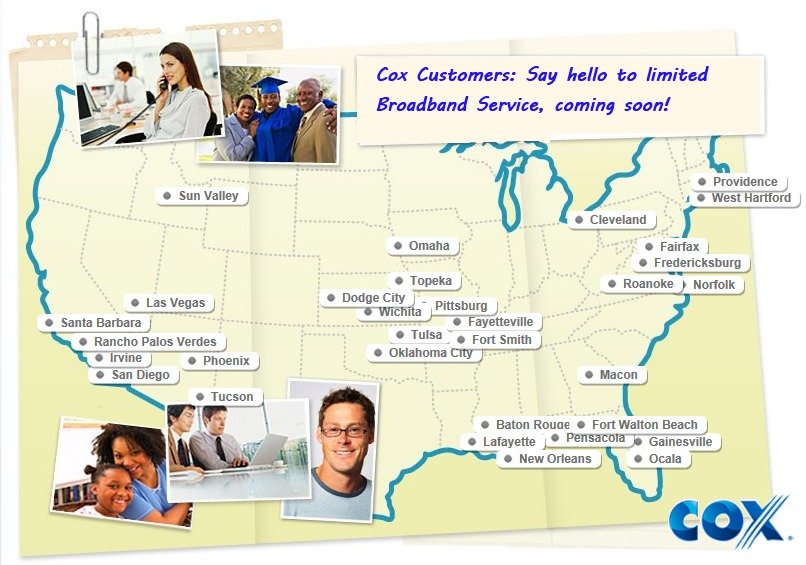
Our view of what Internet Overcharging with usage caps really means.

Dear Cox High Speed Internet Customer,

We’d like to take this opportunity to announce the availability of the Data Usage Meter. This new feature provides an easy way to check monthly household high-speed Internet data usage at any time. Monthly data usage is the amount of data that users send, receive, download or upload each month for movies and videos, photos, web surfing, email, gaming, and other files.

Each of our packages has a specific data usage amount. The amount depends on your Cox High Speed Internet package and corresponds to the speeds provided with the package. Our speediest package provides the highest usage amount. You are currently subscribed to the Premier Package which has a monthly data usage amount of 250 Gigabytes (GB). This is equivalent to streaming about 138 standard definition movies, or 83 high definition movies in a month.

The vast majority of our customers do not exceed their usage amount in a month and Cox does not charge you an additional fee if you exceed it. However, if you find that you are exceeding the usage amount for your package, you should check for the following potential causes:

An unsecured wireless home network. If your wireless router does not have security enabled, others outside your home may be using your Internet service. Cox provides a free tool to test the security of your home network. The Home Network Security Check can be accessed by logging into your account via myaccount.cox.net which will place you into Internet Tools. From there, simply select the Home Network tab

A computer virus. If your computer is infected with a virus, it may be transmitting large amounts of data without your knowledge. Cox strongly advocates Internet safety and security. That’s why we offer all of our High Speed Internet customers free security software that will help protect your computers. Cox Security Suite Powered by McAfee® will shield you from many viruses, spam, phishing and spyware. It even comes with parental controls.

To download your copy in just a few minutes, simply visit myaccount.cox.net and select the Security Suite tab in Internet Tools.

If after checking for these problems you find that you are still exceeding the usage amount, you may want to consider upgrading to another package that more closely matches your use of the service. Cox’s top High Speed Internet package includes 400 GB per month.

To view your current data usage, follow these easy steps:
1. Visit myaccount.cox.net
2. Sign in with your primary Cox username and password
3. Select the “Data Usage Allowance” tab on the left bar

The Data Usage Meter shows daily and monthly usage for your account starting with the beginning of your billing period. The monthly view shows the usage by month determined by the date of the end of your billing period. Over time, you will be able to see your household usage over the previous 12 months. The Data Usage Meter is only available to primary account users and secondary user accounts with billing access.
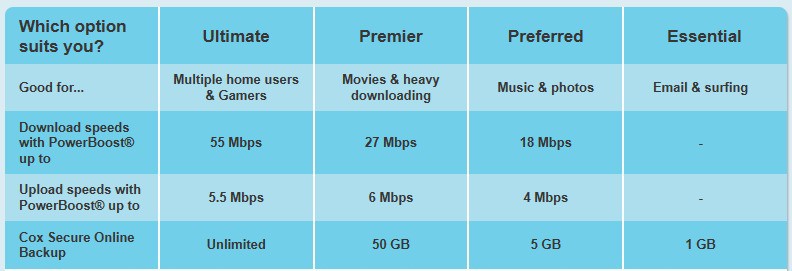
Cox usage caps fly in the face of some of the company's ancillary broadband products, one of which claims to offer "unlimited backups." It's not "unlimited" with a usage cap in place.

Cox customers have been technically under an Internet Overcharging scheme limiting usage for well over a year, but enforcement of those usage caps has traditionally been light, with only the most egregious users occasionally getting phone calls from the cable operator.  Some Cox markets still do not have a functioning usage measurement tool.

But there is growing suspicion that may be about to change.  Some Cox customers in Georgia, Arkansas, and Kansas report Cox is contacting them about Internet usage, and in one case in Georgia, shut off an account after the family exceeded their allowance by just 3GB.

“I was 3GB over my 200GB [allowance] and my Internet was temporarily suspended till I called Cox,” writes Stormside, a customer in Warner Robins, Georgia. “They had a ticket number on me and transferred me to [another] department. I was given the spiel about their policies saying they can suspend or cancel my Internet service if I continue to go over the cap.”

After promising to more closely monitor usage, the account was restored.
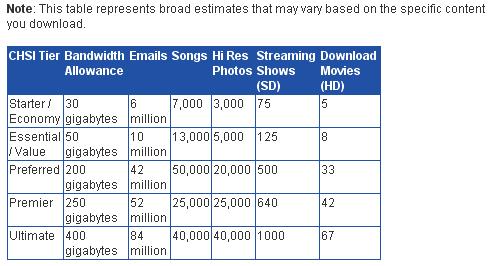
Cox says you can send 84 million e-mails with their Ultimate package.

Another customer in Pensacola, Fla. experienced the same thing.

“They disabled my Internet due to the cap, and I had to call to get it back up,” shares Compaq255 on the Cox Forum on Broadband Reports.

The usage caps Cox may increasingly enforce leaves customers with two options:

  1. Reduce usage to remain within usage allowances;
  2. Upgrade to a faster speed package, with a correspondingly larger allowance.

Stormside intends to do the former, Compaq255 the latter.

“I was going to upgrade to the higher package anyway,” Compaq255 says.

Many Cox customers have no idea the company limits their Internet usage, because the usage allowance is only disclosed in buried fine print contained within the company’s lengthy legaleseAcceptable Use Policy.  For customers like Janet Handshire, a Cox customer in Alma, Ark., the first usage cap disclosure she noticed was in a company e-mail.

“Cox sends e-mail to us all of the time, mostly promoting their various services, but I noticed this one because of all of the text,” says Handshire. “I was surprised to discover we even had a usage cap with Cox, and I am completely uninterested in visiting their usage page all the time to figure out whether I am okay with them or not.”

Handshire says she already pays nearly $200 a month to Cox for their triple play package and can’t believe the company is now becoming stingy over Internet usage.

“I have five boys and a husband in this house,” she says. “I already keep track of all the bills and now I have to start tracking how much everyone around here is using the Internet?  I don’t think so.  They are treating this like it is a limited precious resource.”

“The one thing we’ve learned following the broadband story in this country is Internet access is already a cash cow for these companies, but they keep asking for more,” she says.

Current usage allowances with Cox range from 30GB a month for their “starter” package to 250GB a month for their Premier Package.  An Ultimate package in some areas offers even faster speeds with a 400GB allowance, but it’s not available everywhere.
Verizon Wireless Introduces $50 Unlimited Plan… Good on Only Lower End “Feature Phones”

Phillip Dampier September 14, 2011 Consumer News, Verizon, Wireless Broadband 3 Comments

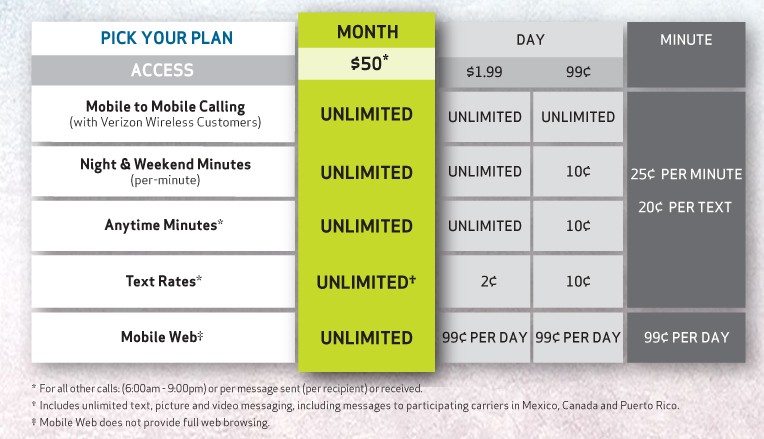
Verizon Wireless has announced a new $50 unlimited talk, text, and web prepaid plan for price sensitive new customers who don’t mind being stuck with a lower-end feature phone.

The new Verizon Unleashed unlimited plan has been test-marketed since April to prepaid customers in southern California and Florida, but will now be available nationwide from Verizon stores, Best Buy, Wal-Mart and Target.

Although existing Verizon Wireless prepaid customers may be able to sign up for the plan on their existing phones, new customers in test markets were limited to a selection of just a handful of “feature phones” that make web use and texting cumbersome:

  • LG Cosmos™ 2 — Now into its second generation, this basic feature phone slightly improved its slide-out keyboard.  The phone was rated “adequate” for an entry-level feature phone, but CNET’s detailed review notes it lacks 3G EV-DO service.  That means you will be web browsing on Verizon’s painfully slow 1xRTT data network.  Verizon has no worries customers using this phone will chew up a lot of wireless data.  Customers rated the build quality as adequate, but found the keys on the first generation of this phone did tend to wear out with a lot of use.  It’s a true “throwaway” phone once the warranty expires.  Repairs always cost more than buying a new phone.  Verizon’s website prices the phone at a stiff $189.99 for month-to-month customers, but it will probably remain priced at around $99.99 for prepaid customers choosing the Unleashed plan.
  • LG Accolade™ — A real workhorse basic phone for Verizon Wireless, the Accolade is much better for making and receiving calls than doing anything with texting or web use.  The phone has no QWERTY keyboard to type on, and no 3G service either, so its usefulness for data and texting is extremely limited.  But it is cheap, routinely selling for under $40.  CNET has a video review.  We suspect this phone will not be major part of the nationwide rollout of Unleashed, as Verizon appears to have discontinued it recently.
  • Pantech Caper — A front facing tiny keyboard features prominently on this phone, which would have been considered cutting edge five years ago.  Now, it’s considered a ho-hum “feature phone” for the non-smartphone crowd.  It received a fair rating from most reviewers, with the biggest complaints coming from unintentional pocket dialing and button pressing, and a lousy built-in camera.  No 3G service.  The Caper also won’t win any awards for its ergonomics.  Verizon Wireless had been selling this phone in test markets for $80 earlier this year.  CNET’s video review is here.

There is a good chance a few different, more current feature phones will be introduced for the Unleashed plan later this week.  But they will all likely dispense with support for 3G service and lack features many customers increasingly seek on smartphones.

Verizon Wireless has traditionally done poorly in the prepaid market, because its plans are considerably more expensive that those offered by competitors, especially T-Mobile and Sprint.  Verizon Wireless had been charging $95 a month for unlimited talk/text prepaid service plus $0.99 per day for web use.  At those prices, Verizon has been losing prepaid customers, now down to 4.4 million.  Many of those customers fled to providers like Sprint’s Virgin Mobile, which saw a 23 percent increase in its customers, which now number 13.8 million.

Verizon’s $50 unlimited plan matches AT&T’s $50 prepaid unlimited GoPhone plan.  Analysts suggest both companies have set prices (and limitations on the phones that work with the plans) at a level that allows them to compete with lower-priced rivals, but does not encourage their contract customers to switch to a cheaper prepaid plan.

For data-hungry smartphone users, there is little here to persuade anyone to downgrade to a $50 prepaid plan.

UK Bans Auto-Renewing ISP Term Contracts: They’re Anticompetitive, Rules Ofcom

Phillip Dampier September 13, 2011 Competition, Consumer News, Public Policy & Gov't Comments Off on UK Bans Auto-Renewing ISP Term Contracts: They’re Anticompetitive, Rules Ofcom

When broadband customers sign up for service under a “price protection agreement,” also known as a “term contract,” “minimum commitment,” or “price-lock guarantee,” few consumers realize their broadband provider will typically renew the contract for an additional one to three year term automatically “for your convenience.”

These Automatically Renewable Contracts (ARCs) require customers to notify their ISP, typically in writing, at least 30 days before their term commitment expires to prevent the provider from renewing the agreement, subjecting customers to stiff early cancellation fees if they want to change providers.

Now the independent UK regulator and competition authority Ofcom has ruled those agreements deliver few benefits to the consumers locked into them and plans to ban them effective Dec. 31.

Richards

Ofcom’s chief executive Ed Richards said: “ARCs raise barriers to effective competition by locking customers into long-term deals with little additional benefit.”

At least 15 percent of British broadband consumers are currently signed to renewable contracts, which have been used by BT, Adept Telecom, Axis Telecom, Eze Talk and iTalk.

“Our research, in particular the econometric analysis that we commissioned on the switching behaviour of BT customers, indicates a clear causal link between ARCs and reduced levels of consumer switching,” Ofcom said in a statement. “We believe this effect stems from the opt-out nature of the process for contract renewal and that any example of such a contract is likely to be harmful to consumers and to effective competition.”

Providers love the auto-renewing contract because most customers long forget about them until they call to cancel service, at which point they face a stiff cancellation fee that can run into the hundreds of dollars.  Faced with that kind of exit fee, many consumers opt to stay with their existing provider, despite better offers from a competitor.

The contracts are also popular in North America, particularly with telephone companies who face increased competition from cable providers.  If a telephone company DSL product loses the speed war with an area cable competitor, holding customers in place with term contracts assures phone companies consumers will stay put.  The more services bundled into a customer contract, the higher the termination fee, especially if a signup bonus was provided.  Phone companies have tried offering free netbook computers, free satellite television, and free HD televisions as part of contract bundles that can last as long as three years.  Some have cancellation fees of up to $500 if a customer leaves early.

Ofcom hopes the retirement of these contracts will encourage consumers to shop around for the best possible broadband and landline deals that serve their specific needs.

Bright House Suffers Worst Outage in Company’s History; Software Glitch Blamed

Phillip Dampier September 13, 2011 Consumer News, Video Comments Off on Bright House Suffers Worst Outage in Company’s History; Software Glitch Blamed

Last Tuesday, Bright House Networks suffered the worst outage in the company’s history, knocking out cable, broadband, and telephone service for over one million Tampa Bay-area customers.

Bright House customers from the beachfront to Lakeland to Spring Hill were forced to rely on cellphones for much of the day.  The company’s own 24-hour news channel, Bay News 9, couldn’t keep their Florida viewers informed about the outage, because that channel went dark as well.

Company officials blamed a software glitch for the series of progressive failures which began after 10:30am and were not repaired until later that evening.

Although Pinellas County’s 911 system remained in operation, Bright House customers couldn’t call the number from their Bright House “digital phone” line.

While customers without broadband or cable TV service were left bored during the outage, Bright House’s business customers without telephone service incurred real losses, unable to process credit card transactions or receive business calls.

Bright House has no plans to issue automatic refunds for the day without service, but WTSP-TV reports customers can directly request three days’ credit for the outage:

  1. Send an e-mail to Bright House Networks using their online form.
  2. Cut and paste the following into the “Describe your issue or concern” box: I am writing to request credit for Tuesday’s (9/6/11) service outage affecting phone, Internet, and cable-TV.  As seen on WTSP-TV and Facebook, I am requesting three days’ credit that Bright House representatives have offered other customers. Please credit my account.
  3. Hit submit.  A credit should be issued within 48 hours, to appear on your next billing statement.  The amount of the credit will vary, depending on the number of services you receive.

[flv width=”540″ height=”380″]http://www.phillipdampier.com/video/Bright House Outage 9-6-11.flv[/flv]

Bright House Networks’ worst-outage-in-history was a major news story in the Tampa Bay-St. Petersburg area.  Watch a selection of stories from WFTS, WTVT, WFLA, and WTSP-TV.  (9 minutes)

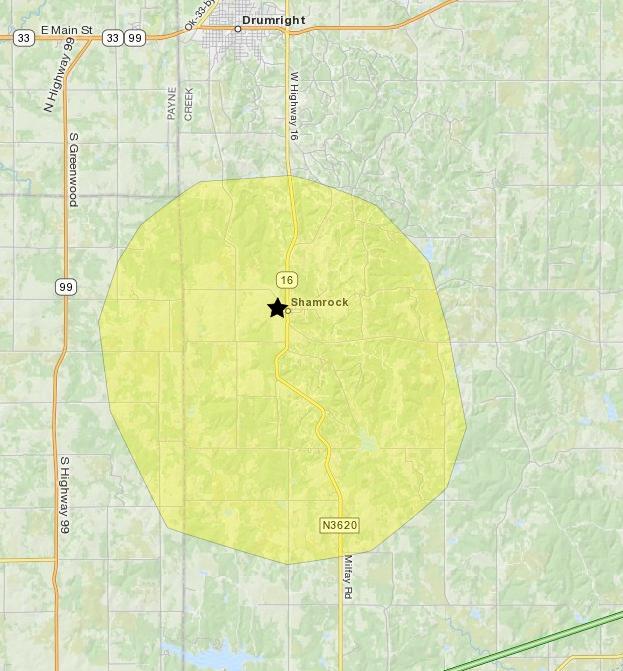
Shamrock, Okla.: Bankrupt City, Abandoned Police Cars, Padlocked Doors, But Internet Service Prevails

Shamrock Museum

The city of Shamrock, Okla. may not be a city for much longer, facing unincorporation and liquidation of its remaining assets, which include the abandoned police cars that used to earn the city enough ticket revenue to keep the doors open.  But fast (and free at the local community center) Internet prevails (with competition, too) in a city with fewer than 100 remaining citizens.  It’s all thanks to a federal broadband grant and an existing Wireless ISP.

Shamrock’s unlucky predicament comes at the expense of the boom-and-bust oil business that launched dozens of small towns in rural Oklahoma, only to leave them largely abandoned when the oil dried up, or the cost to access it becomes too prohibitive.  Once a community numbering 10,000, Shamrock, located nearly halfway between Oklahoma City and Tulsa, had recently been surviving on revenue earned from writing traffic tickets in infamous speed traps set up along Highway 16.  Shamrock, along with Big Cabin, Caney, Moffett, and Stringtown, became so notorious for their dependence on traffic ticket revenue to keep the towns afloat, at one point the state government publicly designated them “speed trap towns” and banned them from writing tickets on state and federal highways. When Creek County officials learned the city was using non-commissioned officers to write tickets, they shut down the whole operation.

Soon after, residents found the city hall padlocked, with coffee cups still on the desks and police evidence lockers still stuffed with property from active criminal cases (although seized marijuana and beer has since disappeared.)

In fact, the only service now in operation at the city hall, now converted into a “community center,” is Internet access on 10 computers made possible by @Link Services LLC, an Oklahoma City-based Wireless Internet Service Provider (WISP) that provides service in rural areas, with the help of a broadband grant from the U.S. Dept. of Agriculture.

The broadband grant, amounting to $536,000, with matching funds of $134,000 kicked in by @Link, covers the costs of running the community center for two years and extending wireless access with the construction of a new wireless radio tower in Stillwater, which allows the company to reach Shamrock residents.

In addition to providing free access at the former city hall, @Link also sells Internet access to area residents (the only remaining business in town is a diner):

@Home Standard  512 Kbps download  512 Kbps upload $34.95
@Home Advanced  1.5 Mbps  up to 1.5 Mbps $39.95
@Home Premium  3.0 Mbps  up to 1.5 Mbps $46.95
@Home Premium Plus  5.0 Mbps  up to 3.0 Mbps $59.95
@Home Max  6.0 Mbps  up to 6.0 Mbps $74.95

“This is going to be the last place anyone would provide Internet without government funding because there is no chance of turning a profit,” Kerry Conn, chief financial officer of @Link Services told The Oklahoman. “But if you don’t have Internet services, your town is going to die.”

@Link CEO Samual Curtis says their wireless Internet access sells itself.

“Broadband is a very easy sell where there is no broadband,” Curtis told the newspaper.

The only problem with that is Shamrock currently does receive service from another Wireless ISP — OnALot, a service of HDR Internet Services, Inc.  OnALot operates from 70 systems in more than 25 cities and communities across rural Oklahoma.  @Link’s arrival in town, with the assistance of a federal broadband grant, came as a surprise to some Shamrock residents who already had Internet service from OnALot.  Now those customers have two choices — both wireless — for Internet service.  OnALot, the incumbent, is often cheaper, too:

PLAN 12 Month
Contract
Credit or
Debit Card
Monthly Fee For Service
A No Contract No $42.00
B No Contract Yes $37.00
D Yes Yes $33.00

OnALot does not sell traditional speed tiers.  Instead customers share access points rated at speeds of 11 and 54Mbps.  Customers do not actually see anything close to those speeds, because they are theoretical maximums and each access point is shared by several users.  But since many residential customers do not have a firm understanding of what different speed levels represent, it has proven workable for HDR Internet to sell services based on price, not speed.

OnALot does sell dedicated, private wireless circuits to customers who don’t want to share, but they are comparatively expensive:

Speed Equipment Monthly Fee
3.0 / 512 $400.00-$600.00 $200.00
6.0 / 768 $400.00-$600.00 $350.00

OnALot.com operates both standard Line-of-Sight and Near-Line-of-Sight systems on the 80' tall water tower on the west side of Shamrock.

One Oklahoman reader, Bobbi, wondered why @Link received federal grant money to provide Internet service in a community that already had access.

“Why this company didn’t do their homework before they used government money to provide a service to a town that had that service,” Bobbi asked. “Wouldn’t that be a misuse of the grant money?”

Broadband grant funding has come under criticism at times for funding projects that incumbent providers accuse of duplicating services.  A study funded by the National Cable & Telecommunications Association, the cable industry’s top lobbyist, found several instances of grants that would deliver broadband service to areas already served by other providers.

“While it may be too early for a comprehensive assessment of the [government]’s broadband programs, it is not too early to conclude that, at least in some cases, millions of dollars in grants and loans have been made in areas where a significant majority of households already have broadband coverage, and the costs per incremental home passed are therefore far higher than existing evidence suggests should be necessary,” the study says.

Thus far, much of the funding for rural Oklahoma seems to be directed towards wireless Internet access projects, which typically serve sparsely populated areas cable and phone companies have traditionally ignored.

The NCTA’s criticism, in particular, was directed against its would-be competitors.  The lobbying group suggests the price of competition was too high.

Based on the cost of the direct grants and subsidizing the loans, the NCTA study estimated that the cost per incremental home passed would be $30,104 if existing coverage by mobile broadband providers was ignored, and $349,234 if mobile broadband coverage was taken into account.

Wireless ISP operators have told Stop the Cap! many of their projects are self-financed and do not receive government assistance.  Some WISP operators have accused the government of making broadband grants to wireless operators a cumbersome, if not impossible prospect because incumbent telephone companies are often most likely to meet the government’s grant criteria.

For Shamrock residents, one piece of good news: @Link Services and OnALot both have no Internet Overcharging schemes like usage caps.  However, OnALot prohibits the use of peer-to-peer software (torrents) and @Link Services maintains the right to curtail speeds for those who create problems for other users on their shared wireless network.

OnALot’s usage policies are among the most frank (and common sense) we’ve seen, because they are up front with customers about the impact certain traffic can have on their wireless network:

  1. You are paying us to download from the Internet. We do not limit you on that. You can download anything you want 24/7. Games, email, web pages, radio stations, and so on – we don’t care, downloading is what you are paying us for. That said, we would prefer that you do not leave an active game un-attended, or run a radio station continuously, as these eat up bandwidth that others could be using. When you’re done with your game, please turn it off.
  2. We do have restrictions when it comes to uploading TO the Internet. P2P or Peer-to-Peer programs are NOT allowed. These limitations apply primarily to file sharing programs. We do NOT allow music or video sharing programs, bit torrent programs or other programs where outside users can extract files from your computer with or without your express consent. And seriously, do you actually WANT others to have full access to your computer? That’s what you’re giving to file sharing programs! Please call us if you are unsure if the program you are using is a file sharing program.
  3. Yes, you can upload to your favorite website, send big emails, and transfer any size files that are under your control. That’s OK with us – these are intermittent in nature and under your full control. It’s the unattended uploading that sharing programs do that we do not allow.
  4. If your computer has a virus and is “spewing” out onto the Internet, we expect you to have it cleaned. Causing others to become infected is wrong, and we may take steps to disable your Internet connection. We will call you first, explain what is going on and ask that you have your machine cleaned. If you decide not to do this, we will then cut you off until you do.

Search This Site:

Contributions:

Recent Comments:

Your Account:

Stop the Cap!