Home » Issues » Recent Articles:

Clearwire Consolidates: Company Pushing $50 4G Mobile Broadband With Throttling Plan

Phillip Dampier November 1, 2011 Competition, Data Caps, Wireless Broadband Comments Off on Clearwire Consolidates: Company Pushing $50 4G Mobile Broadband With Throttling Plan

Now all prepaid and contract-free.

Clearwire customers are being informed the wireless broadband provider is consolidating service plans in a move the company hopes will simplify what’s on offer.  Following on the heels of Leap Wireless’ Cricket, which launched simplified pricing last year, Clearwire will now market prepaid, no-contract broadband to new customers effective today.

Broadband Reports has been talking with Clearwire after forum members began noticing changes on some dealer websites that eliminated 3G coverage and dropped postpaid bundles of voice and data plans.  Earlier today, the company confirmed it was getting rid of contracts, early termination fees, rental fees for devices, and activation fees.  New customers will be asked to purchase their own mobile broadband device which will work exclusively on Clearwire’s own 4G WiMax network.  You can purchase plans that work by the day, week, or month.

The most popular anticipated plan will offer “unlimited” 4G wireless broadband for $50 a month.

Gone is the bundled Sprint 3G voice option and the annoying early termination fees customers howled about when Clearwire’s advertised coverage didn’t live up to expectations.  Although Clearwire continues to pitch “unlimited mobile broadband,” their notorious speed throttles will remain for “congested cell sites.”  Customers have dropped the service over significant throttling issues in some areas, which reduce speeds to near dial-up in some cases.

Broadband Reports speculates Clearwire wants to be in the wholesale broadband business, and slowly exit the retail business that has earned them the scorn (and threatened legal action) of some of their customers.

Existing customers will be able to keep their existing plans, at least for now.

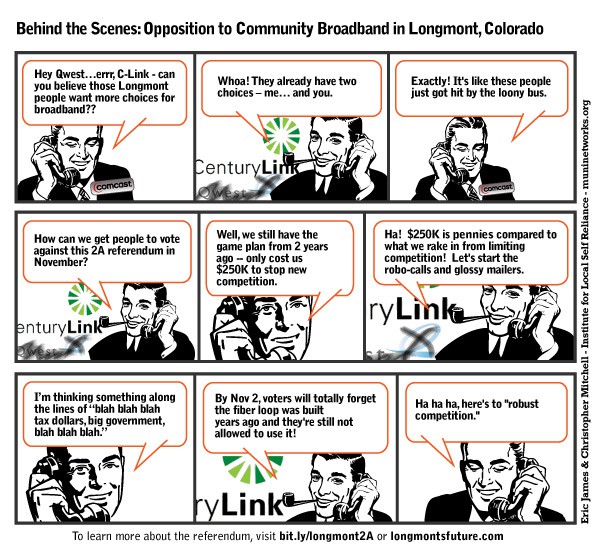
Big Telecom’s Astroturf Snowjob: Blizzard of Bull from CenturyLink and Comcast to Kill Competition

You can look all over this astroturf group's website and never find the fact it's bought and paid for on behalf of Colorado's largest cable company -- Comcast.

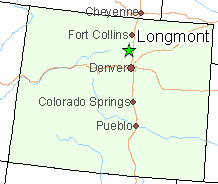
The next time Comcast or CenturyLink wants to increase your rates because of the “increased costs of doing business,” you might want to ask them why they have collectively spent more than $300,000 on an astroturf campaign to stop the city of Longmont, Col. (pop. 86,000) from using excess fiber capacity to provide competition to the phone and cable company without raising taxes a penny.

Longmont voters are headed to the polls today with a simple question to answer: should the city be allowed to open their fiber network to all-comers to provide competitive video, data, and telephone services to city residents.  Longmont’s fiber network was constructed in the 1990s as part of its electrical infrastructure.  Some utility companies buried enormous amounts of fiber intending to use it to electronically collect usage data from ratepayers so meter readers could become a thing of the past.  Like in other cities, Longmont now has a fiber network that is woefully underused, and the city wants to open up the tremendous excess capacity for telecommunications uses.  They are even open to allowing Comcast and CenturyLink to use the network to help service their own respective customers, but the thought a new competitor (including a community-owned provider) might deliver service over that network has created an absurd $300,000 Hissyfit.

Comcast has been caught funding the majority of the opposition, the so-called “No on 2A” and “Look Before We Leap” projects, sponsored primarily by the Colorado Cable Telecommunications Association, which counts Comcast as a member.

But visitors to the campaign’s cheesy website never realize who is running the show because the effort hides its association with Big Telecom.

It’s a classic example of Astroturf Fear, Uncertainty, and Doubt.  Scare residents into believing the city will raise taxes or go into financial distress.  Raise uncertainty by claiming important details are being left out.  Encourage doubt by comparing the advanced fiber network with anemic public Wi-Fi failures of the past involving Earthlink (remember them?).

But the No on 2A campaign is also willing to check themselves into a deluxe suite at the Hypocrisy Hotel, accusing city officials of hiding the names of their pro-fiber supporters and backers, including (gasp!) a company based in France!

The No on 2A website breathlessly relates the incriminating documents were unearthed from “previously secret emails just made public thanks to a Colorado Open Records Act.” They suggest a nefarious connection with Alcatel-Lucent because that company, which sells products and services related to fiber networks, communicated with the city in a handful of e-mail messages last summer.  You know those French, always up to something.

When it doubt, blame the French for being in on it.

The rich, buttery irony of a “group” secretly funded by the state’s largest cable company accusing others of keeping secrets is ignored at Kabletown.

But then I’ve received e-mail from Alcatel-Lucent (and Comcast) myself.  And I have a French last name.  Sacrebleu!

The website’s “opponents,” evidently gleaned from the few hundred residents that signed their visitor’s book, includes names like Joanna Crawford, “Garrett County,” and El Cordova, which we think could be the name of a Mexican pro-wrestler, we’re not sure.

City officials are stunned by the sheer amount of money being spent by cable and phone companies to keep competition far, far away.  So apparently is the local media, which has taken to identifying the “grass roots” opposition right down to their job title and name of the lobbying firm they work for.

Take Times-Call, which helpfully discloses “Look Before We Leap” spokesman George Merritt is actually a senior strategist for Onsight Public Affairs of Denver.  That’s a real nice way to say “lobbying firm hired to develop social media strategies to snooker influence public opinion on behalf of corporate clients.”

You know you’re not dealing with a neighborhood group lobbying to reduce road speeds in the neighborhood or sign a petition for improved trash collection when you read Leap’s financial disclosure reports:

  • $120,913.64 to mass communications firm SE2 of Denver for a variety of services, including mail pieces, consulting, two television buys and ad production and design.
  • $70,500 to Rocky Mountain Voter Outreach of Denver for “canvass, management rent and miscellaneous associates.”
  • $37,500 to OnSight Public Affairs for consulting.
  • $22,000 to Drake Research and Strategy of Boulder for polling.
  • $15,776.84 to Zata3 for phone work.
  • $12,260 to Holland and Hart of Denver for legal expenses.
  • $8,000 to EIS of Grand Junction for consulting.
  • $4,334.65 to Campaign Products of the Rockies, of Denver, for a voter file, mailing lists, stickers and yard signs.
  • $2,500 to Mark Stevens of Denver for research.
  • $743.75 to Tim Thomas of Boulder for general campaign work.

The whole dog and pony show of Big Telecom money has bemused Longmont mayor Bryan Baum, who supports the 2A measure and believes the distortion campaign has gone way over the top.

“It doesn’t really matter at this stage of the game,” Baum told the newspaper. “It’s going to the electorate. The electorate will vote. And we will know on Tuesday how they voted – if they believe a $300,000 ad campaign, or if they believe the people they’ve entrusted their votes to.”

Some of that $300,000 has also gone into vilifying a real grass-roots effort in support of the Longmont fiber initiative — Longmont’s Future.  Comcast’s front group tried to raise questions about where that pro-fiber group got their backing and money.  The newspaper discovered Longmont’s Future isn’t backed by any French conglomerate or nefarious outside interest.  It’s the work of Jonathan Rice, who operates the website all by himself, spending a grand total of $353 to fight Comcast’s $300,000.

“Every single candidate for office and every incumbent, in every race, supports this measure,” says Rice. “But Comcast and its friends are more interested in profit than progress, and continue to run a smear campaign to spread misinformation and outright lies – they recently posted Mayor Baum’s name as an opponent of 2A when he is actually a vociferous supporter.”

Community Broadband Networks has compiled a series of articles detailing the project and helping to expose the so-called “grassroots” opponents.  We encourage readers to become better acquainted with the underhanded tactics community broadband opponents will use to stop anything that resembles competition.

AT&T Overbilling Class Action Lawsuit Shut Down; Forced Into AT&T-Inspired Arbitration

A class action lawsuit accusing AT&T of methodically over-measuring wireless customers’ usage and subjecting them to overlimit fees has been re-assigned to arbitration because AT&T wrote terms into contracts denying customers the right to pursue grievances any other way.

Plaintiff Patrick Hendricks claimed AT&T was systematically overstating customer usage by 7-14 percent with a rigged usage meter.  Hendricks claims some customers were overbilled by as much as 300 percent for phantom data usage that he claims never took place.  The measuring errors found in a two-month study cited by Hendricks were in AT&T’s favor, potentially exposing customers to surprise overlimit fees or, more recently, speed throttles.

Judge Breyer

But U.S. District Judge Charles Breyer shut down the court case, heard in a San Francisco federal courtroom.  Breyer ruled that since AT&T’s contracts bar lawsuits by customers, Hendricks must pursue his case in the venue required by AT&T — arbitration.

“[AT&T’s contract] requires the use of arbitration on an individual basis to resolve disputes, rather than jury trials or class actions, and also limits the remedies available … in the event of a suit,” Breyer ruled.

Ironically, Breyer is the same judge that dissented from an earlier case — AT&T v. Concepcion, that ultimately set the stage allowing AT&T to force consumers to pursue arbitration and practically speaking, remove their right to pursue class action relief.

“What rational lawyer would have signed on to represent the Concepcions in litigation for the possibility of fees stemming from a $30.22 claim?,” Breyer wrote. “The realistic alternative to a class action is not 17 million individual suits, but zero individual suits, as only a lunatic or a fanatic sues for $30’.”

Brandi M. Bennett, a California attorney who specializes in intellectual property law, considers arbitration clauses to be a major threat to class action cases:

“Class actions make it possible to find recourse for individuals with damages that make traditional litigation impractical. AT&T Mobility v. Concepcion appears to leave the average consumer at risk of being defrauded by corporations for $10, $20, $50 without any practical remedy. If one million customers are damaged for $20 each, a corporation can improperly realize a $20 million gain. Class actions serve to prevent that.”

Arbitration can offer a poor substitute, because most arbitration firms are beholden to their corporate clients for repeat business.  An arbitrator perceived to be exceptionally pro-consumer stands little chance of being retained when corporate defendants pay the arbitration firm for its services.  Some arbitration policies require consumers and the company to split the costs of arbitration, but those costs often easily exceed the value of the original claim, discouraging customers from pursuing a refund settlement.

Companies understand that reality, which is why clauses requiring arbitration to settle disputes are increasingly common in service contracts.

Hendricks’ original suit sought restitution for the entire class of consumers and damages for breach of contract, unjust enrichment, unfair and fraudulent business practices, unfair competition, and violations of the federal Communications Act.  Most arbitration clauses require consumers to file individual complaints, which few may ultimately do considering arbitration proceedings may occur in another city and often requires the complainant to appear in person to provide testimony.

The Consumer’s Guide to Universal Service Fund Reform: You Pay More and Get Inadequate DSL

Phillip Dampier November 1, 2011 Broadband Speed, Competition, Consumer News, Editorial & Site News, Public Policy & Gov't, Rural Broadband, Video, Wireless Broadband Comments Off on The Consumer’s Guide to Universal Service Fund Reform: You Pay More and Get Inadequate DSL

Phillip Dampier on USF Reform: It might have been great, it could have been a lot worse, but ultimately it turned out to be not very good.

Last week, the Federal Communications Commission unveiled their grand plan to reform the Universal Service Fund, a program originally designed to subsidize voice telephone service in rural areas deemed to be unprofitable or ridiculously expensive to serve.  Every American with a phone line pays into the fund through a surcharge found on phone bills. Urban Americans effectively subsidize their rural cousins, but the resulting access to telecommunications services have helped rural economies, important industries, and the jobs they bring in agriculture, cattle, resource extraction, and manufacturing.

The era of the voice landline is increasingly over, however, and the original goals of the USF have “evolved” to fund some not-so-rural projects including cell phone service for schools, wireless broadband in Hollywood, and a whole mess of projects critics call waste, fraud, and abuse.  For the last several years, USF critics have accused the program of straying far from its core mission, especially considering the costs passed on to ratepayers.  What originally began as a 5% USF surcharge is today higher than 15%, funding new projects even as Americans increasingly disconnect their landline service.

For at least a decade, proposals to reform the USF program to bridge the next urban-rural divide, namely broadband, have been available for consideration.  Most have been lobbied right off the table by independent rural phone companies who are at risk of failure without the security of the existing subsidy system.  Proposals that survived that challenge next faced larger phone company lobbyists seeking to protect their share of USF money, or by would-be competitors like the wireless industry or cable operators who have generally been barred from the USF Money Party.

This year, FCC Chairman Julius Genachowski finally achieved a unanimous vote to shift USF funding towards the construction and operation of rural broadband networks.  The need for broadband funding in rural areas is acute.  Most commercial providers will candidly admit they have already wired the areas deemed sufficiently profitable to earn a return on the initial investment required to provide the service.  The areas remaining without service are unlikely to get it anytime soon because they are especially rural, have expensive and difficult climate or terrain challenges to overcome, or endure a high rate of poverty among would-be customers, unable to afford the monthly cost for the service.  Some smaller independent phone companies are attempting to provide the service anyway, but too often the result is exceptionally slow speed service at a very high cost.

The new Connect America Fund will shift $4.5 billion annually towards rural broadband construction projects.  Nearly a billion dollars of that will be reserved in a “mobility fund” designated for mobile broadband networks.

The goal is to bring broadband to seven million additional households out the 18 million currently ignored by phone and cable operators.

The FCC believes AT&T will take a new interest in upgrading its rural landline networks, even as the company continues to lobby for the right to abandon them.

Unfortunately, the FCC has set the bar pretty low in its requirements for USF funding.  The FCC defines the minimum level of “broadband” they expect to result from the program — 4/1Mbps.  That’s DSL speed territory and that is no accident.  The phone companies have advocated a “less is more” strategy in broadband speed for years, arguing they can reach more rural customers if speed requirements are kept as low as possible.  DSL networks are distance sensitive.  The faster the minimum speed, the more investment phone companies need to make to reduce the length of copper wiring between their office and the customer.  Arguing 4Mbps is better than nothing has gotten them a long way in Washington, but it also foreshadows the next digital divide — urban/rural broadband speed disparity.  While large cities enjoy speeds of 50Mbps or more, rural towns will still be coping with speeds “up to” 4Mbps.

The FCC does not seem too worried, relying heavily on a mild incentive program to prod providers to upgrade their DSL service to speeds of 6/1.5Mbps.

The irony of asking AT&T to invest in an aging landline network they are lobbying to win the right to abandon is lost on Washington, and future speed upgrades for rural America from companies like Verizon are in serious doubt when they sell off their rural areas to companies like FairPoint and Frontier and leave town.

Critics of USF reform suggest the program is still stacked in favor of the phone companies, and considering the state of their copper wire networks, would-be competitors are scratching their heads.

The cable industry, in particular, is still peeved by reforms they feel leave them at a disadvantage.  Of course, Washington may simply be recognizing the fact cable companies are the least likely to wire rural America, but when they do, the service that results is often faster than what the phone company offers.  The nation’s biggest cable lobbyist — ironically also the former chairman of the FCC, Michael Powell — still feels a little abused after reading the final proposal.

“While we are disappointed in the Commission’s apparent decision to ignore its longstanding principle of competitive neutrality and provide incumbent telephone companies an unwarranted advantage for broadband support,” said National Cable & Telecommunications Association President Michael Powell, “we remain hopeful that the order otherwise reflects the pro-consumer principles of fiscal discipline and technological neutrality that will bring needed accountability and greater efficiency to the existing subsidy system.  We are particularly heartened by the Commission’s efforts to ensure that carriers are fairly compensated for completing VoIP calls.”

Wireless operators are not happy either, because the arcane requirements that come with the USF bureaucracy were written with the phone companies in mind, not them.  Small, family-owned providers find it particularly difficult to do business with the USF, if only because they don’t have the staff or time to navigate through endless documents and forms.  Phone companies do.

Your phone bill is going up.

Many consumer groups are relieved because it could have been much worse.   The FCC could have simply capitulated and adopted the phone companies’ wish-list — the ABC Plan.  Thankfully, they didn’t, but the FCC has naively left the door open to substantial rate increases for consumers by not capping the maximum annual outlay of the fund.  That follows the same recipe that invited higher phone bills and questionable subsidies awarded in an effort to justify the original USF program even after it accomplished most of its goals. Consumers may face initial rate increases of $0.50 almost immediately, and up to $2.50 a month five years from now.

The FCC, unjustifiably optimistic, suspects phone companies and other telecommunications interests won’t gouge customers with higher prices.  They predict rate increases of no more than 10-15 cents a month.  I wouldn’t take that bet and neither will consumer groups.

“We’re going to press the FCC to ensure that these are temporary increases, because history has shown that these types of costs tend to stick around and go on and on and on,” said Parul Desai, policy counsel for Consumers Union.

An even bigger question left unanswered is just how far the FCC will get into the broadband arena when it refuses to take the steps necessary to ensure it has an admission ticket.  The agency has avoided classifying broadband as a telecommunications service, an important distinction that would bolster its authority to oversee the industry.  Without it, some members of Congress, and more importantly the courts, have questioned whether the FCC has any business in the broadband business.  Just one of the many high-powered players in the discussion could test that theory in the courts, and should a judge throw the FCC’s plan out, we’ll be back at square one.

[flv]http://www.phillipdampier.com/video/C-SPAN Tom Tauke from Verizon on Changes to the Universal Service Fund 10-29-11.flv[/flv]

Verizon’s chief lobbyist Tom Tauke spent a half hour last weekend on C-SPAN taking questions about USF reform and the side issues of IP Interconnection and Net Neutrality policies. Tauke supports consolidation of small phone companies into fewer, larger companies.  He also expands on his company’s lawsuit against Net Neutrality, which fortuitously (for Verizon) will he heard by the same D.C. Court of Appeals that threw out the FCC’s fines against Comcast for throttling broadband connections.  Politico’s Kim Hart participates in the questioning, which also covered wireless spectrum issues impacting Verizon Wireless, AT&T’s stumbling merger deal with T-Mobile, and Verizon’s latest lawsuit against the FCC for data roaming notification rules.  (28 minutes)

Time Warner Cable Announces First of a Series of Rate Increases for 2012

Phillip Dampier October 31, 2011 Consumer News 4 Comments

Time Warner Cable intends to implement a series of rate increases for 2012 across many of their service areas, beginning with a 4% rate hike for their cable television service that will take effect in December.

A cable company memo received by Stop the Cap! indicates this isn’t likely to be the only rate increase from the cable operator, with possible rate adjustments for broadband and phone products to be announced at a later date.  The cable television portion of your bill will increase because of what the company calls “dramatically higher programming costs, additional programming and features, and continued investment in the company’s network and customer service operations.”

Some examples of the new rates¹, which will vary slightly in different service areas, includes new pricing for the company’s DVR box in some regions:

  • Digital Cable (was $72.99) $77.49
  • Talk & Surf (was $86.99) $89.94
  • Watch & Surf (was $118.99) $125.49
  • Watch & Surf Plus (was $141.99) $148.49
  • DVR Service (was $11.95) $12.95 (additional equipment rental charges may apply)
¹Time Warner Cable Maine

Customers currently on price protection agreements, term contracts, or special rate promotions will not be impacted by the rate increases until the expiration of their contract or promotion.  Customers will receive an official notification of the rate adjustment on their next billing statement.

Search This Site:

Contributions:

Recent Comments:

Your Account:

Stop the Cap!