Home » Issues » Recent Articles:

Leverett, Mass. Fed Up With Poor Broadband; Town Wants Its Own Gigabit Network

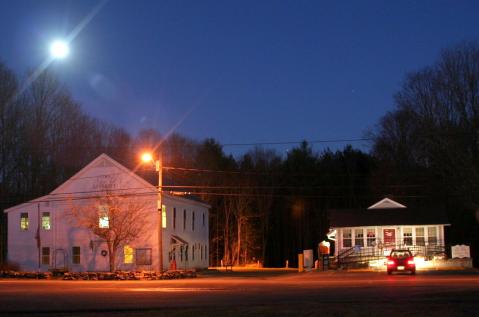
Downtown Leverett (Courtesy: Town of Leverett)

Life in Leverett, Mass. could get a lot faster as the community considers entering the 21st century by bringing high speed gigabit broadband to town.

For years, residents have had three relatively slow choices for Internet access: dial-up, wireless or satellite-delivered service.  Verizon and cable companies like Comcast and Time Warner Cable, which have systems in western Massachusetts, have largely ignored Leverett’s need for speed.

Now the town is considering building its own fiber-to-the-home network to reach every home in Leverett starting in 2014.  The proposed $3.6 million network will also offer residents cable television and phone service — helpful upgrades in the western half of Massachusetts where Verizon has allowed their landline network to degrade to conditions declared intolerable by the state Department of Telecommunications.  Last year, the state agency ordered Verizon to assess and repair its landline network in almost 100 communities in the western half of the state.

Town officials will introduce their plans for the new municipal broadband network at a public meeting April 28.  The community would borrow the money to construct the network, paying it off over 20 years and outsourcing its construction and maintenance to outside companies.

The town originally planned a fiber-to-the-neighborhood network similar to AT&T U-verse, but quickly decided the benefits of a true fiber-to-the-home network were worth the extra investment.

Unlike some other community-owned networks, Leverett will raise taxes on local residents to cover the cost of the service, but Selectman Peter d’Errico says it will save most residents money if they currently pay a satellite provider for broadband service. Research shows the largest majority of Leverett residents get broadband from satellite providers.

“It will be a little more on their tax bill and a lot less on their Internet bill, so overall they will pay less,” d’Errico told the Daily Hampshire Gazette.

d’Errico added the local community is done waiting for private companies to deliver modern telecommunications services in Leverett.  Those companies have repeatedly told town officials there isn’t enough profit or return on investment to justify expanding broadband in rural communities.

Leverett hopes to serve as a template to more than 40 other western Massachusetts communities who belong to WiredWest, a consortium of similarly-situated towns working together to build a regional broadband network.  Leverett’s network would leverage the Massachusetts Broadband Institute’s 1,300 “middle mile” fiber backbone network that is working its way through 123 western and central Massachusetts towns.

[flv width=”480″ height=”290″]http://www.phillipdampier.com/video/WGGB Springfield Internet Connection in Leverett 4-11-12.mp4[/flv]

WGGB in Springfield previews Leverett’s efforts for better broadband. Big commercial providers ignore the community so now they want to provide service themselves.  (2 minutes)
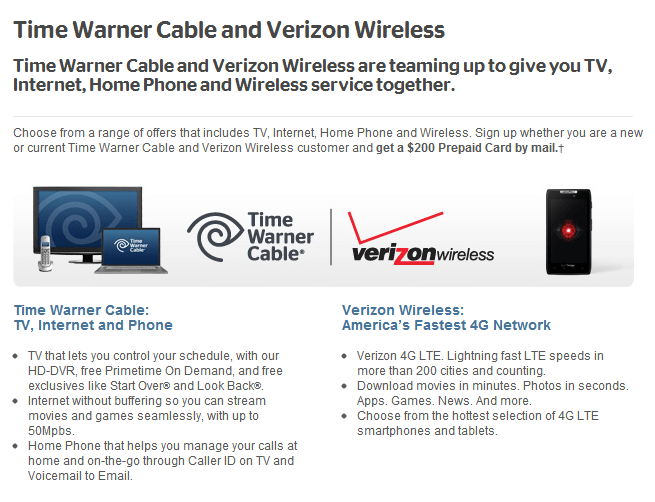
‘VerizonWarner’ Cable Collaboration Launched: $200 Rebate for Cable+Wireless Phone

Phillip Dampier April 12, 2012 Consumer News, Public Policy & Gov't, Verizon, Wireless Broadband Comments Off on ‘VerizonWarner’ Cable Collaboration Launched: $200 Rebate for Cable+Wireless Phone

Time Warner Cable and Verizon Communications have teamed up to sell both companies’ products to their respective customers, sweetened with a $200 rebate card offer.

The collaboration comes well before the federal government approves a wireless spectrum transfer between the cable operator and Verizon Wireless.  Both companies are under scrutiny in Washington for potentially anti-competitive behavior associated with the joint marketing agreement.

Today Time Warner Cable launched the new promotion in Raleigh, N.C., Kansas City, and three cities in Ohio — Cincinnati, Columbus, and Toledo.  Time Warner expects to expand the offer to other cities later this year.

To qualify for the gift card, customers must activate a new two year contract with a Verizon smartphone or tablet (with data service) and choose either a qualifying new service or upgrade to your Time Warner Cable account.  You must agree to keep the service active for at least 90 days.

The Death of the Landline? AT&T Ditches Yellow Pages, Pay Phones Disappear; So Do Customers

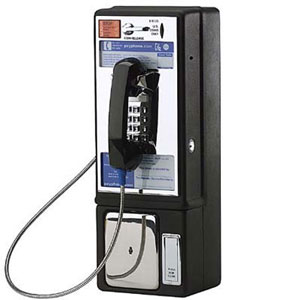
As AT&T joins Verizon selling off its Yellow Pages publishing unit and payphones keep disappearing from street corners, the media is writing the landline obituary once again.

CNN Money asks today whether we’re witnessing the death of the landline.

In as little as 20 years, the concept of a wired phone line may become the novelty a rotary-dial phone represents today.  Yes, traditional phone lines will still be found in businesses and in the homes of those uncomfortable dealing with a mobile phone, but America’s largest phone companies are well aware the traditional telephone line is in decline.

[flv width=”412″ height=”330″]http://www.phillipdampier.com/video/ATT Archives What is the Bell System.flv[/flv]

The Bell System, as it was known until the 1980s, used to comprise AT&T, Bell Labs, Western Electric, Long Lines, and two dozen local “operating companies” like New York Telephone, Mountain Bell, etc.  This AT&T documentary, from 1976, explores how “the phone company” used to function.  New innovations like “lightwave” are showcased, promising to deliver voice phone calls over glass fibers one day.  

Much of the technology seen in the documentary may be unfamiliar if you are under 30 (and check out how customer records were maintained back then), but those who remember renting telephones in garish colors from your local phone company will recognize the phones that occupied space in your home not that long ago.  The only part of the landline network that hasn’t changed much in the last 40 years is the wiring infrastructure itself, which has been allowed to deteriorate as customers continue to depart.

Why was the company so darn big back then?  Because it had to be, the documentary says, to serve a big America.  Hilariously, the company defends its then-status as a “regulated monopoly” telling viewers “[a] regulated monopoly works well in communications because you don’t duplicate facilities and you produce real economies over the long haul.”  (14 minutes)

CNN reports nearly one-third of all American homes no longer have landline service, double the rate from 2008, triple that of 2007.  Verizon is feeling the heat the most, with revenue down 19% over the last five years.  AT&T has seen their revenue drop 16.5% over the same period.

But things are not all bad for phone companies willing to spend money upgrading their networks.  Verizon’s top-rated FiOS fiber to the home service is a compelling competitor to Comcast and Time Warner Cable.  AT&T’s U-verse has gotten a respectable market share larger midwestern cities and draws customers who like its DVR box and the chance to stick it to the local cable company they’ve hated for years.

But where both companies have decided against investing in upgrades — notably in their rural service areas — the traditional phone line is trapped in time.  Only the network it depends on is changing, and not for the better.

[flv]http://www.phillipdampier.com/video/ATT 1993-1994 You Will Ad Campaign Compilation.flv[/flv]

Back in 1993, AT&T produced seven advertisements dubbed the “You Will” series, showcasing future technologies AT&T would “deliver to you.”  Eerily, the vast majority of these predictions came true, but mostly from companies other than AT&T.  While the phone company predicted what would eventually become E-ZPass, Apple’s iPad, Apple’s Siri, the smartphone, Skype, Amazon’s Kindle, the cable industry’s home security apps, video on demand, and GPS navigation, most of those innovations were developed and sold by others.  

AT&T spun away Bell Labs and became preoccupied selling Internet access, cell phones and reassembling itself into its former ‘hugeness’ through mergers and buyouts. With limited investment in innovation, AT&T risks being left as a “dumb pipe” provider, selling the connectivity (among many others) to allow other companies’ devices to communicate. (Alert: Loud Volume at around 2 minutes) (4 minutes)

Verizon decided to ditch its rural service areas to FairPoint Communications in northern New England and Frontier Communications in 14 other states.  The results have not been good for the buyers (and often customers).  FairPoint went bankrupt in 2009, overwhelmed by the debt it incurred buying phone lines in Vermont, New Hampshire, and Maine.  Frontier has watched its sales fall ever since its own landline acquisition, and the company has gotten scores of complaints from ex-Verizon customers about broken promises for improved broadband, billing errors, and poor service.

Analysts predict AT&T will start dumping its rural landline customers in the near future as well, letting the company focus on its U-verse service areas.  But who will buy these cast-offs?  CNN reports nobody knows.  CenturyLink and Windstream, two major independent phone companies, don’t appear to be in the mood to acquire neglected landline facilities they will need to spend millions to repair and upgrade.

One thing is certain — both AT&T and Verizon are tailoring business plans to favor Wall Street approval.  The companies’ decisions to temporarily boost revenue selling pieces of its operations has helped stock prices, but has also made the companies shadows of their former selves.  Nearly 30 years ago, customers still paid the phone company to rent their home telephones, relied extensively on the companies’ lucrative White and Yellow Pages for directory information, and discovered new technology innovations like digital switching thanks to Bell Labs, the research arm of AT&T — today independent and known as Alcatel-Lucent.  Today, people in some cities cannot even find a telephone company-owned payphone.

[flv width=”360″ height=”290″]http://www.phillipdampier.com/video/WJBK Detroit Quest to Find a Working Pay Phone 4-10-12.mp4[/flv]

WJBK in Detroit this week ventured out across Detroit to see if they could find a pay phone that actually works.  That old phone booth on the corner is long gone, and some admit they haven’t touched a pay phone in 20 years.  (2 minutes)

Cable Collusion: Time Warner Cable Sends Letter Welcoming Customer to Comcast Territory

Other than the original “five families” that ruled New York’s underworld from the 1930s on, it is hard to find a level of collusion higher than in today’s telecommunications marketplace.  It’s a veritable No-Fight Club, and the first rule is cable companies don’t fight with other cable companies. (The second is phone companies don’t compete with other phone companies.)  Everyone has their respective territory, and only the bravest interlopers dare to intrude on the cozy duopoly territory most North Americans endure, at least until the boys can drop a dime with the feds and put the kibosh on them with anti-community broadband laws or buying them out and telling them to scram.

But Time Warner Cable does not have to rub it in.  But they do anyway, see.

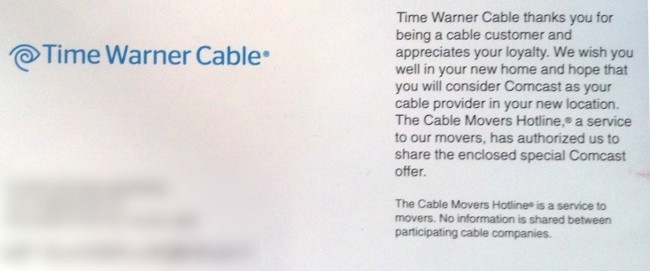
One reader of the Consumerist was perturbed when Time Warner Cable sent him a letter congratulating him for his decision to move... and welcoming him to consider Comcast Cable as his new provider.

Do you think Ford would ever send you a letter suggesting you give Toyota a try? Or would McDonald’s ever shoot you an e-mail telling you to check out the lovely Burger Kings in your new neighborhood? Of course not. So why would the cable industry not care which company you choose?

Consumerist reader Mike recently moved out of an area where he had no choice for cable TV other than Time Warner Cable to a town where Comcast is the only option.

[…] “What makes me even angrier is that they spent money printing and mailing this letter that only serves to remind me that I don’t have any choice!”

That mailer came courtesy of something called, “The Cable Movers Hotline,” which sounds like a clearinghouse for consumers searching for a moving company.  Indeed, the website for the group even includes video moving tips courtesy of HGTV’s Lisa LaPorta, David Gregg, senior editor, Behindthebuy.com, and interior designer Libby Langdon.

What’s the real story, morning glory? Don’t blow your wig, sister.  It’s coming.

In fact, the “Hotline” is a creature of CTAM – the Cable & Telecommunications Association for Marketing, a Maryland-based trade group that includes most of the nation’s largest cable operators as members.  CTAM’s “Hotline” is the cable industry’s attempt to make sure that fresh start in your new cave doesn’t include service from the dirty rat phone company or some grifter satellite TV provider with a flim-flam rebate scam.  With none of CTAM’s members willing to compete head-on with other cable operators, trading customers back and forth doesn’t hurt business, keeps the butter and egg man counting up those bills, and helps bleed you dry.

A 21st century clip joint?  You said it!

Don't thank us, it was nothing!

Cell Tower Sneakiness: Rogers Quietly Erects 50-Foot-High Cell Towers in Yards; Too Short to Regulate

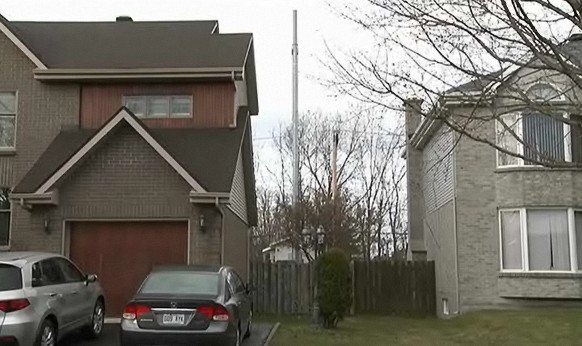
This nearly 15 meter monopole cell tower antenna just showed up one day in the backyard of this Kirkland, PQ resident, who is presumably being compensated up to $200 a month as Rogers' newest cell tower landlord.

Rogers Communications has found a solution to difficult zoning laws and cell tower controversy — find a homeowner willing to accept around $200 a month to host a (relatively) short cell tower antenna in their backyard, skirting the usual dragged-out cell tower siting consultations most local communities have enacted to control visual pollution.

A wealthy neighborhood in the community of Kirkland, a city of 20,000 near Montreal, discovered Rogers’ ingenuity for themselves when a just-under-50-foot monopole antenna suddenly appeared in the backyard of a home on Acres Street.

The neighbors are outraged. But Rogers says everything they did erecting the tower with no prior notice was done by the book.

That book, in the form of Industry Canada regulations, says Rogers doesn’t need to endure lengthy zoning hearings or a town-wide consultation process.  Rogers agrees, stating they can erect antennas of less than 15 meters at their pleasure — no consultation required.

Rogers spokesperson Stephanie Jerrold said Industry Canada regulations are clear: “The protocol says that if it’s a tower that measures under 15 meters, no public consultation is needed,” she said.

That may be true, but the loophole did nothing to appease dozens of nearby residents living in homes valued at $400,000 from raising a ruckus with local officials.  A petition has been submitted to city hall demanding Rogers remove the antenna.  Residents expressed concerns about their health and property values with a cell tower in their midst.

Rogers foreshadowed their intent last fall when they mailed letters to homeowners looking for someone to host the new antenna, offering around $200 a month to any takers. Evidently there was one — the resident at 75 Acres St.

City officials are pondering what to do about the new tower. They did not approve a work permit for its placement, which may provide leverage against Rogers, but no one knows for sure.

Thus far, Industry Canada wants to remain more than 15 meters away from the debate.  A spokesman for the agency, Antoine Quellon, told the West Island Gazette:

“The company must consult with the local community as required and address relevant concerns. It must also satisfy Industry Canada’s general and technical requirements, including Health Canada’s Safety Code 6, aeronautical safety, interference protection and environmental requirements. Under rare circumstances where an agreeable solution for a site is not possible, Industry Canada may need to make a determination based on the facts presented.”

[flv width=”400″ height=”380″]http://www.phillipdampier.com/video/CBC Montreal Backyard cell tower in Kirkland worries neighbours 4-11-12.flv[/flv]

CBC in Montreal covered the Kirkland controversy and talked with the neighbors about the new 50 foot pole owned by Rogers Communications.  (2 minutes)

Search This Site:

Contributions:

Recent Comments:

Your Account:

Stop the Cap!