Home » Issues » Recent Articles:

Updated: Bright House Charges $20 “Collection Fee” When They Call About Past-Due Bills

Phillip Dampier April 18, 2012 Consumer News, Video 20 Comments

Bright House Networks charges a $20 “collection processing fee” when the cable operator calls customers to remind them they have a past due balance. The fee, charged in addition to the company’s traditional “late charge,” has some Bright House customers upset.

The cable company explains the $20 “collection fee” is levied when a customer is two months past due and represents the costs of contacting the customer and “paperwork” inside Bright House’s offices.  But some customers consider it gouging, especially because they already pay a late fee.

Bright House Networks’ Residential Services Agreement implies a “collection fee” may only be charged when the company dispatches a representative to your home to request/collect payment for a past due amount (underlining ours):

If my Services account is past due and BHN sends a collector to my premises, a field collection fee may be charged. The current field collection fee is on the price list or can be provided on request. I will also be responsible for all other expenses (including reasonable attorneys’ fees and costs) incurred by BHN in collecting any amounts due under this Agreement and not paid by me.
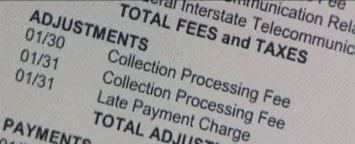
Bright House charges a $20 "Collection Processing Fee" when it calls past due customers.

It also appears the “collection fee” has been a part of the Bright House experience since at least 2009.  We found one customer from Ocoee, Fla. complaining Bright House was charging a $20 “collection fee” for cable service billed at less than $21 a month.

If you have been charged both past-due and collection fees by Bright House, ask them to waive the fees.  We found several customers who successfully requested the company forgive one or both charges when an account is brought up to date.

Customers having trouble paying Bright House should consider dropping services to lower the bill or negotiate for a retention deal.  Customers threatening to switch to the competition are often able to secure a substantially lower price for service.

Bright House’s reasons for charging the $20 fee seem dubious to us, unless the company actually dispatches an employee to a customer’s home to seek payment.  But then we’d find it difficult to recommend any company that would send an employee to visit a customer’s home demanding money.  Cutting off service to deadbeat customers is often effective enough to prompt a payment arrangement.

[flv width=”360″ height=”290″]http://www.phillipdampier.com/video/WOFL Orlando BrightHouse Late Fees 4-12-12.mp4[/flv]

WOFL in Orlando covers the case of one late-paying Seminole County man who is annoyed Bright House charges him $20 to let him know he is past due.  (2 minutes)

[Updated 3:59pm ET 4/19 — A Bright House representative reached out to emphasize the cable company charges a $20 collection fee only after not receiving payment for two months.  A collections agent is physically sent to the address to give notice of possible termination and at that time a collections fee is billed.  The company denies it bills this fee when calling customers to inquire about a payment.  This seems in keeping with the company’s residential customer agreement, quoted above.  We appreciate the additional information and are happy to pass it on to our readers.]

Fort Wayne Prefers Comcast Over Frontier Communications FiOS

Phillip Dampier April 17, 2012 Comcast/Xfinity, Competition, Frontier 2 Comments

A fiber optic network may be only as good as the marketing that sells it.

If that is true, Fort Wayne residents have made their choice, and they prefer Comcast Cable over Frontier Communications FiOS.

City officials released figures this week showing Comcast has a clear lead in the Indiana city.  Both companies pay the city franchise fees to do business in Fort Wayne, and Comcast paid almost $435,000, almost double Frontier Communications’ $262,556.

Ft. Wayne, Indiana

Frontier assumed control of the fiber optics network when it purchased the local assets of Verizon Communications.  But Frontier quickly found that volume pricing for video programming gave the old owner a decided advantage.  Frontier found programming prices for its comparatively smaller footprint far higher than what Verizon paid, and quickly began encouraging its fiber video customers switch to DirecTV satellite service.  Comcast responded with a billboard campaign that suggested Frontier was getting out of the fiber business, and encouraged customers to come back to cable.

Some did, but Frontier says it remains committed to its inherited fiber network, even though it lost over 10,000 customers last year.

“We’ve completed our evaluation of our business model and pricing,” Frontier’s Matt Kelley told the Journal-Gazette. “We’re offering an attractive bundle price. Customers are recognizing the quality and value, and that it’s a very compelling service.”

Frontier does appear to be serious about maintaining the broadband and phone service attached to its FiOS product, but has been looking for ways to bring down the wholesale cost of cable television programming and so far has shown no interest in expanding it.

“Our focus is not on FiOS video deployment,” Frontier CEO Maggie Wilderotter told investors in 2010. “The costs to install, set up and market new FiOS video customers are very expensive and, in our view, uneconomical.”

That’s less of a problem for Comcast, the nation’s largest cable operator.  It enjoys volume discounts few other providers can negotiate.  Comcast always had a built-in advantage associated with its incumbency.  Getting customers to switch providers isn’t easy.  But despite the presence of an advanced fiber optic network operated by the competition, Comcast has held on to customers.

“Our customers that are staying with us and joining us are enjoying our services, especially since the introduction of our Xfinity home security management system,” said Comcast’s Mary Beth Halprin, not missing an opportunity to pitch the cable company’s latest new product line. “The home security service costs $39.95 a month and provides around-the-clock monitoring and allows customers to watch live-streaming video from wireless cameras using an iPhone or iPad.”

Time Warner Introduces Live Video Streaming Enhancement for Android Devices, With Caveats

Phillip Dampier April 17, 2012 Editorial & Site News, Online Video 1 Comment

Found more new customers than AT&T

If you are among the handful of people with an Android phone or tablet running Android v.4 (also known as ‘Ice Cream Sandwich’), Time Warner Cable’s latest version of its TWC TV for Android app introduces live streaming video.

Available as of 3pm ET this afternoon from the Google Play store, TWC TV for Android finally brings streaming video to an app that used to only allow Android owners to browse an online program guide and remotely manage their DVR boxes.  Time Warner Cable originally introduced its TV Everywhere streamed video service on Apple’s iPad.

But the company’s decision to limit streamed video only to the latest Android devices running Ice Cream Sandwich (ICS) is a major disappointment and will leave a lot of Android owners with a hobbled app.

“It’s currently the only version of the Android OS that allows us the security and stability necessary to distribute video over our private network,” claims Time Warner Cable’s Jeff Simmermon. “But it’s up to the device manufacturer and the sometimes the data carrier when or if ICS will be deployed to a particular device.”

Simmermon suggested the iOS platform developed by Apple was easier to contend with because one company developed the operating system and the devices on which it operates.

If you upgrade to the latest version of TWC TV for Android running on a non-ICS phone, a notification warns that live streamed video remains unavailable to you, leaving the app about as useful as its earlier version, which is to say not very.  Simmermon also warns the upgrade is not available to “rooted” devices.

Smartphones purchased within the last year are likely to receive eventual upgrades to ICS, although exactly when depends on your wireless carrier.  Older phones may or may not receive upgrades.  As a general rule, the older the device, the less likely the manufacturer will be willing to keep upgrading it.

Verizon to Sell Super-Fast Broadband to Wall Street Traders

Phillip Dampier April 17, 2012 Broadband Speed, Competition, Verizon 3 Comments

While your phone company refuses to provide you with better than 3Mbps DSL, Verizon Communications is set to unveil its fastest broadband network yet — targeting Wall Street traders.

Verizon Financial Services is upgrading fiber between New York and Chicago and replacing routers, cutting round trip communications to as little as 14.5 milliseconds — 5 milliseconds faster than Verizon’s current network.

Why the need for speed?

To cut trading time to the bare minimum.  The Wall Street Journal reports that even shaving a few milliseconds off deals can mean the difference of millions of dollars.

As Wall Street and other commodities exchanges become increasingly automated, new opportunities to take advantage of tiny price fluctuations that occur over fractions of seconds can earn traders enormous profits from volume trading.  High frequency trading now represents more than half the volume on the U.S. stock exchanges.

Pricing for the new service was not available at press time.

Alleged Comcast Employee Tries to Deliver “Bulk Package” to Huntsville Woman; Gropes Her

Phillip Dampier April 17, 2012 Comcast/Xfinity, Consumer News, Video Comments Off on Alleged Comcast Employee Tries to Deliver “Bulk Package” to Huntsville Woman; Gropes Her

A man claiming to represent Comcast talked his way into a Huntsville, Ala. woman’s home last Wednesday, claiming he had to work with the cable line and do something about a bulk package. After gaining entry, he groped the woman, who was home alone.

“He decided when it was time to go he was going to try to put his hands on my breasts, and I told him that has nothing to do with Comcast – get out,” the woman told WAFF-TV in Huntsville. “Then he put his hands on my shoulders and sat me down in the chair like he was about to give me a massage and then touched my breasts. I said, ‘No, you have to get out.'”

The woman thought the man was a legitimate Comcast employee because he had company paperwork and seemed extremely knowledgeable about the company’s products and prices.  After she threw him out, he returned hours later, getting into what the woman thought was a personal vehicle.

“I didn’t know what to think but now looking back on it, I feel stupid because I’m always telling my friends check IDs, check their badge,” the woman told the station. “Look what happened to me.”

Comcast told the station they were cooperating with local authorities and shared this statement:

If anyone receives an unexpected visit by an individual claiming to be a Comcast representative, identification should be requested prior to allowing entry into the home. All Comcast employees and representatives are required to carry company-issued identification.

If there is any suspicion of a potential scam or other questions, the homeowner should call 1-800-COMCAST immediately to verify legitimacy.

Most telecommunications companies that do in-home work require employees to have clearly visible photo identification with the company logo.  Most companies will not send a repair person to a customer’s home without an appointment, although repair crews may conduct work outside of the home on nearby poles without prior notice.  If an unexpected technician arrives at your door, ask the individual to display credentials through a nearby window or peephole.  Call the provider for verification, and do not open your door until appropriate verification has been obtained.

[flv width=”640″ height=”500″]http://www.phillipdampier.com/video/WAFF Huntsville Woman groped by man claiming to be with Comcast 4-16-12.mp4[/flv]

WAFF in Huntsville talked with a local woman who was groped by a man claiming to work for Comcast Cable.  (Warning: Loud Volume) (4 minutes)

Search This Site:

Contributions:

Recent Comments:

Your Account:

Stop the Cap!