Home » Issues » Recent Articles:

AT&T Forces Texas Customers With DSL to Take “Free U-verse” Upgrade That Costs $337

Phillip Dampier June 4, 2012 AT&T, Competition, Consumer News 1 Comment

Our-verse

Last week, Stop the Cap! reported AT&T customers in Connecticut were being told to dump their long-standing DSL service in favor of a forced upgrade to AT&T U-verse. Now some Texans are in the same boat, only that “free upgrade” AT&T offered ended up costing one angry customer $337.

The Star-Telegram found Judith Hedges, who reports she was bullied and intimidated by AT&T’s increasingly threatening letters warning if she did not upgrade her Internet connection to AT&T U-verse, her DSL service will be summarily disconnected.

AT&T pulled the plug last week, leaving Hedges without Internet service.

Consumer reporter Dave Lieber writes, “AT&T has found a new way to lure customers to its supposedly faster U-verse service: Force them to take it.”

As AT&T installs U-verse fiber to the neighborhood service, the company has decided to stop investing in its older DSL technology, and when conditions are right, the company sends letters to their existing DSL customers imposing an “upgrade” to U-verse.

Hedges suspected the threatening letters were part of a high-pressure sales pitch to add TV and phone service, services she did not want, so she tossed the letter away. Big mistake.

AT&T is giving out different answers as to when and why they are forcing DSL customers to switch to U-verse. One told Lieber the company is now introducing forced upgrades wherever U-verse becomes established, another told the reporter the choice remains with the customer as long as the company does not decommission its DSL service in a particular exchange.

AT&T told the newspaper “the large majority of existing customers we’re reaching out to can upgrade to the same-speed package on U-verse without an increase to their broadband bill.”

But that does not always turn out to be true. Hedges signed up for the “free upgrade” to get her service back and promptly found it was more expensive than what she had. In fact, the company loaded her first bill with add-on equipment fees, installation charges, surcharges, taxes, and fees:

  • AT&T U-verse temporary promotional rate: $29.95
  • Internet Gateway fee: $100
  • Installation: $149
  • Taxes, fees, and surcharges

The total price for Hedges “free upgrade?” $337. AT&T will reserves the right to bill her a late fee if her check is not forthcoming.

“Apparently, this is the world we live in,” Hedges says. “And AT&T reigns supreme.”

Vidéotron Announces 200Mbps Service for Quebec City, Beating Bell’s 175Mbps

Phillip Dampier June 4, 2012 Bell (Canada), Broadband Speed, Canada, Competition, Consumer News, Vidéotron Comments Off on Vidéotron Announces 200Mbps Service for Quebec City, Beating Bell’s 175Mbps

Quebec City residents are enjoying the benefits of an Internet speed race between incumbent cable operator Vidéotron Ltée and telephone company Bell, with both bringing some of Canada’s fastest Internet speeds to the provincial capital.

Vidéotron Ltée announced it will introduce 200Mbps service in the city after completing a network upgrade. The company was undoubtedly responding to increasing competition from Bell, which is installing fiber optic upgrades in the city and selling speeds up to 175Mbps to area consumers and businesses.

The cable company has faced Bell’s Fibe TV service and has lost customers as a result. Now, Vidéotron is trying to regain its footing with upgrades of its own, including the introduction of Illico, which expands on-demand options and provides flexible access to recorded shows on computers, phones, and tablet devices.

Bell’s personal video recorder (PVR) set top box lets customers watch recorded programs on any television in the home, and can also record multiple concurrent shows. Vidéotron hopes Illico will help expand viewing options further for their customers.

Happy Days Are Here for Verizon Wireless Stockholders Over End to Unlimited Data

Phillip Dampier June 4, 2012 Consumer News, Data Caps, Verizon, Wireless Broadband 9 Comments

Forbes magazine reports that Verizon Wireless shareholders can expect the company to enjoy fatter profits and reduced capital expenses from the upcoming deletion of grandfathered unlimited data from the company’s roster of data plans.

Trefis, a Wall Street analysis firm that uses MIT-developed modeling technology to predict future company performance, reports Verizon is on the verge of “monetizing every last byte of data that is transferred on its network.”

Verizon’s decision to end unlimited — announced by the company’s chief financial officer at a recent Wall Street conference, will compel customers upgrading to a 4G-capable phone to forfeit their unlimited plan in favor of tiered data.

With Verizon’s 4G network up and running in a large cross section of the country, the wireless carrier has an interest in moving customers to its more efficient LTE platform, which can sustain greater data traffic. With a de-emphasis on 3G, Verizon will be able to reduce capital investments required to maintain that older technology, yet enjoy the financial benefits monetized data usage will bring.

Verizon also plans to introduce shared family data plans, letting customers share a single usage allowance across multiple data devices. But Trefis warns Verizon it must avoid pricing that plan too low, because it could cannibalize the average fees collected from each subscriber (ARPU) who would otherwise have to pay Verizon for a data plan for every device. Instead, Trefis recommends Verizon price family share data plans in a way that keeps ARPU levels stable, which means consumers would not see much savings from the plans.

More importantly, shared data plans will set the stage for explosive wireless data revenue growth in the future, as customers get used to paying connectivity charges for every wireless device, appliance, automobile, and other future technology that supports so-called “machine-to-machine data exchanges” that could become commonplace in the next few years.

“Done right, Verizon could see higher ARPU levels in the coming years as subscribers increasingly use data intensive applications on its speedier 4G network and the carrier is able to monetize every byte of data that the subscribers use with its tiered data buckets,” Trefis recommends.


Verizon FiOS Rate Increases Announced; Tempered By Faster Service for Some

Phillip Dampier June 4, 2012 Broadband Speed, Competition, Consumer News, Verizon 3 Comments

Verizon FiOS standalone broadband customers choosing the company’s standard service will see rate increases of $10 a month starting June 17, but those upgraded to the company’s premium speed tiers, which are getting much faster, may not see any rate hike at all.

The Verge received word from an anonymous Verizon employee who passed along the rate hike information that will apply to broadband-only customers:

  • Standard 15/5Mbps service: (Was $54.99/mo) now up $10 to $64.99
  • 50/25Mbps service: (Was $74.99/mo for 25/25Mbps) remains $74.99
  • 75/35Mbps service: (New offer) $84.99
  • 150/65Mbps service: (Was $94.99/mo for 50/20Mbps) remains $94.99
  • 300/65Mbps service: (Was $199.99/mo for 150/35Mbps) now $204.99

All new pricing requires a two-year contract (month-to-month service costs $5/mo more) and home phone service with Verizon (or pay a $5/mo surcharge). Speeds of 150 or 300Mbps require a 2-4 hour service call and upgrade fee of $100 for new equipment unless you are on a two-year contract, are a new customer, or already have Verizon’s 150Mbps service. Customers living in multi-dwelling units served by VDSL and not fiber-to-the-apartment will pay the new higher price for standard service, but cannot receive the new enhanced speed tiers.

With the majority of Verizon customers paying only for standard speed service, Verizon will pocket significantly higher revenue for broadband. But customers need not pay for more expensive a-la-carte broadband. Verizon offers significant discounts for customers who sign up for triple play packages on phone, Internet, and television service. Bundled customers continue to get the most bang for the buck, but not if you don’t use the services Verizon wants to sell.

Jonathan Takiff, a columnist for the Philadelphia Daily News says he isn’t buying at the prices Verizon is charging.

I also was disappointed with the announcement that Verizon will continue to offer entry level FiOS Internet running at  15/5 Mbps. If the operation has such superior technology and capacity, why not flaunt it and give us casual users more headroom?  Even with its old school coaxial cable network, Xfinity service starts at 20 Mbps down.

Clearly, Verizon hopes  to up-sell customers to a higher, more profitable tier. And they’re using that grandiose 300 Mbps offering as an attention getter, to get folks thinking more aspirationally. Kinda like the way a car company throws a high powered, ridiculously priced, super flashy sports car into the showroom mix. Makes you go for the bigger engine in the econobox.

[…] What’s a good deal for Internet service on a global basis? In front-running Japan, the  average service runs at 61 Mbps and costs 27 cents per megabit, per month. While not quite as dramatic,  Internet services in South Korea, Finland and France also make U.S. providers look like stingy bastards.

Rogers Relents: Company Starts to Give on Controversial Backyard Cell Towers in PQ

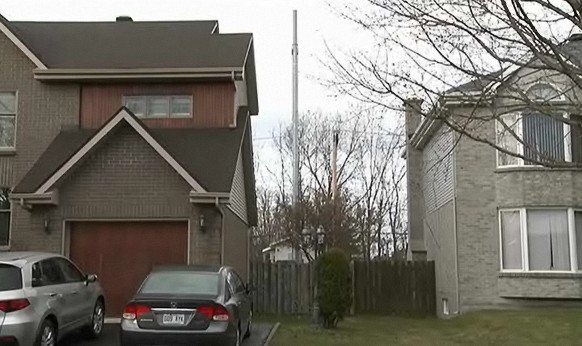
This monopole cell tower antenna just showed up one day in the backyard of this Kirkland, PQ resident.

Kirkland, Que. residents are encouraged by news Rogers Communications has begun to relent on installing nearly-15 meter-high monopole cell towers in residential neighborhoods after the company agreed to relocate a similar antenna in Dorval.

Neighbors in both communities are upset Rogers has located new antennas that tower over homes and trees in residential areas, often in the backyards of residents who permit their presence in return for a monthly check.

The Dorval tower was particularly obtrusive to residents, installed in a city right-of-way adjacent to Morris Avenue. Residents there complained about possible health effects of the nearby tower, and called it an eyesore.

Rogers has now agreed to relocate the antenna to the nearby Sarto Desnoyers Community Centre at company expense.

When the new towers suddenly appear, nearby neighbors feel sandbagged. One Kirkland resident told The Gazette the towers are monstrosities. But Rogers is within the law if it keeps the towers below the 15 meter mark, and the company does not require advance zoning or government approval.

Rogers defends the towers, claiming the unprecedented demand for cellular service requires the company to get creative in finding new places to fill in coverage gaps. Unfortunately, with a shrinking number of suitable commercial or industrial locations, the company has been forced to consider residential installations.

Stop the Cap! has been following the Kirkland tower saga for several weeks. The Gazette reports no immediate progress has been made to get Rogers to relocate that specific antenna, but the company’s responsiveness in Dorval gives local officials and residents optimism an agreement can be reached in Kirkland as well.


Search This Site:

Contributions:

Recent Comments:

Your Account:

Stop the Cap!