

 Subscribe
No service.
Despite New York Gov. Andrew Cuomo’s $500 million, 2015 Broadband for All initiative which guaranteed broadband service for anyone that wanted home internet access, five years later rural broadband gaps continue to plague the state.
A bill that would set aside funds to complete a feasibility study to launch a state owned broadband provider of last resort was quietly vetoed by Cuomo at the end of 2019. Assembly member Aileen Gunther (D-Monticello) sponsored the bill after hearing scores of complaints about terrible or non-existent internet access from constituents in her district, which covers the parts of the rural Catskills region north of the Pennsylvania border.
Gunther complained that despite the governor’s broadband initiative, private phone and cable companies were still ignoring rural customers, leaving them with slow DSL service or no internet access at all. Gunther’s bill was a first step in potentially allowing the state to step in and provide service to New Yorkers unable to get broadband from any private provider.
New York has spent over $500 million on its Broadband for All program and made Charter Spectrum an integral part of its broadband expansion plans in return for approval of its 2016 acquisition of Time Warner Cable. But a growing number of the governor’s critics claim the program has failed to deliver on its mandate, stranding thousands of New Yorkers without internet service and tens of thousands more with just one option — unpopular satellite internet access.

Gunther
Gunther was upset to learn that New York was prepared to hand over more than a half billion dollars to large private telecom companies including Frontier Communications and Verizon while not being willing to spend a penny to fund projects to reach New Yorkers for-profit companies could not be dragged kicking and screaming to service.
“We’re all spending millions and millions of dollars on privately owned internet service providers,” said Gunther. “In return for promises, a lot of our communities do not have access to the internet, or if they do have access to the internet, it’s slow and these companies are not, I think, fulfilling the promises made.”
The rural broadband problem is not resolved in the Finger Lakes or Southern Tier regions of New York either. This week, Yates County announced it was joining an effort by Schuyler, Steuben, and Tioga counties, and the Southern Tier Network, to complete a broadband feasibility study to improve internet access in the four counties. Fujitsu Broadband will manage the study and hopes to have results by June. The study will target the pervasive problem of inadequate broadband service in the region, which includes crucial tourist, winery, and agricultural businesses vital to New York’s rural economy.
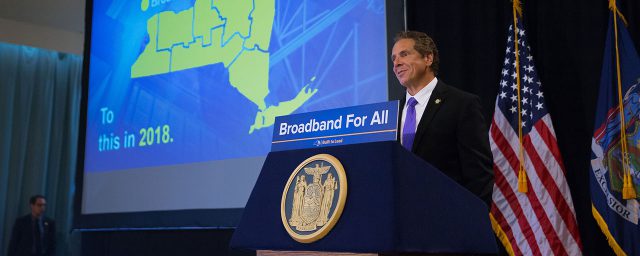
Gov. Andrew Cuomo announcing rural broadband initiatives in New York in 2015.
Gov. Cuomo has called such initiatives “well-intentioned” but was non committal about contributing more state funds to construct new networks or underwrite further expansion of existing ones. New York is about to begin its annual hard-fought budget negotiations in hopes of completing the state budget by April. Finding funding for such projects will probably require a powerful political advocate able to wrestle funding for further broadband improvements.
Even after spending $500 million, New York’s rural broadband problem has not been resolved. That offers insight into the merits of other state broadband programs, which often limit annual broadband expansion funding to under $30 million annually.
Those still without service are likely in high-cost service areas, where each customer could cost over $20,000 to reach. New York’s Broadband for All program relied on a reverse auction that required private companies to bid to service each unserved address. No wireline provider bid on any high-cost service areas, leaving Hughes Satellite as a subsidized satellite provider of last resort. But inadequate broadband mapping left scores of rural New Yorkers behind without even the option of subsidized satellite internet access.
 Comcast and Charter Communications have begun to compete outside of their respective cable footprints, potentially competing directly head to head for your business, but only if you are a super-sized corporate client.
 But neither company wants to end their comfortable fiefdoms in the residential marketplace by competing head to head for customers. Companies claim it would not be profitable to install redundant, competing networks, even though independent fiber to the home overbuilders have been doing so in several cities for years. It seems more likely cable operators are deeply concerned about threatening their traditional business model supplying services that face little competition. In the early years, that was cable television. Today it is broadband. Large swaths of the country remain underserved by telephone companies that have decided upgrading their deteriorating copper wire networks to supply residential fiber broadband service is not worth the investment, leaving most internet connectivity in the hands of a single local cable operator. Most cable companies have taken full advantage of this de facto monopoly by regularly raising prices despite the fact that the costs associated with providing internet service have been declining for years.
 The malware activates the moment a user powers on their phone for the first time. Most customers will simply be annoyed if ad-related apps automatically install, but with a security-compromised phone opening the door to more malware in the future, this “lowers the bar on bad behavior by app development companies,” according to Collier.
 “It’s very much a mobility strategy, with a secondary product of Home [5G], rather than us changing our overarching mobility deployment to try to accelerate Home at the expense of the overall 130 million customer base,” Dunne explained.
 In some cases, customers are being turned over to the collection agency for as little as an allegedly unreturned remote control. As a result, consumers are ending up with damaged credit because of the reported collection activity.