Home » Issues » Recent Articles:

AT&T, Verizon Profit From Illegitimate Cramming Charges on Customer Phone Bills

Phillip Dampier March 30, 2010 AT&T, Consumer News, Editorial & Site News, Verizon 7 Comments

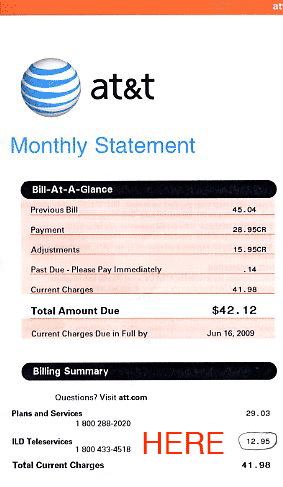
This AT&T customer was billed $12.95 in cramming charges. (Click image for more information)

AT&T and Verizon are among the top recipients of ill-gotten gains from so-called “cramming” incidents — customers who find unauthorized charges on their phone bill placed there by third party companies that maintain a cozy billing relationship with the two phone companies.

Boston-area resident Mike Cunningham paid $567 in phone charges billed “conveniently” to his Verizon Wireless phone bill.  Only he didn’t authorize them.

Cunningham recently sat down and reviewed nearly two years’ worth of dozen-page phone bills scrutinizing them for unauthorized charges.  Speaking to the Boston Globe, Cunningham didn’t initially notice the “enhanced voice mail’’ charges of $14.95 and $13.22 buried on pages five and six.  That’s not surprising, since many Verizon Wireless customers are now billed online and most customers don’t wade through multi-page online billing statements.

After Cunningham added several years of these monthly charges up, totaling $567, that got his attention.

Cunningham was billed by ILD Teleservices Inc., which said Cunningham’s grandson — then 10 years old — ordered its services while on a website that offers free video games. Cunningham said his grandson, who doesn’t have a cellphone, did not intentionally order voice mail — and knew nothing about it.

ILD generates an enormous number of complaints about unauthorized charges placed on consumer phone bills.  The company describes itself as a leading payment processor of online transactions between merchants and consumers, processing more than 120 million billing transactions per year totaling $500 million of third party charges placed on telephone bills.  Although the company claims to put its potential clients through a rigorous screening process, the avalanche of customer complaints, including the fact a 10-year old was able to be victimized by one of ILD’s clients, suggests otherwise.

Even worse, companies like AT&T and Verizon profit handsomely from fees paid by payment processors like ILD to gain the lucrative ability to charge customers’ phone bills for services, ordered or otherwise.  With a profit incentive to protect, consumers are getting the short end of the stick when calling Verizon or AT&T to complain.  More often than not they pass the buck (while keeping the change for themselves) back to the third party billing agency to try and secure refunds.

Only a staggering amount of potential earnings from such billing practices would seem enough to make risking the customer’s relationship with their phone company worthwhile.  After customers spend hours dealing with unruly and hostile customer service representatives working for such billing agencies, there is little chance that customer will be endeared to the phone company that put them through the nightmare in the first place.

Susan from Ambler, Pennsylvania is an excellent example:

“ILD Teleservices placed a charge on my Verizon phone bill for a service that was not requested, authorized or that would even work (ringtones for a land line!) on Feb 22, 2010. When I called Verizon to question the bill, they informed me the charge was not a Verizon charge but from a third party company,” she told Consumer Affairs.

David in Galt, California was billed by ILD on his AT&T phone bill for ordering a service over his home computer, an amazing feat considering he doesn’t have one.

I received a charge of 14.95 on my AT&T phone bill from ILD Teleservices. They claimed that someone in the household went online and ordered the service. We did not have the capability to do that with no computer at the house,” he writes.

More than 3,000 complaints have been logged against ILD by Consumer Affairs, with customers highly annoyed that their phone companies refuse to stand by them when illegitimate charges show up on their phone bills. John from Wisconsin got no help from AT&T when identify theft allowed someone to add unwanted services to his phone bill under his wife’s name.

It turns out someone signed him up for TotalContactSolutions, a Florida-based company that charges $14.95 a month to alert up to 10 people with text or voice messages “during catastrophic events such as terrorist attacks or natural disasters.”  Perhaps the service will come in handy to contact those 10 friends and family members when you discover the charges on your phone bill and pass out on the floor.

John reports his credit rating is being terrorized by a company that refuses to refund the unauthorized charges unless he can prove, with an e-mail from AT&T no less, that nobody could have signed up for the service from John’s home.  Unfortunately for John, AT&T’s surveillance of its customers doesn’t extend that far, and the company refused to forgive the charges, instead threatening him with collections.

Unfortunately, your tax dollars are hard at work paying for state utility commissions, the Federal Communications Commission, and consumer service agencies to assist consumers who are victimized twice by cramming charges — once by Verizon or AT&T for allowing them on their bills in the first place, and a second time trying to deal with a third party company to reverse them.

A Boston Globe review of more than 200 cramming-related complaints from consumers — filed with the Massachusetts Department of Telecommunications and Cable and the attorney general since 2007 — found that state workers reviewing complaints sometimes spent hours trying to resolve a single one.

The case of Soren Jensen, a retired engineer who lives in Duxbury, is typical. Jensen said he spotted four charges of $9.99 apiece for text messages on his wife and son’s cellphone bills starting in 2008. There was a common thread: Jensen’s wife and son said they had both taken IQ tests online, entering their cellphone numbers to receive the results. He suspected they mistakenly signed up for text messaging in the process.

After reviewing the fine print on his bill and doing some online sleuthing, he found Verizon Wireless had an agreement with Solow, a computer gaming website that contacts players using a text message service that charges $9.99 per message.

Jensen said he called Verizon Wireless to complain, and the company agreed to remove one of the $9.99 charges.

“I just don’t get why Verizon doesn’t want to protect us, as the customer,’’ Jensen said. “Verizon should not allow this kind of stuff. It raises a lot of questions.’’

The answers aren’t difficult to find when you follow the money.  Both AT&T and Verizon collect plenty from fees charged to cramming companies and billing agencies for the right to bill their services directly on your phone bill.  Neither company will disclose exactly how much they profit from such arrangements, but they are clear about who is responsible when mystery fees turn up on your phone bill:  you are.

Both companies told the Boston Globe they “encourage customers to scrutinize their bills to make sure they are not improperly charged for services.”

And they make that very easy by labeling mystery fees with such helpful billing descriptions as “enhanced calling service” or “enhanced voicemail.”  One of Stop the Cap!‘s readers was billed for services described as an “enhanced recovery fee” and another for “customer support and assistance.”

Verizon claims complaints about third-party charges are “infrequent” and says customers can contact the company and block all third-party charges from their bills, something we strongly recommend you consider doing before being victimized.

AT&T won’t go that far.  It told the Globe:

AT&T, which also allows third-party billing, advises customers to direct their complaints to the company assessing the fee. Names of third-party vendors are disclosed on AT&T bills, the company said. “AT&T’s third-party billing contracts require service providers to address cramming complaints appropriately, including issuing credits if customers have been crammed,’’ an AT&T spokeswoman said in an e-mail.

But AT&T is still in the business of scaring its customers.  TotalContactSolutions maintains a required AT&T customer disclaimer on their website, which includes several states where AT&T can disconnect your phone line over billing disputes:

You have the right to dispute the Employee Notification Services charges billed on your local telephone bill. You are not legally responsible for Employee Notification Services charges incurred by minors or vulnerable adults without your consent. Your local telephone service will not be disconnected because you fail to pay a charge by Employee Notification Services, except that nonpayment of certain regulated telecommunications charges may result in disconnection of service in AL, FL, GA, KY, LA, SC, and TN.

And we know what phone company lobbied their way into obtaining the right to cut your service off if you don’t pay, don’t we?

In the end, Cunningham got refunds for the unauthorized fees on his Verizon Wireless bill, after the companies discovered a minor child was involved.

ILD claims to have sent Cunningham $1,000 in coupons as part of a settlement, something Cunningham claims is a lie.  Cunningham is better off without them.  The $1,000 in coupons ILD offered is suspiciously similar to an offer from another ILD client that promises that amount in grocery coupons you can print on your computer… if you sign-up for enhanced voicemail service for $12.95 a month.

Was this the $1,000 in "free coupons" offered to Mike Cunningham? If so, it comes with some very expensive strings attached.

Cunningham is so disgusted with Verizon Wireless for putting him through this ordeal, he wanted to cancel his service and move on.  But Verizon knows how to hold customers captive.  Instead of sending him a refund check for $567, they applied it as a credit that can only be redeemed by remaining a Verizon Wireless customer until the credit is exhausted.

“It’s like salt in the wound,’’ he told the Globe. “I can’t leave. I’m a captive audience.’’

Stop the Cap! notes the Federal Communications Commission is overwhelmed with cramming complaints that number well into the thousands every year.  Since telephone companies refuse to stand up for their customers, it is imperative that the FCC order phone companies to stop allowing all third-party billing unless and until a customer “opts-in” to such billing, in writing.  No third party “opt-in” requests should be permitted, and customers should not have to chase their phone companies to opt-out of a service that has a built-in profit incentive for funny business, fraud, and costly scams that cost customers enormous time and money to resolve.

[flv width=”640″ height=”500″]http://www.phillipdampier.com/video/CBS News Cramming Charges 2-23-08.flv[/flv]

The CBS Evening News ran this item about cramming charges and the problems they cause customers more than two years ago, interviewing a representative from Verizon Wireless.  Very little has changed as the money, and complaints, keep pouring in.  (3 minutes)

[Updated] Verizon FiOS Winds Down Buildouts – If You Don’t Have It Now, You’re Not Getting It

Verizon Communications is indefinitely finished expanding FiOS — its fiber to the home triple-play package of broadband, phone, and TV — to new cities across its service area.  In short, if your community isn’t already engaged in franchise negotiations with the telecommunications company, there is no fiber from Verizon in your immediate future.

The company said after spending $23 billion upgrading its aging copper wire phone network, it needs to finish construction and improve its reach in existing FiOS-wired communities.  When the company ceases FiOS construction, it hopes to pass 18 million customer homes across its multi-state service area.

The decision to stop expansion of advanced fiber optics threatens to leave hundreds of communities behind, too late to the party or simply too far down Verizon’s priority list.  Among important cities Verizon will pass up include Alexandria, Virginia, Boston and Baltimore.

That concerns city officials, especially in Baltimore which already considers itself on the disadvantaged list.

“My take on it is that Baltimore is not equipped for the future,” Rev. Johnny Golden, past president of the Interdenominational Ministerial Alliance and an advocate for improved access to technology in the city told the Baltimore Sun. “We have a decent broadband system for today, but it does not have the infrastructure to take us into the future where we need to go.”

Despite the fiber bypass, the company will continue negotiations with about a dozen communities where negotiations were already underway – mostly in New York, Massachusetts, and Pennsylvania.  Despite company spin, the decision to drop the shovels and wheel away the spools of fiber does represent a dramatic change of plans, evidenced by the company’s decision to bypass the aforementioned lucrative urban communities.

For cable companies like Comcast and Time Warner Cable, Verizon’s announcement brings a sigh of relief.  Both cable operators handily beat Verizon’s DSL offerings and are swiping increasing numbers of Verizon’s phone customers who are disconnecting their landline service in favor of cell phones or “digital phone” service from the cable companies.

Both Time Warner Cable and Comcast have also kept a larger percentage of their customers than Verizon hoped.

In markets where FiOS is available, Verizon has only achieved 25% penetration for television service and 28% for Internet, far below the 40 percent penetration Verizon CEO Ivan Seidenberg hoped to achieve.  The reasons consumers didn’t switch to Verizon FiOS vary, but include:

  • Pricing was not always lower than what the incumbent cable operator offered, and in many cases prices for some service were higher once the promotional rate expired;
  • Cable operators in competitive areas improved service, offered more aggressively priced bundles, and increased broadband speed;
  • Many cable operators locked their customers into two year “price protection agreements” which hold customers in place until agreements expire (if they don’t auto-renew);
  • Installation can prove disruptive because of the elaborate rewiring required in many homes;
  • Consumers didn’t see enough compelling reasons to switch.

Seidenberg

Still, Verizon has future-proofed their fiber optic service areas and are better positioned to deliver extremely high broadband speed and HD offerings than their cable counterparts.  But that has never impressed short-term focused Wall Street.  Many in the financial press have attacked Verizon for the costly fiber upgrades they believe will not work for the short-term investor seeking immediate return from their Verizon stock purchase.  With the rumor mill predicting upcoming retirement for Seidenberg, his likely successors are hardly FiOS fanboys.

John Killian, Verizon’s current chief financial officer, is a short-term results man.  Samuel Greenholtz, an analyst with the Gerson Lehrman Group, doesn’t see Killian sharing much of Seidenberg’s visionary long term thinking.  Lowell McAdam, another prospect for the top job, is currently the president of the Wireless Services division, and would likely bring a wireless “solution” for broadband customers left off the FiOS list.  Neither man seems particularly interested in restarting the push for fiber in the future.

For 2010, capital expenses are flat or down across the company except in the Wireless Services division.  Verizon already declared copper phone wiring dead, and has elected to abandon its rural and suburban customers,  systematically sold off to America’s “rural phone companies” Frontier, CenturyLink, or Windstream.  Those still with Verizon but without FiOS will find the future of their landlines increasingly perilous.  Greenholtz notes Verizon has terminated another 1,200 line technicians and the company intends to spend two percent less on its copper wire network this year over last.

Greenholtz witnessed first hand what happens when a company starts to ignore its legacy network — his residential phone line quit working:

Having worked at Verizon and its predecessors for over 25 years, I expected a fix would be swift and trouble-free.  Wrong. I was offered a two-week appointment date for repair people to come out and look at the problem. I might add here that my wife does not use the cellular device that she carries around anymore than necessary and certainly never uses it when in close proximity to the hardwired set. By resorting to measures that I certainly would never have thought of using 10 years ago, I was able to get attention brought to the problem much quicker — and the issue has been resolved satisfactorily.

It seems that Verizon’s residential repair and maintenance has sunk to a new low.  Neighbors and other people on copper cabling are often experiencing problems. If there is static on the line, subscribers are frequently told nothing can be done to correct the situation because they need to replace the cable or do cable maintenance – but there is no budget available to do the work.   So, repairmen take the brunt of the public’s unhappiness with the service they are receiving. In contrast, when I spoke with some friends regarding FiOS and its maintenance issues, I found a much better response time to any difficulties the customers were experiencing.

Shockingly for a Wall Street-focused “expert network,” Greenholtz was allowed to offer his belief the only real solution to phone companies ignoring their undesirable customers is to regulate the heck out of them.

What can be done to cure the situation with residential landline services?   Unfortunately, it is going to have to come down to regulation.  Verizon, and no doubt, AT&T, has been doing what they want for many years now.  The PUCs have given them a lot of opportunities to offer advanced services that the commissions thought would spread throughout the serving areas, but they are increasingly realizing that is not in the plans.  They are going to have to force these companies to be responsive to the needs of the entire footprint, not just the Fortune 500 territories — and the nearby residential homes.

[Update 4/1/2010: While working on another story, I was amused to discover we had written about Mr. Greenholtz before, back on April 15th, when he was telling his readers “do-gooders” forced Time Warner Cable to attempt usage caps on customers.  I wonder if we would have heard something different from him had his broadband service faced an Internet Overcharging scheme.]

Blind deregulation and legislative-friendly handouts to companies like AT&T and Verizon have never resulted in better service for consumers.  They haven’t proven to save consumers any money either.  Ultimately, the decision to provide FiOS and U-verse came with investor consent, and when the economic downturn threatened the value of the stock and dividends, no deregulation or statewide franchise agreement is going to keep the fiber party from coming to a close.

[flv]http://www.phillipdampier.com/video/WSYR Syracuse Verizon FiOS Winds Down 3-26-10.flv[/flv]

WSYR-TV in Syracuse reports on the demise of Verizon FiOS’ expansion plans, which have a significant impact on central New York where many communities will be left behind.  One saving grace for New Yorkers ticked off at Albany — they’re now off the FiOS list indefinitely.  (2 minutes)

Wall Street Journal Report: Verizon iPhone Could Arrive By June

Phillip Dampier March 30, 2010 AT&T, Broadband Speed, Competition, Verizon, Video, Wireless Broadband Comments Off on Wall Street Journal Report: Verizon iPhone Could Arrive By June

Apple iPhone

The Wall Street Journal reports Apple is developing two new iPhones for launch this June, including one that’s designed to work with Verizon Wireless.

According to the report, the new iPhone models can run on CDMA networks, such as the one Verizon Wireless uses.  The introduction of such a phone would mark an end for the three year exclusivity agreement Apple has with AT&T in the United States.

“There has been lots of incorrect speculation on CDMA iPhones for a long time. We haven’t seen one yet and only Apple knows when that might occur,” an AT&T spokesman told the Wall Street Journal.

For AT&T, the Apple relationship has been crucial, helping to make the carrier the U.S. leader in lucrative smart-phone market share. According to comScore Inc., AT&T has over 43% of all U.S. smart-phone customers, compared with 23% for Verizon. These customers are especially attractive because they generally pay higher monthly rates for data plans.

For several quarters, AT&T’s growth has come almost single-handedly from the iPhone. In the fourth quarter of 2009, the carrier said it activated 3.1 million new iPhones. In comparison, it counted only a net total of 2.7 million new subscribers as some customers moved from other phones to iPhones.

“You’re not going to lose the iPhone [exclusivity] and make up growth somewhere else without bearing the cost,” said Sanford C. Bernstein & Co. research analyst Craig Moffett.

The impact on Verizon Wireless data network will be an important measure of whether American wireless broadband networks can sustain the demand customers have for wireless broadband service and speed.

[flv]http://www.phillipdampier.com/video/CNBC Verizon Getting iPhone 3-29-10.flv[/flv]

CNBC carried three reports about the Verizon Wireless iPhone story published in the Wall Street Journal and its potential impact on the American wireless marketplace.  (11 minutes)

[flv width=”512″ height=”308″]http://www.phillipdampier.com/video/Wall Street Journal iPhone On Verizon 03-29-10.flv[/flv]

The Wall Street Journal included this “web-extra” report on their story and what it means for consumers.  (2 minutes)

AT&T Diverts Salt Lake City 911 Calls to Seattle

Phillip Dampier March 29, 2010 AT&T, Consumer News, Video Comments Off on AT&T Diverts Salt Lake City 911 Calls to Seattle

AT&T may have put the safety of its Salt Lake City customers at risk by diverting cell phone 911 calls intended for local authorities to a 911 call center in Seattle, Washington hundreds of miles away.

Starting last Thursday, AT&T customers who tried to report an emergency by dialing 911 ended up speaking with confused operators in Seattle who couldn’t understand why customers were calling them about problems several states away.  Company officials took until the following day to fix the problem, and it took calls from a local television station to alert local officials and the company that a serious problem existed with the area’s 911 system.

Although the problem has now been fixed, company officials have not released an explanation about what caused the glitch.

[flv width=”480″ height=”380″]http://www.phillipdampier.com/video/KSL Salt Lake City ATT mysteriously directing Salt Lake 911 calls to Seattle 3-25-10.flv[/flv]

KSL-TV broke the story about the 911 diversion, interviewing one customer whose local Salt Lake City cell phone mysteriously reported his caller ID as in Seattle, Washington.  Part two of this report is from the following day, after service was restored. (4 minutes)

Comcast’s “All-Digital Migration” Hits Denver – Analog Customers Will Need Digital Boxes Or Face Loss of Channels

Phillip Dampier March 29, 2010 Broadband Speed, Comcast/Xfinity, Video 5 Comments

Denver, Colorado

Comcast, like Time Warner Cable, is slowly transitioning many of its traditional analog channels to digital, making more room for additional HD channels and faster broadband.  The latest city about to experience what Comcast calls its “all-digital migration” is Denver, Colorado.

“As part of the technology enhancement, Comcast is making available up to three devices to customers so they can hook up their (analog) televisions and not miss any channels,” said Cindy Parsons, a spokesperson for Comcast in Denver.  “What this allows us to do is provide hundreds of HD channels in the future, faster Internet speeds, better picture quality, and more ethnic programming.”

Customers with any level of service above Limited Basic with an existing digital set-top box may receive two digital adapters at no additional monthly cost; customers without an existing digital set-top box may receive one standard digital set-top box and two digital adapters at no additional monthly cost.

Parsons claims up to 90 percent of Comcast’s Denver customers already subscribe to digital cable on at least one television set in the home.  Comcast is offering free self-install kits through its Digital Now website.

Comcast intends to commence the transition to digital channel delivery starting this spring continuing into the summer.  The entire state of Colorado will follow, with the transition to digital complete by the end of the year.

Of course, customers with many analog televisions, or who dislike the notion of having to deal with add-on equipment, are out of luck.

[flv]http://www.phillipdampier.com/video/KUSA Denver Comcast Digital Upgrade.flv[/flv]

KUSA-TV Denver talked with Comcast’s Cindy Parsons about the city’s imminent “all-digital-migration” to digital cable television. (3 minutes)

Search This Site:

Contributions:

Recent Comments:

Your Account:

Stop the Cap!