Home » Online Video » Recent Articles:

Transformational Google Fiber: Threatening Traditional Providers’ Broadband Business Models

Google Fiber is more than the experimental publicity/political “stunt” many large cable companies and Wall Street investors have suspected since the search giant first announced it would build a 1,000/1,000Mbps fiber to the home network.

BTIG Research, which follows the telecom sector for large institutional investors and investment managers, says there is a lot more to Google Fiber than many initially thought.

If Google’s fiber project expands outside of Kansas City, it could ultimately transform the business model of broadband in the United States. It already has generated unease for Time Warner Cable, which has resorted to knocking on doors to preserve its customer relationships.

It is one thing to consider Google Fiber from a New York City office and another to see it working on the ground. BTIG’s Rich Greenfield and Walt Piecyk decided to travel to Kansas City to investigate the new fiber service first-hand.

“We believe Google Fiber will accelerate rapidly, changing consumer habits in its territory,” they concluded. “While it is very early in Google Fiber’s life, we fully expect Google to build out more markets after they perfect the broadband and TV offerings in Kansas City.”

There is ready-made demand, judging from the 1,100 cities that asked Google Fiber to set up shop locally. Local governments recognize their telecommunications future has been largely monopolized by one cable and one phone company, and it is important for that to change. Some have taken steps to build their own networks, others will throw a parade if Google does it for them. Reasoning with the likes of Comcast, Time Warner Cable, AT&T, and Verizon — among several others — has not gotten world class broadband at a reasonable price. Instead, many incumbent players have used their market power to raise prices, restrict usage with unnecessary usage caps, and retard innovation.

Google may prove to be the only force large and aggressive enough to throw a monkey wrench into the comfortable business plans and conventional wisdom about how broadband should be packaged and sold in this country. Community owned providers have shown they can deliver superior service and pricing, but face deep-pocketed incumbents that can use predatory pricing to save customers in one market while raising prices on captive customers in others. Incumbent providers also have successfully advocated for protectionist bans on publicly-owned broadband in a number of states. Washington regulators have thus far been largely supine and disengaged when asked to address the challenges consumers face from rising bills for more restricted service.

BTIG’s own research is a marked departure from the usual dismissive attitude incumbents and Wall Street have paid to the Google project. Greenfield himself acknowledges that the investment and business media communities typically respond with three reactions when one mentions Google Fiber:

  • “Is it a sustainable business with those economics?”
  • “How much cash are they blowing?”
  • “Who cares about what they are doing in a couple of relatively small cities such as the Kansas Cities?”

But such thinking underestimates Google’s potential much the same way Yahoo! and AltaVista did with their dominant search engines a decade ago. The biggest mistake one could make is to assume Google just wants to be another competing cable or phone company. It goes far beyond that.

Greenfield believes Google is seeking to become an integral part of the communities it serves, equal in stature to the cable and phone companies, but without their reviled reputation.

But the most significant change Google brings is a challenge to the current business model of consumer broadband.

Phone and cable companies first monetized broadband speeds. The faster the speed chosen, the higher the price. The earnings power of broadband gradually increased as more Americans signed up for service and the costs to provide it declined. But as cable TV margins continue to erode, the money to cover the difference has come from broadband, which has seen regular, unjustified rate increases since 2010. Not content with monetizing broadband speed alone, many providers are also attempting to monetize broadband usage with usage limits and/or consumption-based billing schemes. A recent Wall Street Journal article estimated 90 percent of the price consumers pay for Internet access is profit.
With that kind of profit margin, the economics of Google’s ambitious fiber project do not look as unfavorable as some on Wall Street suggest.

Greenfield calls Google’s 1 gigabit speeds insanely low-priced at $70 a month. He’s right when one considers current pricing models of incumbents. At Time Warner Cable’s current pricing (50/5Mbps service for $99 a month), the cable company would charge consumers $1,980 a month for 1,000/1,000Mbps service, assuming they could actually deliver it. Upstream speeds above 5Mbps might cost even more. Cable television, which used to be the core service offered by cable companies, is almost an afterthought for Google. It can be added for $50 more per month, which is actually cheaper than many competing providers charge for a similar package.

Greenfield feels Google has an aspirational goal for its Kansas City network.

“In Kansas City, Google has a customer facing service with employees who are part of your community, trucks that come to your house and customer service reps that answer your questions when you need help,” Greenfield notes.

On that basis, Google can reboot itself into an entirely new entity in Kansas City, offering much more than a broadband service and a search engine.
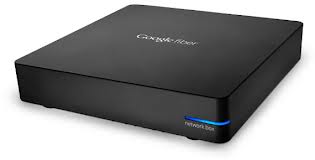
Google’s sleek network box.

Greenfield notes Google Fiber has been carefully developed to break away from the familiar experience one has with the phone and cable company:

  • The home terminals and DVR equipment more closely resemble a sleek Apple product, not a Motorola/Cisco set top box that has looked largely the same since the 1990s;
  • The installation experience has been streamlined — the external network interface on the side of the customer’s home does not require anyone to be home during the installation, reducing the time needed for a customer to sit around while service is installed inside;
  • In-home equipment envisions a more integrated IP-based network future with Ethernet and Wi-Fi connectivity, a centralized storage device which acts as an enhanced whole house DVR, and a minimalist TV box that can be hidden — no more unsightly hulking set top boxes. It represents a home entertainment network that goes far beyond what the competition is offering.

These factors deliver a positive customer experience, if only because Google paid attention to complaints from cable and telephone subscribers and decided to do things differently.

Other traditional business model busters noted by Greenfield:

  • Google will deliver 6/1Mbps budget priced Internet for a $300 one time fee (payable in $20 installments) which includes an in-home router, breaking through the digital divide and getting Google’s infrastructure into homes that simply cannot afford traditional cable or phone company broadband. It blows away the current “lite” offering sold by cable and phone companies with much better speeds at a far lower price;
  • Google is working with charitable organizations to help the poorest get broadband for even less, through donations and other fundraising;
  • Google leverages the community as a crowd-sourced marketing engine. Word of mouth advertising and competition among different neighborhoods helps drive the expansion of the network. Even if a consumer has no interest in the service, many fight to see it in their neighborhoods for the benefit of local community institutions who will receive free hookups;
  • Every new customer signed up for two years’ service receives a free Nexus tablet. The tablet is sold as the service’s “remote control,” but it is capable of much more;
  • No data caps, no speed throttling. With just two speed tiers, Google has completely discarded the speed-based and usage-based business models for broadband.
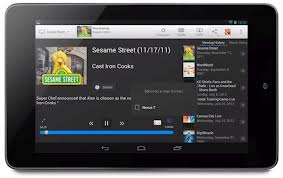
A Nexus 7 tablet comes free with the service (and a two year commitment)

So what exactly does BTIG think is Google’s master plan? Greenfield suspects Google is not recouping its initial investment or costs with their current pricing model, but that may not matter. Google may earn profit in other ways.

A 33% increase in the number of homes with broadband could be a substantial boost for Google search and YouTube, earning Google additional revenue. Improved broadband available to an entire household guarantees people will spend more time online, especially with no data caps or slow speeds. Enormously faster upload speed promotes more content sharing, which in turn means more time online with services like YouTube. A home tablet enables even more broadband usage, according to Greenfield.

As broadband speeds improve, advertisers can expose web visitors to more attractive, multimedia rich advertising not easily possible on slower speed connections. That could let Google tap into a greater share of the $60 billion TV ad market, especially for YouTube videos.

Finally, Greenfield suspects the more Google develops brand loyalty, the more successful it will be pitching consumers and businesses on services of the future.

Greenfield notes there are still bugs and features to be worked on, particularly with Google’s TV offering, but the company will have plenty of opportunities to manage those before it introduces Google Fiber elsewhere.

The implications of an expanding fiber to the home universe in the United States under Google’s price model could deliver a potent punch to incumbents like Time Warner Cable. So far, the cable company has only faced satellite dish competition for television, a technologically inferior AT&T U-verse, which will never have the capacity Time Warner has so long as the phone company still relies on any significant amount of copper wiring, and Verizon FiOS, which has disengaged from a price war with the cable company and is raising prices.

The writing is already on the wall, at least in Kansas City. Greenfield relays that Time Warner has been going all-out to improve its own customer service. One customer noted Time Warner Cable came to his house twice in recent weeks, without a scheduled service call, to check on the quality of his Internet speeds and to make sure the customer was happy.

In some neighborhoods, Time Warner is going door to door to interact with customers, something not done since cable operators first knocked on doors 30 years ago to introduce you to their service.

Google Fiber could ultimately force the end of one more legacy the cable industry has earned itself over the past few decades: customers loathing its service and prices.

[flv width=”640″ height=”380″]http://www.phillipdampier.com/video/Google Fiber Demo by BTIG’s Rich Greenfield and Walt Piecyk 11-23-12.flv[/flv]

BTIG’s Rich Greenfield and Walt Piecyk experience Google Fiber in Kansas City.  (3 minutes)
Time Warner Entertainment Chief Denigrates Young and Cable-Nevers

Phillip Dampier November 20, 2012 Consumer News, Online Video 6 Comments

Bewkes

What cord-cutting?

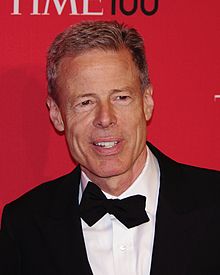
The “other” Time Warner — the separate entertainment company no longer affiliated with Time Warner Cable, has a chief executive who regularly downplays the threat of cable customers dropping television service and switching to alternate forms of online viewing.

At a conference in New York, CEO Jeff Bewkes said cord cutters largely fell in two categories:

  1. Low income households who could never afford cable and still can’t;
  2. Wealthy kids who grew up without cable television, still don’t have it now that they are living on their own, but can easily afford “three Starbucks a day” and don’t mind paying just about any price for the cost of content they actually want.

Bewkes cannot understand what people are complaining about when they open their monthly cable bill. After all, he argued, the value of  cable television and broadband have gone up with larger channel packages and speed upgrades without major price hikes.

But Bewkes’ definition of “major” may differ from those in middle class households who cannot afford rate increases that far outpace inflation year after year.

For now, Time Warner signaled it intends to remain loyal to the “all-or-nothing” cable package. That makes the chance of finding their entertainment shows available a-la-carte or online on-demand without a paid subscription pretty poor.

Half of Your Cable TV Bill Pays for Sports Programming; $200/Month Cable Bills on the Way

Phillip Dampier November 19, 2012 Comcast/Xfinity, Consumer News, Online Video 5 Comments

Cadillac prices for some sports networks you pay for whether you watch or not. (Early Summer 2012 – Prices have since risen for some networks)

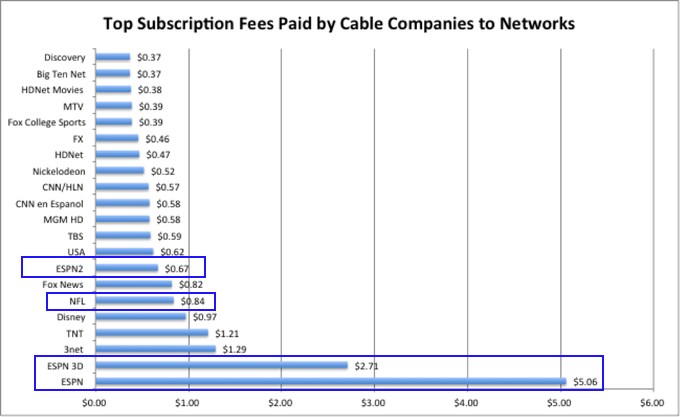
About 50 percent of your monthly cable television bill covers the cost of live sporting events and the networks that cover them, and the price is not going down anytime soon.

At least $21 of that bill is split between more than 50 national and regional channels covering every imaginable sport.

What customers may not know is that a handful of self-interested giant corporations and major sporting leagues have successfully bid up the price to carry those events using your money.

The Philadelphia Inquirer took a hard look at spiraling sports programming costs last weekend, discovering a lot of cable subscribers are paying for sports programming they will never watch.

“Here is a little old lady who wants to watch CNN,” Ralph Morrow, owner of Catalina Cable TV Co. in Avalon, Calif., a 1,200-subscriber system, told the newspaper. “But I can’t give it to her without $21 a month in sports.”

In the last 20 months, some of the biggest names in sports programming including Comcast/NBC, Fox, ESPN, CBS, and Turner have agreed to collectively pay $72 billion in TV rights to air pro, college, and Olympic events over the next decade. Costs are anticipated to soar to $100 billion or more once those contracts come up for renewal.

To cover the growing expense, the pay television industry’s business model insists that every subscriber must pay for sports networks as part of the “basic package” whether they watch or not. Nothing fuels annual rate increases faster than sports programming, and there is no end in sight.

Many contracts specifically prohibit operators from selling their networks “a-la-carte” or in special “sports tiers” that carry extra monthly fees.  Any additional costs are quickly passed onto subscribers in the form of regular rate hikes.

Charlie Ergen from Dish Networks suggests at the current pace of sports programming rate increases, it won’t be long before subscribers will face cable bills up to $2,000 a year, just to watch television.

If you don’t believe him, consider estimates from NPD Group, which predicts the national average for cable TV bills could reach $200 a month as soon as 2020. That is up from the already-high $86 a month customers pay today, after all costs and surcharges are added up.

It was not always this way. As late as the 1980s, the overwhelming majority of marquee sporting events were televised on “free TV” networks like ABC, CBS, and NBC. For decades, major broadcast networks largely had only themselves and the economics of advertiser supported television to consider when submitting bids to win carriage rights.

With the advent of cable sports networks, supported by dual revenue streams from both advertising and subscriber fees, ESPN eventually amassed a back account large enough to outbid traditional broadband networks. If another network moves in on ESPN’s action, the cable network simply raises the subscription fee charged to every cable subscriber to up the ante.

Broadcasters have enviously watched this dual revenue stream in action for several years now, and have recently insisted they be treated equally. Today, cable operators face demands for similar monthly payments from television stations and their network owners. In effect, customers are paying both sides to outbid one another for sports programming.

Consider ESPN as a case study in sports programming inflation. From 1989-2012, ESPN rates increased 440 percent. Today, every cable subscriber pays at least $5.13 for ESPN alone. In fact, the actual amount is considerably higher, because ESPN has successfully compelled most cable and satellite programmers to also carry (and pay for) several additional ESPN-branded networks also found on your lineup.

But why do cable companies agree to pay astronomical fees for sports networks, only to later alienate customers with annual rate hikes?

First, because customers watch sports. If a cable company does not carry the network showing a game or team a customer wants to see, that company will likely hear about it, either in a complaint call or cancellation.

Second, watching live sporting events is not easy for a cord-cutter. With fewer games appearing consistently on broadcast television, a cord cutting sports fan risks missing the action only available from a pay television provider.

In a defensive move, many cable and satellite companies assume the more live sports a  provider offers, the lower the chance a sports enthusiast will consider canceling service.

Cross-ownership also muddies the water for consumers. Comcast, the largest cable operator in the country, has an obvious self-interest loading its systems up with its own sports programming and compelling customers to pay for it.

Comcast owns about a dozen regional sports networks, NBC, NBC Sports Network and Golf.

Other large cable operators are concluding if you can’t beat ’em, join ’em. Time Warner Cable found one lucrative reason to own its own sports networks: its ability to charge competing cable and satellite providers sky high prices to carry that programming.

Time Warner is asking fellow cable, telco, and satellite providers to pay $3.95 a month for its SportsNet English and Spanish language networks, which feature the Los Angeles Lakers. For good measure, the same cable company that routinely complains about being forced to pass on mandatory sports programming costs from others insists companies place both of their sports channels on basic lineups, which guarantees every subscriber will also pay the price for two more sports channels, one in Spanish, they may have no interest in watching.

Comcast Stalled Internet Service for Disadvantaged to Help Win NBC Merger Deal

Cohen

Comcast’s chief lobbyist stalled plans to unveil cheaper Internet service for the financially disadvantaged to use as bait to win regulator approval of its 2009 merger with NBC-Universal.

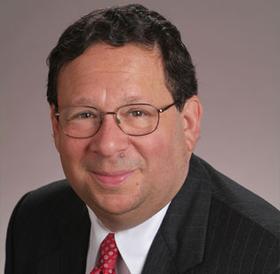
The Washington Post today reports David Cohen’s influence at the cable operator as its chief of lobbying has helped the cable company achieve its status as America’s largest cable operator and entertainment conglomerate.

Cohen has friends in high places thanks to his status as a Democratic Party money bundler. A self-styled “consigliere” to the Roberts family that controls the company, Cohen has overseen a transformation of Comcast from one cable operator among many into a high-powered force not to reckoned with in Washington or Silicon Valley.

Comcast’s growth into a mega-corporation with $58 billion in annual revenues came, in part, from dealmaking that won regulator approval in D.C. Maintaining good relations with those regulators is a Cohen specialty. It did not take the Post too long to find former FCC officials giving Cohen high praise:

  • “Every meeting with David is incredibly substantive,” Eddie Lazarus, former chief of staff to the FCC told the newspaper. “He always comes with a willingness to find solutions.”
  • “David loves politics, he loves government and he has incredible situational awareness — a 360-degree view of business,” said Blair Levin, a former senior adviser to FCC Chairman Julius Genachowski. “He’s just so good at what he does.”

Under Cohen’s leadership, Comcast has spent lavishly on its corporate lobbying and legal team. Today, 20 full time lobbyists work under Cohen’s direction, with dozens of others available on retainer. The company spent $8.3 million of its subscribers’ money solely on lobbying. The Post reports that makes Comcast the ninth biggest K Street spender, above Verizon.

The poor and disadvantaged had to wait for Comcast to seal the deal on their $30 billion acquisition of NBC-Universal before affordable Internet could become reality for them.

In 2009, Comcast insiders were hard at work on a discount program for the disadvantaged who could not afford Comcast’s regular prices for broadband service. But the program was stalled at the direction of Cohen, who wanted it to be a chip with regulators to win approval of its acquisition of NBC-Universal. The program, sure to be popular among advocates of the digitally disadvantaged, was a key part of approving the $30 billion deal.

“I held back because I knew it may be the type of voluntary commitment that would be attractive to the chairman [of the FCC],” Cohen said in a recent interview.

Regulators promoted Comcast’s “concession” to offer the discounted Internet service as a win for consumers as part of the final approval of the deal. In reality, Comcast was planning to offer the service anyway and finally introduced it in 2011 — two years after first being proposed inside the company.

That fact is a slight embarrassment to current FCC chairman Julius Genachowski, who has told audiences the discounted Internet program was partly to his credit.

“This particular program came from our reviewing of the Comcast NBC-U transaction,” Genachowski said in a speech. “Comcast embraced it as good for the country, as well as good for business. And I’m fine with that.”

Cohen defends Comcast’s lobbying expense as part of the company’s effort to combat scrutiny and challenges to its all-or-nothing video business model, denying customers access to a-la-carte programming.

Comcast’s scope has now grown so large, it has become a force few companies are willing to challenge, and those that try are quick to run into a blockade of Comcast lawyers, lobbyists, and carefully constructed contracts that protect the company’s bottom line from would-be competitors.

Deep pockets like Verizon, Apple, Netflix and Google have all tried… and failed to recast the cable television experience with on-demand programming, a-la-carte channels, and cord-cutting technology.

In response, Comcast has kept competitors tied down to the same cable packages that require subscribers to pay for everything, even if they seek only a few channels. Comcast leverages its broadband network with usage limits that effectively curtail cord-cutting among consumers looking to skip the TV package. Anyone seeking a place in today’s entertainment industry ends up dealing with Comcast sooner or later.

“They are hugely important because they can singlehandedly sink or swim multiple businesses that rely on the Internet ecosystem by virtue of controlling the dissemination of information through their pipes and now by supplying so much of the content,” said Joel Kelsey, a policy director at consumer interest group Free Press. “So many companies have come to us and ask we fight their battles for them because they are afraid of retribution.”

Cohen is well-compensated for his effectiveness. His latest three-year contract makes him one of the highest paid corporate lobbyists in Washington, with a $15 million annual compensation package and $3 million in bonuses, not including his ample stock holdings in Comcast.

His influence extends to the highest levels of the Obama Administration. Last summer, the family hosted a $1.2 million campaign fundraiser for President Obama, and the Cohens have separately contributed $877,000 to various campaigns. Comcast itself has spent $3.3 million in campaign contributions so far this year.

52% Say Internet Service is Their Home’s Most Important Utility

Looking for new revenue opportunities

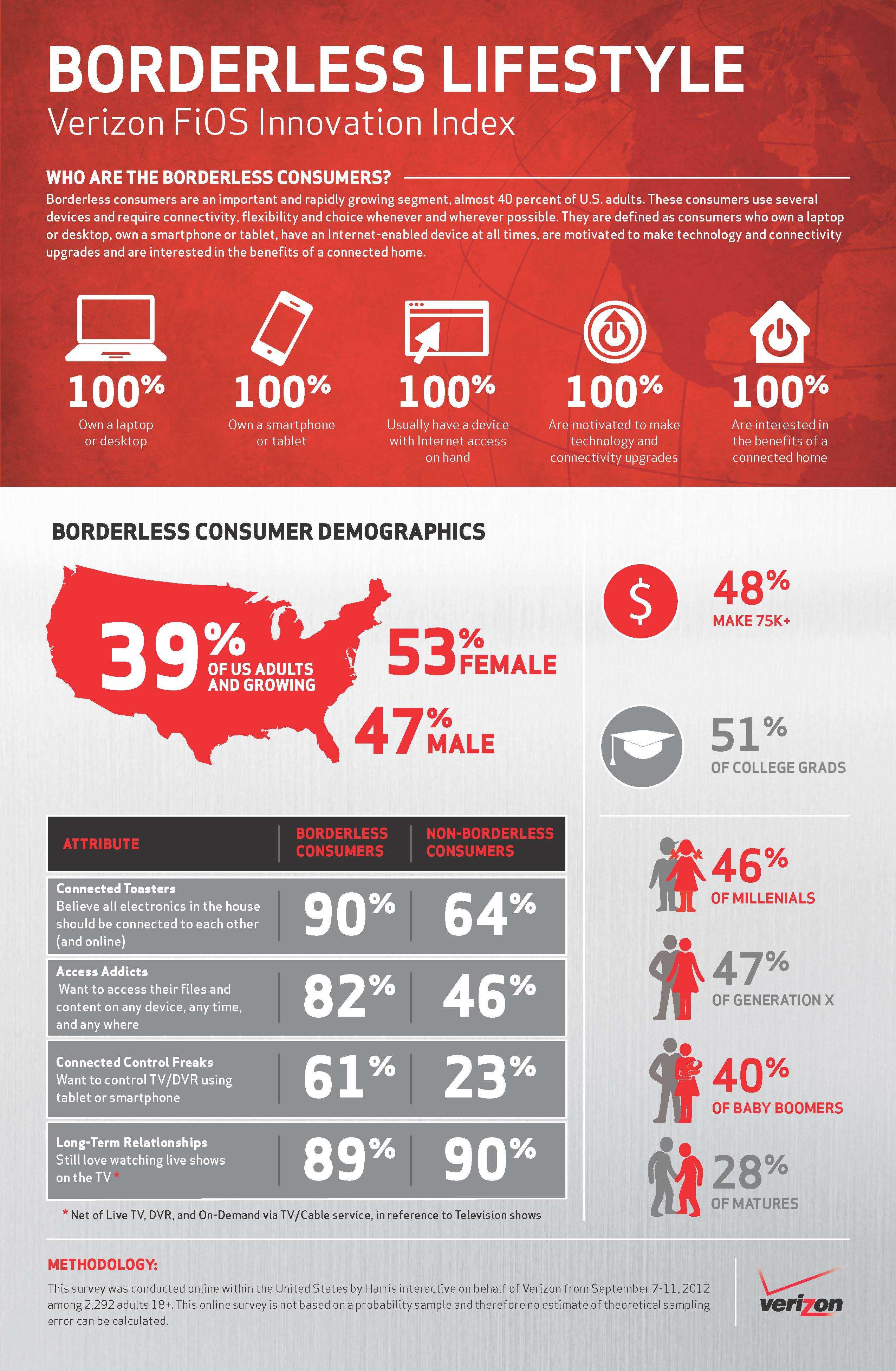
More than half (52 percent) of all U.S. consumers say Internet service is their home’s most important utility, according to a survey conducted by Verizon Communications as part of their Verizon FiOS Innovation Index project.

But Verizon’s research surveys go well beyond simply identifying who loves Internet access. Verizon’s real interest is identifying so-called “borderless consumers,” — customers who are seeking a seamless online experience and connectivity both inside and out of the home.

The convergence of wired and wireless broadband networks is a potentially enormous money-maker for Verizon, especially if you happen to be a Verizon Wireless customer.

“As the borderless consumer segment continues to grow, so will the need to identify, understand and anticipate what consumers truly want in their increasingly connected lives – today and in the future,” said Eric Bruno, vice president of FiOS strategy and development for Verizon.

Fran Shammo, Verizon’s chief financial officer, has previously told investors that monetizing data usage goes beyond text messaging and web browsing. The next frontier for enhanced revenue will come from the machine-to-machine segment. As consumers strive for a more connected future, enabling wireless connectivity for home appliances, automobiles, medical equipment, and other devices will create new revenue streams for the company.

Verizon’s new research surveys help the company target its future marketing to consumers most likely to be living the “borderless lifestyle.” Are you? Here are some key attributes:

  • Above average income: Most are college educated, own their home, and nearly half earn $75,000 or more annually, so they can afford higher broadband bills;
  • They are 18-34: Generation X and Millenials grew up in an increasingly connected world. Baby boomers are not far behind, but seniors are;
  • Women somewhat outnumber men in their need to remain connected;
  • You already have a computer, smartphone, or tablet and are connected to high speed Internet. Most of you want faster speed, if you can get it.

Verizon’s study becomes murkier over the issue of cord cutting. Verizon found that video streaming continues to drive Internet traffic growth, but at least 89% still prefer watching shows on their televisions. Verizon defines that as live TV, DVR, or on-demand from “TV/Cable service.”

But they did not ask whether consumers are watching more or less television provided by their cable, satellite, or phone company or if a larger proportion of viewing now comes from Netflix or other streamed content. That is a key indicator of whether a customer is gradually shifting viewing habits, which could ultimately make it easier to dump cable television.

With 90 percent of those surveyed looking forward to the day when every connectable device in their house can seamlessly interconnect and work together, Verizon’s potential revenue opportunities are enormous, if customers use Verizon Wireless for connectivity and not free Wi-Fi. Machine-to-machine wireless traffic can boost profits without costing the company much, especially under Verizon Wireless’ new Share Everything pricing. The impact of short data exchanges likely from home appliances and other similar devices is expected to be negligible. The profits from charging at least $10 a month to add each of those devices to a Verizon Wireless account are not.

Search This Site:

Contributions:

Recent Comments:

Your Account:

Stop the Cap!