Home » Online Video » Recent Articles:

Virgin Mobile Gives Up on Unlimited Wireless Broadband: Will Adopt 5GB Cap Feb. 15

Your unlimited experience is about to hit a roadblock.

Sometimes being popular isn’t the best thing in the world.

When Virgin Mobile introduced an unlimited, prepaid wireless broadband plan in August, it created a small media frenzy and shocked an industry that assumed usage-capped wireless broadband was the only way to survive the incredible demand for wireless data.

The company’s introduction of a $40 monthly unlimited-use broadband plan, with no term contract and month-to-month billing was a dream come true for casual vacationers and business travelers who don’t need a two year contract for pricey broadband-on-the-go from one of the major carriers.

When the company unveiled the unlimited broadband plan, as Stop the Cap! reported last summer, the demand was so great it brought the company’s network to its knees.  The prepaid provider, a division of Sprint, has struggled ever since to keep up with customer demand.  This week they announced they were throwing in the towel, quietly notifying would-be customers in the fine print of Radio Shack ads effective with all renewals after Feb. 15, a monthly limit of 5GB would be enforced on its Broadband2Go service.  Several of our readers noticed, including Greg, Sam, Jenny, and others.

“Customers who use BB2Go for typical email, internet surfing and reasonable downloading will likely not be impacted/notice any difference,” Virgin Mobile’s Corinne Nosal told PC Magazine by email.

But those who manage to consume just over 200MB daily will notice when the network speed throttle kicks in for those who “use too much.”  Speeds will be slashed to as low as 256kbps.  If you can’t live with that speed, you can pony up an additional $40 to “renew your account” (even if your month isn’t up yet) and the speed throttle will be removed, until you hit 5GB of usage again.

“So much for Virgin Mobile — 5GB means the service is no better or worse than the other players in the market, and considering the problems Virgin has had with reliable service, I’ll probably go back to using Cricket,” writes our Buffalo reader Lance.

Virgin Mobile relies on Sprint’s 3G network which already gets quite a workout from existing Sprint customers, as well as those using Clearwire (and several “private label” wireless broadband services).  Cricket owns and manages their own network, exclusively for the use of its own customers.

“Cricket will also throttle you if you hit 5GB, but you rarely run into overwhelmed cell tower sites like you do with Sprint’s network,” Lance says.

PC Magazine’s Sascha Segan notes the new usage limits makes using Virgin Mobile broadband a difficult proposition if you love multimedia:

The problem comes if you like video or downloads. Streaming Netflix at 1000kbps (if you can get that speed on the Virgin/Sprint 3G network), you use up about 450MB per hour. Some Windows updates can be up to 200MB alone. Want a TV show from your favorite legal downloading Web site? That’ll be 350MB, thanks.

While there are some small wireless ISPs in some parts of the country, Virgin’s abandonment of truly unlimited high-speed data leaves Sprint 4G/Clear as the only remaining major player willing to take on the wired-Internet oligopoly with an unlimited high-speed, wireless solution.

Tough Luck Mobile: T-Mobile Says Get Off Our Network – Download At Home; Slashes UK Usage Limits

Life's for sharing... just not on our wireless network.

British T-Mobile wireless broadband users got — how shall we put it — an “abrupt” and uncharacteristically rude notice about a change in the company’s “Fair Use” policy that takes effect in February (underlining ours):

Browsing means looking at websites and checking email, but not watching videos, downloading files or playing games. We’ve got a fair use policy but ours means that you’ll always be able to browse the internet, it’s only when you go over the fair use amount that you won’t be able to download, stream and watch video clips.

So what’s changing? – From 1st February 2011 we will be aligning our fair use policies so our mobile internet service will have fair use of 500MB.

What does this mean? – We’ll always let you email and browse the internet and you’ll never pay more than you agree to. We do have a fair use policy but ours is there to make sure we deliver the best service possible to all our customers.  This means that you’ll always be able to browse the internet.

So remember our Mobile Broadband and internet on your phone service is best used for browsing which means looking at your favorite websites like Facebook, Twitter, Gmail, BBC News and more, checking your email and looking for information, but not watching videos or downloading files.

If you want to download, stream and watch video clips, save that stuff for your home broadband.

T-Mobile's warning to customers to avoid watching videos on their network flies in the face of their own smartphone promotions.

As our regular reader “Jr” observes, broadband carriers want customers to use their broadband connections to browse web pages and read e-mail — and little else.  Rarely has a carrier come right out and said it, though.

Not only has T-Mobile “aligned” their fair use policies to deliver you less service (down from 1-3GB per month), but they’ve kept the same high price.  T-Mobile is the same company that routinely markets smartphones and other multimedia-equipped handsets specifically for the services they don’t want you to use on their network.

T-Mobile illustrates once again how Internet Overcharging schemes really work:

  1. They implement a usage cap and suggest it is “generous” and that the majority of customers will never come close to hitting it;
  2. They gradually reduce the usage allowance when revenue needs eclipse the needs of customers;
  3. They still claim the new, lower limit is still “generous.”
  4. They suggest almost nobody is likely going to hit the limit, no matter what it is.

Of course, had T-Mobile customers really come nowhere near the old limits, what problem was resolved lowering it?  T-Mobile claims the vast majority of customers don’t exceed 200MB of usage per month, an exceptionally low amount in comparison to other carriers.

The telecoms regulator Ofcom told ZDNet UK on Monday that, “if consumers are being notified of a change likely to cause them material detriment, the provider must give the customer one month’s notice of the change, and at the same time they must also inform the customer of their right to terminate their contract without penalty if the proposed change is not acceptable to the customer”.

As the changes take effect from 1 February, T-Mobile has given less than one month’s notice.

“We encourage unhappy consumers to speak with their provider about their concerns,” Ofcom’s spokesperson said. “If the problem relates to a particular term or condition that you feel is unfair, then you can log your complaint with Ofcom. We monitor complaints about the behaviour of communications providers and if there is a high volume of complaints about a particular issue, we do investigate and take action as required.”

(Thanks to our reader “PreventCAPS” for sharing the story with us.)

Exclusive: Frontier’s California Confuse-o-rama: Residents Victimized by Frontier’s Changing Stories

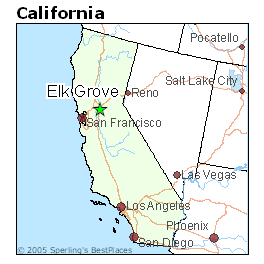
Elk Grove, Calif. residents receiving letters from Frontier Communications claiming they are using the company’s Internet service too much are getting confusing responses from the phone company when calling to register complaints about the Internet Overcharging scheme.  Even worse, one company official told a subscriber they have to keep the new usage limits secret “for legal reasons in case we have to change it again.”  But no worries, Frontier explained to one customer: if you exceed the secret cap again, you’ll be notified future overages will be conveniently billed on a future Frontier bill.

Stop the Cap! has been receiving dozens of e-mailed complaints from customers upset that the company’s bait-and-switch broadband also comes with uninformed customer service representatives who can’t deliver straightforward answers to customers trying to understand how they can avoid up to $250 a month for 3Mbps DSL broadband service.

“When I signed up for Frontier DSL, nobody said a thing about usage limits,” writes our reader Trina who lives near Camden Park.  “My small business has DSL from Frontier as well and we were horrified when we received a letter telling us we were over-using their service.”

Trina and her husband have four teenage boys living at home, all sharing their Frontier DSL account.  When she called the company in response to the letter she received, the confusion began.
“The first representative didn’t understand what I was talking about and denied there were any limits and said the letter must have been a mistake,” Trina says. “But my husband noticed others in our area were talking about the letter on area message boards so when he called, he got a representative that confirmed the limits were real.”

Trina was told her home would need to upgrade to Frontier’s $249 monthly DSL service plan, the same one Frontier held over the heads of some customers in Mound, Minn. last year.

“I told them they must be smoking crack — are they serious?  There is no way I am going to pay $250 a month for DSL that gives us 1.5Mbps service — not in this world,” Trina says.  “My husband laughed when I told him, saying Frontier is going to drive themselves out of business from this stupidity.”

Elk Grove reader Stephen also called Frontier after he received a letter stating he used over 100GB in a month.

“Yeah, I used 104GB according to my router’s logs and Frontier deemed me a bandwidth abuser,” Stephen writes.  “Of course the company tried to sell me a plan priced at $100 a month for their lousy DSL service we got suckered into on one of their term contracts.”

Stephen said he’d manage to find a way to shave 5GB off his monthly usage and forego Frontier’s $99 offer until he signs up with a competitor and tells Frontier to take a hike.

“It’s one thing to be abused by a lackluster phone company like Frontier who never did a thing for Elk Grove — it’s another to pay them more for their abuse,” he writes.

Stop the Cap! reader Pete, also in Elk Grove, says he can’t get a straight answer over exactly what the monthly limit is.
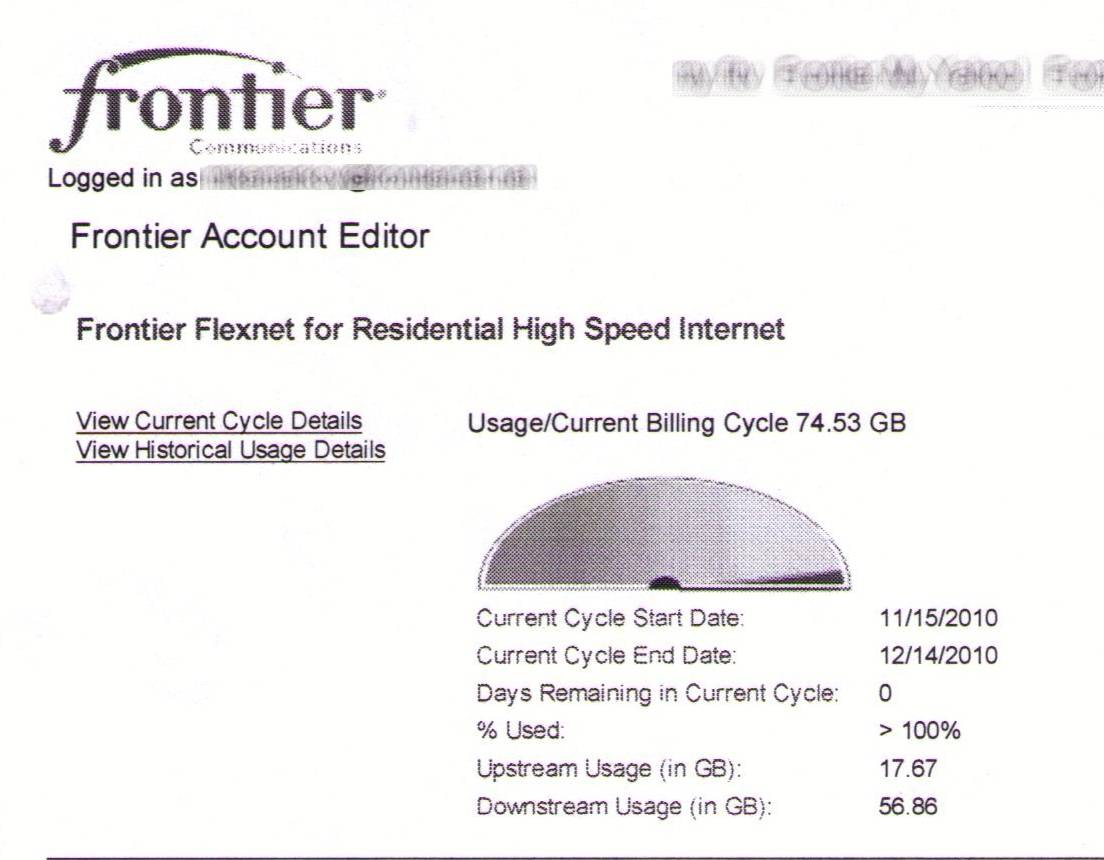
“When I called, I was told 5GB by one representative, 100GB by another, but get this — when I logged into the ‘Flexnet’ Usage Meter the company tells you to review, it showed I had a 20GB limit,” Pete says.  “I called Frontier on the phone and told them I was so through with them — I can’t stand their nonsense.”

Pete wasn’t alone.  Our regular reader Mike figures his cap was actually 20GB a month if the company’s usage meter was to be believed, and he sent pictures.

“I got their nastygram last month over my usage and now my Flexnet meter shows me over the limit,” Pete says.  “I have been vocal on a local Elk Grove message board so I’m feeling like this is retaliation.”

In fact, Mike’s usage meter depicts him as well over the arbitrary 100GB limit Frontier suggests in their letter, despite not coming close to 100GB of usage.  Ditto for our reader Michelle who lives in Palo Cedro, a community Frontier can largely hold captive thanks to limited competition.

Benjamin, also in Palo Cedro, says Frontier’s move will hurt small businesses in the northern California Shasta County community of 1,200.

“I need high speed Internet to help start my business, which will largely involve uploading and downloading multimedia, (which is hard enough to do on a 1.5 connection) but to increase the cost is absolute insanity,” he says.
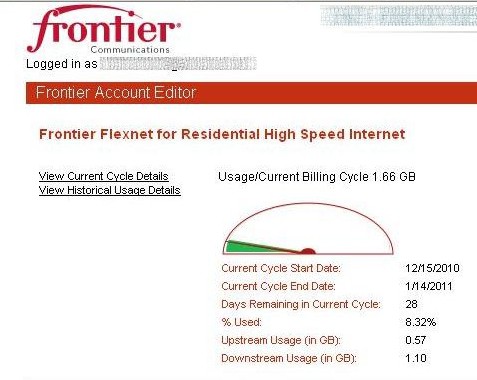
Our reader Mike discovered Frontier's usage meter suggests he has far less than a 100GB monthly usage allowance.

Benjamin’s alternatives barely qualify.

“I can either try Clearwire, which works terribly locally and is known for its speed throttles when congested, or HughesNet satellite-delivered Internet, which is overpriced,” Ben adds.

As our readers already know, satellite fraudband is no replacement for real broadband service, because it comes with a “fair access” policy that isn’t fair and doesn’t deliver much access.

“I will fight this any way I have to,” Benjamin says.

John in Elk Grove writes in to say the entire affair is a Frontier shell game.

“It’s pure bait and switch to sell us broadband without limits and then suddenly impose them while we are supposed to be on ‘price protection agreements’ that the company says will keep our prices stable,” John says. “Now we learn it’s all a shell game — they can say we used too much and that doesn’t count with their price protection scam.”

John adds Frontier can change the limits at will, and customers who choose to depart could still face enormous cancellation penalties.

“The Frontier representative I talked to when I called to cancel service told me I owed $300 for ending my contract early,” he said. “I told them to go to hell and that if they tried to collect, I’d personally make it my life’s work to cost them far more than that in lost business.”

Customer anger only increases after speaking with Frontier’s own representatives.
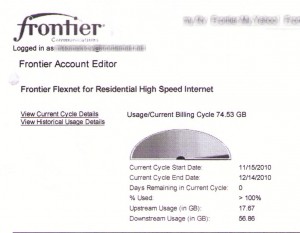
Uh oh. Frontier suggests Mike has already blown through his monthly usage allowance, despite his carefully reduced use of the service.

“Mr. Brown” shares his experience:

I am an Elk Grove resident and a Frontier DSL internet customer. I received the same letter from Frontier about exceeding the 100gb of bandwidth within a 30 day period. It said that I must reduce the amount of use or bump my account up to the next tier of service, a $99/mo business account.

I called the number on the letter to talk to a customer service representative so that they would not disconnect me for not responding within 20 days. I asked him if there is a maximum bandwidth cap. He told me that there is no cap, but that their terms of service says that they can disconnect you if you are exceeding reasonable usage and that Frontier will determine what is reasonable usage. The representative could not help me any further so he connected me with his supervisor.

The supervisor said that Frontier sent this letter out to about 1,000 customers in Elk Grove and that most of the customers who have called after receiving the letter have not questioned them and said they they will reduce their usage.

He also said that there is no longer any $99/mo plan, the only option is to reduce usage. He said they sent the letters out to the costumers who are using more than a reasonable about of bandwidth telling them to use less Internet. Then if they did not, Frontier will send another letter saying that if they use more than a reasonable amount that they will charge the customer for anything over.

He went on to say that Frontier had to remove the statement about the previous 5GB bandwidth cap in their terms and conditions and that for legal reasons they are not going to tell us what the new limit is, in case they have to change it again in the future.

I tried to get him to admit that there is a cap and to tell me what that limit was, but he would not.  He would only say that I would be okay if I did not go over 100gb/mo and that if I do, to expect to receive another letter with the new terms that would allow them to charge my account for excess bandwidth.

The one thing is common with readers we’ve heard from is their urgent search for a new provider.

Trina canceled all of her Frontier services at home and at her business and switched to SureWest, a fiber to the home provider.  Joining her includes Mike, Stephen, Pete and John.  Together, their combined disconnects will cost Frontier more than $500 a month in lost revenue, all because of broadband traffic that costs Frontier far less than 5 percent of that amount.  If each customer shares their horror story with friends, family, and neighbors, the loss in revenue could cost far more.

For customers like Mike, he can’t wait to get his SureWest service installed.  The company offers to buy out current contracts with companies like Frontier valued at up to $200, and their fiber-delivered broadband service leaves Frontier’s speeds in the dust.  Mike says if Frontier gives departing customers a hard time about early cancellation fees, file a complaint with the California Public Utilities Commission Consumer Affairs Branch.

SureWest offers 3/3Mbps service for $36.99 per month, 25/25Mbps service for $51.99 a month, and 50/50Mbps service for $181.99 a month.  A $3.99 High Speed Internet features and services charge applies.  There are no limits on SureWest’s Internet service.

SureWest delivers several fiber to the home broadband service plans that best Frontier's DSL speeds by a mile.

Frontier offers 3Mbps service with a slower upload speed for $32.99 per month or 10Mbps service for $44.99, both with a required price protection plan and $6.99 monthly modem rental fee.

“Why in the world would you pay Frontier more for less service,” asks Pete.  “Once they pile on the administrative fees, surcharges and taxes, it’s well north of $40 a month, and you don’t even get the speed they advertise, much less the usage limits they don’t.”


Roku CEO ‘Not Worried’ About the Demise of Unlimited Broadband

Phillip Dampier January 4, 2011 Competition, Consumer News, Data Caps, Online Video, Video 4 Comments

Wood

Roku CEO Anthony Wood told a cable trade publication he is not worried that providers will kill the market for his online video set-top box with Internet Overcharging schemes.

Wood told Multichannel News the broadband industry faces enough competition to prevent one or both traditional providers from implementing usage caps and metered pricing for broadband service.

“What we see from a practical point of view in the marketplace is that there’s enough competition from cable, telcos and wireless so that in every market there’s an unlimited option — and the price is competitive,” he said.  “Unlimited sells — it’s just a good marketing strategy.”

Wood may want to inform broadband providers of that, because several American phone and cable companies are experimenting with slapping usage limits on their customers, making his web-streaming set top box an expensive proposition.  For customers of Frontier Communications in Elk Grove, Calif., using too much Roku could mean broadband bills as high as $300 a month.

With some HD movies consuming 2-4 gigabytes per title, some companies experimenting with usage limits as low as 5GB per month would make online video the primary culprit for consumers blowing through their monthly usage allowance.  After one bill with overlimit fees arrives, the Roku box will be the first thing to go.

Netflix, a major investor in the Roku box, could see its plans to shift to online distribution of its massive DVD rental business stymied by large phone and cable providers, many of whom see Netflix and other online video services as competitors who use their broadband service to send movies to consumers.  Some cable and phone companies contend Roku, Netflix, and other online video streamers are freeloaders — using their networks “for free” and demanding additional compensation to keep carrying their content.

Wood discloses another reason why cable and phone companies could potentially adopt a hostile position towards his 100-employee operation — “cord cutting.”

Wood told Multichannel News about 12% of Roku customers say they have canceled cable or satellite TV after buying the set-top while another 12% said they reduced their service level.

The cable industry is trying to retain customers by putting an increasing amount of cable content online for subscribers who maintain their cable-TV package.  Roku gives subscribers one more reason to downgrade or cancel service, a problem that could be stopped with an Internet Overcharging scheme that makes using the product an expensive proposition.

Some Roku watchers believe Wood is making a mistake underestimating the telecom industry’s willingness to protect its turf.

Two years ago Roku VP Tim Twerdahl said the company was not worried about Comcast’s 250GB download cap.  But since then, other providers have proposed far lower caps.

Roku is best known for letting Netflix subscribers stream the video rental firm’s online titles direct to television sets.  But Roku also delivers access to Hulu, Amazon video, and a growing number of new “channels” delivering classic movies, music/music videos, news, and user-created programming.

The company offers three set-top models: HD ($60), which delivers up to 720p video; XD ($80), which adds support for up to 1080p and 802.11n Wi-Fi; and the XDS ($99), which offers dual-band 802.11n and component video and optical audio outputs.  The top model occasionally sells for as little as $79.99 when on sale from Amazon.com or direct from the manufacturer.

[flv width=”640″ height=”380″]http://www.phillipdampier.com/video/Introducing Roku.mp4[/flv]

A brief video introduction to Roku.  (1 minute)

MetroPCS Introduces Pay Walls for 4G Users: Web Favorites Locked Out Unless You Spend More

Phillip Dampier January 4, 2011 Broadband Speed, Competition, Consumer News, Data Caps, Editorial & Site News, MetroPCS, Net Neutrality, Online Video, Public Policy & Gov't, Video, Wireless Broadband Comments Off on MetroPCS Introduces Pay Walls for 4G Users: Web Favorites Locked Out Unless You Spend More

Hammer Time: MetroPCS introduces 4G/LTE service plans that establish pay walls for familiar web content.

Want a sneak preview of America’s Internet experience without real Net Neutrality?  Look no further than MetroPCS which has managed to turn the clock back to the early days of “mobile web,” where carriers pre-selected content and blocked much of the rest.  Want access anyway?  Then spend some time with a spreadsheet to figure out what service plan you’ll need and start counting out some ten dollar bills because MetroPCS promises a Long Term Expensive 4G  experience.

The business press focused on MetroPCS’ new pricing — delivering what the company calls “a selection of data access levels to meet customers’ lifestyles.”  But some public interest groups considered today’s announcement the first gauntlet thrown in the Net Neutrality war since the FCC voted to approve a watered down version of the open Internet policy last month.

MetroPCS called their new plans a boon to customers.

“Our customers told us they wanted more video, more sharing of their content and more Web browsing capabilities – they want to have it all with the value and no annual contract that only MetroPCS can deliver,” said Roger D. Linquist, president, CEO and chairman of MetroPCS. “Our 4G LTE network can deliver unlimited voice and mobile broadband data services and, with these new service plans, consumers are in the driver’s seat on how much additional data access and real-time entertainment content they want to pay for on a monthly basis.”

But many customers will discover the company’s road to good intentions pitted with potholes, toll booths, roadblocks, and diversions.

Just getting on this data highway to hell could be very confusing to customers who will need to think about what websites and services they need, want, or can live without, and then finding the corresponding service plan that makes it all work.

MetroPCS says it has three new pricing levels to consider:

  • The $40 service plan offers unlimited talk, text, 4G Web browsing with unlimited YouTube access.
  • The $50 service plan includes the same unlimited talk, text, 4G Web services and unlimited YouTube access as the $40 plan. Additional features include international and premium text messaging, turn-by-turn navigation with MetroNAVIGATOR™, ScreenIT, mobile instant messaging, corporate e-mail and 1 GB of additional data access, with premium features available through MetroSTUDIO™ when connected via Wi-Fi, including audio capabilities to listen and download music and access to preview and trial video content.
  • The $60 service plan provides the same premium features as the $50 plan, plus unlimited data access and MetroSTUDIO premium content such as 18 video-on-demand channels and audio downloads.

You'll need a smart phone to figure out what pricing plan actually delivers the services you need.

A customer could be forgiven if they assumed the $40 plan provided “unlimited web browsing,” which will be interpreted to mean they can access all of the content contained on those websites, but they would be wrong.  Beyond YouTube, MetroPCS customers will need to spend at least $10 more to access embedded video and audio, play online gaming, and access other rich media services.  Want to view videos from a website that isn’t among the carrier’s “preferred content partners?”  Forget it.

What about Skype, Netflix and other popular services?  Nuh uh.

Only the $60 monthly plan delivers unlimited data, along with pre-selected video and audio you can access… or not.

Free Press Policy Counsel M. Chris Riley called MetroPCS’ foray into the toll highway business a profit padding scheme.

“In December, the FCC chose to disregard wireless protections in its Net Neutrality order, and MetroPCS’s new scheme is a preview of the wireless future in a world without protections on the mobile Web. Such blocking of websites, services or applications would clearly be prohibited and deemed unreasonable on a cable or DSL network. Are these the kinds of restrictions the FCC really wants to promote on wireless networks?

“The open Internet order approved in December stated that the FCC was not implicitly approving practices on the mobile Web that violate its rule against unreasonable discrimination – and now we’ll see whether the agency is willing to do anything about such practices. Silence in the face of ongoing violations is no different from outright approval. If MetroPCS is allowed to engage in rampant discrimination and blocking of Internet applications and services, will Verizon be next? Will AT&T extend its history of blocking services like VoIP and Sling on its LTE network in the future?

“MetroPCS’s plan will restrict consumer choice and innovation in a developing mobile market, all for the sake of further padding its bottom line. The FCC must not stand idly by while carriers are engaging in anti-consumer and anti-competitive behavior, and we urge the agency to investigate.”

[flv width=”640″ height=”500″]http://www.phillipdampier.com/video/MetroPCS 1-4-10.flv[/flv]

It’s too bad the company that regularly lampooned their wireless competitors in witty commercials has now adopted the same “gotcha” tricks and traps that will leave customers trying to figure out why they can’t access the web content they thought they paid to receive.  Watch a series of amusing MetroPCS ads and a brief review of the company’s new 4G phone courtesy of TheStreet TV.  “Hello. Hello. Hello.”  (7 minutes)

Search This Site:

Contributions:

Recent Comments:

Your Account:

Stop the Cap!