

Home » Public Policy & Gov’t » Recent Articles:

Scam: NC Democrat Throws Consumers Under the Bus, Broadband Map Crayoning, & $350 Million Taxpayer Dollars Flushed

Is this worth $350 million of your taxpayer dollars?

Is this worth $350 million of your taxpayer dollars?

North Carolina residents should be outraged at Rep. Bill Faison, the Democratic chairman of the state House Select Committee on High-Speed Internet Access in Rural Areas.  He’s set to do for North Carolina broadband what Hurricane Katrina did for urban renewal in New Orleans.  Faison, along with some other cronies, are examples of what is wrong with broadband stimulus planning when certain elected officials open their doors on big special interests, and slam them on the fingers of actual consumers.

Eight years ago, the North Carolina legislature commissioned the state to produce accurate, detailed broadband maps, depicting who has access to what broadband services, if any, across the Tar Heel State. e-NC, an organization of excellence recognized worldwide, set about not only doing broadband mapping, but also advocating for consumer and business interests across the state by pushing for higher quality and faster service.  e-NC’s mapping standard has been recognized by the European Commission, Microsoft, and IBM for its detailed, accurate depictions of broadband service.

e-NC has had its work cut out for it.  AT&T and other North Carolina telecom providers have stonewalled the group since day one, refusing to disclose “private company information.”  Where e-NC could obtain agreements, they came with ludicrous non-disclosure agreements that were the equivalent of ‘here is the information you requested, but you cannot use it in your maps.’

That’s where Faison comes in.  He sends out an invitation to the media to announce North Carolina finally has a broadband map available, and then proceeds to slam e-NC because it produced maps that, at one point, he compared with “swiss cheese.”  Faison is fully aware that e-NC had been complaining about provider stonewalling, and he did nothing to stop it.  But then he did something even worse: he praised the very providers who did the stonewalling and are now in charge of producing the “detailed maps” that the providers want the legislature to see.

Faison said, “In the face of legislation recommended by the Committee which would have required the providers to disclose precise information to the Legislature for our staff to generate a detailed map of availability, the providers have come together and collectively decided to provide the information through Connected Nation, to not only provide the “street address” map but also to make the map both accessible and interactive through the internet. Special recognition should be given to AT&T, Embarq, Sprint, Time Warner Cable, The Cable Association, the Telephone Co-op association, and Alltel for their work on this matter.”

Shameful.

Of course, Faison’s anti-consumer efforts on behalf of his good friends in the telecommunications industry are no secret to our North Carolina readers.  Faison was one of the proponents of the anti-consumer nightmare legislation S1004, which was hand-crafted by big cable and telephone companies to stop municipal broadband projects across the state.  Faison is a menace for consumer interests in North Carolina.

Faison doesn’t care, of course.  He has his eyes on some of that $7.4 billion in broadband stimulus money he hopes to grab for the state AT&T, Embarq, Sprint, Time Warner Cable, and any other provider that will try and use their own maps to “qualify” for the tax dollars you and I are going to hand over for broadband development.

Faison said: “North Carolina will be one of only six states with a detailed “street address” interactive map of broadband availability. It positions us advantageously to obtain a portion of $7.4 billion in Stimulus money available for broadband deployment. A map, such as ours, is now a precondition for obtaining this portion of the Stimulus money. The collaborative work of the Committee and the providers has now postured North Carolina in the most favorable of positions to not only obtain this portion of the Stimulus money, but also to advance broadband deployment for our people.”

In other words, by replacing reality with the telecom industry’s own version of reality, they hope to sneak through applications that look good on paper, whether or not they accurately depict the real “on the ground” state of broadband in North Carolina.  If I were a grant application reviewer with this kind of “detailed” conflict-of-interest map work, I’d disqualify the entire state from getting one penny.

As the excellent investigative piece by Art Brodsky points out over on Public Knowledge (thanks Stop the Cap! reader Michael for showing the way):

AT&T stiffs the state, and then makes up its own map, which state legislators accept. There is no transparency, no verification, no nothing. (But it is interactive.) The only way in which this can not be a total conflict of interest is to recall the (perhaps) apocryphal story of the Maryland state legislator who also owned a liquor store. He introduced a bill to help liquor stores and was asked if this bill was a conflict of interest. “How does this conflict with my interests,” he was said to have replied. Exactly.

Meanwhile, the oh-so-aptly named (well-)Connected Nation, packed to the rafters with big cable and telephone company lobbyists, is busily doing its part to flush $350,000,000 of taxpayer funding down the drain with its own “broadband maps” which resemble the crayoning work your 1st grade son brought home from school.

Connected Nation, a creature of AT&T, spent $7 million dollars of your taxpayer money to commission Connect Ohio, an affiliate, to map broadband availability in that state.  The result was a map you could have drawn yourself during a TV show commercial break.  I think I’ll use Light Pink myself.
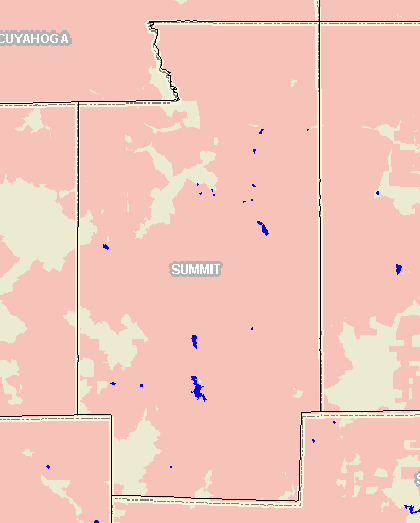
Connect Ohio's "Broadband Map" for Summit County, Ohio

Connect Ohio's "Broadband Map" for Summit County, Ohio

No, the blue speckles are not from blueberry pie stains.  Those are bodies of water.  What exactly does Connect Ohio’s map say?  Not a whole lot.  Basically, it claims the areas in beautiful pink are locations where broadband service is supposed to be available.  The whitish areas are outta luck.

Seven million well spent dollars there!

Meanwhile, here is a map from Strategic Networks Group, a company that was never eligible for federal mapping grant money:
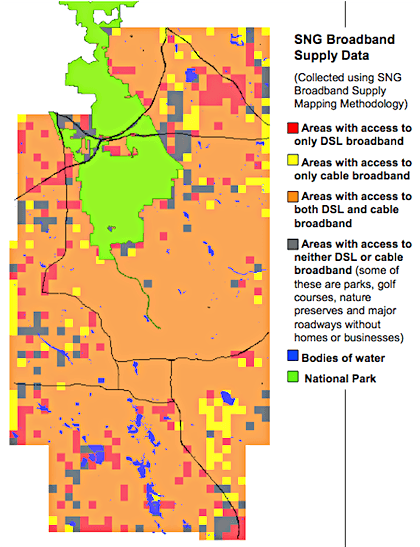
Map from Strategic Networks Group, that didn't cost taxpayers a cent

Map from Strategic Networks Group, that didn't cost taxpayers a cent

Which map would you prefer to rely on?  The $7 million dollar boondoggle from Connect Ohio or the zero taxpayer dollar map from Strategic?

Why didn’t Strategic get the contract?  Because Sen. Dick Durbin, D-Illinois custom wrote language into the Broadband Data Improvement Act, that specifically defined who received the award money.  Basically, it came down to only those well-connected politically with state governments (Connected Nation) getting the lion’s share.  No merit-based mappers need apply.

Strategic’s maps were apparently too good. Take a look at this exceptionally detailed map they produced for just western Akron, Ohio (and notice this is page four of a series of detailed maps):
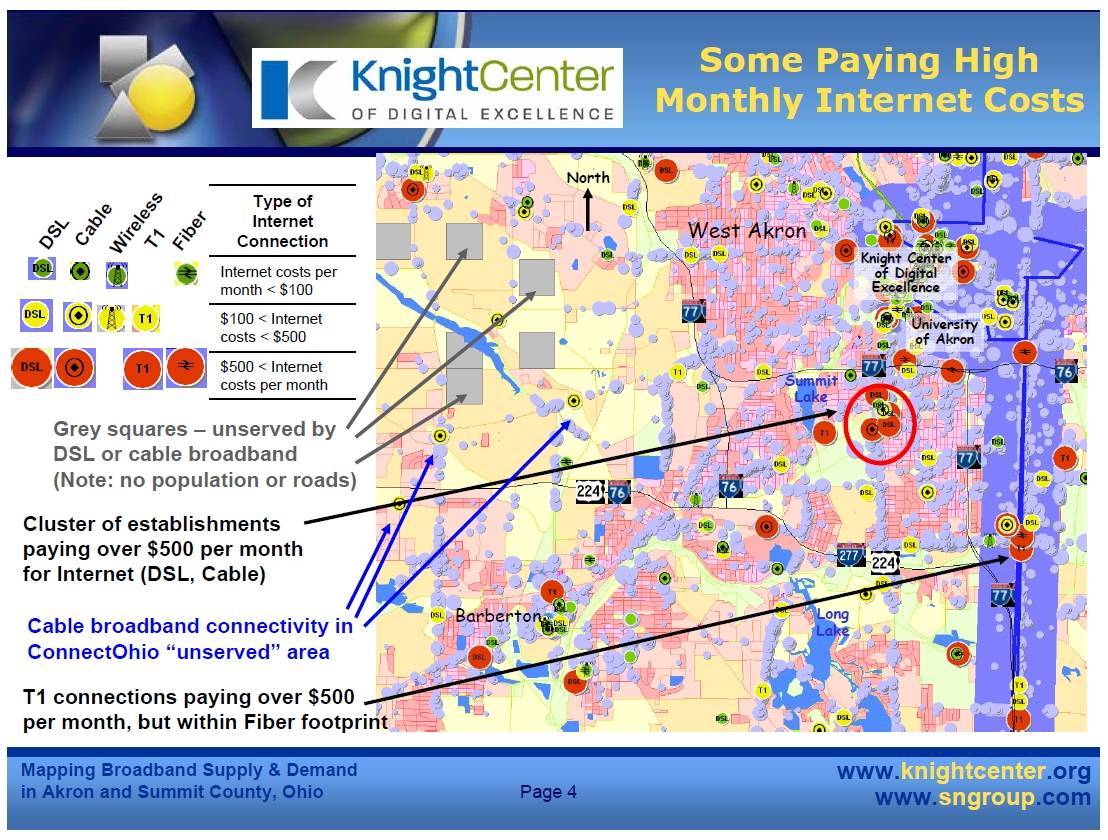
Unlike Connected Nation's maps, you WILL have to click to enlarge!

Unlike Connected Nation's maps, you WILL have to click to enlarge!

Stop the Cap! stands with Art Brodsky and Public Knowledge regarding this travesty:

The government notice setting out the terms for the mapping grants was sadly deficient. Even if one grants that Connected Nation was wired in under the terms of a misguided bill, the agency notice of funds availability had no conflict-of-interest safeguards. There are no requirements for transparency or for verification of information. There are no standard data sets to make sure all the maps measure the same things. Instead, there are what appear to be protections for “confidential” information that could render the process useless.

Perhaps some of these deficiencies can be cured at the program moves forward. Perhaps not. In either case, these cautionary tales are getting a bit tiresome. Jury-rigged RFPs, no-bid contracts, hot-wired legislatures and state agencies are no way to run a program as important as broadband.

The stimulus broadband mapping program is set up for massive failure unless changes are made. Congress has to allow more competition for grants. The Durbin argument that private, for-profit companies shouldn’t do public work like broadband mapping, while non-profits should, falls apart when one considers the advantages of an independent company vs. a compromised non-profit. The agencies responsible need more detailed criteria to protect the public investment. Consistency, transparency, public verification and less protection of information are needed. Maybe then can an #epic fail can be avoided.
The Communications Workers of America Get It: Speed Matters

Jay Ovittore July 7, 2009 Public Policy & Gov't 7 Comments

The Communications Workers of America (CWA) has been running a project I have subscribed to for awhile now, called Speed Matters. Today I received this e-mail from them:

What’s next for SpeedMatters? Growing our movement.

Dear Jason,

Time’s up. Pencils down.

How did you do on the SpeedMatters.org speed test?

Believe it or not, you had one of fastest connection speeds in the country – and you’re probably paying a pretty penny for it. The majority of people who took the test didn’t come close to scoring as high as you did.

But fact is, even some of the fastest internet connections in the United States pale in comparison to many of our global competitors like Korea, Sweden, and Japan. These countries have average speeds that are almost ten times faster than the United States — at about 1/12 the cost to the consumer.

FCC Commissioner Michael J. Copps has admitted “America’s record in expanding broadband communication is so poor that it should be viewed as an outrage by every consumer and businessperson in the country.”

It’s time to fix this problem, and the first step is determining exactly where our current high speed networks reach — and who is getting left behind.

You’ve already helped us begin to gather this crucial data by testing your Internet speed.

So what’s next? Now you can help grow our movement and educate as many people as possible about the importance of improving our country’s high speed Internet access. That way, when we demand our elected representatives take action, they’ll hear us loud and clear.

Forward the message below to everyone you know, and ask them to join you in getting the U.S. up to speed.

Thank you,

Beth Allen
speedmatters.org Online Mobilization Coordinator

P.S. Don’t forget to sign up for our weekly SpeedMatters.org blog update email to stay up-to-date on the nationwide effort to expand high speed Internet access and the amazing things that people are doing with the improved technology.

Dear Friend,

Americans are charged more for slower internet speeds, and our current high-speed networks don’t even reach millions of households. It’s time for that to change — and you can play a part. Testing your own speed will help make our new community research project, SpeedMatters.org, a success.

We’re falling behind in the global economy because we won’t invest in the technology to bring the benefits of this telecommunications revolution to most of our population. We’re the only industrialized country without a national policy to promote high- speed Internet access.

That’s why you’re getting this email. Testing your connection’s speed now will help us better understand the American average — and craft an effective public policy and awareness campaign.

Take the speed test:

High speed Internet means more than smooth web videos or fast downloads.

Advanced high capacity communications networks can increase democratic and civic participation, improve the delivery of health care, education, job training, public safety and other vital services.

What are we waiting for? It’s time to close the digital divide.

Thanks!

What I found interesting was the quote from FCC Commissioner Michael Copps, “America’s record in expanding broadband communication is so poor that it should be viewed as an outrage by every consumer and businessperson in the country.”

Commissioner Copps is right. It is an outrage. When the rest of the world is moving on average 10 times faster and at 1/12 the cost to consumers, I am a little more then outraged. Speed does matter and I urge you all to join and spread the word about Speedmatters.org.  They have a lot of useful information at their site, including speed by state and listing of broadband initiatives.

I took the speed test here in Greensboro, North Carolina, using Time Warner Cable’s Road Runner Turbo and my results were 11.114Mbps download and 4.85Mbps upload.  What is your speed?

I know here in Greensboro, the CWA had tried to to unionize the local Time Warner Cable workers and the company pushed back and won. Now a lot of those same TWC employees have been pink slipped in favor of non-union contract workers or demoted to lesser positions with less pay. I am sure this isn’t the only city this is happening in.  Just goes to show that TWC isn’t just effecting your families with their greed, but their own workers’ families too.

The only downside to this organization I see is that they have a partnership with Connected Nation, which is the cable/telecom industries mapping group.  I would urge the good folks at the CWA to tread lightly with Connected Nation.  They are Time Warner, Comcast, AT&T, Verizon, and the other companies in disguise.  They have their own interests at heart.  This is what Connected Nation is doing here in North Carolina.

Consumer Victory: Broadband Grant Criteria Will Protect Net Neutrality, Create Public Service Infrastructure

Phillip Dampier July 1, 2009 Net Neutrality, Public Policy & Gov't 3 Comments

This represents another consumer victory, and comes thanks to the hard work of Free Press, which has been a strong advocate for creating robust, equitable access to broadband services throughout the United States, available to those in rural locations as well as economically disadvantaged inner city neighborhoods.  This assures that no grant applicant can take public tax dollars and build discriminatory networks that violate Net Neutrality.

The National Telecommunications Information Administration, along with the Rural Utilities Service, today unveiled grant guidelines for the $7.2 billion allocated for broadband deployment in the American Recovery and Reinvestment Act, signed into law by President Barack Obama in February.

The criteria, or “Notice of Funds Availability,” create a detailed system for prioritizing grant applications and outline how the agencies will distribute $4.7 billion in broadband money for the NTIA’s Broadband Technology Opportunities Program and $2.5 billion for RUS loans and grants. Under the rules announced today for the BTOP programs, applicants that provide wholesale access to their networks at reasonable rates will be given preference for funds. Preference will also be given to networks that offer affordable services and community partnerships, among other public service goals. All recipients will have to operate their networks in a manner consistent with the FCC’s Internet Policy Statement as well as agree to “not favor any lawful Internet applications and content over others.”

In March, Free Press released a broadband stimulus grant scorecard that outlined criteria policymakers should use to score potential broadband deployment projects. Many of the factors identified by Free Press in March, such as Net Neutrality, broadband adoption, affordability, speed and job creation, are reflected in the criteria released today.

“Today, the Obama administration reaffirmed its commitment to Net Neutrality by ensuring that public funds will not be used to build closed and discriminatory networks,” said S. Derek Turner, research director for Free Press and author of the scorecard. “These broadband programs are first class examples of public policy serving the public interest. They will use public dollars to build out Internet access as a public service infrastructure.”

“To those large corporations that say public interest requirements are too restrictive, we say step aside and make way for the thousands of other companies, non-profits and municipalities that are eager to bring the transformative benefits of the open Internet to the millions of Americans left on the wrong side of the digital divide,” said Turner.

Along with the release of grant guidelines, leaders from the three federal agencies charged with collaborating and overseeing the national broadband plan were joined by Vice President Joe Biden in Erie, Pa., this morning to discuss funding. Commerce Secretary Gary Locke, Agriculture Secretary Tom Vilsack and newly appointed FCC chair Julius Genachowski discussed broadband stimulus plans and the importance of providing high-speed Internet to rural America.

“These agencies have set the bar for our nation’s digital future,” said Turner. “The success of the national broadband plan hangs heavily on how these federal dollars are doled out and these guidelines will help ensure that funds are allocated in a fair and efficient manner consistent with the priorities set forth by Congress and the president.”

The RUS and NTIA will begin accepting applications and reviewing them over the coming months. The first round of grant awards are expected to be issued in December.

Call for Apple to Get Involved in Campaign Against Internet Overcharging

Phillip Dampier June 29, 2009 Data Caps, Public Policy & Gov't 14 Comments
sunflower

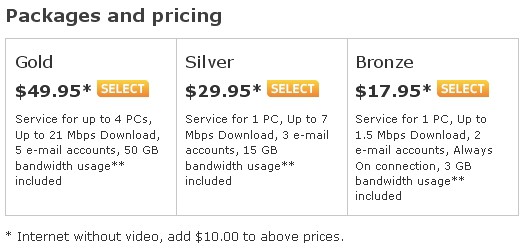
Sunflower Broadband Pricing - Note a $10/month surcharge applies for customers not subscribing to Sunflower's video package.

We’ve covered the story of Sunflower Broadband before here on Stop the Cap! This dubious provider has become well entrenched with its Internet Overcharging schemes in and around the Lawrence, Kansas region, charging top dollar pricing while imposing ridiculous limits on usage.  One Mac owner in the Lawrence area is fed up with Sunflower’s 3GB monthly usage limit for broadband users, charging a ludicrous $27.95 a month for standalone broadband service (that’s $9.32/GB!).  He’s calling on Apple Corporation to get involved in the opposition to price gouging and Internet Overcharging by providers like Sunflower.

Sunflower’s a big proponent of these pricing schemes.  Patrick Knorr, who works for Sunflower and is also ex-officio chair of American Cable Association, wants this kind of pricing for everyone.  No matter how much you consume, you are probably paying too little for your broadband account.  Sunflower’s pricing of its most deluxe Gold plan assumes you’ll never use more than 50GB per month, and for that charges customers $59.95 a month if all you want is broadband service.

Dave Greenbaum, writing for theAppleBlog, considers these kinds of limits to be abusive.

Apple is the leader in multimedia content creation; new Mac users are always pleasantly surprised by how easy it is to buy from the iTunes store, or create their own content. A common question we get in our local user group is “I’m not sure what I did wrong, but all of a sudden I have a substantial overage bill from my cable company.” Of course, the user did nothing wrong, other than subscribe to a few podcasts, and perhaps download a new Apple software update and buy some shows with iTunes! The Mac is also blessed with great online backup services like MobileMe, yet when our user group did a presentation on backup strategy, I had to warn novice users to be careful lest their backups end up costing them an arm and a leg in bandwidth overage fees!

Sunflower Broadband claims, with absolutely no independent verification, that nearly 50% of their customers consume less than ONE gigabyte per month and 98.9% of users had less than 40GB of bandwidth usage.  Of course, despite updates to its website, it curiously only provides statistics from April 2007, more than two years ago.

Greenbaum informs readers of Rep. Eric Massa’s proposed legislation, HR 2902, the Broadband Internet Fairness Act.

Ultimately, without an end to abusive broadband pricing, the implications for consumers go well beyond their own pocketbook:

Unfortunately, using the Internet normally with bandwidth metering is also unsustainable. When Mac owners are worried about downloading movies, doing backups or performing system updates, that hurts the Apple brand. Apple is continually innovating new ways to make the Mac OS the best Internet operating system, creating a whole ecosystem with iTunes, MobileMe and iLife. All of these great products rely on the ubiquity of the Internet. When Internet providers start making normal Internet use an expensive proposition, Mac users lose.

Apple should lead the way and come out against bandwidth caps. Given that many of the offerings on the iTunes store actually compete with cable TV, Apple should be vigilant that cable companies do not use bandwidth metering as a way to stifle alternative ways of viewing content.

Deregulation + Lack of Competition = Rate Increase for Alabama AT&T Customers

Phillip Dampier June 29, 2009 AT&T, Public Policy & Gov't 1 Comment
AT&T Rate Increases Coming

AT&T Rate Increases Coming

AT&T is jacking up phone rates for residents of Alabama, one year after state officials deregulated the Alabama telephone service marketplace based on the premise that competition would bring about lower rates for consumers, not higher.

Darrell Baker, director of the Alabama Public Service Commission’s telecommunications division, said telephone companies heavily promoted the price deregulation plan by claiming competition would keep rates down.  An industry-friendly deregulation bill was passed in 2005 over PSC objections, and another bill the Alabama Legislature passed this spring expanded deregulation further.

Alabama residents will now pay for that free-market construct in a state with limited local line competition.

AT&T spokesman Hood Harris said customers with Basic Service, a single-line home phone, will see their bill rise 3 percent, from $16.95 per month to $17.45.  Approximately 15 percent of AT&T’s Alabama customers have basic service.

Customers with AT&T’s deluxe plan, the Residence Complete Choice Package, will see an increase of 9.5 percent, from $21 per month to $23.

Harris blamed the increases on inflationary costs.

Baker was unimpressed with the rate increase announcement.  “It doesn’t sound like the competitive market is having much impact,” he said.  Baker expects other telephone companies in the state to quickly follow suit.

AT&T increased rates in 2008 by 4.1%.

Search This Site:

Contributions:

Recent Comments:

Your Account:

Stop the Cap!
