

 Subscribe
 A condition imposed by the Federal Communications Commission requiring newly merged Charter-Time Warner Cable-Bright House to expand service into at least two million new homes already served by another cable or phone company already offering High Speed Internet is causing heartburn for smaller cable and phone companies that fear government-mandated competition in their service areas.
FCC chairman Thomas Wheeler has long believed that cable operators could compete against one another for customers, driving down prices for consumers while forcing service improvements. One of the conditions approving the Charter deal could have put Wheeler’s theory to the test, but not if Charter can help it.
Charter CEO Thomas Rutledge implied that he will continue to shield fellow cable operators from unwanted competition.
“When I talked to the FCC, I said I can’t overbuild another cable company, because then I could never buy it, because you always block those,” Rutledge said at last month’s MoffettNathanson Media & Communications Summit. “It’s really about overbuilding telephone companies.”
It seems unlikely Charter will ever directly overbuild one of its friends in the cable industry, especially important ones like Comcast, Cox, and Cablevision. Smaller independent cable companies don’t feel as secure, which is why the trade group that represents many of them, the American Cable Association, has tried to get the FCC to back off.
 “The overbuild condition imposed by the FCC on Charter is stunningly bad and inexplicable government policy,” ACA president Matthew Polka said in a statement. “On the one hand, the FCC found that Charter will be too big and therefore it imposed a series of conditions to ensure it does not exercise any additional market power. At the same time, the FCC, out of the blue, is forcing Charter to get even bigger.”
The FCC probably crafted the deal conditions to force Charter to compete with other cable operators, because one million of those new customer locations must be where at least 25Mbps broadband service is already available. That protects many phone companies still offering DSL as an afterthought, because most don’t offer speeds anywhere close to 25Mbps. But the FCC left several counter-intuitive loopholes in the language that Republican FCC commissioner Ajit Pai says lends credibility to the ACA’s argument.
“Unless Charter chooses to exclusively overbuild areas served by Comcast, which I find highly unlikely, Charter’s increased broadband market share will come at the expense of smaller competitors,” Pai wrote in comments about the proposal.
 Notably, Charter is allowed to buy up other small telecom companies and count up to 250,000 of their customers towards the one million new homes served requirement. If those are small rural cable companies, that means the FCC is allowing Charter to grow even larger instead of providing more competition. Charter could also choose to overbuild municipal broadband providers and co-ops, especially in areas next to existing Charter/TWC/Bright House systems. That would harm the FCC’s current interest in removing roadblocks to publicly owned broadband networks. Enthusiasm for such networks could be dampened if Charter is willing to wire the area at their own expense.
Rutledge’s announcement is sure to make life uncomfortable for a number of rural phone companies that have invested in fiber network upgrades and now face the potential of Charter taking away customers that are helping to pay off those upgrades.
An unintended consequence of the FCC’s various loopholes could place a heavy burden on independent telephone companies that invested in network upgrades for faster broadband even as wealthier and larger phone companies are protected from that competition by delivering frustratingly slow DSL.
One potential target for a Charter overbuild could be UniTel, headquartered in Unity, Maine. UniTel offers residential customers in Albion, Dixmont, Newburgh, Thorndike, Troy, and Unity broadband speeds up to 1 gigabit. Unity is located between Bangor and Portland — both served by Time Warner Cable (now Charter).
Phone companies like UniTel call the FCC’s mandate “artificial competition” that could put it and other rural independent phone companies into financial distress. UniTel has a speed edge over anything Charter plans to offer customers in the immediate future as it deploys fiber to the home service, but television is another matter. One of the benefits of being a large cable company is volume-discounted pricing for cable television networks. Smaller independent operators cannot compete when wholesale television programming discounts are calculated in, allowing larger companies to undercut smaller ones with lower pricing.
UniTel officials criticized the FCC for creating deal conditions that Charter will exploit to the detriment of improving rural broadband service.
“Rather than allow New Charter to unilaterally narrow the scope of the buildout condition to meet its own business objectives, UniTel respectfully urges that the Commission should act to narrow the scope of any buildout condition, not to meet the private business objectives of New Charter, but rather to meet the public policy objectives of universal service in rural areas,” the company argued in its filing with the FCC.
A handful of rural telecom associations generally agree with UniTel and want the FCC to retarget Charter’s buildout requirements to fixing the rural broadband problem by expanding into unserved service areas instead.

 “Size-wise, they’re the Godzilla of telecommunications,” said Steve Oden, director of member services at the tiny electric co-op. “And we’re just a lowly electric co-op here in Middle Tennessee.”
 First credit cards were tied to your credit score, then auto insurance, and now how much you pay for cable television and what kind of support you receive from customer service may also depend on your creditworthiness, at least at Cable One.
 Cable One has even stopped direct marketing its cable service, even though it was winning nine percent of new customer sign-ups. The customers Cable One attracted were so low quality, Might claims the company didn’t make a penny from the marketing effort.
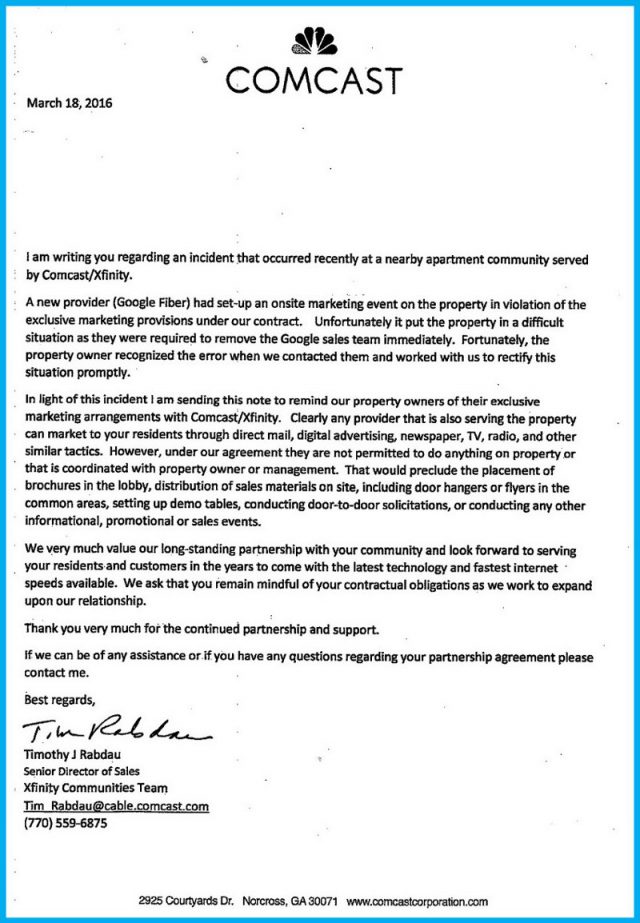
 Is your cable television service included in your rent or condo “services” fee? Have you ever called another provider and told service was not available at your address even through others outside of your condo neighborhood or apartment complex can sign up for service today? Chances are your landlord or property management company is receiving a kickback to keep competition off the property, while you may be stuck paying for substandard services you neither want or need. Worst of all, chances are it’s all legal and everyone is getting a piece of the action… except you.
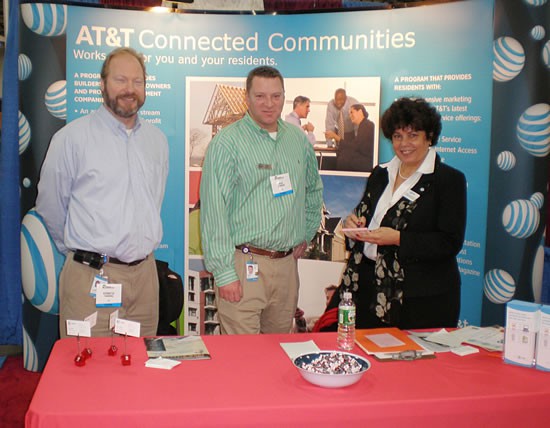 With the FCC’s 2007 declaration that exclusive contracts between cable companies and property owners were “null and void,” the power of the cable industry to negotiate on their terms was markedly diminished. Although many property owners applauded their new-found freedom to tell the local cable company to take a hike if they did not offer better service to their tenants, many others saw dollar signs in their eyes. With leverage now in the hands of the property owner, if the local cable company wanted to stay, in many cases it had to pay. Only the most brazen property owners kicked uncooperative cable companies off their properties, putting tenants at a serious inconvenience. Instead, many found life more peaceful and lucrative to stick with the existing cable company, signing a new contract for “bulk billing” tenants. On the surface, it seemed like a good deal. Property owners advertised that cable TV was included in the rent (and they paid a deeply discounted price per tenant) and the cable operator had a guaranteed number of customers, whether they wanted the service or not.
 If Google Fiber, AT&T U-verse or Verizon FiOS sought to offer service on one of these properties, they would have to overcome the investment insanity of wiring each building with its own infrastructure, including duplicate cables, in separate conduits and spaces not already designated for the exclusive use of the cable company. Verizon in New York City has faced numerous obstacles wiring some buildings, including gaining access to the building itself. Intransigent on site employees, bureaucratic and unresponsive property management companies, and developers have all made life difficult for Verizon’s fiber upgrade.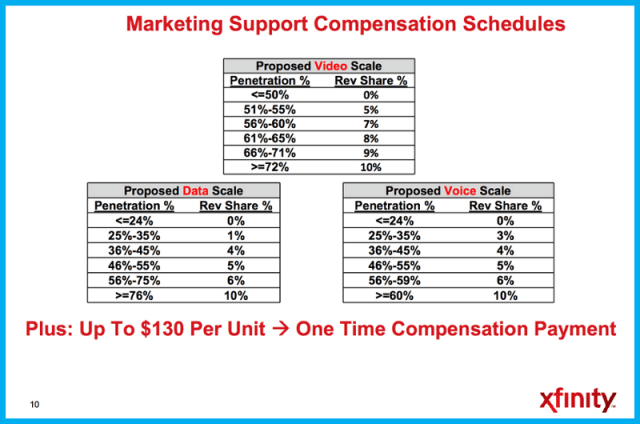


 “I think it’s vital to put our country’s well being ahead of party,” he said in a statement provided by the Clinton campaign. “Hillary Clinton is experienced, qualified, and will make a fine president. The alternative, I fear, would set our nation on a very dark path.”
 Cicconi would be pleased to see someone like former Tennessee congressman Harold Ford, Jr., take a seat at the FCC under a future Clinton Administration instead. Ford has served as an honorary co-chairman of Broadband for America, an industry-sponsored astroturf operation, for most of Obama’s two terms in office. He remains a close friend of both Bill and Hillary and is never far from the public eye, turning up regularly on MSNBC.