Home » Consumer News » Recent Articles:

AT&T Blames Technical Fault for Slow Uploads Affecting Under “Two Percent” of Customers

We have received a copy of AT&T’s statement in response to yesterday’s report about slowed upload speeds impacting customers in several cities around the United States:

AT&T and Alcatel-Lucent jointly identified a software defect — triggered under certain conditions – that impacted uplink performance for Laptop Connect and smartphone customers using 3G HSUPA-capable wireless devices in markets with Alcatel-Lucent equipment. This impacts less than two percent of our wireless customer base. While Alcatel-Lucent develops the appropriate software fix, we are providing normal 3G uplink speeds and consistent performance for affected customers with HSUPA-capable devices.

That two percent figure seems low considering the sheer number of reports received, but it’s not unprecedented.  Equipment and software glitches can create major slowdowns and outages.  While the problem is being fixed, affected customers are falling back to older and slower upload protocols.  AT&T didn’t apologize for the slowed upload speed, nor provide an estimate for when repairs would be complete.  As of the time of writing (3pm ET), problems are still being noted by some customers.

Customers annoyed by the glitch might be able to obtain some credit for the reduced level of service by contacting AT&T customer service and asking for it.

Apple’s Explanation for iPhone’s Performance Issues on AT&T Loses More Bars in More Places

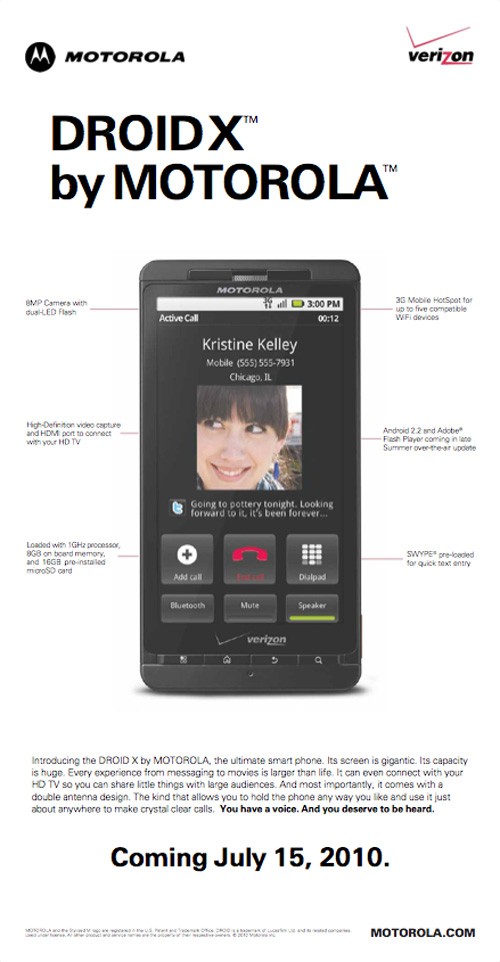
A full page ad from Verizon mocks Apple's iPhone reception problems (click to enlarge)

Apple wants customers to believe it’s not a head-slapping design flaw that is bringing iPhone reception to its knees when holding the phone, it’s the software that is telling you AT&T’s reception quality is better than it really is. Change the formula to calculate how many bars of signal strength AT&T is not delivering to its customers, problem solved.

But just how will Apple make its fan base believe those dropped calls and lousy data transmission rates, made worse when holding the phone “the wrong way” are just the result of some software bug?

In a statement released Friday, Apple told worried customers the latest version of the phone remained the best it had ever produced, and the lack of signal shown on the display is a software problem (inferring AT&T’s usual network issues), not a fundamental design flaw:

Upon investigation, we were stunned to find that the formula we use to calculate how many bars of signal strength to display is totally wrong. Our formula, in many instances, mistakenly displays 2 more bars than it should for a given signal strength. For example, we sometimes display 4 bars when we should be displaying as few as 2 bars. Users observing a drop of several bars when they grip their iPhone in a certain way are most likely in an area with very weak signal strength, but they don’t know it because we are erroneously displaying 4 or 5 bars. Their big drop in bars is because their high bars were never real in the first place.

To fix this, we are adopting AT&T’s recently recommended formula for calculating how many bars to display for a given signal strength. The real signal strength remains the same, but the iPhone’s bars will report it far more accurately, providing users a much better indication of the reception they will get in a given area. We are also making bars 1, 2 and 3 a bit taller so they will be easier to see.

We will issue a free software update within a few weeks that incorporates the corrected formula. Since this mistake has been present since the original iPhone, this software update will also be available for the iPhone 3GS and iPhone 3G.

In other words, Apple is banking that its fans are so enamored with the company and its products that just making a software change will convince customers the phone isn’t the problem. Will AT&T’s already lousy customer rating take an even bigger hit when Apple passes the buck for its design flaws to the cell phone provider?

The ongoing revelations of the flaws in the latest iteration of the Apple iPhone are stunning, if only because they were completely missed during beta testing by company employees. As we learned several weeks ago from the Apple employee who left his phone behind in a California bar, some prototype phones didn’t use the “innovative” case design now implicated in the “grip of death.”  Perhaps other Bay Area testers just assumed the bouncing signal strength meter was simply AT&T-as-usual.

Now that the signal issue, among others, has been made the star of the iPhone show on YouTube, Apple has launched into damage control mode.  What Apple does to regain your trust depends on what type of customer you are:

Tech-minded, Informed Consumers: Apple will have the most trouble convincing these customers to sign-on the iPhone bandwagon, especially now.  Many have refused to hop on board all-along, unwilling to sacrifice their wireless phone service to AT&T.  While many of these customers would happily buy an iPhone… from Verizon, news of technical defects and design faults will not inspire confidence.

Tech-minded Early-Adopters: Apple will need to fix its problems with the iPhone to keep these customers happy.  They are the first to buy new products and are more forgiving of early manufacturing faults (and are among those who probably first documented and reported them), but they won’t forgive intransigence and PR nonsense.  These customers want honest answers, a schedule for a solution, and mitigation — a few free iPhone case bumpers as a consolation would probably make many of these customers happy.

Non-technical Apple Devotees: If it’s from Apple, these people will buy it.  They don’t have the first clue about the technical mumbo-jumbo that explains the design flawed antenna on the newest phone, and probably don’t care.  They are loyal Apple customers, but they’ll happily slam AT&T for dropping their calls.  Most of these customers are probably blaming any reception issues exclusively on AT&T already.

The Fanboys & Fashion-Minded: These are the folks who perennially set up the lawn chairs in front of Apple stores 15 hours before the launch of every version of the iPhone.  A criticism of Apple is a personal affront, and they’ve probably already bought the company explanation for the issue.  The fashion-minded treat the iPhone as a must-have personal accessory.  Nothing short of a total failure of the phone will pry them loose from grabbing the latest version of the phone they need to be seen with.

For those without (or who don’t care about) iPhones, watching customers wait in long lines, proclaiming all things from Apple to be good — quickly followed by torch-bearing complaints when they are not so good brings  rolling eyes and mutterings about why someone would punish themselves over a phone.

Potentially the most irritating of all is the fact Apple could make money from its design failure — by advocating consumers spend a ludicrous $30 on what is little more than a rubber band to protect the rim of the phone from your hand.  Apple is selling their “bumper” case one to a package in multiple colors.  For that amount of money, consumers should get one of every color.  A company memo underscored the fact Apple was not about to give these out for free to aggravated customers.  Why lose an opportunity to extract even more cash from devoted customers?

[flv width=”536″ height=”420″]http://www.phillipdampier.com/video/MSNBC iPhone Troubles 7-6-2010.flv[/flv]

MSNBC’s ‘Morning Joe’ was unimpressed with customers who first lauded and then “whined” about their iPhone purchases, after revelations of inherent design flaws and other quality control issues threaten to turn the product sensation into the Toyota of telephones. (3 minutes)

Class action law firms are salivating at the prospects, and attorneys claim no “software fix” is going to suddenly make the iPhone’s antenna design issues go away:

  • One suit filed on behalf of Steve Tietze and others in the U.S. District Court for the Northern District of California seeks class action status. Tietze accuses Apple of unfair competition, false and misleading advertising, breach of warranty, and violation of the Consumer Legal Remedies Act.
  • A second was filed in the U.S. District Court for the District of Maryland on behalf of Kevin McCaffrey, Linda Wrinn, and others accusing Apple and AT&T of knowingly distributing a phone with a malfunctioning antenna. The suit charges general negligence, defect in design, manufacture, and assembly, breach of warranty, deceptive trade practices, intentional and negligent misrepresentation, and fraud by concealment.
  • Two others: Alan Benvenisty v. Apple, 10-2885, and Christopher Dydyk v. Apple, 10-2897, U.S. District Court, Northern District of California (San Francisco).  “Apple’s sale of the iPhone with this unannounced defect, assuming Apple’s prior knowledge of the defect, constitutes misrepresentation and fraud,” said Christopher Dydyk of Cambridge, Massachusetts in his complaint. “In omitting to disclose the defect in the iPhone 4, Apple perpetrated a massive fraud upon hundreds of thousands of unsuspecting customers.”  Dydyk wants Apple to hand out free “bumper” cases that cover the antenna in rubber to prevent signal issues.

[flv]http://www.phillipdampier.com/video/WJZ Baltimore Lawsuits Filed Over New iPhone 4 7-2-10.flv[/flv]

WJZ-TV in Baltimore covers the Maryland lawsuit seeking class action status.  Baltimore area residents filed the suit against both AT&T and Apple.  (1 minute)

Other phone manufacturers are laughing themselves silly at Apple’s declaration that all smartphones lose reception and drop calls based on how you hold the phone. Nokia is having a field day at Apple’s expense, promoting the fact you can hold their phones anyway you like and won’t suffer signal degradation:

One of the main things we’ve found about the 1 billion plus Nokia devices that are in use today is that when making a phone call, people generally tend to hold their phone like a…. well, like a phone. Providing a wide range of methods and grips for people to hold their phones, without interfering with the antennae, has been an essential feature of every device Nokia has built.

Of course, feel free to ignore all of the above because realistically, you’re free to hold your Nokia device any way you like. And you won’t suffer any signal loss. Cool, huh?

[flv width=”640″ height=”500″]http://www.phillipdampier.com/video/WTTG Washington iPhone Signal Strength Can Drop 7-5-10.flv[/flv]

WTTG-TV in Washington spoke with Washington Post Tech Reporter Rob Pegoraro who discussed the signal ‘death grip’ and characterized AT&T’s service quality: “we have terrible coverage and we were lying to you [about it] all along.” The report also seriously questions Apple’s claims of a “software glitch” asking why a software problem would cause calls to drop when holding the phone “the wrong way.”  (4 minutes)

Apple’s public relations problem continued to grow this week when it declared earlier reports of terse e-mails purporting to be from Steve Jobs as fakes.  Boy Genius Report, who compensated one recipient of the e-mails, posted e-mail headers that they represent proves the messages did, in fact, come from Apple.

Apple also was caught in a case of bad timing when blogs discovered the company posting help wanted ads seeking antenna engineers, which seemed ironic coming after the release of the much-anticipated iPhone 4.

One biochemist offered his advice for free:

Subject: HowToFix for minimal cost — hydrophobic organic thin film layer

Hi,

In truth, Apple’s explanation for iPhone 4 signal reception problem is inaccurate at best and disingenuous at worst. iPhone users are in some of the hottest and most humid parts of the country this summer and have salty, damp hands especially at events such as baseball games, barbecues, or other outdoor activities. having bare metal antennae purposely handled will absolutely short the signal. This problem will be difficult to reproduce in Apple’s labs because the engineers are required to wash their hands before touching devices, which also strips off the natural hand electrolytes that are ever-present in the field on a hot day.

Anyway, the solution is not a redesign of the phone, but rather an electrically insulating organic hydrophobic layer atop the bare metal. a variety of plastics will work, such as polyethers, polystyrenes, or nylons. you could even use the plastic labels ever-present on aluminum soda cans, which likewise have an electrically insulating effect when holding said cans. these plastic coatings can be very very thin films which do not ruin the aesthetics of the device, and would require a minimal change of your production line. More importantly, this coating in no way affects the ability to recycle the aluminum — the organic thin film layer will burn away cleanly during the aluminum remelt process. Phones that have already shipped could easily be coated with this new layer at any Apple retail store or with a simple kit you could send to your customers.

In summary, this is a problem of electrochemistry, and certainly NOT a problem of software design, nor one that can possibly be solved by a software update.

Apple needs to hire some chemists.

Best regards,
XXXXXXXXXX, Ph.D.

[flv width=”512″ height=”308″]http://www.phillipdampier.com/video/KWGN Denver iCafe – Apple seeks iPhone 4 engineers to fix antenna problems 6-30-10.flv[/flv]

KWGN-TV in Denver noted job postings from Apple seeking the help of experienced antenna engineers to help with their iPhone product line.  (3 minutes)

Several additional videos detailing the saga of the iPhone 4’s bugs are included below the jump.

… Continue Reading

Frontier Promises to Keep Their Customer Service Inside the USA

Phillip Dampier June 30, 2010 Consumer News, Frontier Comments Off on Frontier Promises to Keep Their Customer Service Inside the USA

Frontier Communications today announced it was keeping a commitment to use only American-based call centers to provide customer service.  That will be a welcome change for former Verizon customers who often found their customer service calls transferred to overseas help desks and representatives.

“In addition to voice customer service, our broadband Internet help desk jobs will continue to be staffed by a 100 percent U.S.-based workforce. This will include the creation of 500 new US-based jobs replacing work that Verizon sent overseas,” said Maggie Wilderotter, Frontier’s Chairman and CEO.

Many calls for assistance with Frontier’s Internet service end up in Henrietta, New York — near Rochester.  A good deal of Frontier’s general customer service assistance is provided from a large call center in DeLand, Florida — midway between Daytona Beach and Orlando.

Frontier is also pr0mising its customers appointment windows within two hour blocks, making it easier to know exactly when a technician will arrive.  If Frontier keeps its appointments, it means customers don’t have to take an entire day off from work waiting for someone to show up.

iPhone 4 Problems: “Don’t Hold the Phone in Your Hand” to Avoid Dropping Calls on AT&T

Phillip Dampier June 30, 2010 AT&T, Consumer News, Video 2 Comments

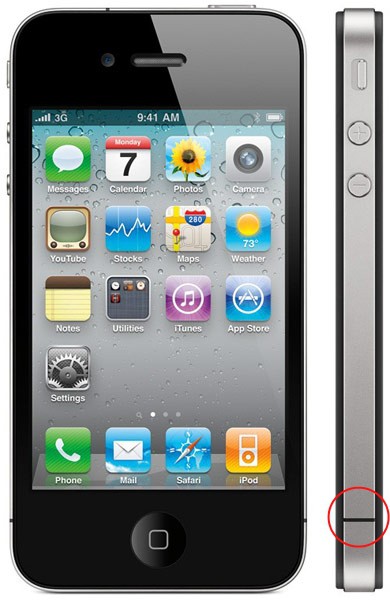
Don't touch this -- Bridging the gap (circled) can drive your iPhone's signal bars into a ditch

The long lines are over.  The hype that drove some Apple fanboys to wait hours in line, even with an advance reservation for the phone, has died down.  The people in the office you irritated bragging about your conquest have moved on with their lives.  For a growing number of early iPhone 4 buyers, that exhilaration is now being replaced with a realization: you are a beta tester for a new product that has some nagging design problems and defects.  And you are still stuck with AT&T, the nation’s least favorite wireless carrier.  Only now, it’s not just AT&T dropping your calls — it’s the iPhone itself.

A growing number of buyers have discovered a flaw so obvious even the most rudimentary testing, even from the drunk guy who left his phone in that California bar, should have picked up — if you hold the phone in your hand a certain way to make a call, the iPhone has a tendency to drop it.  That problem has grown so significant, Apple had to lock the message thread discussing the matter because it was crashing the browsers of support forum visitors.

You didn’t buy the iPhone to actually make calls, did you?

Sorting out whether the dropped calls are Apple’s fault or just business as usual at AT&T is now underway.

Apple’s answer to this particular problem is to turn the potential marketing crisis into an opportunity — by selling you a $30 “bumper”-case to keep your hands from actually touching the phone’s side, which is part of the antenna system.  The case’s odd design, which only covers the sides of the phone, has some speculating Apple knew about this problem all along and designed a case to mitigate the problem, and pocket the proceeds.

A leaked memo from Apple includes talking points to calm customers who have concerns Apple thinks are non-issues.  Apple even insists its representatives take a moment to summon up the proper “tone” when dealing with customers:

1. Keep all of the positioning statements in the BN handy – your tone when delivering this information is important.

  • The iPhone 4’s wireless performance is the best we have ever shipped. Our testing shows that iPhone 4’s overall antenna performance is better than iPhone 3GS.
  • Gripping almost any mobile phone in certain places will reduce its reception. This is true of the iPhone 4, the iPhone 3GS, and many other phones we have tested. It is a fact of life in the wireless world.
  • If you are experiencing this on your iPhone 3GS, avoid covering the bottom-right side with your hand.
  • If you are experiencing this on your iPhone 4, avoid covering the black strip in the lower-left corner of the metal band.
  • The use of a case or Bumper that is made out of rubber or plastic may improve wireless performance by keeping your hand from directly covering these areas.

2. Do not perform warranty service. Use the positioning above for any customer questions or concerns.

3. Don’t forget YOU STILL NEED to probe and troubleshoot. If a customer calls about their reception while the phone is sitting on a table (not being held) it is not the metal band.

4. ONLY escalate if the issue exists when the phone is not held AND you cannot resolve it.

5. We ARE NOT appeasing customers with free bumpers – DON’T promise a free bumper to customers.

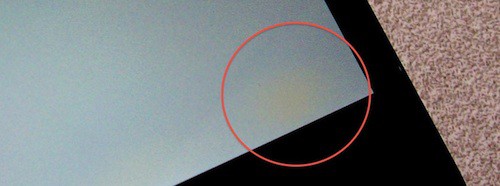
The yellow blotch problem

This week, even more problems are showing up:

  • The Glitchy Proximity Sensor: PC World covers the iPhone’s sudden activation of the menu screen while talking on the phone.  With one’s face next to the screen, customers are reporting calls suddenly switched to speakerphone mode, muted, or throwing blasts of touchtones at callers.
  • AT&T “Still Sucks”: Customers in San Francisco and Los Angeles, among other large cities, report “Bermuda Triangle” reception zones where calls regularly drop and cannot be made.  Randomly dropped calls are also still a major problem, and some customers believe the latest iPhone is more prone to showing “no service” than earlier models.
  • Yellow Screen Blotches: Yellow-tinted blotches are visible on several owners’ iPhone screens.  Apple claims this is residue from the manufacturing process to bind the glass to the screen and will disappear with use as the adhesive fully dries.  Gizmodo reports these phones were likely rushed through manufacturing and shipped in time for the iPhone release day.  While some customers confirm the blotches do seem to be fading, others have been instructed by Apple to return yellow-tinged phones for replacement.
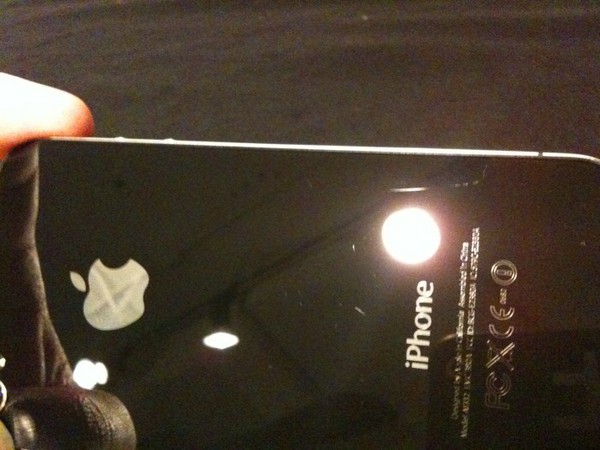
  • Easily-Scratchable: Despite the hype about breakthrough glass technology making the phone more scratch resistant than ever, folks on Engadget found it was quite easy to tear up the phone when placed in a pocket with keys or other scratchy things.

Engadget received photos of scratched iPods hours after being unboxed (click to enlarge)

A Sacramento law firm, Kershaw, Cutter & Ratinoff has already started looking for customers experiencing poor reception quality and dropped calls, presumably to consider a class action lawsuit against Apple, AT&T, or both.  As of now, the law firm has received more than 400 complaints.

The signal loss problem has the prospect of becoming the most notorious — for both Apple and AT&T — especially when it is easily reproduced by reporters on the local evening news (see below).  But Steve Jobs thinks the complaints are overblown, writing back to one complainer, “Non issue. Just avoid holding it in that way.”

Despite that,  Gizmodo launched a petition urging Apple to give free cases to all iPhone 4 owners.

Every product launch has its bugs. We’ve seen a lot this time. Many issues, like the yellow screens, will go away as manufacturing fine tunes and adjusts to solve the problems. But the antenna issue is a fundamental one, a design flaw, that won’t go away as easily without adjusting the product in a deeper way.

So with all these great things, it’s terrible that buyers should have this excellent phone ruined for them because of a single, but serious, design problem. And even worse that Apple should suggest users use their phones in unnatural ways or shell out $30—for what is essentially a double wide livestrong armband—to fix it.

According to some Apple-watchers, the company plans a software fix, suggesting the signal meter displayed on the phone is the real issue, not the actual quality of reception from AT&T.  If the software fix only re-calibrates the signal meter and consumers still see dropped calls and reception problems, additional complaints are likely.

After a week of made-for-TV-lines outside of Apple stores across the country, reality has set in and several stations are now turning their attention to the iPhone 4’s pesky problems.

We have a number of videos for you to watch below the jump!

… Continue Reading

Time Warner Cable Will Pay Frontier’s Early Termination Fee If You Switch Phone Companies

Phillip Dampier June 22, 2010 Competition, Consumer News, Editorial & Site News, Frontier Comments Off on Time Warner Cable Will Pay Frontier’s Early Termination Fee If You Switch Phone Companies

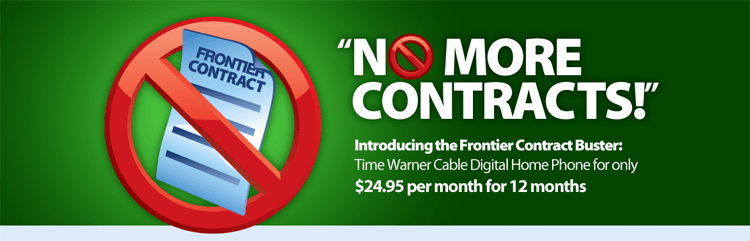
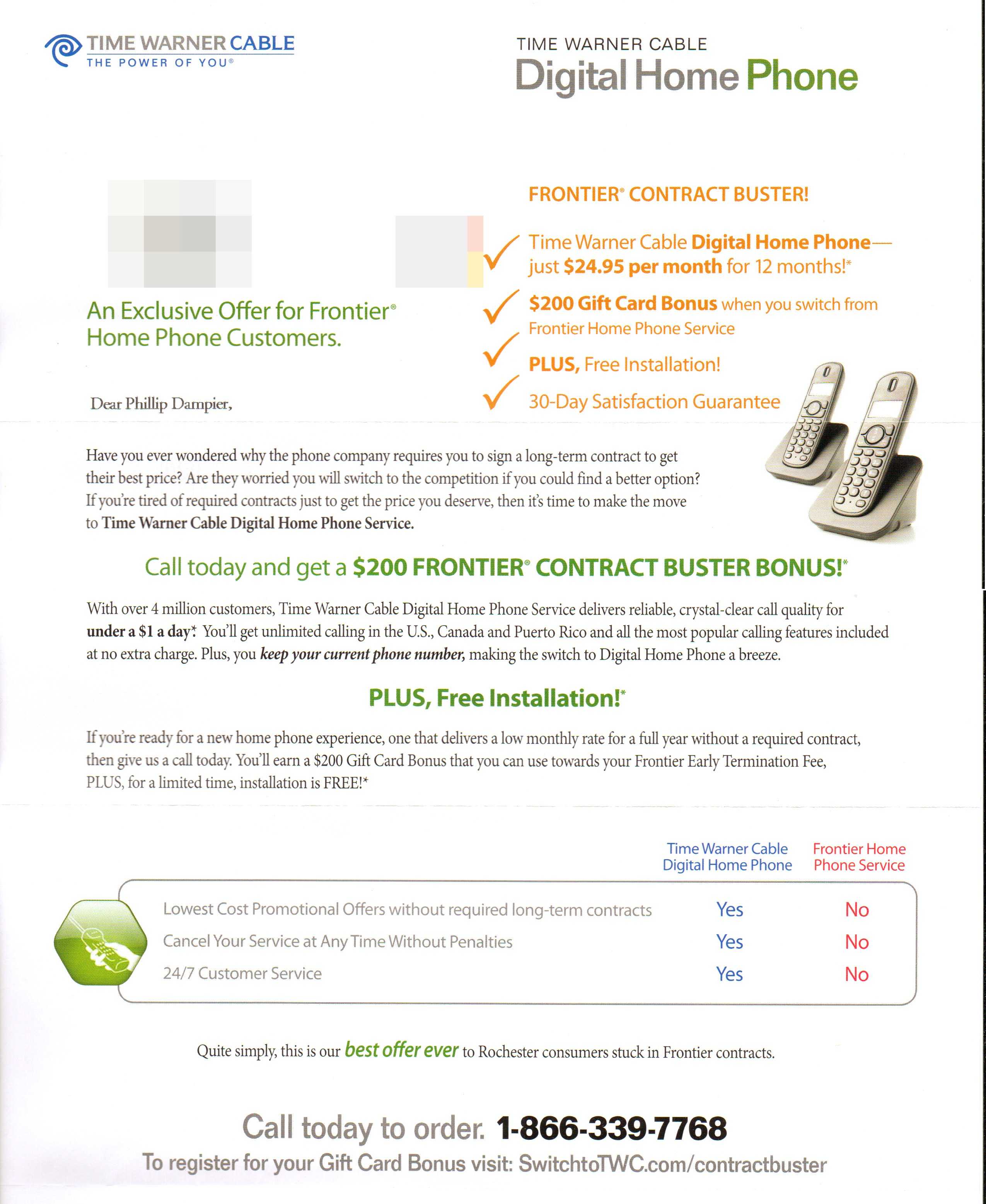
Time Warner Cable is back again with another offer to existing Frontier Communications customers trapped in multi-year service agreements.  If you dump your Frontier landline overboard for Time Warner Cable’s Digital Phone service, the cable company will send you a gift card worth $200 good towards defraying your early termination fee, if any.  If you don’t have such a fee, you pocket the $200.  A year ago on this date the company ran a similar promotion heavily promoted in local cable television ad spots.

Time Warner will provide free installation of the phone line including unlimited nationwide long distance for $24.95 a month for 12 months.  With the $200 gift card, that’s above and beyond their usual promotion.  The company is also extending a bundled discount if a customer also takes Road Runner broadband service with their “digital phone” service.

For Frontier customers looking for an early exit, this offers one opportunity.

Existing cable subscribers can take advantage of the offer.  There are terms and conditions to consider, starting with where the offer is available.  The following Time Warner Cable service areas qualify:

  • TWC Western New York
  • TWC Central New York
  • TWC Albany, NY
  • TWC New England
  • TWC Dothan, AL
  • TWC Enterprise, AL
  • TWC Yuma, AZ
  • TWC El Centro, CA
  • TWC Gunnison, CO
  • TWC Telluride, CO
  • TWC Coeur d’Alene, ID
  • TWC Moscow, ID
  • TWC Madison, IN
  • TWC Newburgh, IN
  • TWC Terre Haute, IN
  • TWC Ashland, KY
  • TWC Owensboro, KY
  • TWC Richmond, KY
  • TWC Kansas City, MO
  • TWC Lincoln, NE
  • TWC Ironton, OH
  • TWC Richlands, VA
  • TWC Pullman, WA
  • TWC Clarksburg, WV

Next, the offer is only good for residential customers switching from Frontier’s landline service.  Limit one gift card per customer.  Your final Frontier phone bill showing a disconnect request must be furnished to Time Warner Cable within 30 days to qualify.  Your name and address must match on both bills.  Offer is not available to customers with past due balances with Time Warner Cable, defined as any money owed in the past 30-60 days or customers who have been disconnected for non-payment in the twelve (12) month period preceding this offer.  Service must be ordered by Dec. 31, 2010, and installation must occur within thirty (30) days of order date.

If you’ve contemplated a change in providers but didn’t want to be subjected to a steep early cancellation fee, this isn’t a bad offer.  Although I don’t use Time Warner Cable Digital Phone myself, others in my family do and they are satisfied with the service, although there have been at least two serious outages so far this year that ran several hours.  Since most people also carry a cell phone, any cable outage or power interruption that also takes out your phone line isn’t as serious as it might have been in earlier years.

And, ahem, unlike Time Warner Cable’s attitude towards broadband, they really do provide unlimited calling with their “digital phone” service.

Time Warner Cable is mailing this letter to Frontier Communications customers in the Rochester, N.Y. market. (Click to enlarge)

Search This Site:

Contributions:

Recent Comments:

Your Account:

Stop the Cap!