Home » Consumer News » Recent Articles:

Time Warner Cable’s 10 Hour Internet/Phone Outage in Rochester, N.Y. – Get Your Service Credits!

Phillip Dampier October 7, 2010 Consumer News, Editorial & Site News 5 Comments

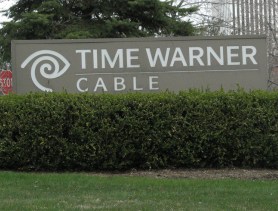
Time Warner Cable's offices on Mt. Hope Avenue in Rochester, N.Y.

Bad marks to Time Warner Cable, who left large areas of metropolitan Rochester, N.Y., with barely/non-functional Internet service and non-working “digital phone” service for 10 hours yesterday.

No explanation for the outage has been given, which resulted in inaccessible websites and traffic bouncing back and forth between equipment in western New York.  “Digital phone” customers were unable to reach… anyone. Customer service lines were jammed as the outage began just after 12 noon.

The disruption extended from Monroe County into both Wayne and Ontario counties, where residents in Newark and Canandaigua also reported service problems.

Time Warner Cable’s automated customer service attendant was the Helen Keller of cable outages:

“I’m not seeing an Internet outage in your area,” came her reply — even after a local employee recorded a message telling callers there were problems with phone and Internet service across the Rochester region.

While some websites still worked, many more were unreachable.  Some customers reported slow, but working service in the early evening.  Full service restoration to the area would not happen until 10pm.

Time Warner Cable’s social media representatives took several complaints from local residents about the extended outage, without reminding them they are qualified to receive service credits for the interruption.

Here at Stop the Cap!, we will remind you, and in fact encourage you to request a full day of credit for the phone and Internet service you did not have from the cable company yesterday.  Of course, we represent your interests and they represent theirs, which is why credits come only to those who ask.

Stop the Cap! Presents Your Easy Service Credit Request Menu

Customers can request one day of credit for both phone and Internet service (assuming you have both services, of course).  Make sure you request -both- credits if you are entitled.

Sample Request You Can Cut and Paste:

I am writing to request one day service credit for the phone and Internet outage that occurred in Rochester yesterday, Wednesday Oct. 6th.  We were without service for most of the day.  Please credit my account.

Methods to Obtain Credit:

  1. Use Time Warner Cable’s Online Chat system, select Billing Inquiry, and type to a customer service representative.
  2. Call (585) 756-5000 or toll free 1-800-756-7956 and speak with a customer service representative.
  3. Use the Online E-Mail form, select Billing Inquiry, and send a message requesting credit.

[Update: 2:47pm ET:  A day’s credit was provided just three hours after submitting the request using the e-mail method, so this was as painless as can be.]

More Frontier Problems: Californians Wait Months on Refunds for Disconnected Landlines

Phillip Dampier October 4, 2010 Consumer News, Frontier, Video 2 Comments

High speed Internet, snail slow refunds

Each time Frontier Communications gets mentioned on Stop the Cap!, we receive e-mail from disgruntled customers arriving to share their horror stories.  Since Frontier has now absorbed Verizon landlines in several states, that e-mail is only increasing.

Because so many messages arrive on different topics, we’ll be trying to share your stories with our readers based on the types of problems experienced.  Today, it’s the issue of refunds.

Stop the Cap! reader Alexia from Elk Grove, California writes:

Phillip, I want my money.  For four months, I have called, written, and called again to ask where my refund check from Frontier is.  We disconnected our service from Frontier back in May and our final bill had a credit of nearly $150 on our two landlines, DSL, and returned equipment.  Why so much?  Because we were quoted a final amount for our account and instead of using their auto-payment service, we mailed them a last check.  They withdrew that amount electronically from our checking account anyway, so we had double payments.

This isn’t just me.  My sister decided to disconnect her phone and will rely on her cell phone from now on, and she’s still waiting for her final credit balance to arrive back as well.

When you call Frontier, assuming you don’t get a busy signal or are left on hold, they seem very sympathetic and promise the refund has been processed and they are sending the check in the mail.  The Pony Express could have gotten the check to us by now.  My sister is waiting for $22 to be returned to her.

When I have canceled credit cards, utilities, and other services and have a credit balance, most of them include a check either in the final statement or in a letter that arrives within the month.  Not Frontier.  One representative claimed they don’t send refunds right away in case they discover additional charges they need to apply to an account.  What charges?  Are they hoping to find some?  We have not made a long distance call on our landline in years since getting a cell phone and I cannot imagine what other charges they are talking about.

What is the story here?

The check is in the mail

Stop the Cap! reader Jeff in Elko, Nevada had a similar problem:

My job transferred me to Reno in July and we canceled our service with Frontier and are still waiting for our last bill refund because we had a credit balance.  It was only around $8, but that was after I had to argue with them about a cancellation fee they tried to charge me and a fee for the DSL modem we returned to them.  They credited our account for both after talking to a supervisor but now it is a waiting game for the final refund check to arrive.  Every other company we canceled service with, right down to the propane people handled our final bill correctly.  Not Frontier.

Since moving to Reno, we signed up for AT&T service which turned out to be way better than the DSL we had with Frontier that went offline nearly every afternoon, so we’re fine saying goodbye to them.  Frontier has been in Elko for awhile now so I can only imagine what the Verizon customers are now dealing with.

In September, Frontier’s “the check is in the mail” excuse caught the attention of a Sacramento TV station’s consumer reporter.

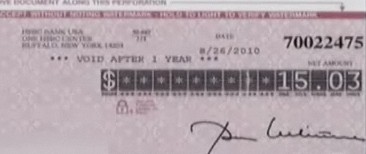
Jeanne Pritchett Melendez of Elk Grove was also waiting for a refund check from Frontier for just over $15.

Back in May, Jeanne paid her Frontier phone bill ahead of time.  And when she canceled her service mid-month, her bill was pro-rated and she was promised her money back.  She called the company… Asking when her check would be sent. And every time, she says she was told, it’s on its way.  But after more than three months…

“I was very frustrated and I said, you know what, if I don’t have a check in the mail by Friday, I’m going to call Kurtis [Ming – CBS13 Consumer Reporter],” says Jeanne.

Melendez got her refund before our readers did, along with an explanation from Frontier about why refunds take months to arrive:

Frontier Communications Statement:

Frontier’s refund process is to refund the final credit balance on disconnected accounts within 2 to 3 bill cycles from the disconnect date to allow time for any additional credits or charges that need to be applied to the account. This process is to ensure that the customer receives an accurate refund check.

The customer’s account reflects that the service was disconnected on May 13, 2010. The May 22nd , June 22nd and July 22nd bills reflected a credit balance in the amount of $15.03. A refund check in the amount of $15.03 was processed on the account on August 9th. The customer will receive the refund check within 10 to 14 business days to the address on record.

The representatives are trained to alert the customer that it can take 2-3 billing cycles which is usually between 30-60 days. However in the case of Ms. Melendez’s account the disconnect notice was so close to the bill date that three bill cycles were required to process the refund.

— Stephanie Beasly, Communications Manager

This isn’t the first time Kurtis Ming has had to approach Frontier Communications about Sacramento area residents’ frustrations with the company.  Back in July, KOVR-TV ran a story about a Frontier customer who was paying a whopping $15 a month for Frontier’s Peace of Mind hard drive backup service he never got because he didn’t realize he had to download software to get the feature installed.  While that was not Frontier’s fault (and the company provided a credit to the customer for the service he never used), charging $15 a month for a service other customers are paying less to receive isn’t exactly fair either.

[flv]http://www.phillipdampier.com/video/KOVR Sacramento Frontier Service Problems 7-7 and 9-17-10.flv[/flv]

KOVR-TV in Sacramento ran two segments on Elk Grove-area customers having problems with Frontier Communications — one waiting for a refund and the other charged for a service he didn’t realize he had.  (4 minutes)

Verizon Wireless’ $50 Million Dollar Oopsy: Refunds Coming for Those $1.99 ‘Mystery Data Charges’

Verizon, the nation’s largest wireless phone company, has agreed to refund erroneous data charges for 15 million subscribers who paid for data sessions they did not initiate.

Those familiar with the proposed refund settlement claim the company could spend between $50-90 million in refunds for customers without data plans who were charged, in some cases repeatedly, $1.99 for a few seconds of web access.

The problem stems from Verizon phones that make accessing data services easy to trigger.  One misplaced button press can launch a data session, resulting in a web access fee.  Verizon repeatedly denied the company was charging customers who accidentally landed on the provider’s wireless home page, but customers loudly claimed otherwise, filing hundreds of complaints against Verizon with the Federal Communications Commission.

Teresa Dixon Murray, a reporter for The Plain Dealer in Cleveland, was among the first to report on the mysterious charges many customers couldn’t figure out, especially as they continued even for customers who placed a “block” on accessing data services or who had powered their phones off and were still charged the fees:

In a column last summer, I chronicled my battle with Verizon after I discovered Verizon had been concocting $1.99 monthly charges for supposed Web use by my family plan numbers. Verizon’s ruse ended the month that my son’s phone was dead and locked away for weeks.

Verizon responded directly to me in a meeting with several top executives, and they promised to investigate the problems suffered by thousands of customers nationwide. The company in August also promised to change its policy of charging customers if they accidentally hit their phone’s “mobile Web” button. The new policy: To get charged, customers now supposedly have to type in a Web address.

A Verizon Wireless employee anonymously told the New York Times the scheme was a planned money-maker for Verizon, which earned up to $300 million a month just from accidental web access:

“The phone is designed in such a way that you can almost never avoid getting $1.99 charge on the bill. Around the OK button on a typical flip phone are the up, down, left, right arrows. If you open the flip and accidentally press the up arrow key, you see that the phone starts to connect to the web. So you hit END right away. Well, too late. You will be charged $1.99 for that 0.02 kilobytes of data. NOT COOL. I’ve had phones for years, and I sometimes do that mistake to this day, as I’m sure you have. Legal, yes; ethical, NO.

“Every month, the 87 million customers will accidentally hit that key a few times a month! That’s over $300 million per month in data revenue off a simple mistake!

“Our marketing, billing, and technical departments are all aware of this. But they have failed to do anything about it—and why? Because if you get 87 million customers to pay $1.99, why stop this revenue? Customer Service might credit you if you call and complain, but this practice is just not right.

“Now, you can ask to have this feature blocked. But even then, if you one of those buttons by accident, your phone transmits data; you get a message that you cannot use the service because it’s blocked–BUT you just used 0.06 kilobytes of data to get that message, so you are now charged $1.99 again!

“They have started training us reps that too many data blocks are being put on accounts now; they’re actually making us take classes called Alternatives to Data Blocks. They do not want all the blocks, because 40% of Verizon’s revenue now comes from data use. I just know there are millions of people out there that don’t even notice this $1.99 on the bill.”

Verizon’s decision to refund the erroneous data charges also comes long after a class action lawsuit was filed earlier this year against the company by Goldman Scarlato & Karon, P.C., of behalf of customers.

Impacted existing customers can expect credits, typically ranging from $2-6 on their October or November bills.  Former customers will get refund checks in the mail.

The Federal Communications Commission said it was opening an investigation into the Verizon overcharges, seeking a financial penalty from the wireless carrier, according to Reuters.

The news agency noted some customers were billed for data fees just because of software pre-loaded onto phones:

The charges affected customers who did not have data usage plans, but were billed because of exchanges initiated by software built into their phones.

For example, trying out a demonstration of a game that Verizon Wireless had pre-loaded onto a phone would sometimes trigger data transmissions from the phone unbeknownst to the customers who were then charged by Verizon Wireless for the data.

[flv width=”480″ height=”380″]http://www.phillipdampier.com/video/WPRI Providence Verizon To Pay Millions In Refunds 10-4-10.flv[/flv]

WPRI-TV in Providence covers the Verizon overcharges, pondering ‘why did it take more than two years for refunds?’  (3 minutes)

Déjà Vu: Is Frontier the Next FairPoint? – Bill Bungling: $671 for Dial Up Internet, “F” Rating from BBB

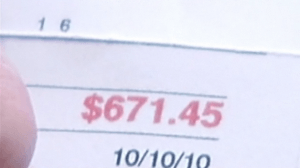
Stage two of the nightmare is billing problems, and one West Virginia family discovered a phone bill they couldn't imagine possible.

Frontier Communications’ performance in West Virginia is starting to resemble northern New England’s never ending nightmare with FairPoint, the phone company that couldn’t manage landline service for customers in Maine, New Hampshire and Vermont and ended up in bankruptcy.  Things have gotten so bad, Frontier Communications now earns an “F” rating from the Better Business Bureau, called out specifically for failing to respond to complaints filed against the provider, failure to resolve the complaints they did acknowledge, and government action taken against the company for deceptive business practices.

Stop the Cap! reader Ralph in West Virginia drops us a line to share the latest progress the company is making in his part of West Virginia, or rather the lack thereof, starting with his own personal story:

The afternoon of  Thursday Sep. 2nd, our phones were out of order for awhile but were working by 4pm.  The DSL was still out so I waited to see if they’d get it fixed later that evening.  When it was still out Friday afternoon, I called to report it and asked if they had a reported outage for the area.  Their answer was no, and they proceeded to ask me to reset the modem and perform some additional diagnostic testing.

That didn’t “fix” it so they filed a trouble ticket and told me a technician would be out to check the outside wiring and, if needed, give me a new modem.  Frontier never showed up, so I called again and was left on hold for 30 of the 35 minutes that phone call lasted. I was finally told that it was a known outage affecting 12 people in the area.  No repairs were made on Sunday so I called on Monday and was told the problem now affected 16 people and they had no idea when it would be fixed.  It was finally fixed five days after initially reporting the outage, and nobody bothered to explain why it took so long.  I was later bemused to find an article in the weekly county paper that noted the outage was now up to impacting 20 people.

In your earlier report about Frontier, a spokesman for the company claimed the company follows a protocol about calling customers with service problems to see if the issues were resolved, but that call didn’t come until Sep. 8th, a full 24 hours after our DSL service was restored.  Keep up the good work, maybe Frontier and other providers will realize that the system is broken and we do want and need high speed Internet.
Ralph is not alone in having trouble with Frontier.  Just as Stop the Cap! reported with FairPoint’s failure in New England, service problems are just the beginning of the “fun” for transitioned customers.  Billing problems come next, and Frontier followed through in spades for one West Virginia family.

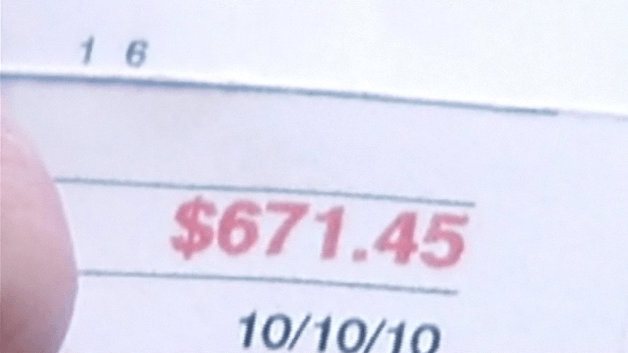
Meet Johna and Paul Snatchko, who are being billed $671.45 for dial-up Internet service calls by Frontier.  Not only did Frontier fail to deliver broadband service to the northwestern part of the state, now the Snatchko family has had to quit using dial-up Internet as well because the Snatchko’s claim Frontier made accessing the service a long distance call.

“When we switched from Verizon to Frontier, they said nothing will change,” Paul told WTOV News. “Well, there’s change.”

Despite selling the Snatchko family “unlimited long distance” service, Frontier still charged every call to their ISP at the regular long distance rate.  Why use dial-up in the first place?

“In this part of West Virginia, you’re very limited in your service,” Paul explained. “Dial-up is it for us. We’ve tried everything else. The only thing we could get was dial-up.”

The family also endured another Frontier specialty — the constantly changing promotional offers that are poorly explained by the company’s customer service representatives.

“They said it doesn’t include their package deal with the computer,” Johnna said, referring to a common Frontier promotion for a free netbook in return for a bundled package of services on a two year contract. “The first couple months it did and now it doesn’t include it.”

Frontier Communications earned an "F" rating from the Better Business Bureau

Frontier’s spokesman for the area, Bill Moon, made yet another TV appearance to try and explain it all away.

“There are billing problems that can happen anytime you have a switch over like that,” he told WTOV. “It’s probably a simple mistake on this particular customer’s bill, something that can be rectified pretty easy.”

Apparently not. Frontier told the family they have received two credits already and that is the last time the company is willing to provide them.

Despite the increasing frequency and seriousness of complaints now becoming a staple on the nightly news, Moon said incidents like this are rare.  He told the station out of more than 60,000 lines of service, they’ve had about 10 problems at most.

West Virginians are also waking up to the realization that Frontier’s promised “fiber upgrades” are little more than bait and switch, and they’ll never be able to directly access the fiber the company is installing.  As Stop the Cap! has reported previously, Frontier’s residential customers are more likely to encounter beneficial fiber in their morning breakfast cereal than from Frontier Communications.

The Charleston media is abuzz about the fact taxpayers are footing the bill for a $40 million fiber network that the company will own free and clear, and charge top dollar prices to access.  Citynet, one of Frontier’s competitors, blew the whistle over Frontier’s much-ballyhooed fiber expansion that is actually intended to serve public institutions, wholesale customers, and Frontier’s “middle-mile” network — not directly benefit consumers:

[…]Once Frontier spends the $40 million of taxpayer money to expand its network, it will be the sole owner of that network and the State will have no ownership rights. Thus, Frontier’s monopoly in the State of West Virginia will have been financed with taxpayer money.

Frontier will then sell services to state entities such as schools and government offices at the existing exorbitant prices. Those prices will never decrease, because no competitor can afford to spend $40 million or more of its own capital to build out its network.

Citynet, however, has provided the state with a plan for the expenditure of the taxpayer money that will expand broadband access in the state while at the same time lowering the cost of broadband access by 70 percent to 90 percent.

It is true that competitors, like Citynet, have existing contracts with Frontier for access to fiber facilities, but given that Frontier’s new network will be built with your money, it is Citynet’s position that those facilities should be made available to competitors at a nominal cost so that competitors can make their services available to the public at large at much lower prices.

Frontier has flatly refused Citynet’s proposal and intends to require competitors to pay inflated prices for access to fiber facilities it built for free.

As currently structured, the state’s plan for expanding broadband will do nothing more than expand Frontier’s monopoly, and will not address the fundamental problem of the high cost of broadband access.

[flv width=”640″ height=”380″]http://www.phillipdampier.com/video/WTOV Steubenville Speaking Too Soon – Frontier’s Customers Still Complaining 9-15 and 9-28-10.flv[/flv]

WTOV-TV thought Frontier’s problems were behind them when they ran the first of two stories about the company Sep. 15th.  But then they met the Snatchko family and learned they spoke too soon.  Last night, they tried to determine how a West Virginia family could be charged nearly $700 for dial-up Internet service.  (4 minutes)

Verizon to Apple: We Won’t Jump Through Hoops for Your iPhone

Phillip Dampier September 29, 2010 Competition, Consumer News, Verizon, Wireless Broadband 1 Comment

Verizon CEO Ivan Seidenberg has sent the strongest hints yet that Verizon’s interest in going the extra mile to acquire the Apple iPhone is waning, and the company is increasingly unlikely to make major concessions to carry it.

Seidenberg’s comments came during last week’s Goldman Sachs Communacopia Conference.

Verizon’s position as America’s leading wireless carrier does not appear to be threatened by AT&T’s exclusive American agreement with Apple.  While AT&T customers desperate for an alternative carrier may be fueling “wishful thinking”-rumors that Verizon is about the obtain the rights to sell the phone, there is no evidence any deal with Apple is imminent.

In fact, Seidenberg’s remarks were clearly interpreted by Wall Street that Verizon won’t jump through Apple’s hoops to win an agreement, especially as Android-based phones are nipping at the iPhone’s heels:

“We have worked hard at building a franchise out of Droid, which proves that if there is an acceptable alternative to the iPhone, and a great network, and a great distribution channel, the market will go there for it. We don’t feel like we have an iPhone deficit. We would love to carry it when we get there, but we have to earn it. We have to show all the suppliers that we have equal treatment, and we have a network for people to put all of their equipment on.  […]Hopefully, at some point Apple will get with the program.”

Apple’s reputation and market power are also on the line, and many analysts think the company’s terms and exclusive agreements are now doing more harm than good.  Earlier this month, Bernstein Research analysts Pierre Ferragu and Toni Sacconaghi concluded Apple must make the iPhone available to all carriers if it wants to compete with Android.

Google has tripled its growth to 200,000 activations per day in just seven months, and with Android being the dominant smartphone technology on major carriers like Verizon, O2 (UK), Vodafone (Germany), China Mobile and NTTDoCoMo (Japan), Android’s total installed base is expected to overtake the Apple iPhone within 15 months.

Apple’s reputation has also suffered from a year of missteps, ranging from the loss of a beta iPhone, “AntennaGate,” occasional outbursts from CEO Steve Jobs, and growing revelations of a new firmware issue that is dramatically stunting battery life on many iPhone and iPod units.

Search This Site:

Contributions:

Recent Comments:

Your Account:

Stop the Cap!