Home » Consumer News » Recent Articles:

Verizon Got Fed Bailout, Twice: $1.5 Billion for Them While Your Credit Trashed and Slashed

Phillip Dampier December 9, 2010 Consumer News, Public Policy & Gov't, Verizon 3 Comments

The Federal Reserve comes to the rescue of Big Telecom

Credit crisis?  What credit crisis?  That’s for little people.

While “challenging economic times” and “a difficult business environment” were among the reasons cited by banks for raising consumer credit interest rates, closing accounts, and slashing credit lines, some of America’s largest corporations received special credit favors from the Federal Reserve — cheap and easy money with little collateral required.

Among the companies that feasted on $3.3 trillion dollars of bailout credit largess — Verizon Communications, which had its $1.5 billion in debt picked up by the Fed — easy credit accessed twice during a major credit crisis.

The Washington Post uncovered Verizon’s Federal Reserve “Platinum Card” while reviewing more than 21,000 recently released loan records, forced into the open by new financial regulatory legislation.

Most of Verizon’s credit came in the form of covering the company’s “short term paper” — temporary debt taken on to fund daily business activities.  Although the Federal Reserve got the loan money back, the fact only major corporations, Wall Street banks, and other inside players got access burns many Americans, especially small business owners forced into hardship or out of business when their credit lines dried up at the height of the credit crisis.

While banks like Advanta, popular with small businesses, shut down all of its credit operations and raised interest rates to 30 percent or more on current balances, large companies like Verizon never had a thing to worry about thanks to the federal government.

“The American people are finally learning the incredible and jaw-dropping details of the Fed’s multitrillion-dollar bailout of Wall Street and corporate America,” said Sen. Bernard Sanders (I-Vt.), a longtime Fed critic whose provision in the Wall Street regulatory overhaul required the new disclosures. “Perhaps most surprising is the huge sum that went to bail out foreign private banks and corporations. As a result of this disclosure, other members of Congress and I will be taking a very extensive look at all aspects of how the Federal Reserve functions.”

Verizon spokesman Robert A. Varettoni said that it was “an extraordinary time,” adding that there was no credit available otherwise at the time.

Ordinary Americans already knew that, of course.  But they didn’t get the same kind of help companies like Verizon received.

As far as Sanders is concerned, banks and large American corporations did splendidly during The Great Recession — some like Goldman Sachs are paying record-busting bonuses for the second year running — all thanks to the special favors given by the federal government during the last months of the Bush Administration.

Sanders told the Post the federal government could have made demands on those accessing easy credit to help ordinary Americans, such as requirements to lend to small businesses, modify mortgages of homeowners, or agree to hire more workers.

“We bailed these guys out, but the requirements placed upon them had very little positive impact on the needs of ordinary Americans,” Sanders said.

Cellular South Offers AT&T Customers Up to $300 to Throw the Carrier Under the Bus

Phillip Dampier December 9, 2010 AT&T, C Spire, Competition, Consumer News, Data Caps, HissyFitWatch, Public Policy & Gov't, Rural Broadband, Verizon, Video, Wireless Broadband Comments Off on Cellular South Offers AT&T Customers Up to $300 to Throw the Carrier Under the Bus

While America’s largest cell phone companies battle over map coverage and work towards limiting wireless data usage, one super-regional wireless carrier is willing to pay customers to dump their old carrier and switch.

Privately owned Cellular South, which delivers home coverage over its own network in Memphis, the Florida Panhandle, Rome, Georgia, and parts of Mississippi and Alabama, is offering $100 to hand over your AT&T iPhone and get a brand new Android phone.  The company will even cover up to $200 of any early termination fees charged by AT&T or other carriers.

The company offers smartphone plans starting at $50 a month that includes unlimited mobile web access.  Customers with two or more smartphones on one account can get “unlimited everything” service for $59.99 per line.

Cellular South, virtually unknown outside of its service areas, has gained wider attention in recent days because of its stand against Verizon Wireless’ LTE network policies and an unrelated total meltdown of a Lauderdale County, Mississippi Board of Supervisors meeting that began with a debate about switching away from AT&T.

[flv width=”640″ height=”447″]http://www.phillipdampier.com/video/Cellular South Ad.flv[/flv]

An ad for Cellular South promotes the fact its smartphone data plan delivers unlimited usage.  (1 minute)

The company is planning its own LTE network for its local coverage areas and got into a major dispute with Verizon Wireless, a fellow CDMA carrier, over the LTE standard’s roaming capabilities.  Wireless providers who belong to the Rural Cellular Association are disturbed that without interoperability requirements from the FCC, big national carriers will be able to exclude small players from their networks.  Even worse, companies like Cellular South may have trouble finding affordable wireless equipment that works on the frequency bands they are allocated to use.  What this means for consumers is that equipment purchased for Cellular South’s LTE network may not function while roaming.  The carrier told the FCC:

Lack of interoperability in the 700 MHz band will impose significant costs and burdens upon A Block licensees, which will competitively disadvantage smaller and regional carriers and their consumers. By delaying a decision on interoperability, the FCC is denying rural America access to 4G service. Cellular South paid $192 million dollars for licenses in Auction No. 73 and for months has been prepared to immediately put available capital to work to deploy its 700 MHz network in compliance with the FCC’s build-out requirements and for the benefit of its rural and regional consumers. But, without the certainty of interoperability across the 700 MHz spectrum, Cellular South’s capital will remain on the sidelines – unable to create jobs or increase economic activity within its 700 MHz license area.

Collectively, the rural and regional carriers holding Lower A licenses do not have the scale or scope to attract equipment manufactures making Band Class 17 or Band Class 13 equipment to produce Band Class 12 equipment at reasonable costs. Even where Band 12 equipment can be made available, the costs are unnecessarily inflated by the limited scale resulting from the lack of interoperability across the 700 MHz bands. If such equipment were produced, it would not be technically capable of roaming outside of Band Class 12 deployed networks. Nevertheless, rural and regional carriers like Cellular South may have no choice but to reduce the speed and size of their 700 MHz deployment and pay the unnecessarily inflated costs of Band 12 equipment and devices if it wants to compete with Verizon Wireless and AT&T in the 4G market.

The Rural Cellular Association noted the FCC inquired whether or not rural carriers could simply rely on the good will of Verizon Wireless, which is running its own private interoperability initiative, the Rural American Partnership Program.  Verizon says it will work with rural carriers and sign roaming agreements with participants to help ensure equipment was standardized across multiple carriers.  But the Rural Cellular Association claims Verizon’s offer was akin to a digital Trojan Horse — a gift to rural operators on the outside, but one that benefits Verizon far more than rural carriers on the inside.

“Verizon’s Plan provides a limited number of rural carriers with nominal opportunity to add or extend their 4G coverage in a way that only fills Verizon’s coverage gaps. Additionally, Lower A licensees paid a significant amount of money for their spectrum, more than Verizon paid for the C block per MHz/pop, and have stringent geographic-based build-out requirements,” Rebecca Murphy Thompson, the rural carriers’ general counsel wrote the Commission. “Considering these strict build-out requirements, Cellular South will focus on building its own business, not helping Verizon expand its network.”

The Rural Cellular Association (RCA) also continued its campaign against what it sees as anti-competitive behavior on the part of AT&T and Verizon.

“In addition to interoperability, RCA described how its members have limited options to obtain nationwide data roaming, but their customers still expect nationwide coverage and comparable services to their urban counterparts. Larger carriers are blocking rural and regional carriers from obtaining data roaming with reasonable terms and conditions because there is no regulatory mandate. RCA plans to supplement the record to provide examples of how AT&T and Verizon have blocked rural and regional carriers from negotiating data roaming agreements with reasonable rates. After a year of negotiations, Cellular South now has a data roaming agreement with one of the larger carriers.”

Lauderdale County, Miss.

For rural America, unaccustomed to getting good cellular coverage, the presence of rural carriers specifically targeting underserved communities as their main business function is a welcome change from “extended service” provided by larger carriers, mostly for travelers, as an afterthought.  These smaller carriers also often deliver savings in the communities they serve.

In Lauderdale County, Mississippi, the Board of Supervisors met earlier this week to review potential savings of at least $10,000 a year for the county sheriff’s department, just by ditching AT&T for Cellular South.  While Sheriff Billy Sollie had no objections to that, a follow up discussion about what to do with the savings started an on-camera debate that quickly descended into personal attacks and traded accusations.

District 5 supervisor Ray Boswell and Sheriff Sollie turned the meeting into a spectacle with allegations of drug and alcohol abuse, illegal use of county property, culminating in claims the sheriff was a “crybaby” and “a disgrace.”  A sheriff’s deputy even joined in at one point, yelling at Boswell for making unsubstantiated allegations and suggesting Boswell was arrested on felony charges but had his record expunged.

While other members of the board, including its president, sat stunned into silence, no one bothered to gavel the shouting match out of order.  The resulting 15 minutes of fame has created a sensation, and many area residents are embarrassed and upset.

Cellular South will probably win the county’s business, but heaven help the customer service representative that takes a call from Ray Boswell about a service problem.

[flv]http://www.phillipdampier.com/video/Lauderdale County Meltdown 12-6-10.flv[/flv]

Watch for yourself as a county meeting descends into chaos.  As it goes from bad to worse, nobody bothered to intervene to stop the escalating accusations and counter-accusations that have since become an embarrassment for residents of Lauderdale County, Miss.  (18 minutes)

CenturyLink Stick It to Embarq Retirees: Freezes Pensions of Non-Union Workers to Save Cash

Phillip Dampier December 7, 2010 CenturyLink, Consumer News, Public Policy & Gov't 1 Comment

Retired employees of Embarq, an independent phone company bought by CenturyLink in 2009 for $11.6 billion dollars, are getting a Christmas “gift” they’d rather not receive: a permanently frozen pension.

Following some earlier moves by other telecommunications firms, CenturyLink is now notifying former Embarq employees that it will permanently freeze benefit accruals for employees not represented by unions as of Dec. 31.

“These changes align our retirement benefits closer to those offered by our competitors, many of whom have previously effected similar changes over the past several years,” CenturyLink said in a filing with the federal government.

It estimated that the changes will save the company about $20 million during the next five years.

CenturyLink apparently had $11.6 billion to acquire Embarq, but does not have $20 million to spare to pay former employees legitimate pension benefit accruals after decades of service.

It is not the first time Embarq’s former employees have suffered from benefits downsizing.  In 2008, retirees were notified their health care benefits were being canceled, the company’s non-profit matching gift program was being thrown under the bus, and life insurance benefits for those most likely to need them were being capped at $10,000.

Many retirees, already having lost their savings in the Great Recession, and have no prospects for future employment, cannot afford to replace the lost benefits.  Many are well into their 70s.

A daughter of one retiree reacted to the ongoing parade of canceled benefits and broken promises to retired employees:

Last night my mother called me in tears. Not with tears of sadness but with tears of rage.

She received a letter yesterday telling her that the company that took over the company that she worked at for 25 years is stopping almost all of her retirement benefits.

Now at 70 years old this tough woman who worked almost every day of her life, never taking a dime from anyone is upset and enraged. She raised two children on her own after her divorce and at 37 years of age became one of the first female telephone lineman in Michigan (1974) later moving to and working in Florida.

She worked all those years, for the most part, to build retirement benefits that she could depend upon and that would provide the security she had been promised by the American way of life.

During her retirement years she has watched her peers turn over property and monies to their children so that they could claim poverty and collect more assistance from the government and to avoid loosing property when it comes time to move into a retirement home. She considers this cheating and never considered it.

Now, with her small 401K (that lost over 100,000 a few years ago) and social security) she makes too much for additional medical benefits that others who did not work or that collected welfare can easily get. The margin of error here? About $100 she says.

To say she is angry is an understatement. There is no way that I know of to get other persons affected by this decision to join together than to somehow get some type of exposure to what has happened. Who will fight the system for these folks who, even if they could start some type of legal action, will probably be dead before anything is decided?

Talk about disenfranchised seniors!

Not every retiree will face the prospect of seeing their benefits terminated, however.  Union employees are protected from CenturyLink’s actions, as are Embarq’s former top-floor executives.

Mike Fuller, the retired chief operating officer of Embarq Corp., keeps his package worth $24 million after leaving the Overland Park company.

Fuller received $2.7 million in severance and bonuses and will get $21.4 million in stock and other benefits over the next couple of years, according to documents filed with the U.S. Securities and Exchange Commission.

Dan Hesse, former chairman and chief executive, maintains a compensation package worth $5.9 million in 2006. He received $960,482 in salary, a $1.2 million bonus, various stock awards and other benefits.  He has since gone on to become CEO of Sprint-Nextel.

Thomas Gerke, Embarq’s top lawyer, received $460,558 in salary and other benefits totaling $2.9 million.

Some current CenturyLink employees are also finding their Christmas spirit challenged by news some are being laid off.

In Galesburg, Ill., over a dozen call center employees will keep their jobs through Christmas, but not long after that.

The reason for the layoffs?  “The company just needs to do business better,” said Company Market Development Manager Jack Moore.

“The center’s closing is part of the company’s overall plan to improve costs and gain operational efficiencies, by consolidating centers,” Moore said. “This consolidation allows the company to streamline customer service, and capture the synergies enabled by the merger of Embarq and CenturyLink.”

Comcastrophe: Customers Looking for Easy Credit for CyberMonday Outage Can Pound Salt

Phillip Dampier December 6, 2010 Comcast/Xfinity, Consumer News, Editorial & Site News, Video Comments Off on Comcastrophe: Customers Looking for Easy Credit for CyberMonday Outage Can Pound Salt

America’s largest cable company, the one seeking permission to become even bigger with a buyout of NBC-Universal, has spent the last two weeks alienating customers, vendors, and some members of Congress.  After Stop the Cap! reported on another cable company’s service outage, our reader Jared wrote to say Time Warner Cable customers should feel lucky because they can get service credits for outages.  Good luck getting them from Comcast.

He, along with more than a million other Comcast customers spent the early hours of CyberMonday offline thanks to a widespread Comcast outage on the eastern seaboard.  Outages happen, but what annoyed Jared was Comcast’s “Don’t Care” attitude, which began when he picked up the phone to call the company.

WBUR Radio in Boston explored, in plain English, the reasons for the Comcast CyberMonday outage and how it affected customers. (5 minutes)
You must remain on this page to hear the clip, or you can download the clip and listen later.

<

p style=”text-align: center;”>

“I, along with probably several hundred thousand other people called Comcast’s 800 number to find out what was going on,” he writes.  “After more than a dozen minutes of busy signals, when I finally got through, a recording came on literally telling me to go to Comcast’s website for assistance!  Duh!”

Moments after that, another recording came on the line telling him Comcast was too busy to take his call (or even leave him on hold) and he should call back later, at which point the line disconnected.

Infuriated, he called back and managed to navigate the voice menu to a human being who seem offended he was forced to take Jared’s call.

“This guy told me he didn’t know about any outage, which must have meant he was sitting in some call center well away from the region,” Jared says. “By now, anyone trying to use Comcast broadband in the northeast who still had a pulse knew it was down.”

But Comcast never misses an opportunity to miss an opportunity, further alienating Jared when the representative tried to change the subject and sell him Comcast phone service.

“I was stunned,” Jared says.  “I asked him if he was serious — why would I want to buy phone service from a cable company that cannot even manage its own phones and hangs up on customers?”

Jared asked if he could obtain a service credit for his Internet downtime.

“No,” came the reply.  “Your service has to be out for at least 24 hours.”

Jared countered he might not be a Comcast customer in 24 hours.

“That’s your choice,” said the voice on the other end of the line.

[flv width=”640″ height=”500″]http://www.phillipdampier.com/video/WMUR WBAL Comcast Outage 11-28-10.flv[/flv]

WMUR-TV in Manchester, N.H., and WBAL-TV in Baltimore were just two of many television stations that reported on Comcast’s CyberMonday outage.  (4 minutes)

Getting a copy of Comcast’s terms and conditions is not easy for non-customers.  The company wants your contact and customer information before it will admit you to its online forum and other website documents.  We found numerous instances of customers getting rejected for service credits on several websites covering the story.  But not all.  Those escalating their demands to a service manager or ending up connected to a customer retention specialist have managed to grab up to $10 in credit for the multi-hour outage, but prying them loose from the cable giant is not easy.

Our efforts to get a Comcast representative to explain the service credit procedure for the benefit of their customers reading Stop the Cap! met with silence.

Meanwhile, the Chicago Sun-Times got into it with Comcast and managed to get a spokesperson to relent — customers could get a credit by applying for one individually, but don’t count on a big payback.  Spokeswoman Angelynne Amores told the newspaper subscribers were eligible to receive a $1 credit for the trouble, but only if they asked.

Comcast does provide a flowery feel-good customer guarantee that includes a link to a customer contact form, which might cut through some red tape for customers seeking a refund, even if just a dollar, for the service they did not receive.

[flv width=”480″ height=”380″]http://www.phillipdampier.com/video/WWLP Springfield Comcast Outage 11-28-10.flv[/flv]

No credit for you from Comcast, notes WWLP-TV in Springfield, Mass.  Their viewers in New Hampshire will get nothing from Comcast for their broadband troubles.  (1 minute)

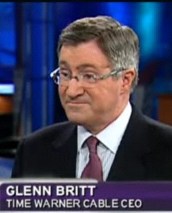
Glenn Britt’s Fireside Chat: Time Warner Cable Wants to “Remain Focused on the Customer” in 2011

Phillip Dampier December 6, 2010 Competition, Consumer News, Data Caps, Online Video, Video 2 Comments

Glenn Britt, Time Warner Cable’s CEO, says the cable company’s biggest challenge in 2011 is remaining “completely focused on the customer.”

Britt told Michael Grebb, writing for CableFAX, that America’s second largest cable company cannot succeed if it dictates terms to customers.

“We have to deliver a differentiated customer experience that’s linked to our brand—a brand that says ‘we give you more control in ways that are simple and easy for you, the customer,'” Britt said. “We’ve heard loud and clear from customers that they want flexibility in packaging, including the ability to buy smaller packages. We’re working hard to deliver what they’re asking for.”

Britt is referring to Time Warner’s new pared-down cable-TV tier, TV Essentials.  Currently undergoing a market trial in northeast Ohio and New York City, it deletes more expensive basic cable networks from the cable package to provide a discounted, smaller lineup to customers.

Britt’s remarks come more than a year after the cable company experimented with an Internet Overcharging scheme that would have restricted consumers’ use of Road Runner unless they were willing to pay triple the price — $150 a month — for unlimited use.  The company shelved the test after an outpouring of customer complaints and threatened congressional action.

Britt’s remarks would seem to indicate Time Warner is not going to antagonize its customers in the coming year, especially considering the economic challenges many face.  Time Warner lost more than 100,000 subscribers in the last quarter alone.

“Even if we weren’t in a bad economy, we’d still want to deliver customized products and experiences to specific customer segments, which is smart business in any environment,” Britt said. “And it just so happens our lower [revenue] customer segments are most affected by the economy and are the same customers who are really shouting about smaller packages. With respect to ‘higher-end fare,’ I would add that, even with the tough economy, we’re still seeing good demand from higher [revenue] customer segments.”

Britt added Time Warner plans to be more aggressive about its own TV Everywhere project in the coming year.  TV Everywhere delivers on-demand programming online for “authenticated” customers who also subscribe to a corresponding cable-TV package.  No cable-TV package means no access to that programming online.

“Our firm belief is that consumers want access to any content, anywhere, any time and from any device,” Britt said.

Britt signaled the cable company feels on-demand is only part of the online video equation.  Portability — the ability to access content on-the-go, is also a very high priority for Time Warner.  Britt encouraged cable programmers to get on board and participate in the TV Everywhere project to help grow awareness of the service for existing cable-TV subscribers.

Britt also telegraphed the company was moderating its tone over retransmission consent agreement battles with cable networks and broadcasters.  While previous statements from the cable operator indicated the company was prepared to “get tough” with programmers seeking dramatic price increases, Britt’s latest comments suggest the company recognized consumers do not want to be put in the middle of the disputes and the company was taking the matter to Washington lawmakers to adjudicate instead.

Time Warner faces a major showdown with Sinclair Broadcasting, owner of several network affiliate stations, which will come to a head on New Year’s Eve.

“We will continue to work hard to reach fair agreements, but we believe existing retransmission consent rules – set by the government almost 20 years ago – have not kept up with a changing marketplace,” Britt noted. “The rules are outdated, and they’re in urgent need of reform in order to avoid more public battles.”

[flv width=”640″ height=”500″]http://www.phillipdampier.com/video/Bloomberg Britt Calls for Cable Content Dispute Resolution Process 11-23-10.flv[/flv]

Time Warner Cable CEO Glenn Britt told Bloomberg News the company wants to reform the retransmission consent dispute process.  (3 minutes)

Search This Site:

Contributions:

Recent Comments:

Your Account:

Stop the Cap!