Home » Consumer News » Recent Articles:

Time Warner Yanks WKTV Off Central NY Cable Screens, Replaced With Pennsylvania NBC Station

Phillip Dampier December 16, 2010 Consumer News, Video 5 Comments

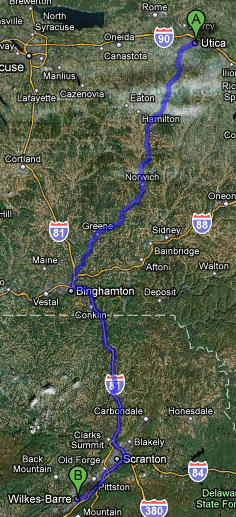
It's a three hour drive down Interstate 81 from Utica to Wilkes-Barre.

WKTV-TV Utica is off Time Warner Cable's lineup in parts of central New York this morning.

Viewers across Oneida, Herkimer, and other adjacent central New York counties lost their local NBC station early this morning after another retransmission consent dispute led Time Warner Cable to drop WKTV-TV in Utica, N.Y., from the lineup.

The fact Time Warner dropped a station is hardly unprecedented, but the cable company managed to replace the station almost immediately.  Away went WKTV, in came Nexstar-owned WBRE-TV, an NBC station serving Wilkes-Barre/Scranton, Penn.

This morning, Mohawk Valley viewers woke up to watching local news and weather for the Susquehanna Valley — 187 miles away to the south.

While Time Warner’s apparent agreement with WBRE keeps NBC shows rolling, the loss of local news and weather represents a major blow for area subscribers, many enduring a western and central New York winter that has brought more than 50 inches of snow in just the last two weeks in some areas.

Utica city officials expressed concern about the loss of the local Utica station because important snow emergency alerts were often delivered over the station.

“They might as well have imported a station from Florida, because there is very little in common between Herkimer County, New York and Luzerne County, Pennsylvania,” writes Steve, who lives in Herkimer.  “You would have thought they would have just grabbed an NBC station from Syracuse.”
...replaced with WBRE-TV, a station in Wilkes-Barre, Penn.

Apparently, Time Warner has permission from Nexstar to import the distant signal of the Pennsylvania station for impacted subscribers.  The effective reinstatement of network programming may make it more difficult for WKTV’s owner, Smith Media, to negotiate the station’s return to Time Warner’s lineup anytime soon.  That one NBC affiliate may have granted permission to replace another station during a contract dispute may become a point of contention on the network level.  Traditionally, broadcasters have not been quick to undercut other stations with such carriage agreements.

Smith’s other stations were also affected.  Time Warner dropped WFFF (Fox) AND WVNY (ABC), which serve the Burlington, Vt. market and the CW-affiliated digital sub-channel running alongside WKTV in Utica.  The station owner launched a website to share their position and educate people about how to receive the signals either over-the-air or via satellite.

In nearby Rochester, Time Warner continues to play hardball with Sinclair Broadcasting over a carriage agreement renewal for WUHF-TV.  But Time Warner customers facing the loss of the Fox affiliate will not see any interruption of Fox network programming — the cable company has a separate agreement with the network.  Ironically, Sinclair jointly operates WUHF with Nexstar Broadcasting of Rochester LLC, the owner of WROC-TV, the city’s CBS affiliate.

[flv width=”640″ height=”500″]http://www.phillipdampier.com/video/WKTV Carriage Dispute 12-16-10.flv[/flv]

Time Warner’s replacement of WKTV-TV in Utica with a distant station may be a new tactic in the hardball war over cable-broadcaster carriage agreements.  WKTV ran several stories about how the station’s loss impacts the area.  YNN’s Central NY news station, run by Time Warner Cable, also ran its own story this morning, all of which are covered here.  (9 minutes)

Clear’s Unclear Internet Overcharging Scheme Subject of a Class Action Lawsuit in Washington State

Phillip Dampier December 16, 2010 Broadband Speed, Consumer News, Data Caps, Wireless Broadband Comments Off on Clear’s Unclear Internet Overcharging Scheme Subject of a Class Action Lawsuit in Washington State

Clearwire’s often-unclear “network management” policies are the subject of a lawsuit filed yesterday in Seattle seeking class action status.

Angelo Dennings vs. Clearwire Corporation was filed in the Western District of Washington federal court, and seeks refunds for consumers who were mislead by the company’s failure to disclose its network speed throttling and usage limitations, and charged early termination fees when subsequently canceling service.

Clearwire promises that its high-speed Internet service provides a “fast” and “always on, always secure” Internet connection allowing users to “[d]ownload pictures, music and videos.” But Clearwire does not provide an “always on,” “high-speed” connection as it promises. Clearwire purposefully slows the connection of its users because it cannot accommodate the high volume of traffic. Clearwire engages in a practice known as “throttling,” which is the intentional delay and/or blocking of Internet communications. This practice deprives Clearwire customers of the ability to “[d]ownload music and videos,” and leads to slow connection speeds.  Clearwire engages in throttling at times when demand for Internet use is highest, beginning at approximately 7:30 p.m. and ending at about 1:00-to-2:00 a.m.

If users attempt to cancel their service, Clearwire claims that, pursuant to its “contract” with them, it is entitled to collect an early termination or a re-stocking fee. The “contract” referred to by Clearwire is not a contract between it and its customers. The contract between Clearwire and its customers is simply that the customers will pay for, and Clearwire will provide, “unlimited” Internet usage at certain speeds, depending on the speed and payment plan selected in Clearwire’s stores, kiosks, or online.

The remaining “terms” invoked by Clearwire at its convenience are embedded in a document that consumers never see prior to subscribing to Clearwire’s service. Clearwire sells its services in its stores, kiosks at shopping centers, and online. Clearwire’s stores and kiosks do not have copies of this “contract” on hand for potential subscribers to read before they “agree” to its terms. Users who subscribe through Clearwire’s website never see the contract either because the link to it is at the bottom of a page, in substantially smaller font and lighter shade than all of the other text on the page. The text states: “Want to read the fine print (and who doesn’t read the fine print?) It’s all there in the CLEAR Legal Index.” No one wants to read fine print legalese and almost no one does. The statement is obviously and sharply ironic, and mocks anyone who may have been fussy enough to have considered continuing.

Despite not showing its terms to consumers, Clearwire refuses to allow users to cancel their service without paying the unconscionable fees it claims it is owed under this “contract.” These fees include an early termination fee (“ETF”), which penalizes consumers that want out before the end of the two-year term. Although Clearwire breached its contract with its customers, Clearwire insists on the payment of this ETF when customers realize they are not getting what they bargained for.

The suit argues that Clearwire has oversold its wireless broadband network, and allegedly quotes a company representative at one point telling Dennings, “Clearwire had signed up more customers than its cell towers could accommodate, and that therefore it was ‘managing’ users’ accounts.”

Attorney Clifford Cantor argues in the filing that Clearwire reduces customer speeds to 300kbps or lower when their network is congested, making the service unsuitable for most broadband applications.  Dennings, who lives near Ft. Worth, Tex., was outraged to learn Clear sold him a home and mobile broadband account that was advertised as a replacement for wired cable or DSL broadband, but was left with service he considered largely useless when throttled.  Even more upsetting, the suit alleges, Denning was asked to pay a $219 early contract termination and restocking fee when he tried to cancel service over the matter.

Cantor is asking for a court ruling declaring Clear’s policies to be unconscionable, attorneys’ fees of at least $5,000, and refunds for all impacted subscribers.

Thanks to Stop the Cap! reader Michael in Chicago for sending along a copy of the lawsuit.  He runs the “Clear/Clearwire internet not as advertised” Facebook group.

Dish Network Buys Denver-Based Liberty-Bell Phone Company: Start of a New Trend?

Satellite company Dish Network suffers a competitive disadvantage its grounded competition doesn’t — the ability to offer a broadband and phone service package along with a lineup of video channels.

Not anymore.

On Monday, Dish announced its intention to acquire Denver-based Liberty-Bell Telecom, a small telephone company serving 6,000 residential and 4,000 business customers in Colorado, New Mexico and Utah.

The purchase, if approved by the Federal Communications Commission, would give Dish the chance to sell a “triple-play” bundle of telephone, broadband, and satellite-delivered TV channels to Liberty-Bell customers.

Martino

Liberty-Bell was started by a consumer reporter, Tom Martino, currently working for KDVR-TV in Denver and host of the national radio program, The Troubleshooter Show.  The acquisition would deliver a 90 percent stake to Dish.  The phone company has an established reputation for consumer-friendly service, even giving out the personal cell phone number of company owner Nigel Alexander in case customers run into trouble.

The phone company already had an extensive bundling arrangement with Dish, heavily promoting the satellite service as part of its phone and broadband service package.

The move to acquire Liberty-Bell may be Dish’s first foray into developing its own triple-play package to compete with cable and phone companies.  Liberty-Bell delivers service to customers under a wholesale agreement with incumbent provider Qwest and is licensed to provide service to residential and business customers in 10 states.  Theoretically, Liberty-Bell could develop a much larger reach with wholesale agreements with incumbent phone companies around the country, especially with the financial backing by Dish.

That could create opportunities for the satellite company to meet the needs of an increasing number of Americans seeking telecommunications services from a single company.

Dish currently has reseller agreements with other independent phone companies, including Frontier Communications.

‘Tis the Season for the Rate “Adjustment” Mailer: Time Warner’s Glossy Brochure Means It’s Time to Pay

Phillip Dampier December 14, 2010 Consumer News, Editorial & Site News 8 Comments

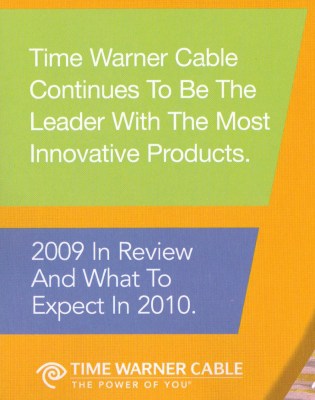
Last year's glossy mailer gave fair warning what subscribers could expect in 2010 were rate increases.

Time Warner Cable customers in several areas of the country are now receiving good tidings in their mailbox — the annual glossy mailer that portends the company’s annual “rate adjustments.”

Customers in areas from snowed-in western New York to fogged-in Los Angeles will find the company quick to congratulate themselves on their “achievements” in 2010 — achievements that someone has to pay for — you.

After you’ve finished reading all of the self-back-patting accolades, somewhere towards the bottom of the piece the company tries to break the bad news, telling you it must periodically “adjust prices.”  We know what that means and so do you.

The company’s new rate schedule for 2011 delivers price increases across the board, but the exact amounts and percentages depend on where you live.  For customers in western New York, expect around a 6 percent rate hike.  In southern California, rates for just about everything are increasing, some by a percentage considered high even for the cable industry.  The more services you bundle with the cable company, the less the total increase will bite your wallet.

Considering America’s inflation rate stands at less than 1 percent and will remain at that level through next year, a rate increase six times that amount is certain to start another round of package trimming and cord cutting from strapped subscribers.

“Everytime they increase their rates, I drop something to keep my bill manageable,” writes our reader David in Charlotte, N.C.  Rate increases in that state were announced in November.

“When I’m down to just standard cable and Internet, I’ll look to drop them,” he adds.

David says he used to have a fully-loaded package from Time Warner, taking every premium channel, Digital Phone, and Road Runner Turbo.  But not anymore.

“When they raised rates three years ago, we dropped several premium channels,” David said. “Two years ago we dropped the rest and some of their HD programming, and last year we chucked Digital Phone for our cell phone.”

What is going in 2011?  Road Runner Turbo.

“It’s a pointless product ever since they raised upload speeds for standard Road Runner customers.”

For customers in Rochester, the latest rate hike is the latest of several over the past year.  The company has been incrementally increasing prices on individual components of the cable package in an effort to drive more customers into bundled service packages.

In Los Angeles, it’s much the same.  Rate increases are on the way for DVR service and for set top boxes.  So are dramatic price hikes for virtually anything requiring an employee to come to your home. Want them to pick up or exchange equipment?  Pony up $29.99 (up 50 percent).  Need someone to install your phone or Internet?  That’s going up 65 percent to $32.99.

The company’s response to these increases?

The usual — programming cost increases.  The company also encourages customers to do installations themselves and drop off equipment at a local cable store to avoid the charges.

Columnists are using the occasion to scream once again for a-la-carte cable — allowing customers to pick and pay for only the channels they want to receive, always a Dead-on-Arrival idea for cable companies.

Tom Joyce from the Mount Airy News noticed as rates increase, the channels he wants to see either aren’t on the system, are being dropped, or are at risk of being dropped because of contract disputes:

What really irks cable television subscribers is that not only are we paying more, we are getting less for our money as well. It would be one thing to simply charge subscribers more for the same service, but what Time Warner seems to be doing is hiking prices while also diminishing the quality of its programming.

For example, C-SPAN2 recently was dropped from the system. C-SPAN2 is a great outlet for public-affairs programming and also focuses on books written on government, history and similar topics.

While some TV watchers might say good riddance to such a high-brow channel, I think it’s a shame viewers now have one less outlet that might actually broaden their intellectual horizons or help them become better-informed citizens.

Yet Time Warner’s cuts also could affect mainstream broadcast content as well. There have been announcements that Channel 48, a Triad TV station, is being dropped from the local cable system at the end of this month. I rely on Channel 48 for many entertainment shows, including late-night reruns of “The Office.” This trend isn’t new. It’s been occurring over the years, paralleling a scenario of constant price increases.

The cable package I receive once included the Fox Movie Channel, Encore Westerns and others that I found enjoyable, but which gradually fell by the wayside. Only one bona fide movie selection remains, Turner Classic Movies.

Channels that I now receive basically are a collection of commercial-laden garbage and cheap filler.

David Lazarus at the LA Times agrees:

“I’ve said it before and I’ll say it again: Cable and satellite bills are too high, and it’s nuts that people have to pay through the nose for channels they never watch,” Lazarus writes. “It’s time for cable and satellite companies to switch to a la carte programming so we can start paying for products we actually want, rather than ones that we’re forced to accept.”

Lazarus also noticed Time Warner Cable’s efforts to placate subscribers with freebies backfired again this year as well:

As it did last year, Time Warner is again trying to make its annual rate hike more palatable by giving customers coupons to watch premium movies for just 99 cents.

The catch is that you have to mail in the coupon with your bill to have it redeemed. Or you can mail it separately if you want to add 44 cents in postage to your 99-cent movie.

But what about all those customers who have gone paperless — as Time Warner prefers — with automatic bill payments or electronic cash transfers? Isn’t this unfair to them?

When I suggested last year that maybe the cable giant should include a digital code on its coupons so that customers could redeem them online, a company spokeswoman said this was a good idea and she’d take it up with her superiors.

I suggested the same this year to Gordon. He said it was a good idea and he’d take it up with his superiors.

Cable Cut Ruins AT&T Cell Phone Service for Northern & Central Florida

Phillip Dampier December 14, 2010 AT&T, Consumer News 2 Comments

It’s 27 degrees outside, the oranges are turning into orangesicles, and now this.

AT&T reports an independent construction crew in Volusia County accidentally cut a fiber cable that has resulted in a major cell phone outage for residents across northern and central Florida.

“An AT&T wireless disruption is currently impacting some customers in parts of Jacksonville, Tallahassee, Daytona, Ocala, Gainesville, and Panama City,” says an AT&T spokesperson. “Some customers may have trouble connecting to voice calls and voicemail at this time.”

AT&T is trying to repair the cable to restore service.

Stop the Cap! reader Jasper in Wildwood, Fla., wonders how one fiber cut can take out AT&T’s cell phone network for half the state.

“This sure isn’t your father’s AT&T,” Jasper writes. “Hasn’t AT&T ever heard of redundant backup systems for just these occasions?”

Jasper noticed his AT&T cell phone service quit connecting calls earlier this evening.

“It’s either a fast busy signal or nothing at all,” Jasper reports.  “AT&T froze us out.”

Search This Site:

Contributions:

Recent Comments:

Your Account:

Stop the Cap!