Home » Consumer News » Recent Articles:

Roku CEO ‘Not Worried’ About the Demise of Unlimited Broadband

Phillip Dampier January 4, 2011 Competition, Consumer News, Data Caps, Online Video, Video 4 Comments

Wood

Roku CEO Anthony Wood told a cable trade publication he is not worried that providers will kill the market for his online video set-top box with Internet Overcharging schemes.

Wood told Multichannel News the broadband industry faces enough competition to prevent one or both traditional providers from implementing usage caps and metered pricing for broadband service.

“What we see from a practical point of view in the marketplace is that there’s enough competition from cable, telcos and wireless so that in every market there’s an unlimited option — and the price is competitive,” he said.  “Unlimited sells — it’s just a good marketing strategy.”

Wood may want to inform broadband providers of that, because several American phone and cable companies are experimenting with slapping usage limits on their customers, making his web-streaming set top box an expensive proposition.  For customers of Frontier Communications in Elk Grove, Calif., using too much Roku could mean broadband bills as high as $300 a month.

With some HD movies consuming 2-4 gigabytes per title, some companies experimenting with usage limits as low as 5GB per month would make online video the primary culprit for consumers blowing through their monthly usage allowance.  After one bill with overlimit fees arrives, the Roku box will be the first thing to go.

Netflix, a major investor in the Roku box, could see its plans to shift to online distribution of its massive DVD rental business stymied by large phone and cable providers, many of whom see Netflix and other online video services as competitors who use their broadband service to send movies to consumers.  Some cable and phone companies contend Roku, Netflix, and other online video streamers are freeloaders — using their networks “for free” and demanding additional compensation to keep carrying their content.

Wood discloses another reason why cable and phone companies could potentially adopt a hostile position towards his 100-employee operation — “cord cutting.”

Wood told Multichannel News about 12% of Roku customers say they have canceled cable or satellite TV after buying the set-top while another 12% said they reduced their service level.

The cable industry is trying to retain customers by putting an increasing amount of cable content online for subscribers who maintain their cable-TV package.  Roku gives subscribers one more reason to downgrade or cancel service, a problem that could be stopped with an Internet Overcharging scheme that makes using the product an expensive proposition.

Some Roku watchers believe Wood is making a mistake underestimating the telecom industry’s willingness to protect its turf.

Two years ago Roku VP Tim Twerdahl said the company was not worried about Comcast’s 250GB download cap.  But since then, other providers have proposed far lower caps.

Roku is best known for letting Netflix subscribers stream the video rental firm’s online titles direct to television sets.  But Roku also delivers access to Hulu, Amazon video, and a growing number of new “channels” delivering classic movies, music/music videos, news, and user-created programming.

The company offers three set-top models: HD ($60), which delivers up to 720p video; XD ($80), which adds support for up to 1080p and 802.11n Wi-Fi; and the XDS ($99), which offers dual-band 802.11n and component video and optical audio outputs.  The top model occasionally sells for as little as $79.99 when on sale from Amazon.com or direct from the manufacturer.

[flv width=”640″ height=”380″]http://www.phillipdampier.com/video/Introducing Roku.mp4[/flv]

A brief video introduction to Roku.  (1 minute)

MetroPCS Introduces Pay Walls for 4G Users: Web Favorites Locked Out Unless You Spend More

Phillip Dampier January 4, 2011 Broadband Speed, Competition, Consumer News, Data Caps, Editorial & Site News, MetroPCS, Net Neutrality, Online Video, Public Policy & Gov't, Video, Wireless Broadband Comments Off on MetroPCS Introduces Pay Walls for 4G Users: Web Favorites Locked Out Unless You Spend More

Hammer Time: MetroPCS introduces 4G/LTE service plans that establish pay walls for familiar web content.

Want a sneak preview of America’s Internet experience without real Net Neutrality?  Look no further than MetroPCS which has managed to turn the clock back to the early days of “mobile web,” where carriers pre-selected content and blocked much of the rest.  Want access anyway?  Then spend some time with a spreadsheet to figure out what service plan you’ll need and start counting out some ten dollar bills because MetroPCS promises a Long Term Expensive 4G  experience.

The business press focused on MetroPCS’ new pricing — delivering what the company calls “a selection of data access levels to meet customers’ lifestyles.”  But some public interest groups considered today’s announcement the first gauntlet thrown in the Net Neutrality war since the FCC voted to approve a watered down version of the open Internet policy last month.

MetroPCS called their new plans a boon to customers.

“Our customers told us they wanted more video, more sharing of their content and more Web browsing capabilities – they want to have it all with the value and no annual contract that only MetroPCS can deliver,” said Roger D. Linquist, president, CEO and chairman of MetroPCS. “Our 4G LTE network can deliver unlimited voice and mobile broadband data services and, with these new service plans, consumers are in the driver’s seat on how much additional data access and real-time entertainment content they want to pay for on a monthly basis.”

But many customers will discover the company’s road to good intentions pitted with potholes, toll booths, roadblocks, and diversions.

Just getting on this data highway to hell could be very confusing to customers who will need to think about what websites and services they need, want, or can live without, and then finding the corresponding service plan that makes it all work.

MetroPCS says it has three new pricing levels to consider:

  • The $40 service plan offers unlimited talk, text, 4G Web browsing with unlimited YouTube access.
  • The $50 service plan includes the same unlimited talk, text, 4G Web services and unlimited YouTube access as the $40 plan. Additional features include international and premium text messaging, turn-by-turn navigation with MetroNAVIGATOR™, ScreenIT, mobile instant messaging, corporate e-mail and 1 GB of additional data access, with premium features available through MetroSTUDIO™ when connected via Wi-Fi, including audio capabilities to listen and download music and access to preview and trial video content.
  • The $60 service plan provides the same premium features as the $50 plan, plus unlimited data access and MetroSTUDIO premium content such as 18 video-on-demand channels and audio downloads.

You'll need a smart phone to figure out what pricing plan actually delivers the services you need.

A customer could be forgiven if they assumed the $40 plan provided “unlimited web browsing,” which will be interpreted to mean they can access all of the content contained on those websites, but they would be wrong.  Beyond YouTube, MetroPCS customers will need to spend at least $10 more to access embedded video and audio, play online gaming, and access other rich media services.  Want to view videos from a website that isn’t among the carrier’s “preferred content partners?”  Forget it.

What about Skype, Netflix and other popular services?  Nuh uh.

Only the $60 monthly plan delivers unlimited data, along with pre-selected video and audio you can access… or not.

Free Press Policy Counsel M. Chris Riley called MetroPCS’ foray into the toll highway business a profit padding scheme.

“In December, the FCC chose to disregard wireless protections in its Net Neutrality order, and MetroPCS’s new scheme is a preview of the wireless future in a world without protections on the mobile Web. Such blocking of websites, services or applications would clearly be prohibited and deemed unreasonable on a cable or DSL network. Are these the kinds of restrictions the FCC really wants to promote on wireless networks?

“The open Internet order approved in December stated that the FCC was not implicitly approving practices on the mobile Web that violate its rule against unreasonable discrimination – and now we’ll see whether the agency is willing to do anything about such practices. Silence in the face of ongoing violations is no different from outright approval. If MetroPCS is allowed to engage in rampant discrimination and blocking of Internet applications and services, will Verizon be next? Will AT&T extend its history of blocking services like VoIP and Sling on its LTE network in the future?

“MetroPCS’s plan will restrict consumer choice and innovation in a developing mobile market, all for the sake of further padding its bottom line. The FCC must not stand idly by while carriers are engaging in anti-consumer and anti-competitive behavior, and we urge the agency to investigate.”

[flv width=”640″ height=”500″]http://www.phillipdampier.com/video/MetroPCS 1-4-10.flv[/flv]

It’s too bad the company that regularly lampooned their wireless competitors in witty commercials has now adopted the same “gotcha” tricks and traps that will leave customers trying to figure out why they can’t access the web content they thought they paid to receive.  Watch a series of amusing MetroPCS ads and a brief review of the company’s new 4G phone courtesy of TheStreet TV.  “Hello. Hello. Hello.”  (7 minutes)

Telecom Deregulation Fails Canadian Consumers: Mediocre Broadband Now Comes With Limits

The Public Interest Advocacy Centre just released a report that found deregulation in Canada's telecommunications marketplace delivered most of the benefits to providers, leaving consumers holding the higher bill.

Four years after Canada deregulated its telecommunications industry with the promise it would bring competition, better service and lower prices, Canadian consumers are instead paying too much for broadband service that delivers too little.

That is the conclusion of a new report from the Public Interest Advocacy Centre, a non-profit consumer protection organization that compared provider promises with the bills ordinary Canadians ultimately pay for their Internet service.

Michael Janigan, the report’s author told CBC News that deregulation has brought “super-normal” profits for Bell, Telus and Rogers — among Canada’s largest telecom companies — while those same providers continue to increase prices and, in some cases, reduce the amount of broadband usage customers can access before overlimit fees kick in.

“We still have three big players with over 90 per cent of the market, and they’re pretty fat and happy,” Janigan said in an interview with CBC News. “We’re still seeing the incredible clout of the big telcos in relation to their ability to swing competition in their favor.”

Bell, Canada’s largest telecom company, stands to gain even more power over the broadband marketplace with a ruling from Canada’s telecommunications authority that has direct implications for Canada’s independent service provider market.  Most third party providers obtain their Internet connectivity from Bell at wholesale pricing.  Thanks to a now-approved-request from Bell to charge wholesale customers usage-based pricing, providers are now forced to pass along those artificially high prices to Canadian consumers.

“The days of unlimited Internet service are about to become extinct in Canada,” says Stop the Cap! reader Giles in Trois-Rivières, Quebec.  “How surprised can you be that the company that sells access to competitors has managed to find a way to price that competition out of business.”

For one such competitor, Primus, the effect of Bell’s usage-based pricing will have an immediate impact on their customers’ monthly bills.

The company is now notifying customers that effective Feb. 1, the unlimited service plans that appealed to those opposed to usage-limited broadband will be now limited to just 25GB of usage per month.  Primus directly implicated both Bell and the the Canadian Radio-television and Telecommunications Commission (CRTC) for the pricing changes.

Those who exceed the limit face overlimit fees of $2.00 per gigabyte, up to a maximum of $60 per month.

Here today, gone tomorrow: Primus is discontinuing its unlimited use services. Effective Feb. 1, overlimit fees of $2/GB kick in after just 25GB of usage.

Those limits could put Primus at a competitive disadvantage with larger providers delivering lower cost plans with higher usage allowances.

“Why would you still be a Primus customer after this,” asks Giles.

Primus will not be alone among third party DSL service providers — almost all will be forced to adopt similar pricing.  The result? More expensive service for Canadian broadband customers, and major troubles for third party competitors whose new pricing could turn customers away.

The price increase is a direct result of a recent decision by the Canadian Radio-television and Telecommunications Commission (CRTC) to approve Bell Canada’s request to introduce Usage Based Billing on wholesale Internet services. Over the last four years, critics charge the CRTC with abandoning its watchdog role to protect Canadian consumers from unfair and uncompetitive practices and kowtowing to the interests of large telecom companies.

“In 2006 and 2007, the government stepped in to tell the CRTC to deregulate as a priority and to deregulate local telephone service faster promising better deals for consumers. As a our report notes, this did not happen despite all the hype”, said Janigan, author of the report, Waiting for the Dream, The Consumer Brief for Telecom Reform 2010.

In fact, the report concludes that Canada’s performance in telecommunications services such as broadband and wireless has been less than impressive, and the results for customers of cable and satellite services from deregulation of basic service has been the opposite of what should be expected in competitive markets.

“It is one thing to try a course of action that doesn’t work out: it is another to ignore the results and simply try more of the same,” said Janigan. “It doesn’t now make sense to have a government Policy Direction in place that hampers both competition and consumer protection”:

This report concludes that the failure of the regulatory reform of the last two decades to deliver the goods for ordinary residential consumers is not one that has its roots in theory, but in practice. Here, the interests of powerful stakeholders have affected the service landscape. In the same way that incumbent players used their political and economic influence and regulatory capture to get their way in the monopoly era of regulation, the winners have used the market- based system to their advantage. Neither regulation nor deregulation will engineer a thriving telecommunications industry producing innovative and efficient products and services with resultant economic growth for Canada if the decision making processes for each are skewed by conditions and assumptions that favour some stakeholders over others.

Most importantly, the governance and regulation of the telecommunications industry in Canada must respond to results. For the most part, the restructuring of telecommunications has been guided by untested economic theories, largely provided by experts engaged by the largest stakeholders. The relatively poor performance of telecommunications service for ordinary consumers should have long ago engendered a review of the  regulatory framework and market structure that is producing the same. In the last five years, the only acknowledged measure of success has been how fast telecommunications services have been deregulated with predictable market results.

The solution is not a return to old regulation but new models. First of all, there are a variety of consumer issues associated with basic rights for information, quality of service, security of service, disconnections, privacy etc. that should be met by all carriers whether they are incumbent or not. Basic service, obligations to serve, complaints resolution, and burdens of service in uneconomic areas have to be in place for all across the board. The best way to ensure that this occurs is for mandatory licensing for all carriers, with appropriate codes of conduct and enforcement with meaningful force in the form of administrative monetary penalties. The Telecommunications Act should be amended to reflect these improvements.

Interconnection with essential telecommunications facilities should be available for competitors at rates that are fair to users and suppliers. We cannot let abstruse theories supposing innovation and duplication in the absence of access to govern this important issue.

Sinclair and Time Warner Cable Agree to Two More Weeks of Talks; No Blackout Tonight

Phillip Dampier December 31, 2010 Consumer News Comments Off on Sinclair and Time Warner Cable Agree to Two More Weeks of Talks; No Blackout Tonight

When the ball overlooking Times Square drops at midnight tonight, Time Warner Cable subscribers won’t have to say goodbye to local stations owned by Sinclair Broadcasting.  The two companies reached an agreement Friday to extend negotiations over programming fees paid by the cable operator until Jan. 14.

While the talks progress, Sinclair-owned stations will continue to be seen on Time Warner with no interruption.

The two companies have been locked in a dispute over programming fees that Sinclair characterizes as a dime’s worth of difference.

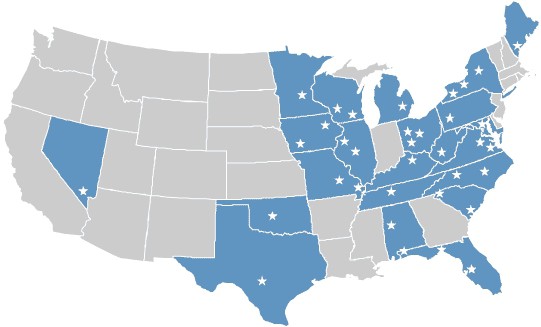
Sinclair owns stations in these communities.

Barry Faber, general counsel for Sinclair, said the two are arguing over Sinclair’s request to charge ten cents per month more per subscriber for their stations.

“We intend to continue our good-faith negotiations during this period with the intent of finalizing a longer-term agreement at pricing that reflects the higher cost of programming we are faced with today,” said Barry Faber, executive vice president and general counsel of Sinclair, in a statement released Friday.

The notion Sinclair faces “higher programming costs” is one some industry experts seriously question, considering Sinclair does not have a reputation for being a big spender.

Instead, many believe Sinclair is attempting to earn additional revenue they lost in the advertising downturn, attributable to the Great Recession.

The two companies hope to hammer out a final agreement after the New Year holiday, potentially ending the latest retransmission consent dispute threatening to throw channels and networks off the cable dial.

Avoid the Bully Boys’ Retransmission Consent Battles: Get ivi for Blacked Out Football, Shows

Phillip Dampier December 30, 2010 Consumer News, Editorial & Site News, Online Video 2 Comments

A reminder to those who are at risk of losing some channels Saturday: you can watch stations from the East, Central, and West coast with newly expanded ivi.tv, which remains $4.99 a month.  We’ve had the service here since the first week it launched and it generally works well and delivers access to a very large number of network affiliates and stations.  For football fans in particular, ivi.tv is a great way to avoid local blackouts.  For an additional dollar a month, the player can timeshift programming by recording it to watch later.

The ivi service is not done adding channels either.  Philadelphia is forthcoming in a few weeks, and ivi will carry all of the market’s network signals.  What is still missing?  A mountain time zone bouquet of stations — Denver being the obvious choice.

If you want to give it a shot, here is the sign-up form: ivi.tv

Current Channel Guide

  • WCBS 2 (CBS) New York
  • WNBC 4 (NBC) New York
  • WNYW 5 (Fox) New York
  • WABC 7 (ABC) New York
  • WPIX 11 (The CW) New York
  • WNET 13 (PBS) New York
  • Universal Sports (NBC) New York
  • Kids 13 (PBS) New York
  • Qubo (Ion) New York
  • WWOR 9 (My TV) New York
  • WPXN (Ion) New York
  • Estrella TV (LBI) New York
  • WXTV Univision (UCI) New York
  • WFUT TeleFutura (UCI) New York
  • WNJU Telemundo (NBC) New York
  • New York NonStop (NBC) New York
  • KCBS 2 (CBS) Los Angeles
  • KNBC 4 (NBC) Los Angeles
  • KTLA 5 (The CW) Los Angeles
  • KABC 7 (ABC) Los Angeles
  • KCAL 9 (CBS) Los Angeles
  • KTTV 11 (FOX) Los Angeles
  • KOCE 50 (PBS) Los Angeles
  • KCOP 13 (My Network) Los Angeles
  • KMEX 34 Univision (UCI) Los Angeles
  • KVEA 52 Telemundo (NBC) Los Angeles
  • KAZA 54 (TV Azteca) Los Angeles
  • KSCI 18 SBS Korean Los Angeles
  • MBC-D (MBC) Korean Los Angeles
  • Trinity Broadcasting Network (TBN) Los Angeles
  • Enlace USA (TBN) Los Angeles
  • WBBM 2 (CBS) Chicago
  • WMAQ 5 (NBC) Chicago
  • WLS 7 (ABC) Chicago
  • WGN 9 (The CW) Chicago
  • WTTW 11 (PBS) Chicago
  • WFLD 32 (FOX) Chicago
  • WCIU 26 (The U) Chicago
  • MeTV (WWME) Chicago
  • MeToo (WMEU) Chicago
  • Chicago NonStop (NBC) Chicago
  • WLS Live Well (ABC) Chicago
  • WYCC 21 (PBS) Chicago
  • KOMO 4 (ABC) Seattle
  • KING 5 (NBC) Seattle
  • KIRO 7 (CBS) Seattle
  • KCTS 9 (PBS) Seattle
  • KSTW 11 (The CW) Seattle
  • KCPQ 13 (Fox) Seattle
  • KZJO (My Network TV) Seattle
  • KONG 6/16 (Belo) Seattle
  • Retro TV (RTV) Seattle
  • V-ME (PBS) Seattle
  • This TV (MGM) Seattle
  • Create TV (PBS) Seattle
  • ScreenPlay
  • TopShop Direct
  • CedarburgTV
  • Intereconomia Business TV
  • Orange Sport Info
  • Sport Italia
  • RTL 102.5
  • CCTV9
  • Zeilsteen TV
  • Telemicro
  • Play TV

Search This Site:

Contributions:

Recent Comments:

Your Account:

Stop the Cap!